
 Online Learning
Do Online Schools Have Breaks?
Yes, online schools have breaks. Most offer the same standard holidays as traditional schools, including summer, winter, and spring breaks, along with festival and national holidays and daily pauses between classes. The main difference is how those breaks work. Live (synchronous) programs give students a fixed holiday calendar, while self-paced (asynchronous) programs let students plan their own rest around deadlines.
That single distinction explains why you will find students online insisting they get every holiday imaginable, and others swearing they never got a day off. Both are telling the truth. They are simply in different types of programs. This guide answers every version of the question directly, so you know exactly what to expect before you enrol.
What types of breaks do online schools have?
Online schools have several types of breaks: short pauses between classes, a daily lunch break, and longer seasonal holidays like winter, spring, and summer break. Here is how they typically compare.
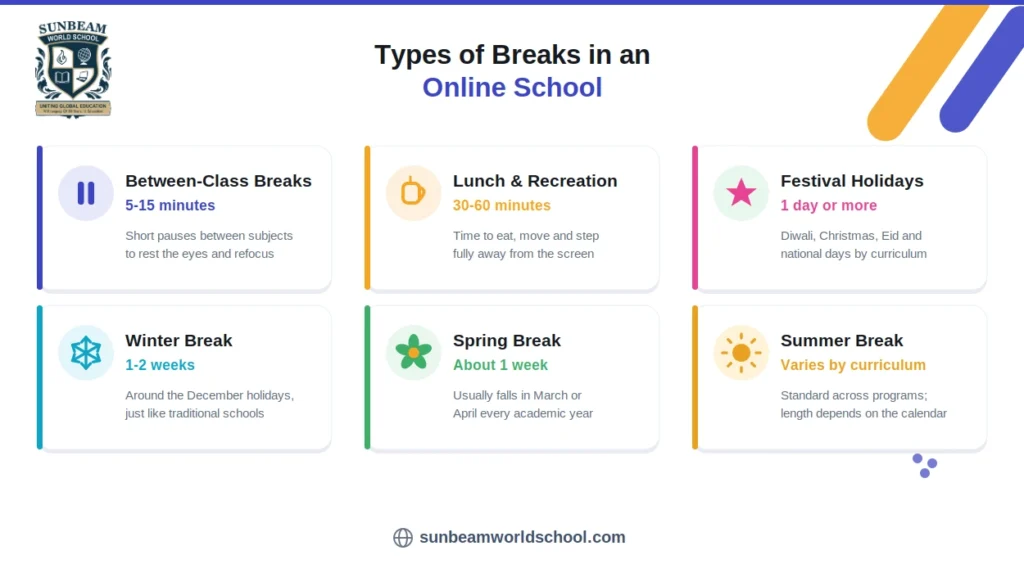
Types of Breaks in an Online School: From daily screen breaks to seasonal and festival holidays.
| Type of break | When it happens | How long | How it works |
|---|---|---|---|
| Between-class breaks | Throughout each school day | 5 to 15 minutes | Short pauses between subjects to rest the eyes and reset focus |
| Lunch and recreation break | Midday, every school day | 30 to 60 minutes | Time to eat, move, and step fully away from the screen |
| Festival and national holidays | Across the year | 1 day or more | Observed based on the curriculum and student body (Diwali, Christmas, Eid, national days) |
| Winter break | Around December | 1 to 2 weeks | A scheduled holiday in live programs; self-paced students plan work around it |
| Spring break | March or April | About 1 week | A set week off in live programs; flexible in self-paced ones |
| Summer break | End of the academic year | Varies by curriculum | Standard across most programs; length depends on the calendar |
| Mid-term or day holidays | Throughout the year | 1 day or a few days | Short recesses, more common in live programs |
At a structured online school, all of these are mapped out in advance. Sunbeam World School, for example, publishes an academic-year schedule that lists term start and end dates, examination periods, holidays, and special events, so families can see the full break calendar before the year begins.
Do online schools have breaks between classes?
Yes, online schools have breaks between classes. In a well-structured program, students get short pauses of roughly 5 to 15 minutes between subjects, plus a longer lunch and recreation break in the middle of the day.
These regular between-class breaks matter more than people expect. Children cannot stay focused through hours of uninterrupted screen time, so quality online education is built around short, frequent resets. A pause between subjects lets a student rest their eyes, stretch, grab a snack, and switch mental gears before the next lesson. A well-run online school such as Sunbeam World School, which delivers live interactive classes for Nursery to Grade 12, structures the day so learning happens in manageable blocks rather than one long stretch. It also runs grade-wise class timings across morning, afternoon, and evening slots, so families can pick a schedule that fits their routine. You can see exactly how these pauses fit into a full day in this breakdown of a day in the life of an online school student, and why they matter is covered in this guide to how much screen time online school really involves. If a program runs long sessions with no gaps between subjects, that is a warning sign, not the norm.
Do online schools have holiday breaks (summer, winter, spring)?
Yes, most online schools observe summer, winter, and spring breaks, plus major national, regional, and festival holidays.
Here is the typical shape of the year in a structured online school:
- Summer break is standard, though its length varies by curriculum. Indian, British, American, and Australian academic calendars each run differently, so a school following one framework may break at a different time than another.
- Winter break usually runs one to two weeks around the December holidays.
- Spring break typically lands in March or April.
- Festival and national holidays are observed based on the student body, such as Diwali, Christmas, Eid, regional festivals, and national days depending on the school and its learners.
- Shorter mid-term recesses and single-day holidays appear throughout the year, especially in live programs.
The reason calendars vary so much is that "online school" is not one thing. A public virtual school, a self-paced private academy, and a hybrid program can each structure their year completely differently. So the honest answer is that yes, breaks exist, but always check the specific school's calendar rather than assuming. A school like Sunbeam World School, which offers Indian, British, American, and Australian curricula, aligns its holidays to whichever curriculum a student follows, and the full holiday list is available inside its learning management system alongside timetables and tasks.
Do online classes get a spring break too?
Yes, online classes get a spring break. In a live program it is a scheduled week off, usually in March or April, set by the school administration. In a self-paced program there is no fixed week, but nothing stops you from planning lighter coursework around that period and taking the time off yourself.
The only catch worth knowing is that in self-paced courses, a deadline can technically fall during that spring break window. If you do not work ahead, the break ends up filled with assignments. Plan for it and it is a genuine week off. Ignore it and it will not feel like one.
How long is winter break in online school?
Winter break in online school is usually one to two weeks around the December holidays, the same as most traditional schools. The exact length depends on the program and curriculum.
Some students feel a two-week winter break is short, but that is actually in line with what physical schools offer in many systems. Programs following a British or American calendar may give a slightly longer end-of-year break, while others keep it tighter to fit the academic year. If a longer winter holiday matters to you, it is a specific question worth asking a school before enrolling.
What is the difference between synchronous and asynchronous breaks?
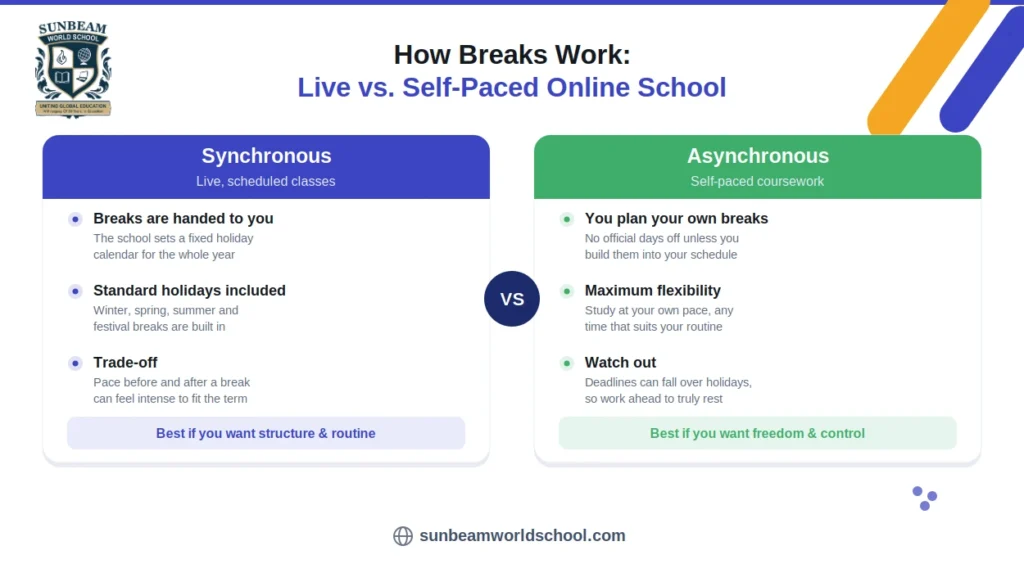
Synchronous vs. Asynchronous Online Schools: How breaks, holidays, and study schedules differ.
Different types of online education, like Synchronous (live) programs, follow a fixed holiday calendar set by the school, so breaks are handed to you. Asynchronous (self-paced) programs have no scheduled days off, so you set your own pace and plan breaks around your deadlines.
This is the most important thing to understand, because it explains nearly every disagreement you will see about online school breaks.
Synchronous (live classes). Students log in at set times to attend live, virtual classes, similar to a scheduled video call with a teacher and classmates. These programs run on a fixed academic calendar with defined holidays: winter break, spring break, festival days, and summer vacation. The trade-off is that the pace right before and after a break can feel intense, because teachers still need to cover the full curriculum within the term. Schools like Sunbeam World School, which run live classes with recorded sessions and live doubt-solving for K-12, fall into this category and follow a set holiday calendar.
Asynchronous (self-paced). There are no live sessions to attend. You work through the material on your own timeline, which is extremely flexible, but it means there are no official days off unless you build them in. Because you control the pace, deadlines can land in the middle of a holiday week if you have not planned ahead.
Hybrid programs combine both: some scheduled live classes plus self-paced work. Breaks in a hybrid model usually follow the live-class calendar, with self-paced tasks arranged around it.
The practical takeaway is that synchronous students get breaks scheduled for them, while asynchronous students have to schedule their own. Neither approach is better, but knowing which one you are in tells you exactly how much planning your time off will require.
Why do some online students say they don't get breaks?
Some online students feel they don't get breaks because self-paced deadlines can fall over holidays, live programs sometimes cram material into short terms, or a poorly designed program schedules too little time off. The break usually exists. The deadline just does not move unless you get ahead of it.
Three specific situations create this feeling:
- Deadlines over holidays. In self-paced courses, an assignment due date can overlap with a break. The school did not cancel the holiday. The work simply needs to be finished or buffered in advance.
- Intense catch-up pace. Some live programs pack a lot into short terms, so the days surrounding a break feel heavier than a normal week.
- Poorly structured programs. During the rapid shift to online classes a few years ago, some schools ran long daily sessions with almost no holidays and minimal downtime. That is a sign of a badly designed program, not a feature of online learning itself.
A well-run online school avoids all of this by building proper holidays into the year, keeping daily screen time reasonable, and publishing a clear academic calendar from day one. When you are comparing programs, the break schedule and daily class length are completely fair things to ask about directly, and a quality school will answer them without hesitation.
Is it okay to take a day off from studying in online school?
Yes, it is okay to take a day off. An occasional rest day protects focus, mental wellbeing, and long-term motivation. It is not slacking.
This is actually one of the quiet advantages of a flexible study schedule. In a self-paced or hybrid setup, a student can take a mental-health day when they genuinely need one, as long as they stay ahead of upcoming deadlines. Rest is part of sustainable learning, not the opposite of it. The key is intention. A planned day off around your workload is healthy, while an unplanned one that leaves you scrambling to catch up is not.
How do online school breaks compare to traditional school breaks?
Online school breaks cover the same major holidays as traditional school, but they are more flexible in how they are used. In offline school, everyone rests when the bell rings, whether or not that timing suits them. Online learning lets a focused student keep working through a topic and rest afterward, while another can pause exactly when they hit a wall.
The difference is not whether breaks exist, because both systems have them. It is that online learning adds a layer of flexibility on top. A well-run online school pairs that flexibility with a clear, structured holiday calendar, so students get the freedom of self-paced learning and the reassurance of proper, scheduled time off. That combination is one of the main reasons families choose online schooling in the first place.
Do online schools in India have breaks and holidays?
Yes, online schools in India have breaks and holidays. Reputable programs observe national holidays, major festivals like Diwali and Holi, and scheduled seasonal breaks, alongside daily pauses between classes.
Some early complaints from Indian students during the sudden move to online classes came from rushed, poorly planned programs with long daily sessions and few holidays. That was a program-design problem, not a limitation of online schooling. An established online school in India today runs on a proper academic calendar with defined breaks, reasonable class hours, and holidays aligned to the curriculum it follows. Sunbeam World School, for example, is a 100% online K-12 school accredited by bodies including NIOS, Cambridge, and Cognia, and it offers Indian, British, American, and Australian curricula, so its calendar and holidays align with whichever curriculum a family chooses. You can review its term dates and holidays on the online school academic year page.
How do I make sure I actually get breaks in online school?
Ask for the official holiday calendar before enrolling, plan your self-paced work ahead of any break, and choose a program with reasonable daily class hours. Here is a simple checklist:
- Get the academic calendar up front. A quality school shares its holiday schedule openly.
- Work ahead before holidays. In self-paced courses, finish or buffer assignments so you can actually switch off.
- Protect daily downtime. Build screen-free pauses into every study day, not just seasonal breaks.
- Keep a steady study routine. A predictable rhythm makes it obvious when to work and when to rest.
- Ask about daily class length. Reasonable hours with breaks between subjects signal a well-structured program.
- Take planned days off. Schedule rest around your deadlines so it does not create a backlog.
The Bottom Line
Online schools do have breaks. Summer, winter, spring, festival holidays, between-class pauses, and daily downtime are all part of a well-run program. The only real nuance is that live programs hand you a fixed calendar, while self-paced programs let you schedule your own rest around deadlines.
So when you are choosing an online school, do not just ask whether it has breaks. Ask how the calendar is structured, how deadlines are handled around holidays, and how many hours students spend in class each day. Get clear answers to those, and you will get the best of online learning: real flexibility and proper time to recharge. To see how a structured live program handles all of this, explore Sunbeam World School and its published academic year schedule.

Frequently Asked Questions
Do online schools have breaks between classes?
-Yes, well-structured online schools give students short pauses of roughly 5 to 15 minutes between subjects, plus a longer lunch and recreation break in the middle of the day. These regular pauses are deliberately built into the timetable to reduce screen fatigue, let students rest their eyes and move around, and help them refocus before the next lesson. If a program runs long sessions with no gaps at all, that is a warning sign of poor design rather than a normal feature of online learning.
Do online schools follow a fixed holiday calendar?
+Do online classes get a summer break?
+Do online students get festival and national holidays?
+Can I take breaks whenever I want in online school?
+Is a two-week winter break normal for online school?
+Are long daily sessions with no breaks normal?
+
In this article
Share this post:


Press and Blogs
Stay updated with our press releases, educational blogs, and more.
Quick Summary The Hindi alphabet, known as Varnamala, is written in the Devanagari script and...
Quick Summary The area of a triangle equals half the product of its base and...
Quick Summary The most common words that start with X include xylophone, x-ray, xenon, xerox,...