
 Online Learning
What Are the Different Types of Online Education? A Parent’s Guide
Parents come to us having read that there are fourteen types of online education, and leave the reading more confused than they started. Search types of online learning or types of e-learning and it gets worse, because most lists mix two different things: the handful of options you can actually enrol a child in, and the delivery methods used inside them.
There are seven types of online education a parent can choose between: a full time online school, online classes run by a physical school, online tuition and learning apps, homeschooling, open schooling self study, a hybrid or blended school, and distance education. They differ on two things only, who teaches your child and who certifies them.
Everything else on those lists, synchronous, asynchronous, blended, game based, microlearning, AI based, virtual reality, mobile learning, is a method rather than a school. Both layers are explained below, in that order, because confusing them is how families end up paying for a learning app while believing they bought an education.
What Are the 7 Types of Online Education a Parent Can Choose From?
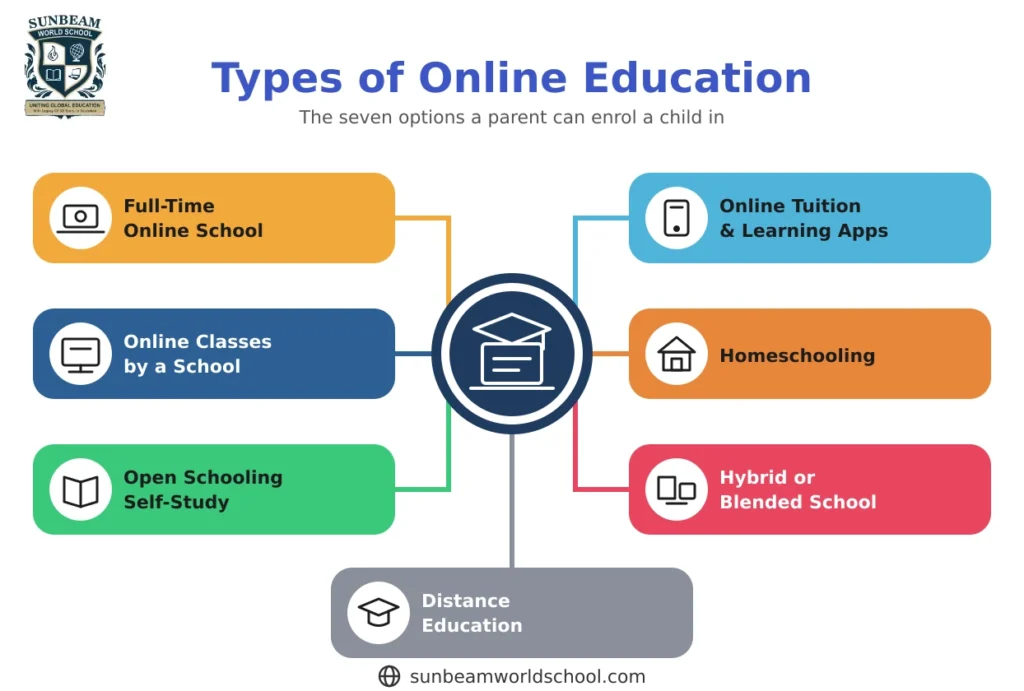
Explore the seven types of online education and understand which learning model is best for your child's needs
The seven types of online education differ by who teaches and who certifies, and that pair decides everything else: the cost, the structure, and whether your child ends up holding a board certificate or nothing at all.
|
Type |
Who teaches |
Who certifies |
Best for |
|
1. Full time online school |
The school's own teachers, in live classes |
NIOS, BOSSE, Cambridge, Cognia accredited US pathway or SCSA for WACE |
Families who want a complete school without a building |
|
2. Online classes run by a physical school |
The physical school's teachers, temporarily |
The school's usual board |
Disruptions: pollution closures, illness, fuel or transport shortages |
|
3. Online tuition and learning apps |
Nobody formally. Content creators and doubt solvers |
Nobody |
Extra support alongside a school |
|
4. Homeschooling |
The parent |
Nobody, until the child sits a board exam as a private candidate |
Families with the time and subject knowledge to teach |
|
5. Open schooling self study |
Nobody. The child studies alone with board materials |
NIOS or BOSSE |
Self disciplined older students, or students returning after a gap |
|
6. Hybrid or blended school |
The school, partly on campus and partly online |
The school's board |
Families who want a campus but less of it |
|
7. Distance education |
Varies by institution |
University level bodies, not school boards |
Adults and college learners, not school children |
1. Full Time Online School
A full time online school is a complete school delivered over the internet: enrolment, a timetable, live classes with certified teachers, assessments, report cards and recognized board certification. The building is the only thing missing. A full time online school offers national and international curriculum options, Indian, British, American and Australian, and it is the only type on this list that replaces a conventional classroom outright, which our guide to what an online school is and how it works covers in full.
2. Online Classes Run by a Physical School
Online classes are a campus school's temporary delivery method during a disruption, not a type of school. The teachers are the classroom teachers adapting live, assessment is often suspended, and the arrangement ends when the campus reopens. Most of what parents disliked about online education in 2020 was this, and judging full time online schools by it is judging one product by another's failures.
3. Online Tuition and Learning Apps
Online tuition and learning apps supplement a school, they do not replace one. They provide recorded content, practice questions and doubt solving, and they certify nothing. This is the most expensive confusion on the list, because a family can spend a year of fees on an app and discover their child is not enrolled anywhere and has no board registration.
4. Homeschooling
Homeschooling puts the parent in charge of teaching, with no school involved at all. India has no formal homeschooling law, and families typically register the child as a private candidate for NIOS or CBSE board examinations when the time comes. It suits parents with the time and subject knowledge to teach, and our homeschool versus online school guide sets out the full comparison. Sunbeam's own structured homeschooling programme sits between the two.
5. Open Schooling Self Study
Open schooling self study means registering directly with NIOS or BOSSE and studying alone from board materials, with periodic contact sessions but no daily teaching. The certificate is identical to the one an online school student receives, because the board is the same. What is missing is instruction, which is why outcomes track a student's self discipline. Our BOSSE and NIOS comparison explains the boards themselves.
6. Hybrid or Blended School
A hybrid or blended school splits the week between a campus and online learning. NEP 2020 supports blended models, and PRAGYATA explicitly pairs live teaching with offline work. The catch for families is geography: a hybrid school still requires you to live near it, so it solves the timetable problem without solving the commute or the relocation one.
7. Distance Education
Distance education is a higher education term in India, regulated for universities through the University Grants Commission's Distance Education Bureau. It is not a school option, and parents searching it for a child usually land on college pages by mistake. The school level equivalent is open schooling through NIOS or BOSSE, which is types four and five above.
Online School, Virtual School or Digital School: Are They Different?
Online school, virtual school, digital school and remote school describe the same thing, and the choice between the words is marketing rather than meaning. All four mean classes conducted over the internet in place of a physical school, with e-learning, digital education and virtual learning used loosely for the same territory. Distance learning is the exception on that list, because in India it carries a specific higher education meaning covered below.
So do not compare a virtual school with an online school as though they were rival categories. Compare who teaches, who certifies, and what happens on a Tuesday morning.
What Are Synchronous and Asynchronous Learning?
Synchronous learning happens live with a teacher present, and asynchronous learning happens whenever the student opens it. Those two words describe how teaching is delivered inside any of the seven types above, and every other mode on the internet's lists is a combination of them.
|
Mode |
What it means |
Where you meet it |
|
Synchronous |
Live, at a fixed time, with a teacher and classmates present |
Live classes in a full time online school; a school's temporary online classes |
|
Asynchronous |
Recorded or self paced, opened whenever the student chooses |
Recorded lessons, learning apps, MOOCs, open schooling materials |
|
Blended |
A planned mix of the two, usually with campus time |
Hybrid schools; some online schools for revision |
|
Hybrid |
Used interchangeably with blended in India. Ask any school which of the two it means |
Campus schools adding online days |
|
Self paced |
Asynchronous with no fixed calendar at all |
Apps, MOOCs, open schooling |
For a school aged child the balance matters more than the vocabulary. A young child learns very little asynchronously, because nobody is there to notice they stopped understanding twenty minutes ago. Live teaching with recordings kept for revision is the combination that works, and it is why our learning platform holds recordings as a safety net rather than as the lesson.
Are Game Based, AI Based and Microlearning Types of Online Education?
Game based learning, microlearning, AI based learning, virtual reality, mobile learning and web based learning are teaching techniques, not types of school. No child enrols in microlearning. These appear on every list of online education types because they are easy to describe, and they mislead parents into comparing a school with a feature.
- Game based learning: quizzes, points and challenges used to hold attention. A good online school uses it inside lessons for younger grades.
- Microlearning: short units of content. Useful for revision, useless as a school.
- AI based or adaptive learning: software that adjusts practice to a child's level. A feature of a platform, not a substitute for a teacher.
- Virtual reality learning: immersive simulations. Real, expensive, and rare in Indian K-12 outside demonstrations.
- Mobile and web based learning: the device the class runs on. Worth knowing that a phone is the worst option for daily study, since a small screen pulls the eyes close for hours.
- Linear, interactive, and individual e-learning, and computer-assisted instruction: categories borrowed from corporate training and older e-learning literature. They describe how content is sequenced, not what a child enrols in.
MOOCs, or Massive Open Online Courses, are the one honest exception on that list. Platforms such as SWAYAM and NPTEL in India, and Coursera, edX and Khan Academy internationally, offer full courses, sometimes with certificates, and they are genuinely a type of online education. They are built for adults and university learners rather than school children, and they certify a course rather than a school year.
Why Do Most Lists of Online Education Types Not Apply to School Children?
Most lists of online education types are written for adults, which is why they leave parents lost. Search the phrase and you meet Coursera, edX, Udemy, Khan Academy and MIT OpenCourseWare, alongside terms borrowed from corporate training: linear e-learning, interactive e-learning, individual e-learning, computer assisted instruction. None of that describes a school your eight year old can attend.
The confusion is structural rather than anyone's fault. Online education as an industry grew up around adult learners and university courses, so its vocabulary describes courses, modules and platforms. School education is a different product with a different question at the end of it: which board certifies the child.
An online course and an online school are not the same thing. A course teaches a subject and may issue its own certificate. A school teaches a curriculum across years, runs assessments, keeps records and registers your child with a board for Class 10 and Class 12. If you are choosing for a school aged child, the seven types above are the list. The rest is vocabulary from a neighbouring industry.
Which of the seven suits your own child is a different question from what they are, and we answer it separately in our guide to who online school is best for. The short version: decide who will teach, decide who must certify, and decide whether a campus has to be part of the week. Those three answers eliminate five of the seven types before you compare a single school.
Which Type Is Sunbeam World School?
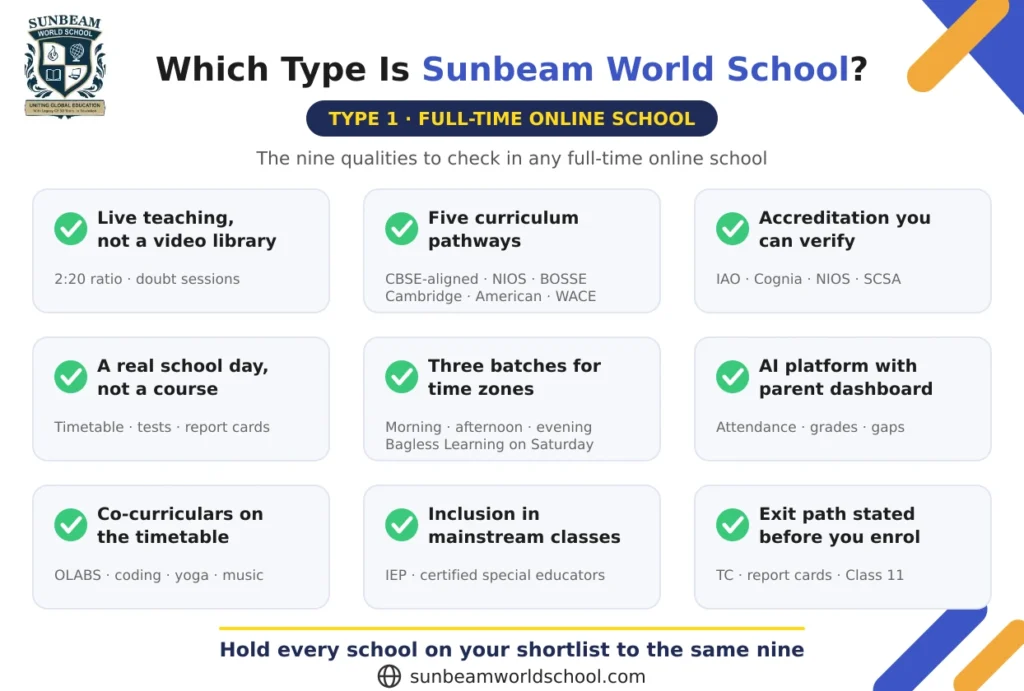
Discover what makes Sunbeam World School a full-time online school and the nine essential features of a high-quality online education.
Sunbeam World School is a full-time online school. That is worth stating plainly, because several providers describe themselves in language borrowed from types three and five while charging for type one.
Below are the nine qualities a full time online school should have, whoever you are considering. Ours are listed because each one is checkable on this site, not because the list is unique to us. Hold every school on your shortlist against the same nine.
- Live teaching rather than a video library. Every class runs live with a certified teacher, at a 2:20 teacher to student ratio, so doubts are cleared inside the lesson and subject teachers run one to one sessions outside class hours. Teachers are trained in online pedagogy rather than moved from a classroom to a webcam, and recordings sit on the learning platform for revision, which is the correct use of them.
- Five curriculum pathways under one school. The pathway should follow the child's destination rather than the school's inventory. Sunbeam teaches CBSE aligned on NCERT with NEP 2020 and NCF 2023, NIOS and BOSSE, Cambridge IGCSE and A Levels, the American curriculum under Cognia, and WACE with an ATAR, from Nursery to Grade 12. Because all five sit in one school, a student can change pathway later if the plan changes.
- Accreditation and board registration you can verify. Accreditation audits the school; a board certifies the child, and a school should show you both. Sunbeam holds IAO and Cognia accreditation and registers students with NIOS or BOSSE under India's Ministry of Education, with WACE governed by Western Australia's SCSA. The list sits on our accreditations page, and every number on it can be looked up on the accreditor's own directory.
- A real school day, not a course. The difference between a school and a subscription shows up in the apparatus: a structured daily timetable, attendance, homework, continuous assessments through the year, mock exams before the boards, report cards and scheduled parent conversations. Senior students get JEE, NEET and CUET preparation alongside the board syllabus, and NIOS registration is handled by the school rather than left to the family.
- Three batches, built for time zones. Live classes run in morning, afternoon and evening batches, so a family in the Gulf, Europe or Southeast Asia attends live rather than watching alone at midnight. The school timings page carries the grade wise windows, and Saturdays run as Bagless Learning, which keeps a full day of the week off screen by design.
- An AI assisted platform with a parent dashboard. A platform should tell you what is happening without you asking. Sunbeam's LMS carries the live classroom, more than 7,000 hours of supporting content, immersive OLABS activity sessions, and progress tracking that flags a learning gap early enough for a teacher to act on it. Parents see attendance, grades, activity reports and teacher messages on the dashboard and mobile app rather than waiting for a term report.
- Co-curriculars on the timetable, not in the brochure. Activities belong inside the school week or they do not happen. OLABS sessions and clubs cover coding, robotics, chess, yoga, music, dance, art, storytelling, public speaking and personality development, with more than fifty live activities available. Regional and foreign languages run as live classes with native speaker teachers across Tamil, Bengali, Punjabi, Marathi, Sanskrit, Urdu, French, German and Spanish, through our language programme.
- Inclusion built into mainstream classes. Special education should sit inside the school rather than beside it. Our special education programme supports SEND and neurodivergent learners, including autism, ADHD, dyslexia, Down syndrome, speech delays and sensory processing differences, with certified special educators, an Individualised Education Program for each child, visual schedules, adaptive assessments and flexible pacing, delivered within mainstream live classes alongside peers rather than in a separate track.
- An exit path stated before you enrol. A school confident in its work tells you how leaving works. Sunbeam issues a Transfer Certificate and grade wise report cards, and a NIOS or BOSSE Class 10 certificate admits a student into Class 11 at a conventional school. Our guide to returning to a regular school after online school sets out the process, and that open door is the reason families can choose on fit rather than on fear.
If what your family needs is type three, four or five, we will say so on the call. The seven types exist because families differ, and the wrong one bought confidently is more expensive than any fee. Book a free demo if you want to test type one against your child's actual situation.

Frequently Asked Questions
What are the different types of online education?
-There are seven types of online education a parent can enrol a child in: a full time online school, online classes run by a physical school, online tuition and learning apps, homeschooling, open schooling self study through NIOS or BOSSE, a hybrid or blended school, and distance education, which is a higher education format rather than a school one. They differ by who teaches the child and who certifies them.
What is the difference between synchronous and asynchronous learning?
+What are the types of e-learning?
+What is the difference between an online course and an online school?
+Is distance education the same as online school?
+Are learning apps a type of online school?
+
In this article
Share this post:


Press and Blogs
Stay updated with our press releases, educational blogs, and more.
Quick Summary An algebra equation is a maths statement that sets two expressions equal using...
Quick Summary The area of rectangle equals its length multiplied by its width (A =...
Quick Summary Sympathy means feeling sorry for someone from your own point of view. Empathy...