
 Online Learning
What Are Remedial Classes? Meaning, Benefits, and Who Needs Them
Remedial classes are extra, focused teaching sessions that help a student catch up on core skills they have not yet mastered, usually in reading, writing, or math. Instead of moving ahead with a new syllabus, remedial teaching goes back to the exact point where understanding broke down and rebuilds from there.
They are not the same as tuition, and they are not a punishment. This guide explains what remedial classes and remedial education mean, what actually happens in a session, which children need them, the warning signs parents should watch for, the teaching methods used, whether they work, and how remedial support is delivered in an accredited online school.
What Are Remedial Classes?
Remedial classes are additional teaching sessions designed to close a specific learning gap so a student can return to grade level. They target the skill a child missed earlier rather than repeating the current lesson, and they end once the gap is closed.
The word remedial comes from remedy. The purpose is to correct one missing piece of learning, not to label a child as weak or slow.
You will also see remedial classes called remedial teaching, remedial instruction, corrective teaching, or learning support. All of these describe the same idea: teach the missing skill, in a different way, until the child has it. Remediation focuses most often on reading, writing, and math, because these are the subjects where every new topic depends directly on an earlier one.
What Is Remedial Education?
Remedial education is the broader field of teaching designed to bring students who have fallen behind back to the expected level for their grade. Remedial classes are how remedial education is delivered, in the same way that a lesson is how a curriculum is delivered.
The distinction matters when you are comparing schools. Remedial education covers the whole system around the support, including how gaps are diagnosed, how teachers are trained, how progress is tracked, and when a student exits. Remedial classes are simply the sessions themselves. A school can run remedial classes without having any real remedial education behind them, which is the most common reason the support fails.
The term is also used differently depending on the stage of education. In schools, remedial education means correcting foundational gaps in literacy and numeracy so a child can follow the regular curriculum. In colleges and universities, particularly in the United States, remedial education often refers to developmental courses that students must pass before they can take credit-bearing subjects. This article deals with the school meaning, which is what most parents are searching for.
What Do You Do in a Remedial Class?
In a remedial class, the teacher first tests where the gap begins, re-teaches that concept using a different method, guides the child through practice, and then checks progress. Sessions usually run 30 to 45 minutes, in very small groups or one on one, two or three times a week.
A typical remedial session moves through five stages:
- Find the real starting point. A short diagnostic task locates the lowest broken link rather than the most recent chapter. A Grade 6 student struggling with algebra may need to start at Grade 3 multiplication.
- Re-teach differently. The concept is taught using a method the child has not already failed with, such as counting blocks instead of a formula, or a number line instead of mental arithmetic.
- Practice with guidance. The teacher watches how the child thinks, not just whether the answer is right. This is where the real diagnosis happens.
- Practice independently. Support is gradually withdrawn until the skill becomes automatic.
- Check and adjust. A short check at the end decides whether to move on or re-teach tomorrow.
Remedial sessions carry no marks, no ranking, and no comparison with the rest of the class. The pressure that made the child freeze in the first place is deliberately removed.
How Are Remedial Classes Different From Tuition and Bridge Courses?
Remedial classes fix gaps from the past, tuition reinforces the present syllabus, and a bridge course prepares a student for a future transition. A tutor re-explains today's algebra lesson, while a remedial teacher discovers the child never mastered multiplication tables and starts there instead.
| Aspect | Remedial Class | Private Tuition | Bridge Course |
|---|---|---|---|
| Purpose | Fix an existing learning gap | Reinforce current syllabus | Prepare for a new stage |
| Starting point | The child's actual skill level | The class syllabus | The gap between two levels |
| Timing | Whenever a gap is found | Through the academic year | Before a new grade begins |
| Goal | Reach grade level | Improve marks | Ensure a smooth transition |
| Ends when | The gap closes | Often continues indefinitely | The course finishes |
This distinction has a real cost attached. Families often spend years paying for tuition that never solves the problem, because tuition assumes the foundation is already in place. If a child has had a tutor for two years and results have not moved, the issue is almost certainly a gap that nobody has gone back far enough to find.
Which Children Need Remedial Teaching?
Remedial teaching is for any student with a gap between what they were taught and what they actually absorbed. This includes children who missed school, changed curriculum or medium of instruction, have a learning difficulty such as dyslexia or dyscalculia, or simply needed an explanation nobody gave them.
The most common situations are:
- Interrupted schooling. Illness, relocation, or family disruption. Children of parents who move countries for work are especially affected.
- A change of curriculum or medium. Moving from a regional language school to an English medium one, or from a state board to CBSE or Cambridge.
- A specific learning difficulty. Dyslexia, dyscalculia, or ADHD, which usually need special education support alongside remediation.
- Weak reading fluency. This quietly damages performance in every other subject, including math word problems.
- Children labeled slow learners. Usually learners who needed a different explanation rather than more time.
- Bright but inattentive students. Those who drifted for a term and have accumulated gaps since.
- Learning loss. From extended school closures or a long break between schools.
Needing remedial help says nothing about intelligence. Learning gaps are almost always a matter of timing, circumstance, or teaching method, not capacity.
What Are the Signs My Child Needs Remedial Classes?
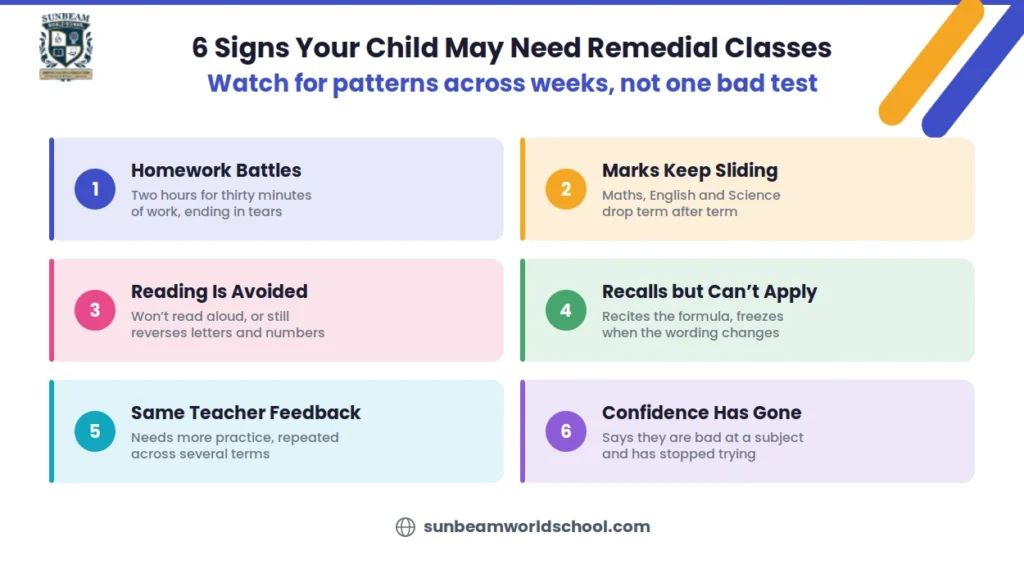
Recognizing these six signs early can help parents identify when remedial classes may provide the extra academic support their child needs.
The signs a child needs remedial classes are homework that takes far longer than it should, steadily declining marks in cumulative subjects, an ability to memorize without understanding, and a child who has started saying they are simply bad at a subject. Look for patterns across weeks, not one bad test.
Six warning signs worth acting on:
- Homework becomes a daily battle. It takes two hours instead of thirty minutes, or reliably ends in tears and avoidance.
- Marks slide in cumulative subjects. Math, English, and Science are the early indicators, because every chapter depends on the last. A drop here is structural, not careless.
- Reading aloud is avoided. Or letters and numbers are still reversed well past the age when that is typical.
- They can memorize but not apply. They recite the formula perfectly, then freeze when the question is worded differently. This is the single most reliable sign of a genuine gap.
- Teachers repeat the same feedback. Comments such as not paying attention or needs more practice, appearing across several terms, usually mean the child cannot follow rather than will not.
- Confidence has collapsed. "I am just bad at math" is normally the first visible symptom of a gap that formed years earlier.
One sign is worth watching. Three or more together warrant a conversation with the class teacher this month, not next term.
What Methods Do Remedial Teachers Use?
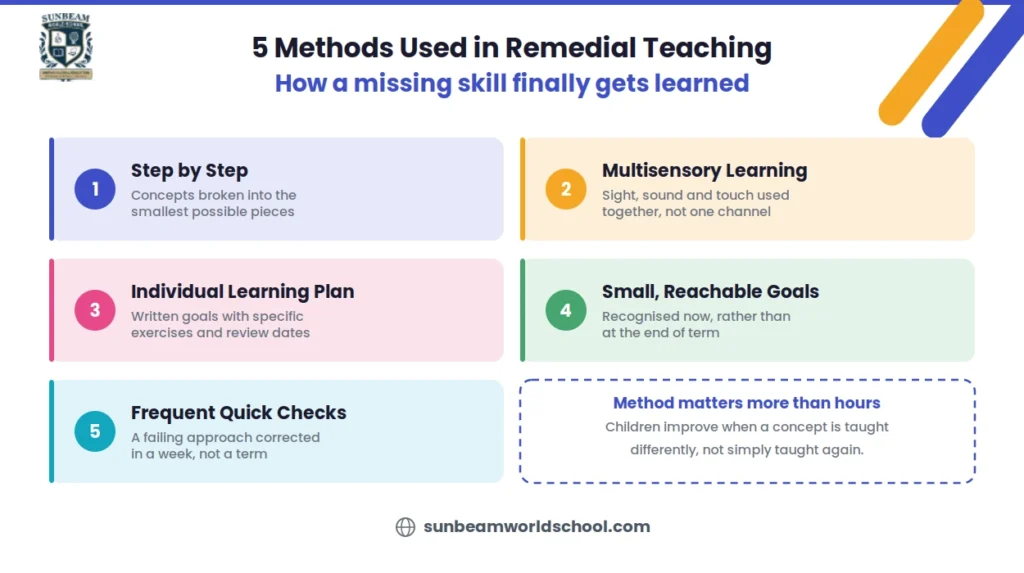
Effective remedial teaching focuses on personalized methods that help students master concepts through structured, engaging, and consistent support.
Remedial education relies on step-by-step instruction, multisensory methods that combine sight, sound, and touch, an individualized plan with measurable goals, small achievable targets with immediate recognition, and frequent low-stakes progress checks. The defining feature is that the concept is taught differently the second time, not simply repeated.
- Step-by-step instruction. Concepts are broken into the smallest possible pieces, and no piece is skipped even when it looks obvious to an adult.
- Multisensory teaching. Tracing letters, clapping syllables, building fractions from paper strips, or using color-coded visuals on screen. A child who fails to learn through one channel often succeeds through three at once.
- An individualized education plan. A written plan with short-term and long-term goals, specific exercises, and fixed review dates, so progress is measured rather than assumed.
- Pull-out or in-class support. In a physical classroom, a child is either taken out for a focused session or supported by a second teacher in the room. The first is more focused, the second is less visible to classmates.
- Goal setting and recognition. Small, specific, achievable targets with immediate acknowledgment. For a child who has stopped believing effort pays off, end-of-term marks are far too distant to motivate.
- Frequent low-stakes checks. Short assessments every few sessions, so an approach that is not working is corrected within a week rather than a term.
What Are the Benefits of Remedial Classes?
The main benefit of remedial classes is targeted teaching aimed at exactly what a child finds difficult, which then produces several further advantages.
- Individual attention. In a group of six or fewer, a teacher can see how a child is getting something wrong, which is where real teaching begins.
- Restored confidence. Repeated success in a low-pressure setting dismantles the belief that they are bad at a subject.
- Stronger foundations. Later concepts sit on earlier ones, so fixing the base makes everything above it permanently easier.
- Better classroom engagement. Students who can follow the lesson participate instead of withdrawing or acting out.
- Earlier identification of learning difficulties. Sustained close work often surfaces conditions a large classroom would never reveal.
- Better long-term outcomes. Early remedial education measurably reduces the risk of repeated grades and dropping out.
Do Remedial Classes Actually Work?
Remedial classes work when the teaching changes method rather than simply adding hours, and when they start as early as possible. Re-explaining the same concept in the same way, louder and for longer, mostly reinforces confusion.
Timing matters as much as method. Remediation in Grades 1 to 3 is far more effective and less disruptive than remediation in Grade 9, because there is less accumulated ground to recover and far less damage to the child's self-image.
Where remedial education programs fail, the reasons are predictable: untrained teachers, groups that are too large, no diagnostic step at the start, or no exit plan, so children remain in remedial support indefinitely. These are design faults rather than evidence that remediation does not work. Before enrolling anywhere, it is worth asking four questions: who teaches the sessions, how the starting point is identified, how progress is measured, and what exit looks like.
One signal is worth knowing. If a child receives consistent, well-designed remedial support for a full term and makes very little progress, that itself is useful information. It usually points to an undiagnosed learning difficulty that needs specialist assessment rather than more practice.
Are Remedial Classes Bad for a Child's Confidence?
Remedial classes are not bad for a child's confidence when they are temporary, well taught, and discreetly handled. The stigma parents worry about comes from how a school presents the support, not from the support itself, and it has to be weighed against the alternative of years of quiet failure.
Four myths are worth clearing up:
- "It means my child is weak." It means one specific skill was missed. High-achieving students take remedial support too, most often after a school change or a long absence.
- "Once remedial, always remedial." Remediation is designed as temporary scaffolding, and most children exit within one or two terms. If a school has no exit criteria, ask why.
- "More homework will fix it." Extra practice of a concept the child does not understand simply cements the misunderstanding.
- "The embarrassment is not worth it." Discreet scheduling and framing sessions as skill-building removes most of it. In an online setting, extra support can be given without classmates being aware of it at all.
How Can Parents Support Remedial Learning at Home?
Parents can support remedial learning by keeping practice short and daily rather than long and weekly, reading together at any age, asking the teacher which specific skill is being worked on, and praising effort rather than marks.
- Talk about the gap, not the child. "This chapter is tricky and we are going to fix it" lands very differently from "You are careless."
- Fifteen focused minutes daily beats two hours on Sunday. Consistency rebuilds skills, intensity does not.
- Read together every day, at any age. Reading fluency drives performance in every subject.
- Ask one specific question. "What exact skill are we working on this month, and how will we know it has improved?" A good remedial teacher will answer immediately.
- Praise effort and progress, never marks. The child needs to relearn that effort produces results.
- Watch the emotional side. Persistent anxiety, sleeplessness, or school refusal needs a counselor, not another tutor.
Does Sunbeam World School Offer Remedial Support?
Yes, Sunbeam World School provides remedial classes as part of how students are taught, rather than as a separate program a child is referred to after failing. Pace is built into the model, so a student who needs longer on a concept takes longer without leaving the class or being visibly singled out.
- Learning adapts to the child's pace. If a student needs more time to master a concept they take it, and if they are ready to move ahead they do. For a child with a genuine gap, that is the difference between catching up and permanently trailing the syllabus.
- Lessons can be revisited, not just repeated. Students attend live classes and also work through recorded material, so a child who did not follow something the first time can return to it as often as needed.
- Small groups and trained special educators. A 2:20 teacher-student ratio keeps individual attention possible, and students with additional needs including ADHD and autism spectrum disorder are supported by special educators using adaptive learning tools and multilingual support.
- Parents see the gap forming. Our AI-powered LMS gives parents real-time access to grades, attendance, assignments, and teacher feedback. Most gaps go unnoticed for years because parents only see a report card twice a year.
- Support without stigma. Extra help is given privately, which removes the embarrassment that causes so many older students to refuse the help they need.
- Curriculum flexibility for students who have switched systems. We offer CBSE-aligned, Cambridge, American, and NIOS pathways from Nursery to Grade 12. A large share of learning gaps come from children moving between education systems, and placing a student correctly matters more than pushing them into a fixed track.
More than 100,000 students across 135 countries study with Sunbeam World School, and many arrived because a child was struggling somewhere else. You can see how lessons are taught on the learning approach page or book a free demo class.
Conclusion: Are Remedial Classes Right for Your Child?
Remedial classes are worth it when a child has a genuine gap in a foundational skill, because learning is cumulative and no student can build on a foundation that is not there.
The hardest part for most parents is not arranging the support. It is the delay before acting. A gap that takes one term to fix in Grade 3 can take two years to fix in Grade 8, and by then the child has usually decided something permanent about themselves: that they are not a math person, that they are bad at English, that school is not for them. That belief is far harder to undo than the original gap.
- Act on patterns, not one bad test. Three warning signs together are enough to start a conversation with the teacher.
- Method matters more than hours. The children who improve are taught differently the second time, not simply taught again.
- Early is cheaper. Grades 1 to 3 is the highest-return window, though remediation helps at any age.
- Ask about the exit. Good remedial support is temporary by design and should tell you what finishing looks like.
If a change of setting is part of the answer, it is worth reading who online school is best for before deciding.

Frequently Asked Questions
What is the meaning of remedial classes in simple words?
-Remedial classes are extra classes that help a student learn something they missed earlier so they can keep up with the rest of the class. The difference from ordinary extra classes is that remedial teaching goes backward before it goes forward, working out which earlier concept was never understood and teaching that first. In Hindi this is often described as upchaaratmak shiksha, meaning corrective teaching. The aim is always to return the student to regular class, not to keep them separate.
What is the difference between remedial classes and remedial education?
+How long do remedial classes last?
+Will my child fall behind in regular class while attending remedial sessions?
+At what age should remedial teaching start?
+Are remedial classes only for math and English?
+Is remedial teaching the same as special education?
+What if my child refuses to attend remedial classes?
+Do remedial classes cost extra?
+
In this article
Share this post:


Press and Blogs
Stay updated with our press releases, educational blogs, and more.

Quick Summary Animal sounds are the noises animals make to communicate, warn of danger and...

Quick Summary An algebra equation is a maths statement that sets two expressions equal using...

Quick Summary Essential Repeat (ER) in CBSE means a student has not met the passing...