
 Education
12 Months Name in English
Quick Summary The 12 months name in English are January, February, March, April, May, June, July, August, September, October, November, and December. Learning their correct order, spelling, number of days, seasons, and common uses helps children understand calendars, dates, birthdays, school schedules, and everyday time.
Learning the months of the year is one of the first time-related concepts children use in everyday life. They see months on calendars, talk about birthdays, learn school terms, and hear dates in conversations, so knowing the month names in English helps them communicate with confidence.
For young learners, memorising all 12 names can take some practice because several months have similar endings or spellings. A combination of repetition, songs, calendars, simple examples, and memory tricks can make the process easier and more enjoyable.
What Are the 12 Months Name in English?
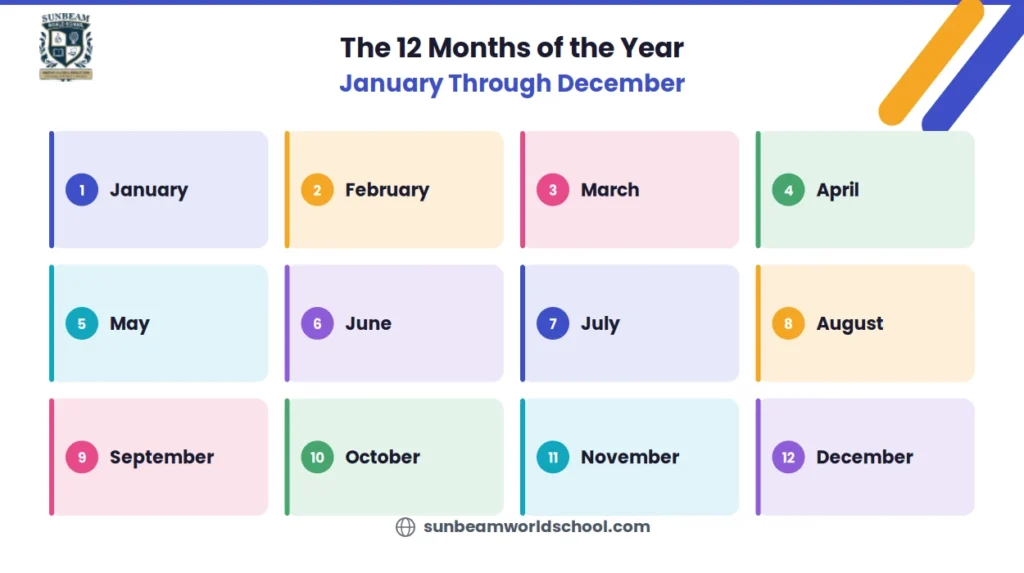
All 12 months of the year
The 12 months name in English, in order from the beginning to the end of the year, are January, February, March, April, May, June, July, August, September, October, November, and December.
| No. | Month Name | Short Form | Days |
|---|---|---|---|
| 1 | January | Jan. | 31 |
| 2 | February | Feb. | 28 or 29 |
| 3 | March | Mar. | 31 |
| 4 | April | Apr. | 30 |
| 5 | May | May | 31 |
| 6 | June | Jun. | 30 |
| 7 | July | Jul. | 31 |
| 8 | August | Aug. | 31 |
| 9 | September | Sep. | 30 |
| 10 | October | Oct. | 31 |
| 11 | November | Nov. | 30 |
| 12 | December | Dec. | 31 |
A useful way to practise the list is to say the names aloud in order several times. Children can also write January to December on a calendar and circle important dates such as birthdays, holidays, or school events.
How Can Children Learn the Months in Order?
Children can learn the months in order more easily when they connect the names with repetition, rhythm, visuals, and real-life events. Instead of asking them to memorise all 12 names at once, practise the sequence in smaller groups and then gradually combine them.
For example, begin with January to April, then May to August, and finally September to December. Once the groups are familiar, ask your child to say the complete sequence without looking.
Songs and rhymes also make the order easier to remember, especially when paired with rhyming words for kids that help younger children notice sound patterns while they practise the sequence.
What Are the Months in Order From January to December?
The months in order from January to December are January, February, March, April, May, June, July, August, September, October, November, and December.
A simple sequence to practise is:
- January
- February
- March
- April
- May
- June
- July
- August
- September
- October
- November
- December
Children can write this list once each day for a week, say it aloud while pointing to a calendar, or ask a parent to name one month and let them identify the month that comes before or after it.
Learning the sequence also helps children understand phrases such as "January comes before February" and "December is the last month of the year."
How Do You Spell the 12 Month Names in English?
The correct spelling of the 12 month names is January, February, March, April, May, June, July, August, September, October, November, and December.
| Month | Spelling Tip |
|---|---|
| January | Remember the "Jan-u-ar-y" sound pattern |
| February | The first "r" can be easy to miss when spelling |
| March | A short, four-letter word |
| April | Ends with "il" |
| May | Three letters |
| June | Ends with "ne" |
| July | Ends with "ly" |
| August | Starts with "Au" |
| September | Remember "Sep-tem-ber" |
| October | Starts with "Oct" |
| November | Starts with "Nov" |
| December | Starts with "Dec" |
Writing each month while saying it aloud helps children connect pronunciation with spelling, and mixing month names into regular dictation words in English practice is a natural way to build on this as they grow more confident writing longer words.
How Many Days Are There in Each Month?
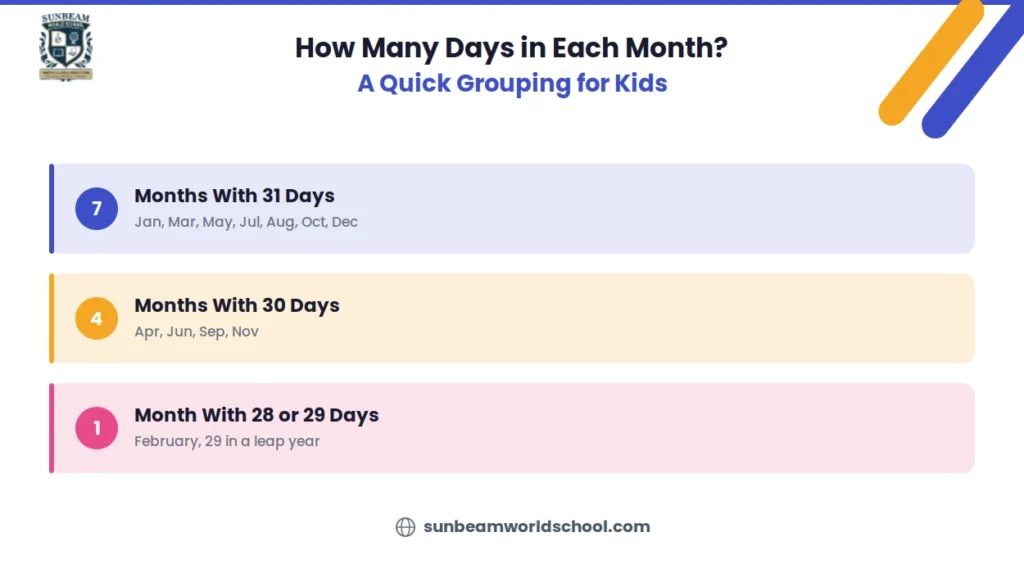
A quick way to group the months by how many days each one has.
The number of days in each month is 28, 29, 30, or 31, depending on the month. February is the only month that has fewer than 30 days, while seven months have 31 days and four months have 30 days.
Which Months Have 31 Days?
January, March, May, July, August, October, and December have 31 days. Children can remember these months by grouping them rather than trying to memorise seven separate facts.
A common memory method is the knuckle trick. Starting with January on the first raised knuckle, move across the knuckles and spaces. The raised knuckles represent months with 31 days, while the spaces represent months with fewer days.
Which Months Have 30 Days?
April, June, September, and November have 30 days. A familiar rhyme can help children remember these four months: "Thirty days hath September, April, June, and November."
Once children know this group, they only need to remember that February is different and that the remaining months have 31 days.
Why Does February Have 28 or 29 Days?
February has 28 days in a common year and 29 days in a leap year. A leap year generally occurs every four years, although years divisible by 100 are not leap years unless they are also divisible by 400.
For young children, it is enough to understand that February can have one extra day, making 29 days, and that this happens in a leap year.
What Are the Months and Their Seasons?
The months and their seasons depend on the part of the world where a child lives, because the seasons are opposite in the Northern and Southern Hemispheres. In India and many countries in the Northern Hemisphere, months are commonly grouped around spring, summer, autumn, and winter.
A simple Northern Hemisphere grouping is:
| Season | Common Months |
|---|---|
| Spring | March, April, May |
| Summer | June, July, August |
| Autumn | September, October, November |
| Winter | December, January, February |
Seasonal groupings can vary by country and climate, so children should learn that these are broad calendar groupings rather than fixed weather rules. For younger learners, connecting each season with pictures, clothing, weather, or festivals can make the concept easier to understand.
Why Should Children Learn the Names of the Months?
Children should learn the names of the months because month names help them understand dates, calendars, schedules, birthdays, holidays, and other everyday events.
Knowing the months also supports early language and time concepts. Children can use sentences such as "My birthday is in May," "School starts in June," or "December comes after November."
Month names are also useful once children begin reading timetables, writing dates, completing forms, and understanding school calendars, the kind of everyday context found throughout simple English sentences for kids that use days, months, and time.
How Can Kids Remember the 12 Months Easily?
Kids can remember the 12 months easily by using repetition, songs, calendars, grouping, and simple memory games. The best method depends on the child's age and learning style, so it is useful to combine visual, spoken, and written practice.
A Calendar Help Children Learn the Months
A calendar can help children learn the months because it gives them a visual sequence from January to December. Let your child turn the pages of a calendar, identify the current month, and find important dates such as birthdays or holidays.
You can also create a simple 12-month calendar together. Ask the child to write one month on each page and add a drawing representing something they associate with that time of year.
Songs and Rhymes Help Children Learn Months
Songs and rhymes can help children learn months because rhythm and repetition make the sequence easier to recall. Encourage your child to sing the month names while pointing to each month on a calendar.
For younger children, repetition through songs can feel more like play than memorisation. Once they can sing the sequence confidently, ask them to say the names without the song and then write them independently.
Games Make Learning Month Names More Fun
Games can make learning month names more engaging by turning repetition into a small challenge. Try writing all 12 months on separate cards, mixing them up, and asking your child to put them back in the correct order.
You can also ask questions such as "Which month comes after June?", "Which month comes before October?", or "What is the ninth month?" These questions help children understand both the names and their position in the year.
How Can Children Use Month Names in English Sentences?
Children can use month names in English sentences to practise both vocabulary and real-world communication. Simple sentences make it easier for young learners to understand how month names work in everyday language.
Here are some examples:
- My birthday is in January.
- We have a holiday in March.
- School starts in June.
- My sister was born in August.
- Diwali is in October this year.
- December is the last month of the year.
- February has 28 days in a common year.
- September comes before October.
- I like December because of the holidays.
- Our exams begin in November.
When children practise these sentences, encourage them to replace the months with dates and events from their own lives. This makes vocabulary practice more meaningful and improves their confidence with English.
Why Are Month Names Capitalized in English?
Month names are capitalized in English because the names of months are proper nouns. Therefore, the first letter of January, February, March, and every other month should be written as a capital letter.
For example, write "My birthday is in April," not "My birthday is in april." This is an easy grammar rule to practise because children encounter month names frequently in calendars, notebooks, schoolwork, and written dates.
Regular reading and writing practice can reinforce capitalization naturally. For younger children, activities involving dates and calendars can be especially useful because they combine grammar with a familiar everyday concept.
How Can Parents Make Learning the Months More Interactive?
Parents can make learning the months more interactive by connecting the names to birthdays, holidays, seasons, school events, family plans, and activities children already understand.
Ask your child to identify the current month, name the previous and next month, and find an upcoming birthday or holiday on the calendar. You can also let them create a monthly drawing, write one sentence about each month, or make a simple year-long timeline.
For younger children, combining month names with stories, songs, and pictures keeps practice interesting, and short stories in English for kids offer natural opportunities to talk about dates, seasons, and events while building broader vocabulary along the way.
How Does Learning Months Support Early Education?
Learning months supports early education by helping children build vocabulary, understand sequence, develop time awareness, and connect language with everyday events. It is a small concept that supports several early learning skills at once.
Children use month names when they learn about calendars, dates, seasons, birthdays, festivals, school schedules, and historical timelines. They also practise sequencing when they identify which month comes before or after another.
For younger learners, this kind of sequencing and vocabulary work fits naturally into the foundational experiences behind why early childhood education matters for language and cognitive development.
What Are Common Mistakes Children Make With Month Names?
Common mistakes with month names include spelling errors, putting the months in the wrong order, forgetting to capitalize them, and confusing the number of days in certain months.
February is particularly easy to misspell, while September, November, and December may be confused because their names have similar endings. Children may also forget that June and July are separate months or mix up their order.
Short, regular practice is usually more helpful than asking children to memorise the entire list repeatedly. Use calendars, spelling games, sentence practice, and quick questions to reinforce the parts they find difficult.
Conclusion
Learning the 12 months name in English becomes easier when children connect the names with calendars, real-life events, songs, spelling practice, and simple games. With regular practice, they can confidently remember the order, spelling, days, seasons, and everyday use of each month, the same steady, practice-based approach that also shows up in setting short-term goals for students. For families looking for a flexible learning environment, Sunbeam World School offers a child-centered approach where learning can fit naturally into a child’s pace and routine.

Frequently Asked Questions
What are the 12 months name in English?
-The 12 months name in English are January, February, March, April, May, June, July, August, September, October, November, and December. These month names follow the same order every year and are used to talk about dates, birthdays, holidays, school schedules, and other events.
How many days are there in each month?
+Which months have 30 days?
+How can kids remember the months in order?
+Why does February have 28 or 29 days?
+How do you use month names in English sentences?
+
In this article
Share this post:


Press and Blogs
Stay updated with our press releases, educational blogs, and more.

Quick Summary There are 25 prime numbers from 1 to 100: 2, 3, 5, 7,...

Quick Summary Roman numerals 1 to 1000, also called Roman numbers, use seven letters: I...

Quick Summary Animal sounds are the noises animals make to communicate, warn of danger and...