
Quick Summary The CBSE Class 10 syllabus 2026-27 was released on 2 April 2026 and covers five compulsory subjects (two languages, Mathematics, Science and Social Science), each marked out of 80 in theory and 20 in internal assessment. The chapters and unit weightage are the same as last year, the 2027 board exam keeps the competency-based pattern, and Class 10 students again get a compulsory first board exam in February and an optional second exam in May.
The CBSE Class 10 syllabus is the official list of units, chapters, marks and assessment rules that every CBSE school in India and abroad follows for the 2027 board exams. This guide puts the latest syllabus of CBSE Class 10 in one place: the subject list with codes, the exam pattern and marking scheme, unit-wise weightage for English, Science, Maths and Social Studies, the language and skill subjects, and the steps to download the official PDF. It is written for students and parents who want a clear 10th syllabus overview before planning the year, whether the student studies in a regular school, an online school or at home.
CBSE Class 10 Syllabus 2026-27
The CBSE Class 10 syllabus 2026-27 applies to students appearing in the 2027 board exams and was published by CBSE on 2 April 2026 as part of the CBSE curriculum 2026-27 (Secondary Curriculum, Class X) on cbseacademic.nic.in. Every main subject is assessed out of 100 marks, split into an 80-mark board theory paper and 20 marks of internal assessment run by the school, and students need 33% to pass each subject. Whether you search for the CBSE syllabus 2026 27, the CBSE 10th syllabus 2026-27, the class 10th 2026-27 syllabus or simply the class 10 2027 syllabus, they all point to this same document, which also sits within the wider CBSE new curriculum reforms the board has rolled out under NEP 2020.
CBSE Class 10 Syllabus 2026-27 at a Glance
| Detail | Information |
|---|---|
| Board | Central Board of Secondary Education (CBSE) |
| Session | 2026-27 (board exams in 2027) |
| Syllabus released | 2 April 2026 |
| Compulsory subjects | 2 languages, Mathematics, Science, Social Science |
| Marks per main subject | 80 theory + 20 internal assessment |
| Passing marks | 33% in each subject |
| Board exams | First exam February to March 2027 (compulsory), second exam May 2027 (optional) |
| Official website | cbseacademic.nic.in |
The full 10th class course, often called the CBSE portion for Class 10, is laid out subject by subject in the sections below. Families also search for it as the Class X syllabus, the class 10th syllabus, the 10 std syllabus, the CBSE grade 10 syllabus, the 10th board syllabus or 10 class ka syllabus, and every one of these refers to the CBSE board Class 10 syllabus described here.
CBSE Class 10 Subjects List with Subject Codes
CBSE Class 10 students study five compulsory subjects and can add one optional sixth subject, and each subject has a fixed code that appears on the registration form, admit card and marksheet. The table below lists the CBSE subjects for Class 10 that most students choose, so you can match the 10th subject name with its code.
| Subject | Code | Type |
|---|---|---|
| English Language and Literature | 184 | Language 1 (compulsory) |
| English Communicative | 101 | Language 1 (only for students who chose it in Class 9) |
| Hindi Course A | 002 | Language 2 |
| Hindi Course B | 085 | Language 2 |
| Sanskrit | 122 | Language 2 |
| Mathematics Standard | 041 | Compulsory |
| Mathematics Basic | 241 | Compulsory (alternative to Standard) |
| Science | 086 | Compulsory |
| Social Science | 087 | Compulsory |
| Information Technology | 402 | Optional skill subject |
| Artificial Intelligence | 417 | Optional skill subject |
| Computer Applications | 165 | Optional academic subject |
| Home Science | 064 | Optional academic subject |
CBSE also offers more than 30 Indian and foreign languages, such as Punjabi, Bengali, Tamil, Urdu, French and German, along with subjects like Painting, Music, Elements of Business and Elements of Book Keeping and Accountancy. Students should always confirm their subject codes for Class 10 CBSE with the school before registration closes, because a wrong code means sitting the wrong paper.
How Many Subjects Are There in CBSE Class 10?
There are five compulsory subjects in CBSE Class 10, which are two languages, Mathematics, Science and Social Science, and a student may add a sixth optional subject such as Information Technology, Artificial Intelligence or a third language. So the short answer to how many subjects in 10th class is five, or six with an optional subject. Health and Physical Education, Art Education and Work Experience are also part of the CBSE 10th subjects, but they are assessed only inside the school and do not have a board paper. The sixth subject is useful, because if a student fails Science, Maths or Social Science but passes the skill subject, CBSE replaces the failed subject with the skill subject when computing the result.
Is the Class 10 Syllabus Changing in 2026-27?
The Class 10 syllabus is not changing in 2026-27 at chapter level, so the CBSE new syllabus 2026 27 has the same NCERT textbooks, the same units and the same marks weightage for Maths, Science, Social Science and English as in 2025-26. Anyone expecting a new syllabus of Class 10 with fewer chapters should note that there is also no class 10 reduced syllabus this year, so students should prepare every chapter listed in the official curriculum. The few updates that matter for the 2027 batch are about rules rather than content:
- Two board exams continue. The CBSE new rules for Class 10 2027 board exams keep a compulsory first board exam in February and an optional second exam in May, both covering the full syllabus.
- English Communicative is closing. CBSE has stopped offering English Communicative (101) to new Class 9 students from 2026-27, so only students who already chose it in Class 9 can take it in Class 10.
- The three-language rule does not apply yet. The R3 rule covers Classes 6 to 9 from 2026-27, and Class 10 students in 2026-27 continue with two languages.
CBSE Class 10 Exam Pattern 2026-27
The CBSE Class 10 exam pattern 2026-27 has an 80-mark, three-hour board paper and 20 marks of internal assessment in each main subject, and half of every theory paper is made up of competency-based questions that test how well students apply concepts. The CBSE class 10 paper pattern is the same as the previous session, so last year's official sample papers remain a reliable guide to the structure.
| Subject group | Subjects | How it is assessed |
|---|---|---|
| Compulsory | English or Hindi (Language 1 and 2), Mathematics, Science, Social Science | Board theory (80) + internal assessment (20) |
| Optional | IT, AI, Computer Applications, third language and others | Board theory + practical or internal assessment (varies by subject) |
| Internal only | Health and Physical Education, Art Education, Work Experience | Assessed by the school, grades shown on the marksheet |
Question Types and Their Weightage
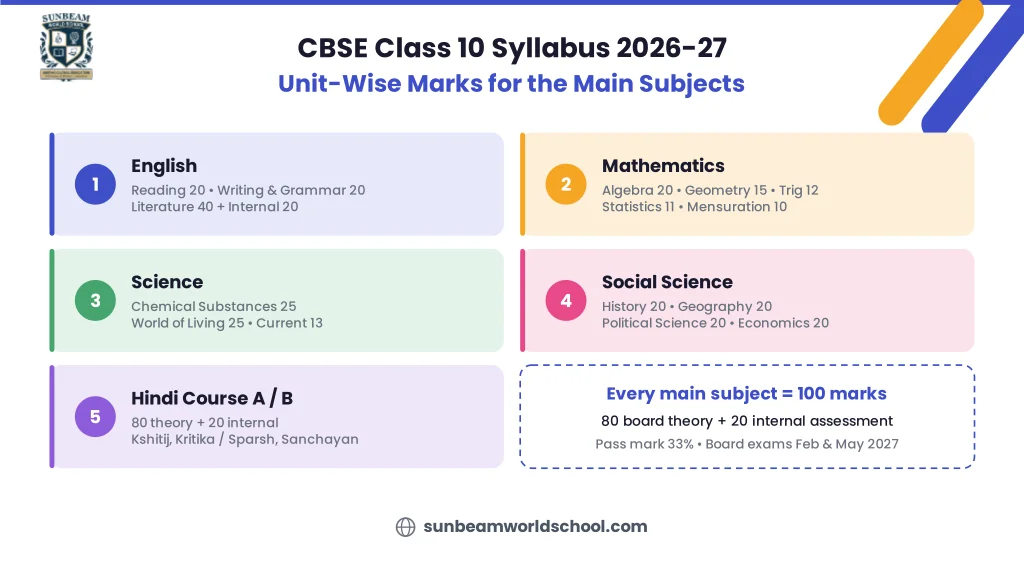
CBSE Class 10 Syllabus 2026-27: every main subject is marked out of 80 in theory and 20 in internal assessment, with 33% needed to pass.
Competency-based questions carry 50% of the marks in the CBSE Class 10 theory paper, objective select-response questions such as MCQs carry 20%, and short and long answer questions carry the remaining 30%. Competency-based questions come as MCQs, case-based questions, source-based questions and assertion-reason items, which means rote answers are rarely enough on their own. Students who practise reading a short passage or data table and then applying a concept to it tend to score better in this section than those who only revise definitions. This question-type split, together with the unit-wise CBSE weightage for Class 10 given in each subject section below, works as the blueprint of Class 10 CBSE papers.
| Question type | Share of theory marks |
|---|---|
| Competency-based (MCQs, case-based, source-based, assertion-reason) | 50% |
| Select-response (MCQs) | 20% |
| Constructed response (short and long answer) | 30% |
CBSE Class 10 Marking Scheme 2026
The CBSE Class 10 marking scheme 2026 gives every main subject 100 marks, made up of 80 marks for the board theory paper and 20 marks for internal assessment, and most theory papers last three hours. Skill subjects such as IT and AI follow a different split of 50 theory and 50 practical marks, so the class 10th scheme depends on the subject a student picks.
| Subject | Theory | Internal assessment / Practical | Total | Duration |
|---|---|---|---|---|
| English Language and Literature | 80 | 20 | 100 | 3 hours |
| Hindi Course A / Course B | 80 | 20 | 100 | 3 hours |
| Mathematics Standard / Basic | 80 | 20 | 100 | 3 hours |
| Science | 80 | 20 | 100 | 3 hours |
| Social Science | 80 | 20 | 100 | 3 hours |
| Information Technology (402) | 50 | 50 | 100 | 2 hours |
| Artificial Intelligence (417) | 50 | 50 | 100 | 2 hours |
| Computer Applications (165) | 50 | 50 | 100 | 2 hours |
Internal Assessment Marks in Class 10
Internal assessment in Class 10 is worth 20 marks per main subject, and schools build it from periodic tests, a subject portfolio and subject enrichment work such as lab activities in Science, maths activities, listening and speaking tasks in English and a project in Social Science. These marks are uploaded by the school before the board exam, and they count only once even if the student appears for the second board exam in May. Because 20 marks are much easier to secure through steady work than in a three-hour paper, a full internal score gives students a real cushion before they walk into the exam hall.
Passing Marks for CBSE Class 10
The passing marks for CBSE Class 10 are 33% in each subject, which works out to 27 out of 80 in the theory paper and 7 out of 20 in internal assessment, rounded up from the exact percentage. A strong internal score cannot rescue a very weak theory paper, which is why the full working in passing marks out of 80 in CBSE is worth reading before the pre-boards. A student who fails in one or two subjects can clear them in the May second board exam, while failing in three or more subjects places the student in the Essential Repeat category.
CBSE Class 10 English Syllabus 2026-27
The CBSE Class 10 English syllabus 2026-27 divides the 80-mark English Language and Literature paper into Reading (20 marks), Writing Skills and Grammar (20 marks) and Literature (40 marks), with the remaining 20 marks for internal assessment through listening and speaking activities. This structure is unchanged from the English syllabus Class 10 CBSE 2025-26, so the same books and the same writing formats continue.
| Section | Content | Marks |
|---|---|---|
| A: Reading | Two unseen passages (discursive and case-based factual) | 20 |
| B: Writing Skills and Grammar | Formal letter, analytical paragraph and grammar | 20 |
| C: Literature | First Flight and Footprints Without Feet (prose, poetry, extracts) | 40 |
| Internal assessment | Listening and speaking, portfolio and periodic tests | 20 |
| Total | 100 |
English Grammar Syllabus for Class 10 CBSE
The English grammar syllabus for Class 10 CBSE covers tenses, modals, subject-verb concord, reported speech (commands and requests, statements and questions) and determiners, tested through gap filling, editing and transformation tasks. The writing section asks for one formal letter, such as a letter of complaint, inquiry, placing an order or a letter to the editor, and one analytical paragraph based on a chart, graph, table or cue. Students who learn the fixed letter format and practise describing data in clear, linked sentences usually secure most of these 20 marks.
First Flight and Footprints Without Feet Chapter List
The Class 10 English literature syllabus is taught from two NCERT books, First Flight as the main reader and Footprints Without Feet as the supplementary reader.
| First Flight (prose) | First Flight (poems) | Footprints Without Feet |
|---|---|---|
| A Letter to God | Dust of Snow | A Triumph of Surgery |
| Nelson Mandela: Long Walk to Freedom | Fire and Ice | The Thief's Story |
| Two Stories About Flying | A Tiger in the Zoo | The Midnight Visitor |
| From the Diary of Anne Frank | How to Tell Wild Animals | A Question of Trust |
| Glimpses of India | The Ball Poem | Footprints Without Feet |
| Mijbil the Otter | Amanda! | The Making of a Scientist |
| Madam Rides the Bus | The Trees | The Necklace |
| The Sermon at Benares | Fog | Bholi |
| The Proposal | The Tale of Custard the Dragon | The Book That Saved the Earth |
| For Anne Gregory |
CBSE Class 10 Science Syllabus 2026-27
The CBSE Class 10 Science syllabus 2026-27 has five units worth 80 theory marks, led by Chemical Substances and World of Living at 25 marks each, plus 20 marks of internal assessment that include practical work. The science syllabus Class 10 CBSE 2025-26 used the same units and weightage, so the 13 NCERT chapters remain exactly as before.
| Unit | Name | Chapters | Marks |
|---|---|---|---|
| I | Chemical Substances: Nature and Behaviour | 1 to 4 | 25 |
| II | World of Living | 5 to 8 | 25 |
| III | Natural Phenomena | 9 to 10 | 12 |
| IV | Effects of Current | 11 to 12 | 13 |
| V | Natural Resources | 13 | 5 |
| Internal assessment | 20 | ||
| Total | 100 |
Chemical Substances: Nature and Behaviour
Chemical Substances is the chemistry unit of Class 10 Science, worth 25 marks, and it covers four chapters: Chemical Reactions and Equations, Acids, Bases and Salts, Metals and Non-metals, and Carbon and its Compounds. Balancing equations, identifying the type of reaction and writing reactions of acids and metals are tested every year, so these skills are worth practising until they become automatic. Carbon and its Compounds is the longest chapter and is often where students lose marks on naming and structure questions.
World of Living
World of Living is the CBSE 10th biology syllabus, worth 25 marks, and it covers Life Processes, Control and Coordination, How Do Organisms Reproduce? and Heredity. Life Processes alone spans nutrition, respiration, transportation and excretion, which makes it the heaviest biology chapter in the paper. Labelled diagrams of the digestive system, heart, nephron, neuron and flower carry marks of their own, so students should practise drawing them neatly as well as explaining them.
Natural Phenomena
Natural Phenomena is the light unit of Class 10 Science, worth 12 marks, and it covers Light: Reflection and Refraction and The Human Eye and the Colourful World. Ray diagrams for mirrors and lenses, the mirror and lens formulas and sign conventions appear in almost every paper, along with numericals on magnification and power. Questions on defects of vision, dispersion and the blue colour of the sky are common in the short answer section.
Effects of Current
Effects of Current is worth 13 marks and covers Electricity and Magnetic Effects of Electric Current. Ohm's law, resistances in series and parallel, and electric power and heating effect numericals form the core of this unit. The magnetic effects chapter is more conceptual and focuses on field lines, the right-hand thumb rule and domestic electric circuits.
Natural Resources
Natural Resources is the smallest unit of Class 10 Science, worth 5 marks, and it is covered by a single chapter, Our Environment. It deals with ecosystems, food chains and food webs, trophic levels, the ozone layer and waste management, and a clear understanding of food chains and the 10% energy rule answers most of its questions.
CBSE Class 10 Maths Syllabus 2026-27
The CBSE Class 10 Maths syllabus 2026-27 has seven units worth 80 theory marks, with Algebra carrying the highest weightage at 20 marks, followed by Geometry at 15 and Trigonometry at 12, and 20 marks of internal assessment. The same mathematics syllabus applies to both Maths Standard and Maths Basic, and only the difficulty of the question paper changes.
| Unit | Name | Marks |
|---|---|---|
| I | Number Systems | 6 |
| II | Algebra | 20 |
| III | Coordinate Geometry | 6 |
| IV | Geometry | 15 |
| V | Trigonometry | 12 |
| VI | Mensuration | 10 |
| VII | Statistics and Probability | 11 |
| Internal assessment | 20 | |
| Total | 100 |
Class 10 Maths Chapter List
The Class 10 Maths syllabus is taught through 14 NCERT chapters, grouped under the seven units above.
| Unit | Chapters |
|---|---|
| Number Systems | Real Numbers |
| Algebra | Polynomials; Pair of Linear Equations in Two Variables; Quadratic Equations; Arithmetic Progressions |
| Coordinate Geometry | Coordinate Geometry |
| Geometry | Triangles; Circles |
| Trigonometry | Introduction to Trigonometry; Some Applications of Trigonometry |
| Mensuration | Areas Related to Circles; Surface Areas and Volumes |
| Statistics and Probability | Statistics; Probability |
Algebra, Geometry and Trigonometry together carry 47 of the 80 theory marks, so these chapters deserve the most practice time, while the step-wise presentation tips in how to write a maths paper in the board exam help students keep the marks they have earned.
Maths Standard vs Maths Basic
Maths Standard (041) is meant for students who plan to study Mathematics in Class 11, while Maths Basic (241) is meant for students who do not, and both follow the same syllabus but are tested with papers of different difficulty. A student who passes Maths Basic can usually take Applied Mathematics in Class 11 but not core Mathematics, so families should decide based on the stream the student is likely to choose. Students who are unsure should pick Maths Standard, since it keeps every option open for Class 11.
CBSE Class 10 Social Studies Syllabus 2026-27
The CBSE Class 10 Social Studies syllabus 2026-27, also called the CBSE Class 10 SST syllabus, gives 20 marks each to History, Geography, Political Science and Economics, of which 5 marks are reserved for map pointing (2 in History and 3 in Geography), plus 20 marks of internal assessment that include a project. The SST syllabus Class 10 CBSE 2026-27 is unchanged from the social science syllabus Class 10 CBSE students followed in 2025-26.
| Section | Textbook | Marks |
|---|---|---|
| History | India and the Contemporary World II | 18 + 2 (map) |
| Geography | Contemporary India II | 17 + 3 (map) |
| Political Science | Democratic Politics II | 20 |
| Economics | Understanding Economic Development | 20 |
| Internal assessment | Periodic tests, portfolio, project | 20 |
| Total | 100 |
History Chapters
The Class 10 History syllabus has five chapters from India and the Contemporary World II: The Rise of Nationalism in Europe, Nationalism in India, The Making of a Global World, The Age of Industrialisation and Print Culture and the Modern World. Nationalism in India is the most heavily tested chapter, and it is also the source of the History map questions on Congress sessions and freedom movement locations. Source-based questions in this section usually quote a short historical passage, so students should practise reading a source and answering in their own words.
Geography Chapters
The Class 10 Geography syllabus has seven chapters from Contemporary India II: Resources and Development, Forest and Wildlife Resources, Water Resources, Agriculture, Minerals and Energy Resources, Manufacturing Industries and Lifelines of the National Economy. Geography carries 3 map marks, mostly on dams, crops, mineral areas, industries, ports and airports. Students who prepare a single practice map for each chapter through the year find map work much easier in the final revision.
Political Science Chapters
The Class 10 Political Science syllabus has five chapters from Democratic Politics II: Power Sharing, Federalism, Gender, Religion and Caste, Political Parties and Outcomes of Democracy. Power Sharing and Federalism together form the base for case-based questions on Belgium, Sri Lanka and India's three-tier government. Answers score best when they use the exact terms from the textbook, such as horizontal and vertical power sharing.
Economics Chapters
The Class 10 Economics syllabus has five chapters from Understanding Economic Development: Development, Sectors of the Indian Economy, Money and Credit, Globalisation and the Indian Economy and Consumer Rights. Consumer Rights is usually assessed through the internal project rather than the board paper, so students should check with their school how it is being covered this year. Questions on the three sectors and formal versus informal credit are among the most frequent in the paper.
Class 10 SST Map Work
Class 10 SST map work carries 5 marks, with 2 marks for History locations and 3 marks for Geography features, and the map list is printed in the official curriculum. These are among the easiest marks in the paper because the list is fixed and does not change during the year. Students who mark every listed item on a blank outline map at least three times before the board exam rarely lose these marks.
CBSE Class 10 Hindi and Language Syllabus
CBSE Class 10 students study two languages, and most choose English with either Hindi Course A or Hindi Course B, each marked out of 80 in theory and 20 in internal assessment. Students in 2026-27 continue with two languages, since the CBSE third language R3 rule applies only to Classes 6 to 9 this session.
Hindi Course A vs Hindi Course B
Hindi Course A is meant for students who studied Hindi as a full language up to Class 8, while Hindi Course B is meant for students who studied it for fewer years, and the two use different textbooks and paper levels. Hindi Course A is taught from Kshitij Part 2 and Kritika Part 2, while Hindi Course B uses Sparsh Part 2 and Sanchayan Part 2. Both courses test reading, grammar, textbook answers and creative writing such as letters and notices, but Course A expects more depth in literature and grammar.
Sanskrit, Punjabi and Other Languages
CBSE offers Sanskrit and more than 30 other Indian and foreign languages, including Punjabi, Urdu, Bengali, Tamil, Marathi, French and German, as the second language or as an optional sixth subject. The class 10 Sanskrit syllabus covers reading, composition, applied grammar and the Shemushi textbook, and the Punjabi syllabus Class 10 CBSE students follow uses a similar mix of reading, grammar, writing and literature. Each language has its own curriculum PDF on cbseacademic.nic.in, so students should download the one that matches their subject code.
CBSE Class 10 IT and AI Syllabus 2026-27
The CBSE Class 10 IT and AI syllabus 2026-27 covers two optional skill subjects, Information Technology (402) and Artificial Intelligence (417), and each carries 100 marks split into 50 marks for theory and 50 marks for practical and project work. Both start with a common 10-mark Part A on employability skills (communication, self-management, ICT, entrepreneurial and green skills), and they differ in the subject-specific Part B.
Information Technology (402)
The Class 10 IT syllabus (402) teaches advanced office and database skills, with Part B covering Digital Documentation (Advanced), Electronic Spreadsheet (Advanced), Database Management System and Maintaining a Healthy, Safe and Secure Working Environment for 40 marks. The practical half is built on hands-on work in Writer, Calc and Base, a viva, a project and a practical file. IT 402 suits students who want a practical, scoring sixth subject that also builds everyday computer skills.
| Part | Content | Marks |
|---|---|---|
| A | Employability Skills | 10 |
| B | Digital Documentation, Electronic Spreadsheet, Database Management System, Healthy and Safe Working Environment | 40 |
| C | Practical work and viva | 30 |
| D | Project and portfolio | 20 |
| Total | 100 |
Artificial Intelligence (417)
The AI syllabus Class 10 CBSE students follow in Artificial Intelligence (417) teaches how AI projects are planned, built and evaluated, with Part B covering the AI Project Cycle and Ethical Frameworks, Advanced Concepts of Modeling, Evaluating Models, Statistical Data, Computer Vision, Natural Language Processing and Advance Python. Statistical Data and Advance Python are assessed only in the practical exam, which includes a practical file of at least 15 programs, a practical test, a project and two viva rounds. AI 417 is a strong choice for students interested in coding or data, and it introduces ideas they will meet again in Classes 11 and 12.
| Part | Content | Marks |
|---|---|---|
| A | Employability Skills | 10 |
| B | AI Project Cycle and Ethics (7), Modeling (11), Evaluating Models (10), Computer Vision (4), NLP (8) | 40 |
| C | Practical file, practical exam, project and viva | 50 |
| Total | 100 |
Class 10 Half Yearly and Pre-Board Syllabus
The Class 10 half yearly syllabus and Class 10 pre board syllabus are set by each school, not by CBSE, but most schools test about half the syllabus in the half yearly exam around September and the complete syllabus in the pre-boards between December and January. Mid term syllabus Class 10 tests and periodic tests fall in between and usually cover two or three chapters per subject, and these marks often feed into internal assessment. Students should ask the school for its 2026-27 split in writing at the start of the year and plan to finish the full syllabus before the pre-boards, since the CBSE date sheet 2027 places the first board exam soon after.
| Exam | Usual timing | Usual coverage |
|---|---|---|
| Periodic tests | Throughout the year | 2 to 3 chapters each |
| Half yearly / mid term | September to October | About 50% of the syllabus |
| Pre-board | December to January | Full syllabus |
| First board exam | February to March 2027 | Full syllabus |
| Second board exam (optional) | May 2027 | Full syllabus, up to three subjects |
How to Download the CBSE Class 10 Syllabus 2026-27 PDF
Students can download the CBSE Class 10 syllabus PDF for 2026-27 free from the official website cbseacademic.nic.in in five steps, and each subject has its own PDF.
- Open cbseacademic.nic.in, the CBSE academic website (not cbse.gov.in, which is mainly for exams and results).
- Click on "Curriculum" in the top menu and choose "Curriculum 2026-27".
- Select "Secondary Curriculum: Part 1 (Class X)" to open the subject list.
- Click your subject, such as Science, Mathematics or Social Science, and the PDF opens in a new tab.
- For IT, AI and other skill subjects, go to the "Skill Education" section instead, where each subject is listed by its code.
The syllabus of Class 10 CBSE 2026-27 on the class 10 syllabus 2026-27 CBSE official website is the only version schools and examiners follow, so use it rather than a class 10 syllabus 2026 27 CBSE PDF download link shared on social media.
CBSE Class 10 Study Material
The best CBSE Class 10 study material is the set of NCERT textbooks for each subject, backed by NCERT Exemplar problems, CBSE's official sample papers and previous year question papers. The NCERT Class 10 syllabus 2026-27 textbooks are the same editions as last year and match the CBSE syllabus chapter for chapter, so they should always be the first thing a student finishes before moving to reference books or question banks.
| Subject | NCERT textbooks |
|---|---|
| English | First Flight, Footprints Without Feet |
| Hindi Course A | Kshitij Part 2, Kritika Part 2 |
| Hindi Course B | Sparsh Part 2, Sanchayan Part 2 |
| Mathematics | Mathematics (Class 10) |
| Science | Science (Class 10) |
| Social Science | India and the Contemporary World II, Contemporary India II, Democratic Politics II, Understanding Economic Development |
Is NCERT Enough for Class 10?
NCERT is enough to cover the full Class 10 CBSE syllabus, because every question in the board paper is based on concepts from the NCERT textbooks, but students need extra practice material to handle the competency-based questions well. A sensible plan is to finish all NCERT exercises first, then solve NCERT Exemplar for Maths and Science, and finally practise CBSE sample papers and previous year papers under timed conditions. Reference books are useful for extra questions, though they should never replace the NCERT text itself.
CBSE Class 10 Sample Papers
CBSE Class 10 sample papers are released by CBSE every year with their marking schemes on cbseacademic.nic.in, and the 2026-27 sample question papers are the most accurate preview of the 2027 board paper. They show the exact number of questions, the sections, internal choices and the marks for each question type, which no other practice paper can match. Students should solve at least three full sample papers per subject under three-hour conditions and check their answers against the official marking scheme to learn how marks are actually awarded.
How to Complete the Class 10 Syllabus on Time
Students can complete the Class 10 syllabus on time by finishing all chapters by the end of November, leaving December for pre-boards and January to February for revision and full-length sample papers. A month-by-month plan, a fixed daily timetable and steady internal assessment work are what turn a long syllabus into one that feels manageable.
CBSE Class 10 Study Timetable
A CBSE Class 10 study timetable works best with three to four hours of focused self-study on school days, rotating Maths and Science daily and covering languages and Social Science on alternate days. A simple monthly plan looks like this:
| Months | Goal |
|---|---|
| April to June | Finish about 40% of chapters, especially Algebra, Life Processes and Nationalism in India |
| July to September | Complete about 80% of the syllabus before the half yearly exam |
| October to November | Finish remaining chapters, complete internal assessment work and projects |
| December | Pre-boards and full revision of weak chapters |
| January to February | Sample papers, previous year papers and final revision |
Revision Plan Before the Board Exam
The best revision plan before the board exam is to revise every chapter at least twice in the last ten weeks, once through notes and once through timed sample papers. Students should keep a short list of formulas, reactions, dates and map items for each subject and read it daily in the final month. Mistakes made in sample papers are more useful than marks scored, so writing them down and revisiting them weekly improves scores faster than reading new material.
How Online School Students Cover the Class 10 Syllabus
Online school students cover the same CBSE Class 10 syllabus through live classes, recorded lessons and regular online tests, and they sit the same board exams, either through their school's CBSE registration or as private candidates. The flexible schedule lets students spend extra time on weak chapters and move faster through strong ones, which helps when the syllabus is long. Families who are considering this route can read more on whether online school students give board exams and how registration works.
Conclusion
Preparing for the CBSE Class 10 exams becomes easier when you know what to study and how to plan your time. With the 2026-27 syllabus as your guide, focus on completing NCERT, revising important topics and practising sample papers regularly. Remember, you do not have to figure everything out at once. Take one topic at a time, stay consistent and trust your preparation.
At Sunbeam World School, students receive live teacher support, structured revision and regular mock tests to approach their board exams with greater confidence. Book a free counselling session to explore how we can support your learning journey.