
 Online Education
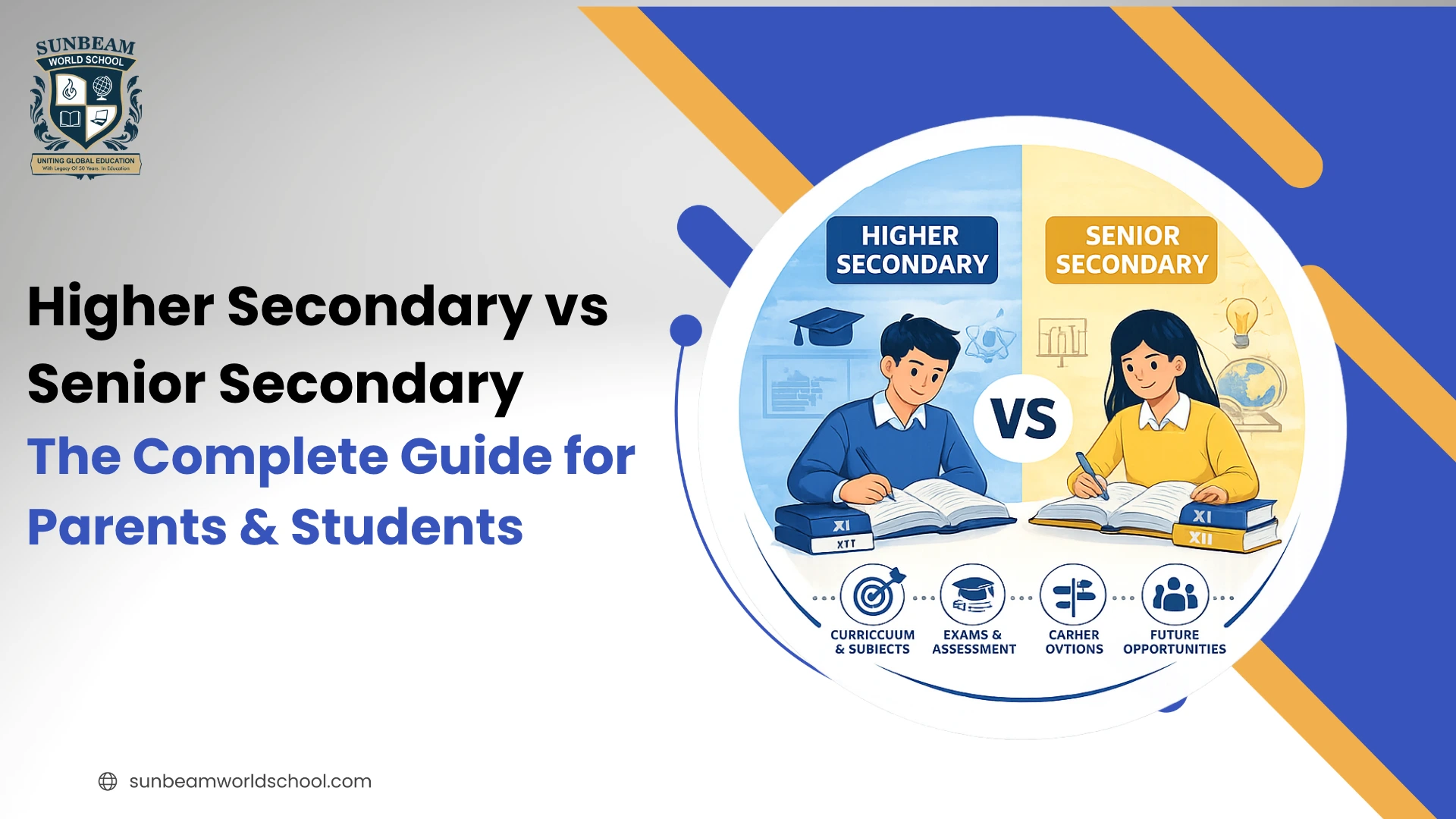
Higher Secondary vs Senior Secondary: The Complete Guide for Parents & Students
| What is the difference between higher secondary and senior secondary?
Quick Answer: Higher Secondary and Senior Secondary both mean the same thing: Classes 11 and 12. The difference is purely terminological. State boards (Maharashtra, Tamil Nadu, Andhra Pradesh, etc.) use the term "Higher Secondary," while national boards like CBSE and ISC use "Senior Secondary." The academic stage, the classes covered, and the streams offered are identical. |
You’ve just finished Class 10, and suddenly, everyone around you is throwing around terms like “Higher Secondary,” “Senior Secondary,” “CBSE,” and “HSC.” It sounds complicated, but here’s the truth: it doesn’t have to be.
At its core, both Higher Secondary and Senior Secondary refer to the same stage, Classes 11 and 12. There are real differences between the boards that use these terms in curriculum design, examination patterns, and how the resulting certificate is perceived for college admissions.
So if you’re wondering “Which one is better?” or “What’s the actual difference?” — you’re in the right place. Let’s break it down in the simplest way possible.
Understanding India's School Education Structure
Before diving into the comparison, it helps to see where Classes 11–12 fit within the full picture of school education in India. The system is structured in clearly defined stages, each with a specific purpose:
| Stage | Level | Classes | Age Group | Key Focus |
| Stage 1 | Pre-Primary | Nursery – UKG | 3–6 years | Foundational play-based learning |
| Stage 2 | Primary | Classes 1–5 | 6–11 years | Core literacy and numeracy |
| Stage 3 | Middle School | Classes 6–8 | 11–14 years | Subject specialisation begins |
| Stage 4 | Secondary | Classes 9–10 | 14–16 years | Board exams (SSC / SSLC / Matriculation) |
| Stage 5 — You Are Here | Higher / Senior Secondary | Classes 11–12 | 16–18 years | Stream selection, board exams, gateway to college |
| NEP 2020 Note:
Under the National Education Policy 2020, India's school structure is being reorganized into a 5+3+3+4 framework — Foundational (5 years), Preparatory (3 years), Middle (3 years), and Secondary (4 years, covering Classes 9–12). This groups Classes 11–12 under "Secondary" rather than as a separate stage, but the academic content and stream structure remain the same. |
What Is Higher Secondary Education?
| Higher Secondary Education means the stage of schooling that follows secondary education, typically covering Grades 11 and 12, where students specialize in streams like science, commerce, or humanities to prepare for higher studies or career paths. |
The term Higher Secondary refers to the two-year academic stage following the completion of Class 10, covering Classes 11 and 12. This terminology is predominantly used by state education boards across India — you'll hear it most commonly in Maharashtra, Tamil Nadu, Karnataka, West Bengal, Gujarat, Kerala, and most other states with their own boards.
Schools offering education up to Class 12 under state boards are officially called Higher Secondary Schools, and the certificate awarded after passing the Class 12 board examination is the Higher Secondary Certificate (HSC).
One important nuance: the curriculum for higher secondary education can differ significantly from state to state. A student studying in Maharashtra's HSC board will follow a different syllabus than one in Tamil Nadu's HSC board — even though both are called "Higher Secondary."
| Category | Details |
| School Name | Higher Secondary School or Junior College (in Maharashtra) |
| Certificate Issed | Higher Secondary Certificate (HSC) by respective state boards |
| Governing Body | State Board of Secondary & Higher Secondary Education (each state has its own) |
| Exam Pattern | State-level standardised exams; question patterns vary by state |
What Is Senior Secondary Education?
| Senior Secondary means the final stage of school education, typically Grades 11 and 12, where students choose a specific stream (such as science, commerce, or humanities) to prepare for higher education or careers. |
The term Senior Secondary covers the exact same academic stage, Classes 11 and 12, but it's the preferred terminology of national and central education boards, primarily CBSE (Central Board of Secondary Education) and ISC (Indian School Certificate).
Because CBSE's curriculum is centralized, a student in Chennai and a student in Delhi studying under the same board will follow the same syllabus. This uniformity makes transferring schools across states much easier — a significant advantage for families in transferable jobs.
| Category | Details |
| School Name | Senior Secondary School (CBSE, ISC-affiliated institutions) |
| Certificate Issued | Senior School Certificate by CBSE; ISC Certificate by CISCE |
| Governing Body | CBSE (under Ministry of Education) or CISCE (Council for ISC) |
| Exam Pattern | National-level standardized exams with consistent question formats across India |
10 Key Differences: Higher Secondary vs Senior Secondary
Here's a comprehensive side-by-side breakdown of every meaningful difference between the two terms and the systems they represent:
| # | Parameter | Higher Secondary (HSC) | Senior Secondary (SSC/CBSE) |
| 01 | Classes Covered | Classes 11 and 12 | Classes 11 and 12 |
| 02 | Primary Board | State boards (MSBSHSE, TNBSE, etc.) | CBSE, ISC / CISCE |
| 03 | Certificate Name | Higher Secondary Certificate (HSC) | Senior School Certificate (CBSE) / ISC |
| 04 | Curriculum Design | Varies by state; each board has its own syllabus | Uniform and centrally designed nationwide |
| 05 | Exam Level | State-level board examinations | National-level standardised examinations |
| 06 | Streams Offered | Science, Commerce, Arts (availability may vary by state) | Science, Commerce, Arts (consistent across all schools) |
| 07 | JEE/NEET Alignment | Indirect; students may need extra preparation | Closely aligned with JEE/NEET syllabi |
| 08 | State Admission Edge | Strong advantage for state university quotas | No specific state quota advantage |
| 09 | Transferability | Transfers between states can be complex | Easy to transfer schools anywhere in India |
| 10 | International Recognition | Recognised in India; limited abroad without equivalence | Widely recognised in India and internationally |
The terminology difference is cosmetic. The real decision parents need to make is which board to choose, not what that board calls its Class 12 stage.
1. Classes Covered
Both Higher Secondary (HSC) and Senior Secondary (CBSE/ISC) refer to the exact same academic stage — Classes 11 and 12. This is the final phase of school education in India, typically for students aged 16–18.
There is no difference in duration or level; the distinction lies only in terminology used by different boards.
2. Primary Board
Higher Secondary is governed by state education boards such as Maharashtra (MSBSHSE), Tamil Nadu (TNBSE), and others. Each state has its own board and policies.
Senior Secondary, on the other hand, is governed by national boards like CBSE and CISCE (ISC), which follow a centralized system across India.
3. Certificate Name
Students completing Higher Secondary receive a Higher Secondary Certificate (HSC) issued by their respective state board.
In Senior Secondary systems, students receive a Senior School Certificate (CBSE) or ISC certificate (CISCE). While the names differ, all are valid Class 12 qualifications recognized across India.
4. Curriculum Design
In Higher Secondary, the curriculum varies from state to state. This means textbooks, marking schemes, and subject depth can differ significantly depending on the board.
Senior Secondary (CBSE/ISC) follows a uniform, centrally designed curriculum, ensuring consistency in what students study across the country.
5. Exam Level
Higher Secondary exams are conducted at the state level, with question papers and evaluation handled by individual state boards.
Senior Secondary exams are national-level standardized exams, meaning students across India appear for the same pattern of questions and evaluation criteria.
6. Streams Offered
Both systems offer the three main streams: Science, Commerce, and Arts/Humanities. However, in Higher Secondary, availability of subjects may vary depending on the state or even the school.
In Senior Secondary systems like CBSE/ISC, stream options and subject combinations are generally more standardized and consistent nationwide.
7. JEE/NEET Alignment
Higher Secondary (state boards) may not always be fully aligned with national entrance exams like JEE and NEET, so students often need additional coaching or self-study.
CBSE, being closely based on NCERT, is highly aligned with JEE/NEET syllabi, making it a preferred choice for students aiming for engineering or medical careers.
8. State Admission Edge
Higher Secondary students often get a strong advantage in state-level college admissions, especially through domicile quotas or reservation systems.
Senior Secondary students (CBSE/ISC) do not typically receive this state-specific advantage but are equally eligible for central universities and national institutions.
9. Transferability
Transferring between state boards can be challenging due to differences in syllabus, language, and academic structure.
CBSE and ISC offer high transfer flexibility, allowing students to move between cities or states without major academic disruption, ideal for families with transferable jobs.
10. International Recognition
Higher Secondary certificates are fully valid in India but may require equivalence certification (e.g., from AIU) for some international university applications.
CBSE and ISC certificates are widely recognized globally, making the admission process smoother for students planning to study abroad.
Which Education Boards Use Higher Secondary vs Senior Secondary
Understanding the terminology becomes much simpler once you map it to the actual boards:
| Board / System | Term Used | Overview |
| CBSE | Senior Secondary | Central Board of Secondary Education. Pan-India, government-backed. Most schools across India are CBSE affiliated. Strongly aligned with JEE and NEET entrance exams. |
| ISC / CISCE | Senior Secondary | Indian School Certificate. Known for a detailed, analytically rigorous curriculum. ISC is for Classes 11–12; ICSE is for Class 10. |
| State Boards | Higher Secondary | 30+ state boards including Maharashtra (MSBSHSE), Tamil Nadu (TNBSE), Karnataka, AP, Telangana, West Bengal, etc. Curriculum varies; strong for state-level admissions. |
| IB (International) | Neither / Diploma | International Baccalaureate. Uses a global framework — the IB Diploma Programme (DP) is equivalent to Classes 11–12. Globally recognised. |
Streams Available at Classes 11–12
Whether you're in a Higher Secondary or Senior Secondary school, Classes 11 and 12 are where students choose a specialised stream. This is one of the most consequential academic decisions a student makes, as it shapes future college admissions and career pathways. Here are the various streams available for classes 11 & 12.
Science
Physics, Chemistry, Mathematics / Biology, Computer Science, English
→ Engineering, Medicine, Research
Commerce
Accountancy, Business Studies, Economics, Maths (optional), English
→ CA, MBA, Finance, Business
Arts / Humanities
History, Political Science, Sociology, Geography, Literature, Psychology
→ Law, Civil Services, Journalism
Vocational (NEP)
Design, Agriculture, IT, Tourism, Health Science, Performing Arts
→ Skill-based careers
| Common Misconception:
Many students and parents believe that choosing Science is the "safest" option because it keeps more doors open. While it's true that a Science student can later pursue Commerce or Arts-based courses at college level, the reverse is not always true for certain professional entrances. Choose based on genuine interest and aptitude, not social pressure. |
How NEP 2020 Changed Classes 11 and 12
The National Education Policy 2020 is the most significant overhaul of India's education framework in over 34 years. For students in Classes 11–12, NEP 2020 brings some genuinely transformative changes that were not possible under the old system.
1. No More Rigid Stream Boundaries
Under NEP 2020, students are no longer locked into a single stream. A student can now combine Physics and History, or Economics and Biology — something that was structurally impossible under the traditional Science/Commerce/Arts divide. This multidisciplinary approach mirrors how global universities already function.
2. Skill-Based Subjects Integrated into the Mainstream
Vocational subjects like coding, carpentry, fashion design, and healthcare are no longer "alternative" choices for students who couldn't keep up academically. They are now full-credit, mainstream subjects that can be taken alongside Physics or Economics.
3. Reduced Curriculum Load, Deeper Learning
NEP 2020 emphasises conceptual understanding over rote memorisation. Textbooks are being redesigned to reduce factual content and increase problem-solving, critical thinking, and application-based questions.
4. The 5+3+3+4 Structure
Under the new framework, Classes 9–12 form a single "Secondary" stage — rather than splitting into "Secondary" (9–10) and "Higher/Senior Secondary" (11–12). This is still being rolled out, but it signals a move toward treating these four years as a unified phase of learning.
| "NEP 2020 doesn't just change what students study. It changes how India thinks about learning — and Classes 11–12 are at the heart of that shift." |
After Class 12: What Comes Next?
Regardless of whether your child completed "Higher Secondary" or "Senior Secondary," Class 12 is the gateway to one of several post-school paths. Here is what to choose after class 12
| Pathway | Details | Key Exams / Bodies |
| Undergraduate Degree | B.Tech, MBBS, B.Sc, BA, B.Com, BBA, Law — the most common path after Class 12 | JEE/NEET, CUET, State CET |
| Diploma / Polytechnic | 3-year technical diploma programs; faster route into engineering or applied fields | AICTE Approved, Lateral Entry to B.Tech |
| Study Abroad | UK, US, Canada, Australia — most accept CBSE/ISC Class 12 results; state board students may need equivalence certificates | SAT/ACT, IELTS |
| Skill / Vocational Courses | ITI, NSDC-certified programs, and skill universities; growing under NEP 2020 & Skill India | NSDC, ITI |
Choosing the Right Board for Your Child
This is the question that really matters. Here's a practical framework to help Indian parents make an informed decision:
Choose CBSE (Senior Secondary) if…
Your child is likely to appear for JEE, NEET, or other central entrance exams — CBSE's syllabus is most closely aligned.
Your job involves relocating between states — CBSE schools exist everywhere, making transfers seamless.
You want uniform quality standards with a nationally recognised certificate.
Your child is interested in studying abroad — CBSE results are widely accepted internationally.
Choose ISC if…
Your child thrives in an analytically rigorous environment with detailed, application-based learning.
You are targeting humanities, social sciences, or liberal arts programs at top Indian or international universities.
Writing skills and in-depth subject knowledge are priorities.
Choose State Board (Higher Secondary) if…
Your child plans to attend state universities or apply for state government quota seats — state board students often receive a weighted advantage.
You want affordable, accessible education with a curriculum relevant to the local context.
Your child intends to appear for state-level competitive exams (e.g., KCET in Karnataka, MHT-CET in Maharashtra).
| Parent Tip:
Don't choose a board based on what your neighbour chose, or what sounds more prestigious. The best board for your child is the one that aligns with their learning style, your family's circumstances, and their likely career direction. All three boards produce successful students every year. |
The Bottom Line
If you've read this far, here's what you need to remember:
Higher Secondary and Senior Secondary are the same academic stage. The terminology reflects which board you're affiliated with, not a difference in the level or quality of education.
The real choice is between boards: CBSE for national uniformity and entrance exam alignment, state board for local advantage and affordability, and ISC for depth and analytical rigor.
Whatever path your child takes, Classes 11 and 12 are two of the most formative years of their academic life. Choose a board that suits how your child learns, not just what looks good on paper.
We at Sunbeam World School focus not just on academic excellence, but also on helping students choose the right stream, build confidence, and prepare for competitive exams and global opportunities.
Choose wisely, stay focused, and remember, these two years can shape the foundation of everything that comes next.
Frequently Asked Questions
Are Higher Secondary and Senior Secondary the same thing?
-Yes, completely. Both terms refer to Classes 11 and 12, which is the final stage of school education in India. "Higher Secondary" is used by state boards, while "Senior Secondary" is used by CBSE and ISC. The academic stage, age group (16–18 years), and duration (2 years) are identical.
What is the full form of HSC and SSC?
+Which is better for JEE and NEET preparation — state board or CBSE?
+Is a state board HSC certificate valid for college admissions outside the state?
+Can a student switch from Higher Secondary (state board) to Senior Secondary (CBSE) after Class 10?
+What does NEP 2020 mean for my child in Classes 11 and 12?
+Is Higher Secondary the same as 10+2?
+What is the difference between Higher Secondary and Intermediate?
+Does class 12 is called higher secondary?
+
In this article
Share this post:


Press and Blogs
Stay updated with our press releases, educational blogs, and more.

Quick Summary Student success motivational quotes are short, memorable lines that can help students stay...
Quick Summary The area of a square is A = s² (side × side). A...
Quick Summary The Hindi alphabet, known as Varnamala, is written in the Devanagari script and...