 CBSE
Synonyms and Antonyms: Meaning, Examples and Word List
Quick Summary Understanding synonyms and antonyms is simple. Synonyms are words with the same or nearly the same meaning, such as happy and joyful, while antonyms are words with opposite meanings, such as happy and sad. Learning synonyms and antonyms builds vocabulary, makes writing less repetitive and helps students answer vocabulary questions in school and competitive exams.
Synonyms and antonyms are two of the simplest ways to grow your vocabulary, because every new word you learn brings its "same meaning" and "opposite meaning" partners along with it. Once a student knows that brave means courageous and is the opposite of cowardly, they have learned three words instead of one.
Some word pairs look like synonyms but carry different shades of meaning, which is exactly why pairs such as empathy and sympathy confuse so many readers. This guide explains what synonyms and antonyms are, the difference between them, their types, a list of 100 synonyms and antonyms with meanings, how to use them in sentences, and seven exercises with answers.
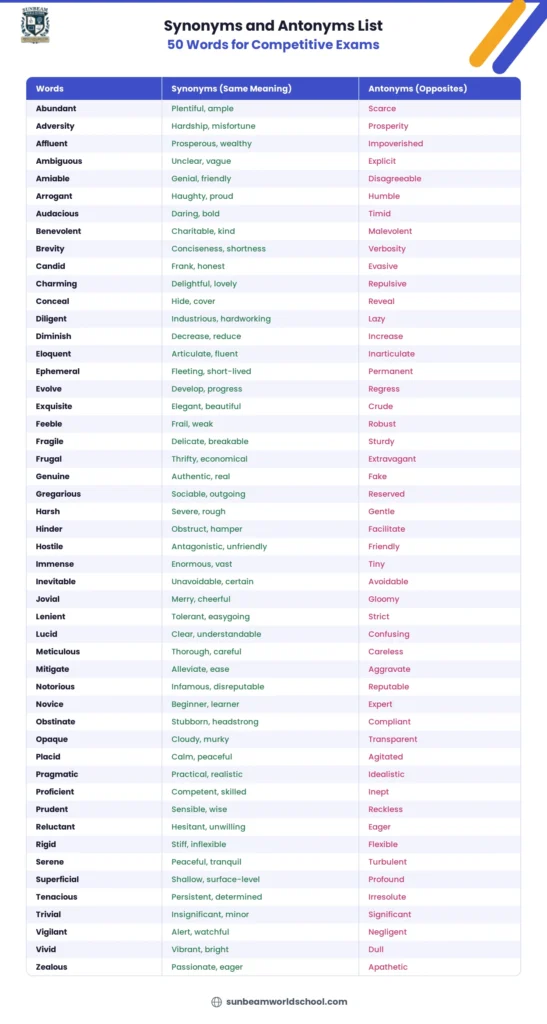
50 advanced words with their synonyms and antonyms, a quick revision chart for competitive exams.
What Are Synonyms and Antonyms?
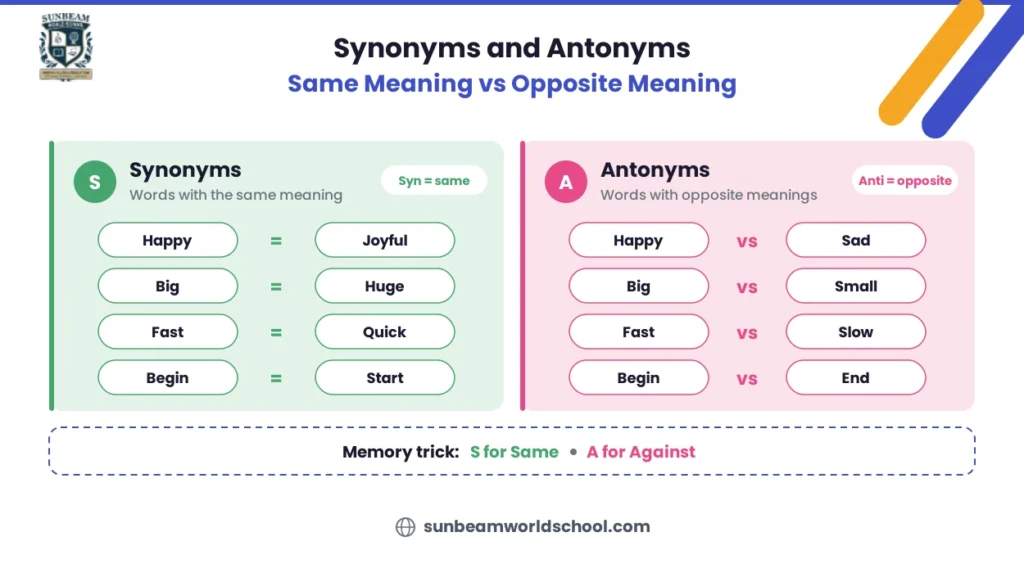
Synonyms share the same meaning, while antonyms have opposite meanings.
Synonyms and antonyms are word pairs that describe how two words relate in meaning: synonyms mean the same (big and large), while antonyms mean the opposite (big and small). Both are basic building blocks of English vocabulary.
The two terms come from Greek. "Synonym" joins syn (together or same) with onyma (name), so it literally means "same name," while "antonym" joins anti (against or opposite) with onyma, meaning "opposite name." Remembering these roots is the quickest way to stop mixing the two words up, since "syn" sounds like "same" and "anti" means "against."
What Is a Synonym and Antonym?
A synonym is a word that means the same as another word, and an antonym is a word that means the opposite of another word. For the word "fast," quick is a synonym and slow is an antonym.
People search this in many ways, such as "what is an antonyms and synonyms" or "what is antonyms and synonyms meaning," but the answer is always the same: synonyms share meaning and antonyms reverse it. Most English words have several synonyms, while many, though not all, have at least one clear antonym.
What Are Synonyms?
Synonyms are words that have the same or nearly the same meaning as another word, such as begin and start, or smart and clever. They let you say the same idea in different ways without repeating yourself.
Synonyms are useful because English often has three or four words for one idea, each with a slightly different feel. "Walk," "stroll," "march" and "wander" all describe moving on foot, but each paints a different picture. Choosing the right synonym makes writing clearer, more precise and more interesting to read.
What Does Synonym Mean?
Synonym means a word or phrase that has the same, or almost the same, meaning as another word in the same language. For example, "happy" is a synonym of "glad," and "close" is a synonym of "shut."
Put simply, the synonym meaning is "a same meaning word." A synonym does not always fit every sentence the original word fits. "Big" and "large" are synonyms, yet we say "my big sister" and not "my large sister," so it always helps to check that a synonym sounds natural in context.
Synonym Definition
The standard synonym definition, or definition of synonym, is "a word having the same or nearly the same meaning as another word in the same language." So a synonym of a word can replace it in a sentence without changing the overall meaning.
This synonym definition has two key parts. First, the meaning must match closely, and second, both words must belong to the same language, which is why "house" and the Hindi word "ghar" are translations rather than synonyms.
Synonyms Examples
Common synonyms examples include happy and joyful, big and huge, fast and quick, and begin and start. The table below shows more examples of synonyms with two choices for each word.
| Word | Synonyms |
|---|---|
| Happy | Joyful, cheerful |
| Big | Huge, large |
| Fast | Quick, rapid |
| Smart | Clever, intelligent |
| Begin | Start, commence |
| Angry | Furious, annoyed |
| Brave | Courageous, bold |
| Tired | Exhausted, sleepy |
| Beautiful | Pretty, lovely |
| Help | Assist, support |
What Is an Antonym?
An antonym is a word that means the opposite of another word, such as hot and cold, or up and down. Antonyms show contrast, which helps readers understand an idea by seeing what it is not.
Antonyms are everywhere in daily speech, from "open" and "closed" signs on shop doors to "push" and "pull" labels on gates. Many antonyms are also formed simply by adding a prefix, so happy becomes unhappy and possible becomes impossible.
Antonyms Examples
Common antonyms examples include hot and cold, happy and sad, begin and end, and buy and sell. The table below gives more examples of antonyms across different types of words.
| Word | Antonym |
|---|---|
| Hot | Cold |
| Happy | Sad |
| Begin | End |
| Buy | Sell |
| Arrive | Depart |
| Accept | Reject |
| Generous | Selfish |
| Ancient | Modern |
| Victory | Defeat |
| Include | Exclude |
What Is the Difference Between Synonyms and Antonyms?
The difference between synonyms and antonyms is that synonyms are words with the same meaning (big, large), while antonyms are words with opposite meanings (big, small). Synonyms replace a word, and antonyms contrast with it.
| Feature | Synonyms | Antonyms |
|---|---|---|
| Meaning | Same or similar meaning | Opposite meaning |
| Greek root | Syn = same | Anti = opposite |
| Purpose | Avoid repetition, add variety | Show contrast |
| Example with "happy" | Joyful, cheerful | Sad, unhappy |
| Example with "fast" | Quick, rapid | Slow |
| Formed with prefixes? | Rarely | Often (un-, dis-, in-, im-) |
| Found in a thesaurus? | Yes, listed first | Yes, usually listed after synonyms |
When comparing synonym vs antonym, a simple memory trick is "S for Same, A for Against." Synonym starts with S like same, and antonym starts with A like against.
What Is the Opposite of Synonym?
The opposite of synonym is antonym. A synonym is a word with the same meaning, so a word with the opposite meaning, an antonym, is its natural opposite.
What Is the Synonym of Antonym?
The closest synonym of antonym is "opposite," as in "opposite word." Some linguists also use "counterterm," but in everyday English, "opposite" is the most natural word to use.
What Are the Types of Synonyms?
There are three main types of synonyms: absolute synonyms (exactly the same), partial synonyms (the same in some contexts) and near synonyms (similar but different in tone).
Absolute Synonyms
Absolute synonyms are words that mean exactly the same thing and can replace each other in every sentence, such as car and automobile. They are very rare, because over time most word pairs develop small differences in use.
Partial Synonyms
Partial synonyms are words that share a meaning in some contexts but not in others, such as big and large. "A big house" and "a large house" mean the same, but "a big decision" sounds natural while "a large decision" does not.
Near Synonyms
Near synonyms are words with similar meanings but different feelings, such as slim and skinny. "Slim" sounds positive, while "skinny" can sound negative, so choosing between them changes the tone of a sentence.
What Are the Types of Antonyms?
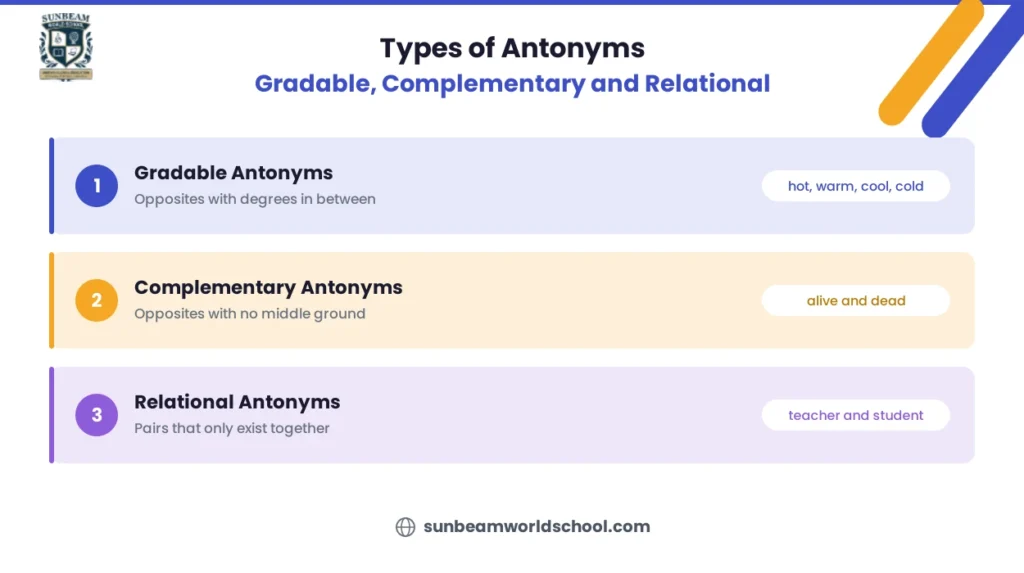
The three types of antonyms are gradable, complementary and relational
There are three main types of antonyms: gradable antonyms (hot and cold), complementary antonyms (alive and dead) and relational antonyms (teacher and student). Each type shows opposition in a different way.
[Image: types-of-antonyms.webp, three cards showing gradable, complementary and relational antonyms with examples. Alt text: "Types of antonyms: gradable, complementary and relational with examples"]
Gradable Antonyms
Gradable antonyms are opposites with degrees in between, such as hot and cold, where warm and cool sit in the middle. Other examples include big and small, happy and sad, and old and young.
Complementary Antonyms
Complementary antonyms are opposites with no middle ground, such as alive and dead, or on and off. If one is true, the other must be false, so a light cannot be half on in this sense.
Relational Antonyms
Relational antonyms are pairs that only make sense together, such as teacher and student, buy and sell, or parent and child. Each word describes one side of the same relationship, so you cannot have one without the other.
Synonyms and Antonyms List
This synonyms and antonyms list gives 100 words with their synonyms and meanings, plus one antonym each, split into everyday words for younger learners and advanced words for competitive exams. It works as a quick list of synonyms and a list of antonyms in one place.
Synonyms and Antonyms for Kids
The 50 synonyms and antonyms for kids below use common everyday words that students meet in primary and middle school reading.
| Word | Meaning | Synonym | Antonym |
|---|---|---|---|
| Happy | Feeling pleased | Joyful | Sad |
| Big | Large in size | Huge | Small |
| Fast | Moving quickly | Quick | Slow |
| Begin | To start | Commence | End |
| Brave | Not afraid | Courageous | Cowardly |
| Rich | Having a lot of money | Wealthy | Poor |
| Hot | Very warm | Scorching | Cold |
| Easy | Not difficult | Simple | Hard |
| Beautiful | Pleasing to look at | Pretty | Ugly |
| Clean | Free from dirt | Spotless | Dirty |
| Strong | Having power | Powerful | Weak |
| Smart | Quick to learn | Clever | Foolish |
| Old | Having lived long | Elderly | Young |
| Loud | Making a lot of noise | Noisy | Quiet |
| Polite | Well-mannered | Courteous | Rude |
| Laugh | Make sounds of joy | Giggle | Cry |
| Love | A strong liking | Adore | Hate |
| Friend | Someone you like and trust | Companion | Enemy |
| Early | Before the expected time | Prompt | Late |
| Full | Holding as much as possible | Packed | Empty |
| Shout | Speak very loudly | Yell | Whisper |
| Open | Not closed | Unlocked | Closed |
| True | Correct | Accurate | False |
| Kind | Caring towards others | Gentle | Cruel |
| Bright | Full of light | Shiny | Dim |
| Accept | Agree to take | Receive | Reject |
| Arrive | Reach a place | Reach | Depart |
| Increase | Become larger | Grow | Decrease |
| Remember | Keep in mind | Recall | Forget |
| Buy | Pay for something | Purchase | Sell |
| Win | Come first | Triumph | Lose |
| Give | Hand over | Donate | Take |
| Tired | Needing rest | Exhausted | Energetic |
| Wet | Covered with water | Damp | Dry |
| Heavy | Weighing a lot | Weighty | Light |
| Sharp | Having a fine edge | Pointed | Blunt |
| Safe | Free from danger | Secure | Dangerous |
| Calm | Not worried or excited | Relaxed | Nervous |
| Inside | In the inner part | Within | Outside |
| Push | Press away from you | Shove | Pull |
| Near | Close by | Close | Far |
| Rough | Not smooth | Bumpy | Smooth |
| Sweet | Tasting of sugar | Sugary | Bitter |
| Truth | What is real | Fact | Lie |
| Victory | Winning a contest | Success | Defeat |
| Hope | Wish for something | Wish | Despair |
| Include | Make something part of a group | Contain | Exclude |
| Expand | Become bigger | Enlarge | Contract |
| Generous | Happy to give | Giving | Selfish |
| Ancient | Very old | Antique | Modern |
Synonyms and Antonyms for Competitive Exams
The 50 advanced synonyms and antonyms below are the kind of words that appear in vocabulary sections of competitive exams such as SSC, banking, CAT, GRE and SAT.
| Word | Meaning | Synonym | Antonym |
|---|---|---|---|
| Evolve | Develop gradually | Develop | Regress |
| Ambiguous | Having more than one meaning | Unclear | Explicit |
| Harsh | Cruel or severe | Severe | Gentle |
| Charming | Very pleasant or attractive | Delightful | Repulsive |
| Abundant | Existing in large amounts | Plentiful | Scarce |
| Benevolent | Kind and generous | Charitable | Malevolent |
| Candid | Honest and direct | Frank | Evasive |
| Diligent | Hardworking and careful | Industrious | Lazy |
| Eloquent | Fluent and persuasive in speech | Articulate | Inarticulate |
| Frugal | Careful with money | Thrifty | Extravagant |
| Gregarious | Fond of company | Sociable | Reserved |
| Hostile | Unfriendly | Antagonistic | Friendly |
| Inevitable | Certain to happen | Unavoidable | Avoidable |
| Jovial | Cheerful and friendly | Merry | Gloomy |
| Lucid | Clear and easy to understand | Clear | Confusing |
| Meticulous | Very careful with details | Thorough | Careless |
| Notorious | Famous for something bad | Infamous | Reputable |
| Obstinate | Refusing to change one's mind | Stubborn | Compliant |
| Pragmatic | Dealing with things practically | Practical | Idealistic |
| Prudent | Wise and careful | Sensible | Reckless |
| Reluctant | Unwilling | Hesitant | Eager |
| Serene | Calm and peaceful | Peaceful | Turbulent |
| Tenacious | Not giving up easily | Persistent | Irresolute |
| Trivial | Of little importance | Insignificant | Significant |
| Vivid | Bright and clear | Vibrant | Dull |
| Zealous | Full of enthusiasm | Passionate | Apathetic |
| Adversity | Difficulty or misfortune | Hardship | Prosperity |
| Affluent | Wealthy | Prosperous | Impoverished |
| Amiable | Friendly and pleasant | Genial | Disagreeable |
| Arrogant | Too proud of oneself | Haughty | Humble |
| Audacious | Bold and daring | Daring | Timid |
| Brevity | Shortness of speech or writing | Conciseness | Verbosity |
| Conceal | Keep hidden | Hide | Reveal |
| Diminish | Become less | Decrease | Increase |
| Exquisite | Extremely beautiful | Elegant | Crude |
| Feeble | Very weak | Frail | Robust |
| Fragile | Easily broken | Delicate | Sturdy |
| Genuine | Real, not fake | Authentic | Fake |
| Hinder | Slow down or block | Obstruct | Facilitate |
| Immense | Extremely large | Enormous | Tiny |
| Lenient | Not strict | Tolerant | Strict |
| Mitigate | Make less severe | Alleviate | Aggravate |
| Novice | A beginner | Beginner | Expert |
| Opaque | Not see-through | Cloudy | Transparent |
| Placid | Calm and not easily upset | Calm | Agitated |
| Proficient | Skilled | Competent | Inept |
| Rigid | Stiff and not bending | Stiff | Flexible |
| Superficial | On the surface only | Shallow | Profound |
| Vigilant | Watchful | Alert | Negligent |
| Ephemeral | Lasting a very short time | Fleeting | Permanent |
How Do You Use Synonyms and Antonyms in a Sentence?
You use a synonym in a sentence by replacing a word with one of the same meaning, and an antonym by switching to the opposite meaning. For example, "The test was easy" becomes "The test was simple" (synonym) or "The test was hard" (antonym).
Seeing words in sentences is the best way to learn how they actually behave. The examples below show synonyms in a sentence and antonyms in a sentence side by side.
| Original Sentence | With a Synonym | With an Antonym |
|---|---|---|
| The puppy is small. | The puppy is tiny. | The puppy is big. |
| She gave a brave speech. | She gave a courageous speech. | She gave a timid speech. |
| The road is wide. | The road is broad. | The road is narrow. |
| He was happy with his result. | He was delighted with his result. | He was disappointed with his result. |
| The water is cold. | The water is chilly. | The water is hot. |
| Riya arrived early. | Riya reached early. | Riya left early. |
A good habit is to read the new sentence aloud and check that it still sounds natural, because a synonym that fits the meaning may still sound odd in a particular phrase.
How Are Synonyms, Antonyms and Homonyms Different?
Synonyms share meaning, antonyms have opposite meanings, and homonyms share the same spelling or sound but have different meanings, such as "bat" (the animal) and "bat" (used in cricket). Homophones and homographs are two special kinds of homonyms.
| Word Type | What It Means | Example |
|---|---|---|
| Synonyms | Different words, same meaning | Fast and quick |
| Antonyms | Different words, opposite meaning | Fast and slow |
| Homonyms | Same spelling or sound, different meaning | Bat (animal) and bat (cricket) |
| Homophones | Same sound, different spelling and meaning | Their, there and they're |
| Homographs | Same spelling, different sound and meaning | Lead (to guide) and lead (a metal) |
Students often study synonyms, antonyms and homonyms together, because all three describe how words relate to each other and all three appear in school grammar exercises.
How to Find Synonyms and Antonyms?
You find synonyms and antonyms by using a thesaurus, checking a dictionary's word entries, or forming antonyms with prefixes such as un-, dis-, in- and im-. Each method works best for a different situation.
Using a Thesaurus
A thesaurus is a reference book or website listing synonyms and antonyms for each word, and the best-known one, Roget's Thesaurus, was first published in 1852. It was compiled by Peter Mark Roget, and most thesaurus entries list synonyms first and antonyms after them.
When using a thesaurus, always check the meaning of an unfamiliar synonym before using it, because thesauruses group words by general idea rather than exact meaning. Looking a new word up in a dictionary, or reading it in an example sentence, prevents awkward choices.
Forming Antonyms With Prefixes
Many antonyms are formed by adding a prefix to the start of a word, such as un- (happy, unhappy), dis- (honest, dishonest), in- (complete, incomplete) and im- (possible, impossible). This is one of the quickest ways to build vocabulary.
| Prefix | Example | Antonym |
|---|---|---|
| un- | Kind | Unkind |
| dis- | Agree | Disagree |
| in- | Correct | Incorrect |
| im- (before p, b, m) | Patient | Impatient |
| il- (before l) | Legal | Illegal |
| ir- (before r) | Regular | Irregular |
| non- | Fiction | Nonfiction |
Some antonyms are formed with suffixes too, such as careful and careless, or useful and useless, where -ful and -less flip the meaning.
Why Are Synonyms and Antonyms Important?
Synonyms and antonyms are important because they help students avoid repeated words, understand difficult texts and score marks in vocabulary sections of school and competitive exams.
They improve writing. Swapping a repeated word for a fitting synonym keeps essays and stories fresh, and using antonyms helps show contrast, such as "the morning was calm, but the evening was stormy."
They improve reading. When a student meets an unknown word, nearby synonyms or antonyms in the same sentence often reveal its meaning, which is a skill called using context clues.
They help in exams. Questions asking students to choose a synonym or an antonym are a standard part of English vocabulary sections, so a strong word bank directly adds marks.
How Can Students Learn Synonyms and Antonyms Easily?
Students learn synonyms and antonyms most easily by learning words in groups of three (word, synonym, antonym), reading daily and using new words in their own sentences within 24 hours. Small, regular practice works far better than memorising long lists.
Learn Words in Families
Learning words in families means studying each new word with its synonyms and antonyms at the same time, such as brave, courageous and cowardly. This builds three connected memories instead of one, so each word helps you recall the others.
Read a Little Every Day
Reading for 15 to 20 minutes a day exposes students to new words in real sentences, which shows how synonyms differ in tone and use. Keeping a small notebook to jot down new words and their opposites turns reading into vocabulary practice.
Use Every New Word Within a Day
Using a new word in a sentence within 24 hours, whether spoken or written, makes it far more likely to stick. This kind of active recall, also part of the habits in how to become a top 1% student, beats rereading a list many times.
Synonyms and Antonyms Exercises With Answers
These seven synonyms and antonyms exercises with answers move from easy to harder, covering multiple choice, fill in the blanks, matching, odd one out, prefixes and sentence rewriting. Try each one before checking the answer key at the end.
Exercise 1: Choose the Correct Synonym
Choose the word that means the same as the word in bold.
- Brave: (a) timid (b) courageous (c) weak (d) shy
- Ancient: (a) modern (b) old (c) new (d) young
- Ambiguous: (a) clear (b) unclear (c) certain (d) simple
- Evolve: (a) develop (b) shrink (c) stop (d) destroy
- Harsh: (a) gentle (b) severe (c) soft (d) kind
Exercise 2: Choose the Correct Antonym
Choose the word that means the opposite of the word in bold.
- Generous: (a) kind (b) selfish (c) giving (d) noble
- Expand: (a) grow (b) contract (c) widen (d) spread
- Charming: (a) pleasant (b) delightful (c) repulsive (d) lovely
- Victory: (a) win (b) triumph (c) defeat (d) success
- Ancient: (a) old (b) modern (c) aged (d) antique
Exercise 3: Fill in the Blanks With a Synonym or Antonym
Fill in each blank with the type of word shown in brackets.
- The movie was not boring; it was very ______. (antonym of boring)
- Riya was glad, or ______, to see her grandmother. (synonym of glad)
- The test was easy, not ______. (antonym of easy)
- The elephant was huge, truly ______. (synonym of huge)
- The library is quiet, not ______. (antonym of quiet)
Exercise 4: Match the Words With Their Opposites
Match each word in Column A with its antonym in Column B.
| Column A | Column B |
|---|---|
| 1. Accept | (a) Depart |
| 2. Arrive | (b) Exclude |
| 3. Increase | (c) Reject |
| 4. Hope | (d) Despair |
| 5. Include | (e) Decrease |
Exercise 5: Find the Odd One Out
In each group, three words are synonyms and one is an antonym. Find the odd one out.
- happy, joyful, cheerful, miserable
- big, large, tiny, huge
- quick, fast, rapid, slow
- smart, clever, foolish, intelligent
- begin, start, commence, finish
Exercise 6: Make the Antonym by Adding a Prefix
Add un-, dis-, im-, il- or in- to make the antonym of each word.
- Happy
- Honest
- Possible
- Legal
- Complete
Exercise 7: Rewrite the Sentence Using an Antonym
Rewrite each sentence by replacing the word in bold with its antonym.
- The room is dark.
- She arrived early.
- The bag is heavy.
- He is a strong swimmer.
- The shop opens at 9 am.
Answer Key
Exercise 1: 1 (b) courageous, 2 (b) old, 3 (b) unclear, 4 (a) develop, 5 (b) severe
Exercise 2: 1 (b) selfish, 2 (b) contract, 3 (c) repulsive, 4 (c) defeat, 5 (b) modern
Exercise 3: 1 exciting, 2 happy, 3 difficult, 4 enormous, 5 noisy
Exercise 4: 1 (c) reject, 2 (a) depart, 3 (e) decrease, 4 (d) despair, 5 (b) exclude
Exercise 5: 1 miserable, 2 tiny, 3 slow, 4 foolish, 5 finish
Exercise 6: 1 unhappy, 2 dishonest, 3 impossible, 4 illegal, 5 incomplete
Exercise 7: 1 The room is bright. 2 She arrived late. 3 The bag is light. 4 He is a weak swimmer. 5 The shop closes at 9 am.
What Are Some Fun Synonyms and Antonyms Games?
Fun synonyms and antonyms games include Synonym Chain, Antonym Snap, Word Map and Thesaurus Treasure Hunt, each taking 10 to 15 minutes with no special materials.
Synonym Chain
Synonym Chain is a turn-taking game where each player adds a synonym to a starting word, such as happy, glad, cheerful, joyful. A player who repeats a word or cannot think of one is out, and the last player left wins the round.
Antonym Snap
Antonym Snap is a quick card game where one player shows a word card and the first person to call out its correct opposite wins the card. Making the cards together beforehand doubles as extra vocabulary practice.
Word Map
A Word Map is a drawing activity with one word in the centre of a page, synonyms on the left and antonyms on the right. Students then write three sentences using words from the map, and it works especially well for visual learners.
Thesaurus Treasure Hunt
Thesaurus Treasure Hunt asks students to pick five plain words, such as good, nice or said, from a storybook and replace each with a stronger synonym from a thesaurus. Reading the rewritten passage aloud shows how much richer the writing becomes.
Conclusion
Every word you learn can bring two more with it, its synonym and its antonym, so learning words in families turns every new word into three. Start today by picking five words from the list above, writing a sentence for each word, its synonym and its antonym, then try all seven exercises without peeking at the answers. If you would like a live teacher to guide you through English vocabulary at your own pace, explore personalized learning at Sunbeam World School.

Frequently Asked Questions
What is a synonym for synonym?
-A synonym for synonym is "equivalent," as in an equivalent word, and other options include "alternative word" and "substitute." There is also a rare technical term, poecilonym, but in everyday English most people simply say "a word with the same meaning."
What is an antonym for antonym?
+What are the synonyms and antonyms of evolve?
+What are the synonyms and antonyms of ambiguous?
+What is another word for harsh?
+Can a word have more than one synonym or antonym?
+What is the opposite of synonymous?
+What are 10 examples of synonym?
+
In this article
Share this post:


Press and Blogs
Stay updated with our press releases, educational blogs, and more.
Quick Summary The periodic table of elements is a chart of all 118 known chemical...
Quick Summary The area of a circle is equal to πr², where r is the...
Quick Summary Common words that start with V include very, visit, voice, value, vase, van,...