 Digital Learning
Periodic Table of Elements: Groups, Periods and Chart
Quick Summary The periodic table of elements is a chart of all 118 known chemical elements, arranged in order of increasing atomic number in 7 horizontal rows called periods and 18 vertical columns called groups. Elements in the same group share similar chemical properties because they have the same number of valence electrons, which is why the table can predict how an element will behave.
The periodic table is the single most useful chart in chemistry, because one page tells you the name, symbol, atomic number and atomic mass of every element, along with clues about how each one reacts. Whether you call it the periodic table of elements, the table of elements, the element table, the elements table, the periodic table chart or simply the chemistry chart, it is the same tool, and learning to read it makes topics like chemical bonding, formulas and reactions far easier.
This guide covers a labeled periodic table, the full list of 118 elements with names and symbols, how the table is organized, how to read an element, groups, periods, families, metals and nonmetals, blocks, electron configuration, the first 20 elements, periodic trends and simple ways to learn it all. The periodic table image below shows the periodic table labeled with every group, period and element category.
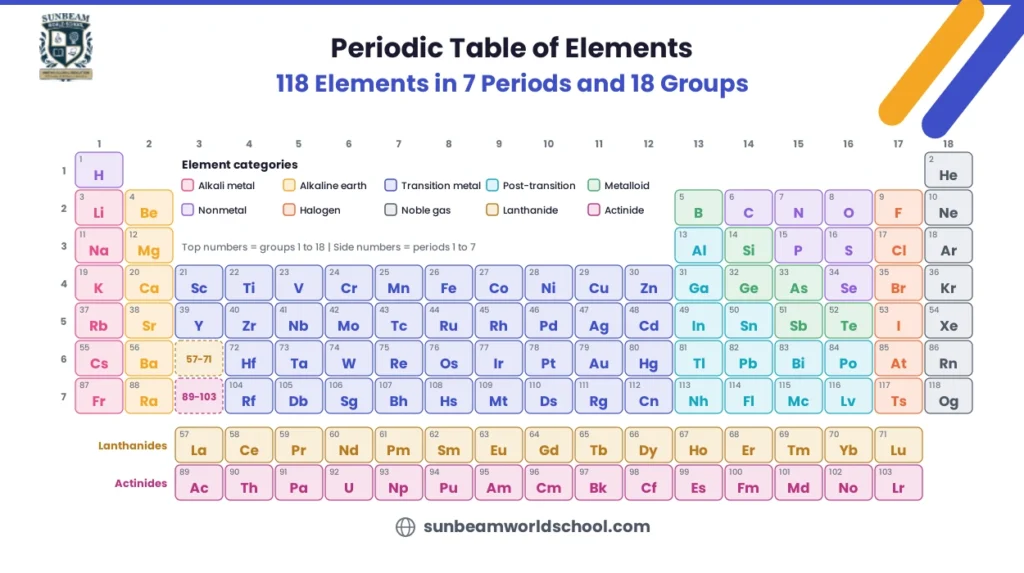
The periodic table of elements, with all 118 elements in 7 periods and 18 groups, color-coded by element type.
What Is the Periodic Table?
The periodic table is a chart that arranges all 118 known chemical elements by increasing atomic number, so that elements with similar properties line up in the same column. The word "periodic" means that these properties repeat at regular intervals as the atomic number goes up.
A simple periodic table definition is "an ordered table of the chemical elements, organised by atomic number, electron arrangement and repeating chemical properties." Each box in the table holds one element, and its position tells you a great deal about it, such as whether it is a metal, how many electrons sit in its outer shell and which other elements it behaves like. Chemists, doctors, engineers and students all use the same chart, which is why it hangs on the wall of almost every science classroom in the world.
What Is the Periodic Table of Elements Used For?
The periodic table of elements is used to look up basic data about any element and to predict how elements will react, bond and form compounds. For example, knowing that sodium is in group 1 tells you it loses one electron easily and reacts strongly with water, even before you look it up.
What Does a Labeled Periodic Table Look Like?
A labeled periodic table shows 18 numbered groups across the top, 7 numbered periods down the side, and two separate rows at the bottom for the lanthanides and actinides. Most labeled versions also colour code each element by type, such as alkali metals, transition metals, metalloids, halogens and noble gases.
The main body of a complete periodic table has a tall column on the left (groups 1 and 2), a lower middle section (groups 3 to 12) and a stepped block on the right (groups 13 to 18). The two rows at the bottom actually belong in periods 6 and 7, but they are pulled out so that the chart fits neatly on a page instead of stretching 32 columns wide. A zigzag "staircase" line near the right side separates the metals on the left from the nonmetals on the right, with the metalloids sitting along that line.
[Image: periodic-table-color-coded.webp, colour coded periodic table with a legend for each element family. Alt text: "Color coded periodic table showing element families"]
How Many Elements Are in the Periodic Table?
The periodic table has 118 elements, from hydrogen (atomic number 1) to oganesson (atomic number 118). Of these, 94 occur naturally on Earth, while the remaining 24 have only been made in laboratories.
The seventh period was completed in 2016, when the International Union of Pure and Applied Chemistry (IUPAC) officially named the last four elements: nihonium (113), moscovium (115), tennessine (117) and oganesson (118). Scientists are still trying to make element 119 and beyond, which would start an eighth period, but none has been confirmed so far.
Periodic Table List of 118 Elements With Names and Symbols
This periodic table of elements list gives all 118 elements and their symbols, arranged as a periodic table of elements by atomic number, so it doubles as a periodic table with names and symbols and a full list of elements. Each row also shows the element's atomic mass, group and period. Atomic masses in square brackets are the mass numbers of the most stable known isotope, used for radioactive elements that have no fixed natural atomic mass, and these values can differ slightly between sources.
| Atomic Number | Symbol | Element Name | Atomic Mass (u) | Group | Period |
|---|---|---|---|---|---|
| 1 | H | Hydrogen | 1.008 | 1 | 1 |
| 2 | He | Helium | 4.003 | 18 | 1 |
| 3 | Li | Lithium | 6.94 | 1 | 2 |
| 4 | Be | Beryllium | 9.012 | 2 | 2 |
| 5 | B | Boron | 10.81 | 13 | 2 |
| 6 | C | Carbon | 12.011 | 14 | 2 |
| 7 | N | Nitrogen | 14.007 | 15 | 2 |
| 8 | O | Oxygen | 15.999 | 16 | 2 |
| 9 | F | Fluorine | 18.998 | 17 | 2 |
| 10 | Ne | Neon | 20.18 | 18 | 2 |
| 11 | Na | Sodium | 22.99 | 1 | 3 |
| 12 | Mg | Magnesium | 24.305 | 2 | 3 |
| 13 | Al | Aluminium | 26.982 | 13 | 3 |
| 14 | Si | Silicon | 28.085 | 14 | 3 |
| 15 | P | Phosphorus | 30.974 | 15 | 3 |
| 16 | S | Sulfur | 32.06 | 16 | 3 |
| 17 | Cl | Chlorine | 35.45 | 17 | 3 |
| 18 | Ar | Argon | 39.95 | 18 | 3 |
| 19 | K | Potassium | 39.098 | 1 | 4 |
| 20 | Ca | Calcium | 40.078 | 2 | 4 |
| 21 | Sc | Scandium | 44.956 | 3 | 4 |
| 22 | Ti | Titanium | 47.867 | 4 | 4 |
| 23 | V | Vanadium | 50.941 | 5 | 4 |
| 24 | Cr | Chromium | 51.996 | 6 | 4 |
| 25 | Mn | Manganese | 54.938 | 7 | 4 |
| 26 | Fe | Iron | 55.845 | 8 | 4 |
| 27 | Co | Cobalt | 58.933 | 9 | 4 |
| 28 | Ni | Nickel | 58.693 | 10 | 4 |
| 29 | Cu | Copper | 63.546 | 11 | 4 |
| 30 | Zn | Zinc | 65.38 | 12 | 4 |
| 31 | Ga | Gallium | 69.723 | 13 | 4 |
| 32 | Ge | Germanium | 72.63 | 14 | 4 |
| 33 | As | Arsenic | 74.922 | 15 | 4 |
| 34 | Se | Selenium | 78.971 | 16 | 4 |
| 35 | Br | Bromine | 79.904 | 17 | 4 |
| 36 | Kr | Krypton | 83.798 | 18 | 4 |
| 37 | Rb | Rubidium | 85.468 | 1 | 5 |
| 38 | Sr | Strontium | 87.62 | 2 | 5 |
| 39 | Y | Yttrium | 88.906 | 3 | 5 |
| 40 | Zr | Zirconium | 91.224 | 4 | 5 |
| 41 | Nb | Niobium | 92.906 | 5 | 5 |
| 42 | Mo | Molybdenum | 95.95 | 6 | 5 |
| 43 | Tc | Technetium | [98] | 7 | 5 |
| 44 | Ru | Ruthenium | 101.07 | 8 | 5 |
| 45 | Rh | Rhodium | 102.905 | 9 | 5 |
| 46 | Pd | Palladium | 106.42 | 10 | 5 |
| 47 | Ag | Silver | 107.868 | 11 | 5 |
| 48 | Cd | Cadmium | 112.414 | 12 | 5 |
| 49 | In | Indium | 114.818 | 13 | 5 |
| 50 | Sn | Tin | 118.71 | 14 | 5 |
| 51 | Sb | Antimony | 121.76 | 15 | 5 |
| 52 | Te | Tellurium | 127.6 | 16 | 5 |
| 53 | I | Iodine | 126.904 | 17 | 5 |
| 54 | Xe | Xenon | 131.293 | 18 | 5 |
| 55 | Cs | Caesium | 132.905 | 1 | 6 |
| 56 | Ba | Barium | 137.327 | 2 | 6 |
| 57 | La | Lanthanum | 138.905 | Lanthanide | 6 |
| 58 | Ce | Cerium | 140.116 | Lanthanide | 6 |
| 59 | Pr | Praseodymium | 140.908 | Lanthanide | 6 |
| 60 | Nd | Neodymium | 144.242 | Lanthanide | 6 |
| 61 | Pm | Promethium | [145] | Lanthanide | 6 |
| 62 | Sm | Samarium | 150.36 | Lanthanide | 6 |
| 63 | Eu | Europium | 151.964 | Lanthanide | 6 |
| 64 | Gd | Gadolinium | 157.25 | Lanthanide | 6 |
| 65 | Tb | Terbium | 158.925 | Lanthanide | 6 |
| 66 | Dy | Dysprosium | 162.5 | Lanthanide | 6 |
| 67 | Ho | Holmium | 164.93 | Lanthanide | 6 |
| 68 | Er | Erbium | 167.259 | Lanthanide | 6 |
| 69 | Tm | Thulium | 168.934 | Lanthanide | 6 |
| 70 | Yb | Ytterbium | 173.045 | Lanthanide | 6 |
| 71 | Lu | Lutetium | 174.967 | Lanthanide | 6 |
| 72 | Hf | Hafnium | 178.486 | 4 | 6 |
| 73 | Ta | Tantalum | 180.948 | 5 | 6 |
| 74 | W | Tungsten | 183.84 | 6 | 6 |
| 75 | Re | Rhenium | 186.207 | 7 | 6 |
| 76 | Os | Osmium | 190.23 | 8 | 6 |
| 77 | Ir | Iridium | 192.217 | 9 | 6 |
| 78 | Pt | Platinum | 195.084 | 10 | 6 |
| 79 | Au | Gold | 196.967 | 11 | 6 |
| 80 | Hg | Mercury | 200.592 | 12 | 6 |
| 81 | Tl | Thallium | 204.38 | 13 | 6 |
| 82 | Pb | Lead | 207.2 | 14 | 6 |
| 83 | Bi | Bismuth | 208.98 | 15 | 6 |
| 84 | Po | Polonium | [209] | 16 | 6 |
| 85 | At | Astatine | [210] | 17 | 6 |
| 86 | Rn | Radon | [222] | 18 | 6 |
| 87 | Fr | Francium | [223] | 1 | 7 |
| 88 | Ra | Radium | [226] | 2 | 7 |
| 89 | Ac | Actinium | [227] | Actinide | 7 |
| 90 | Th | Thorium | 232.038 | Actinide | 7 |
| 91 | Pa | Protactinium | 231.036 | Actinide | 7 |
| 92 | U | Uranium | 238.029 | Actinide | 7 |
| 93 | Np | Neptunium | [237] | Actinide | 7 |
| 94 | Pu | Plutonium | [244] | Actinide | 7 |
| 95 | Am | Americium | [243] | Actinide | 7 |
| 96 | Cm | Curium | [247] | Actinide | 7 |
| 97 | Bk | Berkelium | [247] | Actinide | 7 |
| 98 | Cf | Californium | [251] | Actinide | 7 |
| 99 | Es | Einsteinium | [252] | Actinide | 7 |
| 100 | Fm | Fermium | [257] | Actinide | 7 |
| 101 | Md | Mendelevium | [258] | Actinide | 7 |
| 102 | No | Nobelium | [259] | Actinide | 7 |
| 103 | Lr | Lawrencium | [266] | Actinide | 7 |
| 104 | Rf | Rutherfordium | [267] | 4 | 7 |
| 105 | Db | Dubnium | [268] | 5 | 7 |
| 106 | Sg | Seaborgium | [269] | 6 | 7 |
| 107 | Bh | Bohrium | [270] | 7 | 7 |
| 108 | Hs | Hassium | [269] | 8 | 7 |
| 109 | Mt | Meitnerium | [278] | 9 | 7 |
| 110 | Ds | Darmstadtium | [281] | 10 | 7 |
| 111 | Rg | Roentgenium | [282] | 11 | 7 |
| 112 | Cn | Copernicium | [285] | 12 | 7 |
| 113 | Nh | Nihonium | [286] | 13 | 7 |
| 114 | Fl | Flerovium | [289] | 14 | 7 |
| 115 | Mc | Moscovium | [290] | 15 | 7 |
| 116 | Lv | Livermorium | [293] | 16 | 7 |
| 117 | Ts | Tennessine | [294] | 17 | 7 |
| 118 | Og | Oganesson | [294] | 18 | 7 |
The atomic mass in this periodic table with atomic masses is given in unified atomic mass units (u), and the same number in grams per mole is the element's molar mass. So a periodic table with molar mass is really the same chart read in g/mol, which means carbon's atomic mass of 12.011 u gives a molar mass of 12.011 g/mol.
How Is the Periodic Table Organized?
The periodic table is organized by increasing atomic number from left to right, with a new row starting each time a new electron shell begins to fill. This places elements with the same number of outer electrons, and therefore similar properties, in the same vertical column.
Three ideas hold the whole layout together. Periods (rows) show how many electron shells an atom has, groups (columns) show elements with matching outer electron patterns, and blocks show which type of orbital, s, p, d or f, is being filled. Because of this, the table is not a random list, it is a map in which an element's address alone tells you much of its chemistry.
How Are Elements Arranged in the Periodic Table?
Elements are arranged in the periodic table in order of atomic number, which is the number of protons in each atom's nucleus. Hydrogen, with 1 proton, comes first, helium with 2 protons comes second, and so on up to oganesson with 118 protons.
This arrangement follows the modern periodic law, which says that the properties of elements are a periodic function of their atomic numbers. Henry Moseley showed in 1913 that atomic number, not atomic mass, is the true basis of the table, and this fixed a few places where ordering by mass had put elements in the wrong spot, such as argon (39.95 u), which is heavier than potassium (39.098 u) but belongs before it.
What Is Mendeleev's Periodic Table?
Mendeleev's periodic table is the 1869 table by Russian chemist Dmitri Mendeleev, which arranged the 63 elements then known by increasing atomic mass. It was the first widely accepted periodic table, and he grouped elements with similar properties together and left gaps for elements that had not yet been discovered.
What made the Mendeleev periodic table stand out was that he used those gaps to predict new elements and their properties. He described "eka-aluminium" and "eka-silicon" in detail, and when gallium (1875) and germanium (1886) were discovered, their properties closely matched his predictions. This is why Mendeleev is often called the father of the periodic table, even though the modern version is based on atomic number rather than atomic mass.
How to Read a Periodic Table?
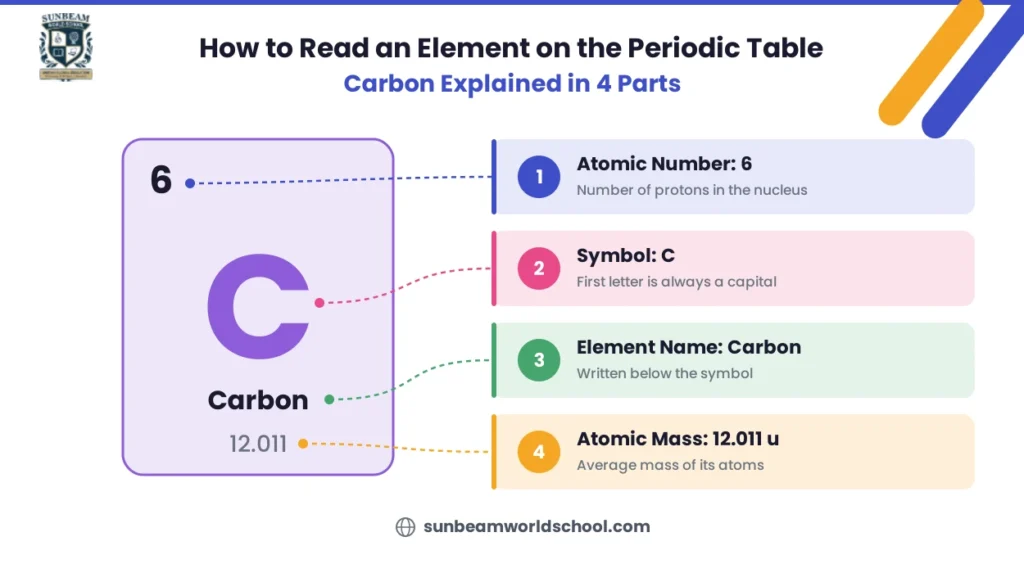
Each box on the periodic table shows four things: atomic number, symbol, element name and atomic mass.
You read a periodic table by noting an element's atomic number, symbol and atomic mass, then using its period for electron shells and its group for outer electrons. The position tells you as much as the numbers in the box.
Start by finding the element by its symbol, such as O for oxygen or Fe for iron. Then look at the period number on the left to see how many electron shells it has, and the group number at the top to see its family and likely behaviour. Finally, check the colour or the staircase line to see whether it is a metal, nonmetal or metalloid.
How to Read an Element on the Periodic Table
An element's box shows its atomic number at the top, its symbol in the centre, its name below and its atomic mass at the bottom. Carbon's box, for example, shows 6, C, Carbon and 12.011.
[Image: how-to-read-an-element.webp, enlarged carbon tile with arrows pointing to atomic number, symbol, name and atomic mass. Alt text: "How to read an element on the periodic table using carbon as an example"]
The symbol always starts with a capital letter, and a second letter, if there is one, is always lowercase, so Co is cobalt while CO is carbon monoxide. Some symbols come from Latin names, which is why sodium is Na (natrium), iron is Fe (ferrum), gold is Au (aurum) and potassium is K (kalium). Some periodic tables also show extra details in each box, such as electron configuration, electronegativity or common charges.
What Does the Atomic Number Tell You About an Element?
The atomic number tells you the number of protons in an atom's nucleus, which is what makes each element unique. In a neutral atom it also equals the number of electrons, so oxygen, with atomic number 8, has 8 protons and 8 electrons.
Because no two elements share the same atomic number, it works like an identity number for each element. You can also use it to find the number of neutrons, since neutrons = mass number − atomic number, which means a carbon-12 atom has 12 − 6 = 6 neutrons.
What Are Periods in the Periodic Table?
Periods in the periodic table are the 7 horizontal rows, and every element in the same period has the same number of electron shells. Sodium, magnesium and chlorine are all in period 3, so each of their atoms has 3 shells.
So, what is a period in the periodic table? It is one row, and reading the periodic table by energy levels, each period adds one new electron shell. Moving across a period from left to right, each element has one more proton and one more electron than the element before it. The properties change steadily along the row, from reactive metals on the left, through metalloids, to nonmetals and finally an unreactive noble gas at the far right.
How Many Periods Are in the Periodic Table?
There are 7 periods in the periodic table, and they hold 2, 8, 8, 18, 18, 32 and 32 elements, which adds up to 118. Period 1 is the shortest, with only hydrogen and helium, while periods 6 and 7 are the longest because they include the lanthanides and actinides.
What Are the Rows on the Periodic Table Called?
The rows on the periodic table are called periods. Each period is numbered from 1 to 7 down the left side of the table, and the period number matches the outermost electron shell being filled.
What Are Groups in the Periodic Table?
Groups in the periodic table are the 18 vertical columns, and elements in the same group have the same number of valence electrons, so they react in similar ways. For example, lithium, sodium and potassium in group 1 all have one outer electron and all react strongly with water.
Groups are numbered 1 to 18 from left to right under the IUPAC system. Older tables, especially in the US, use Roman numerals with A and B labels, such as IA for group 1 and VIIA for group 17, so it helps to recognise both when reading a periodic table with groups labeled.
How Many Groups Are in the Periodic Table?
There are 18 groups in the periodic table. Groups 1, 2 and 13 to 18 are called the main group elements, while groups 3 to 12 hold the transition metals.
What Is the Column on the Periodic Table Called?
A column on the periodic table is called a group, and it is also often called a family. Both words mean the same thing: a vertical set of elements that share the same outer electron arrangement and similar chemical behaviour.
Periodic Table Groups Names
The periodic table group names describe the family of elements in each column, from the alkali metals in group 1 to the noble gases in group 18. The table below lists the names for periodic table groups along with their valence electrons.
| Group | Group Name | Example Elements | Valence Electrons |
|---|---|---|---|
| 1 | Alkali metals (plus hydrogen) | Li, Na, K | 1 |
| 2 | Alkaline earth metals | Be, Mg, Ca | 2 |
| 3 to 12 | Transition metals | Fe, Cu, Zn, Au | Varies (1 or 2 in the outer s orbital) |
| 13 | Boron group | B, Al, Ga | 3 |
| 14 | Carbon group | C, Si, Sn | 4 |
| 15 | Nitrogen group (pnictogens) | N, P, As | 5 |
| 16 | Oxygen group (chalcogens) | O, S, Se | 6 |
| 17 | Halogens | F, Cl, Br, I | 7 |
| 18 | Noble gases | He, Ne, Ar | 8 (helium has 2) |
What Are the Families of the Periodic Table?
The main families of the periodic table are the alkali metals, alkaline earth metals, transition metals, halogens, noble gases, lanthanides and actinides, each sharing similar properties. Each family sits in a fixed part of the table, so its position alone tells you how its members behave, which is why learning the periodic table in families is easier than learning 118 separate elements.
Alkali Metals (Group 1)
Alkali metals are the six elements in group 1 below hydrogen, lithium, sodium, potassium, rubidium, caesium and francium, and they are the most reactive metals on the periodic table. Each has one valence electron, which it gives away easily to form a +1 ion.
They are soft enough to cut with a knife, have low densities and react with water to form hydroxides and hydrogen gas, with the reaction getting more violent as you go down the group. Because of this, sodium and potassium are stored under oil in school laboratories. Hydrogen sits at the top of group 1 because it also has one electron, but it is a nonmetal gas and does not belong to the alkali metal family.
Alkaline Earth Metals (Group 2)
Alkaline earth metals are the six group 2 elements, beryllium, magnesium, calcium, strontium, barium and radium, and each loses two valence electrons to form a +2 ion. They are reactive, but less so than the alkali metals next to them.
These metals are common in everyday life, since calcium builds bones and teeth, magnesium is used in lightweight alloys and fireworks, and barium compounds help doctors take X-ray images of the digestive system.
Transition Metals (Groups 3 to 12)
Transition metals are the elements in groups 3 to 12, in the middle of the periodic table, and they include familiar metals such as iron, copper, silver, gold and zinc. Most are hard, shiny, good conductors of heat and electricity, and able to form ions with more than one charge.
Iron, for instance, forms both Fe²⁺ and Fe³⁺ ions, which is why it appears in more than one type of rust and compound. Many transition metal compounds are brightly coloured, which is why copper sulfate is blue, and several of these metals act as catalysts that speed up important industrial reactions.
Halogens (Group 17)
Halogens are the elements in group 17, fluorine, chlorine, bromine, iodine, astatine and tennessine, and they are highly reactive nonmetals with seven valence electrons. They gain one electron to form a −1 ion and readily combine with metals to form salts.
The name halogen means "salt former", and common table salt, sodium chloride, is a perfect example. At room temperature the halogens show all three states of matter, since fluorine and chlorine are gases, bromine is a liquid and iodine is a solid.
Noble Gases (Group 18)
Noble gases are the elements in group 18, helium, neon, argon, krypton, xenon, radon and oganesson, and they are the least reactive elements on the periodic table. Their outer shells are already full, with 8 electrons (or 2 for helium), so they have little need to gain, lose or share electrons.
Because they are so stable, noble gases are used where a non-reactive gas is needed, such as helium in balloons, argon inside light bulbs and neon in glowing advertising signs.
Lanthanides and Actinides
Lanthanides (atomic numbers 57 to 71) and actinides (89 to 103) are the two rows of 15 elements each placed below the main periodic table. Together they make up the f-block, and they are also called the inner transition metals.
Lanthanides are often called rare earth elements and are used in strong magnets, phone screens and electric vehicle motors. Actinides are all radioactive, and they include uranium and plutonium, which are used as fuel in nuclear power plants.
Where Are Metals Located on the Periodic Table?
Metals are located on the left side and in the centre of the periodic table, covering groups 1 to 12 and the lower parts of groups 13 to 16. About 95 of the 118 elements are metals, which makes them by far the largest category on the table.
The easiest way to find the metals on the periodic table is to locate the staircase line that starts below boron and steps down to the right. Almost everything to the left of that line is a metal, everything to the upper right is a nonmetal, and hydrogen is the one important exception, since it sits on the far left but is a nonmetal.
Periodic Table Metals, Nonmetals and Metalloids
The staircase line splits the periodic table into about 95 metals on the left, 17 nonmetals on the upper right and 6 metalloids along the line itself. A periodic table metals and nonmetals chart shades each side of the line in its own colour, and each category has its own clear set of properties.
| Type | Where on the Table | Properties | Examples |
|---|---|---|---|
| Metals | Left side and centre | Shiny, good conductors, malleable, usually solid, lose electrons | Iron, copper, sodium, gold |
| Nonmetals | Upper right side, plus hydrogen | Dull, poor conductors, brittle when solid, gain or share electrons | Oxygen, carbon, nitrogen, chlorine |
| Metalloids | Along the staircase line | Mix of metal and nonmetal properties, often semiconductors | Boron, silicon, germanium, arsenic, antimony, tellurium |
The periodic table nonmetals include gases such as oxygen and nitrogen as well as solids such as carbon and sulfur. The periodic table metalloids are especially important in technology, because silicon and germanium can conduct electricity under some conditions and not others, which is exactly what computer chips and solar cells need. Some scientists also count polonium or astatine as metalloids, which is why you may see the number of metalloids given as 6 or 7 in different books.
Color Coded Periodic Table
A color coded periodic table gives each family of elements its own colour, so you can spot alkali metals, transition metals, metalloids, halogens and noble gases at a glance. There is no single official colour scheme, but every good chart includes a legend that explains its colours.
Colour coding is one of the best ways to learn the table, since your brain remembers regions and patterns more easily than single facts. Students who are drawing their own periodic table of elements to colour can use one colour per family and add the staircase line in a dark marker.
What Are the Blocks of the Periodic Table?
The blocks of the periodic table are four regions, the s, p, d and f blocks, named after the type of orbital that each element's last electron enters. The s-block is 2 columns wide, the p-block is 6, the d-block is 10 and the f-block is 14, and a periodic table of elements blocks chart shades each region in a different colour.
[Image: periodic-table-spdf-blocks.webp, periodic table shaded into s, p, d and f blocks. Alt text: "Periodic table of elements blocks: s, p, d and f"]
S, P, D and F Blocks Explained
The s, p, d and f blocks match the shape of the spdf periodic table, where the width of each block equals the number of electrons its orbitals can hold. An s orbital holds 2 electrons, p orbitals hold 6, d orbitals hold 10 and f orbitals hold 14.
| Block | Location | Groups | Includes |
|---|---|---|---|
| s-block | Far left, plus helium | 1 and 2 | Alkali and alkaline earth metals |
| p-block | Right side | 13 to 18 | Metalloids, most nonmetals, halogens, noble gases |
| d-block | Centre | 3 to 12 | Transition metals |
| f-block | Two rows at the bottom | Lanthanides and actinides | Inner transition metals |
Helium is the one element placed outside its block, since its electrons fill an s orbital but it sits above the noble gases in group 18 because it shares their full-shell, unreactive nature.
How Does the Periodic Table Show Electron Configuration?
The periodic table shows electron configuration through its layout, since the period number gives the outermost shell and the block gives the orbital type being filled. Reading across the rows in order works like an electron configuration chart, so sodium in period 3, s-block, ends in 3s¹ and has the full configuration 1s² 2s² 2p⁶ 3s¹.
To write the electron configuration of any element using the table, start at hydrogen and move across each row, writing down the block you pass through until you reach your element. For chlorine, that gives 1s² 2s² 2p⁶ 3s² 3p⁵, which shows 7 electrons in the outer shell, matching its place in group 17. Some charts go a step further and work as a periodic table with electron configuration printed in every box.
| Element | Atomic Number | Electron Configuration | Shortened (Noble Gas) Form |
|---|---|---|---|
| Hydrogen | 1 | 1s¹ | 1s¹ |
| Carbon | 6 | 1s² 2s² 2p² | [He] 2s² 2p² |
| Oxygen | 8 | 1s² 2s² 2p⁴ | [He] 2s² 2p⁴ |
| Sodium | 11 | 1s² 2s² 2p⁶ 3s¹ | [Ne] 3s¹ |
| Chlorine | 17 | 1s² 2s² 2p⁶ 3s² 3p⁵ | [Ne] 3s² 3p⁵ |
| Calcium | 20 | 1s² 2s² 2p⁶ 3s² 3p⁶ 4s² | [Ar] 4s² |
Periodic Table With Valence Electrons
A periodic table with valence electrons shows that main group elements have the same number of valence electrons as the last digit of their group number. Group 1 elements have 1, group 2 have 2, group 13 have 3, and so on up to group 18 with 8.
Valence electrons are the electrons in the outermost shell, and they decide how an element bonds with others. So nitrogen in group 15 has 5 valence electrons and magnesium in group 2 has 2, which lets you answer most "how many valence electrons" questions straight from the table without writing a full configuration. In this way, the periodic table of elements valence electrons pattern turns the whole table into a ready-made valence electron chart.
Periodic Table With Charges
On a periodic table with charges, group 1 forms +1 ions, group 2 forms +2, group 13 +3, group 15 −3, group 16 −2 and group 17 −1. Noble gases in group 18 usually form no ions at all.
| Group | Common Charge | Example Ion |
|---|---|---|
| 1 | +1 | Na⁺ |
| 2 | +2 | Mg²⁺ |
| 13 | +3 | Al³⁺ |
| 14 | ±4 (usually shares electrons) | C, Si form covalent bonds |
| 15 | −3 | N³⁻ |
| 16 | −2 | O²⁻ |
| 17 | −1 | Cl⁻ |
| 18 | 0 | None |
| 3 to 12 | Varies | Fe²⁺ and Fe³⁺, Cu⁺ and Cu²⁺ |
Metals lose electrons and form positive ions, while nonmetals gain electrons and form negative ions, which is why the charges switch from positive to negative as you cross the table.
What Are the First 20 Elements of the Periodic Table?
The first 20 elements of the periodic table are hydrogen to calcium, filling periods 1, 2 and 3 completely and the first two places of period 4. These are the elements students learn first, because they show every major pattern of the table in a small, easy set, and the first 20 elements table below lists each one with its type.
| Atomic Number | Symbol | Element Name | Atomic Mass (u) | Type |
|---|---|---|---|---|
| 1 | H | Hydrogen | 1.008 | Nonmetal |
| 2 | He | Helium | 4.003 | Noble gas |
| 3 | Li | Lithium | 6.94 | Alkali metal |
| 4 | Be | Beryllium | 9.012 | Alkaline earth metal |
| 5 | B | Boron | 10.81 | Metalloid |
| 6 | C | Carbon | 12.011 | Nonmetal |
| 7 | N | Nitrogen | 14.007 | Nonmetal |
| 8 | O | Oxygen | 15.999 | Nonmetal |
| 9 | F | Fluorine | 18.998 | Halogen |
| 10 | Ne | Neon | 20.18 | Noble gas |
| 11 | Na | Sodium | 22.99 | Alkali metal |
| 12 | Mg | Magnesium | 24.305 | Alkaline earth metal |
| 13 | Al | Aluminium | 26.982 | Post-transition metal |
| 14 | Si | Silicon | 28.085 | Metalloid |
| 15 | P | Phosphorus | 30.974 | Nonmetal |
| 16 | S | Sulfur | 32.06 | Nonmetal |
| 17 | Cl | Chlorine | 35.45 | Halogen |
| 18 | Ar | Argon | 39.95 | Noble gas |
| 19 | K | Potassium | 39.098 | Alkali metal |
| 20 | Ca | Calcium | 40.078 | Alkaline earth metal |
What Are the Periodic Trends in the Periodic Table?
Periodic trends are regular patterns in element properties across the periodic table, and the three main ones are atomic size, electronegativity and ionization energy. Atomic size grows down a group and shrinks across a period, while electronegativity and ionization energy do the opposite, and these patterns are the periodic table properties that exam questions test most often.
Atomic Size Trend
Atomic size decreases from left to right across a period and increases from top to bottom down a group. Across a period, more protons pull the electrons in tighter, while down a group each new shell makes the atom larger, so helium is the smallest atom and caesium and francium are among the largest.
Electronegativity Trend
Electronegativity, the pull an atom has on shared electrons in a bond, increases across a period and decreases down a group. Fluorine is the most electronegative element with a value of 3.98 on the Pauling scale, while caesium and francium are among the least electronegative.
Ionization Energy Trend
Ionization energy, the energy needed to remove an electron from an atom, increases across a period and decreases down a group. Helium has the highest first ionization energy of all elements at about 2372 kJ/mol, because its two electrons sit very close to the nucleus.
| Property | Across a Period (Left to Right) | Down a Group (Top to Bottom) |
|---|---|---|
| Atomic size | Decreases | Increases |
| Electronegativity | Increases | Decreases |
| Ionization energy | Increases | Decreases |
| Metallic character | Decreases | Increases |
How Can Students Learn the Periodic Table Easily?
Students learn the periodic table most easily by understanding its patterns first, then memorising small chunks such as the first 20 elements with mnemonics and regular self-testing. Learning why the table is shaped the way it is makes the facts stick far better than repeating a list.
Learn the Layout Before the Details
Learning the layout first means knowing that rows are periods, columns are groups, metals sit on the left and nonmetals on the right. Once a student understands that the group number gives the valence electrons and the period gives the number of shells, many questions can be answered by reasoning instead of memory.
Use Mnemonics for the First 20 Elements
Mnemonics turn the first 20 elements into short, memorable sentences, which works much better than repeating symbols. Try "Happy Harry Lives By Big Calm Nice Old Ferry Nest" for H, He, Li, Be, B, C, N, O, F and Ne, and "Naughty Magpies Always Sing Pretty Songs Close At Kids' Camps" for Na, Mg, Al, Si, P, S, Cl, Ar, K and Ca.
Learn One Family at a Time
Learning one family at a time, such as the alkali metals one week and the halogens the next, connects each element to its neighbours and their shared behaviour. Students can make a flashcard for each family with its group number, valence electrons, common charge and two real-life uses.
Test Yourself With a Blank Periodic Table
Testing yourself with a blank periodic table, filling in symbols from memory and then checking against the full chart, is one of the fastest ways to learn it. This active recall habit, which is part of the routine described in how to become a top 1% student, builds memory far faster than rereading notes, and short daily sessions of 10 minutes work better than one long weekend session.
Where Do CBSE Students Study the Periodic Table?
CBSE students study the periodic table in depth in Class 11 Chemistry, in the chapter Classification of Elements and Periodicity in Properties. The chapter covers the classification of elements in the periodic table, Mendeleev's table, the modern periodic law, blocks and periodic trends. A clear grasp of the table also supports later chapters on chemical bonding, the p-block and the d and f block elements in Class 11 and 12.
Conclusion
The periodic table is not 118 facts to memorize, but one map to read, where every row tells you an element’s shells and every column tells you how it behaves. Start this week by learning the first 20 elements with the two mnemonics above, then fill in a blank table from memory each evening until you can complete it without peeking. If you would like a live teacher to guide you through chemistry at your own pace, explore personalized learning at Sunbeam World School.

Frequently Asked Questions
What is the first element in the periodic table?
-The first element in the periodic table is hydrogen, with atomic number 1 and the symbol H. It is the lightest and most abundant element in the universe, and it sits at the top of group 1, although it is a nonmetal gas.
What is the last element in the periodic table?
+What is the purpose of the periodic table?
+What is the chemistry chart called?
+What group are the alkali metals in?
+How many metals are on the periodic table?
+Why is it called the periodic table?
+Who is the father of the periodic table?
+
In this article
Share this post:


Press and Blogs
Stay updated with our press releases, educational blogs, and more.

Quick Summary The area of a circle is equal to πr², where r is the...

Quick Summary Common words that start with V include very, visit, voice, value, vase, van,...
Quick Summary Roman numerals 1 to 1000, also called Roman numbers, use seven letters: I...