

 Online School
Dummy School vs Regular School: Key Differences, Benefits & Limitations
Quick Answer A dummy school provides enrolment mainly for board exam purposes without requiring regular daily attendance, giving students more time for coaching, sports, arts, or competitive exams. A regular school involves daily attendance, structured classes, and participation in school activities. Both have trade-offs in terms of attendance, cost, and overall development. An accredited online school can offer a middle path, combining academic structure with greater flexibility.
What Is a Dummy School?
A dummy school is a school where a student is formally enrolled and registered for board exams. Daily attendance is not required. The arrangement exists to serve students who need most of their day for something other than regular classroom attendance. Most commonly, that means coaching for competitive exams like JEE or NEET. It also covers serious sports training, performing arts, and other demanding commitments. The student still keeps a valid board exam registration through the school's name.
The student's actual daily time goes toward their real focus instead of a classroom. This could be a coaching institute, a training academy, a film set, or independent study. The school mainly handles the paperwork, internal assessments, and practical exam formalities needed to sit for board exams. This setup became widely known through coaching hubs like Kota. This is why it gets talked about almost exclusively in a JEE or NEET context. The underlying arrangement is actually used far more broadly.
What Is a Regular School?
A regular school is one where students attend daily classes and follow a fixed timetable. They also participate in a structured curriculum alongside extracurricular activities. Teachers deliver lessons in person and track attendance and performance continuously. Students are expected to engage in both academic and non-academic school life throughout the year.
Beyond academics, a regular school builds in sports, cultural events, clubs, and regular peer interaction. All of this contributes to a student's social and personal development alongside their marks. A regular school student's day is largely set by the institution. This is in contrast to the open schedule a dummy school allows.
Who Actually Chooses a Dummy School?
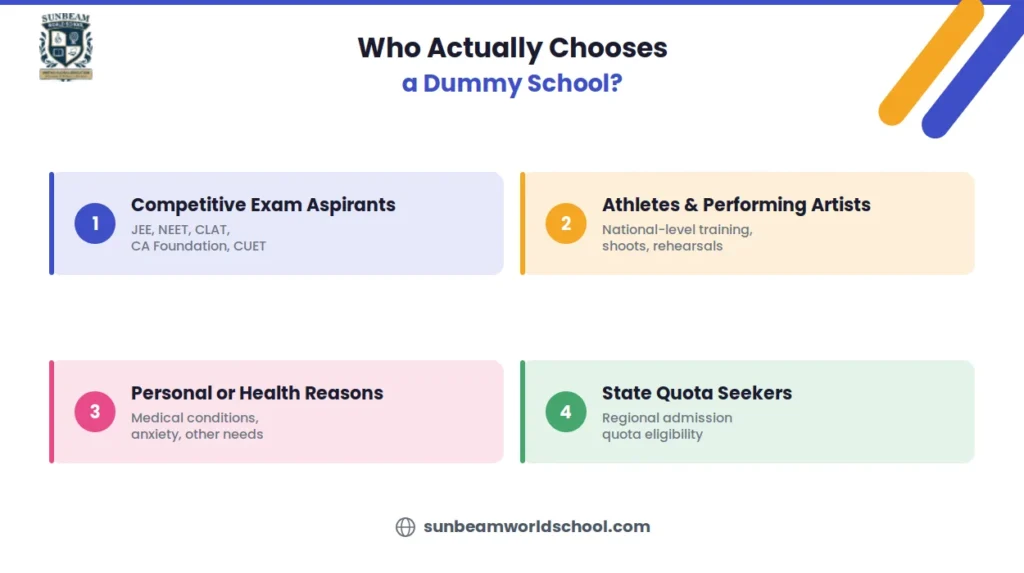
Who actually chooses a dummy school, beyond JEE and NEET aspirants
Dummy schools are chosen by any student whose main commitment genuinely cannot fit around a full daily school schedule. Competitive exam coaching is only the most visible example of that, not the only one.
Competitive Exam Aspirants
Students preparing for JEE or NEET make up the largest and most talked-about group. They often spend six to twelve hours a day at a coaching centre in hubs like Kota, Hyderabad, or Delhi. The same logic applies to students preparing for other demanding exams. This includes CLAT for law, CA Foundation, and intensive CUET or Olympiad coaching. In each case, the daily time commitment leaves little room for a regular school schedule.
Athletes and Performing Artists in Serious Training
A student training at a national or international level faces the same time conflict as a JEE aspirant. This applies to cricket, football, swimming, or classical dance. Full days of practice, travel to competitions, or shoots simply cannot fit around a fixed school timetable. For these students, a dummy school arrangement protects their board exam registration. Their actual hours go into training, matches, rehearsals, or professional commitments instead of a classroom.
Students With Personal or Health Circumstances
Some families choose a dummy school arrangement for a child managing a medical condition or significant anxiety. Daily physical attendance may simply not be realistic for a period of time. In these cases, the flexibility is less about pursuing an external goal. It is more about keeping a board exam pathway open while the student manages something happening in their own life.
State Quota Seekers
A smaller group of students enrol in a dummy school in a specific state or region. The goal is to become eligible for that region's local quota in college admissions. This is a widely reported use of the arrangement, not a formally endorsed one. It also carries its own scrutiny risk, separate from the attendance issue covered below.
What Is the Difference Between a Dummy School and a Regular School?
The core difference between a dummy school and a regular school comes down to structure. A dummy school gives a student freedom and flexibility with very little built-in routine. A regular school provides routine and structure at the cost of that same flexibility.
| Aspect | Dummy School | Regular School |
|---|---|---|
| Attendance | Rarely mandatory, name is mostly kept on record | Daily attendance required, tracked closely |
| Time allocation | Most hours spent on the student's main pursuit, whether coaching, training, or rehearsal | 6 to 7 hours daily in classes plus commute |
| Daily routine | Built entirely around self-discipline | Built externally by the school timetable |
| Classroom learning | Little to none, students self-study or attend coaching | Structured daily instruction from teachers |
| Primary focus support | Full time available for exam coaching, sports, or other serious commitments | Available outside school hours, if at all |
| Extracurricular activities | Little to no involvement, unless that is the student's main pursuit | Sports, arts, clubs, and cultural events |
| Peer interaction | Minimal, mostly limited to coaching batchmates or teammates | Daily interaction with classmates and teachers |
| Cost structure | School fee plus a separate, often substantial coaching or training fee | One combined fee covering academics and activities |
The trade-off stays fairly consistent across every row in this table. A dummy school buys time and flexibility for whatever a student's main commitment happens to be. A regular school buys structure, routine, and a broader school experience.
Is Dummy School Allowed by CBSE, and Is It Legal?
Dummy schooling itself is not illegal, but it sits in a grey area. CBSE's examination bye-laws set a minimum attendance requirement for board exams. This is commonly cited as 75 percent. Schools offering dummy admissions typically manage this informally. They either relax enforcement or adjust how attendance gets recorded. This is not the same as CBSE formally sanctioning the arrangement.
This creates a real compliance risk rather than a clear legal one. Attendance records can be scrutinised closely at any time. A student technically short of the minimum could then face last-minute eligibility problems. Board exam results matter well beyond the marks themselves. They feed into CUET cutoffs, scholarship eligibility, and international university applications. Parents considering a dummy school should ask directly how it handles attendance compliance. It helps to understand how online school recognition actually works in India. This shows how a fully accredited pathway avoids this grey area entirely.
How Do Dummy School and Regular School Fees Compare?
Dummy school arrangements usually work out more expensive overall. This is not because the school fee itself is high. It is because that fee comes on top of a separate, often substantial cost. This could be a coaching institute for JEE or NEET, a sports academy, or a training programme. A regular school with school-based or integrated coaching usually rolls both academics and exam preparation into one fee.
Families should also factor in less obvious costs on the dummy school side. These include transport to a coaching centre or training venue, and equipment or materials bought separately. There is also the effort of managing two institutions instead of one. A regular school avoids this fragmentation. Even if its overall fee looks higher on paper, it is not layered on top of a second, independent expense.
What Are the Advantages and Disadvantages of a Dummy School?
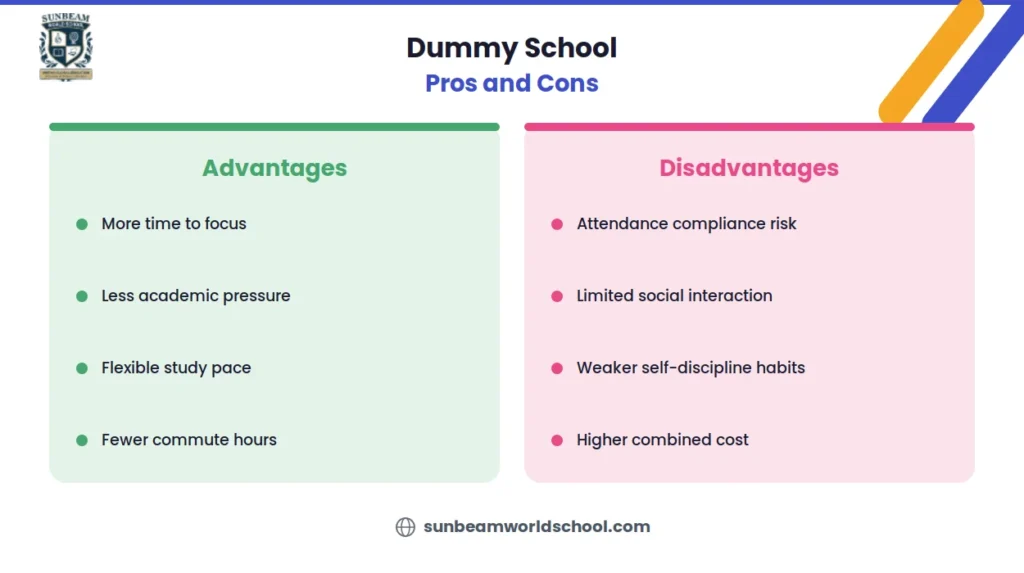
Dummy school pros and cons, side by side
A dummy school works well for a specific kind of student. It also comes with trade-offs that are easy to underestimate until they surface months into the arrangement.
| Advantage | Why It Matters |
|---|---|
| More time for the main pursuit | Six to eight hours a day can go directly into coaching, training, or rehearsal |
| Less academic pressure | No homework, projects, or daily assessments from a regular school |
| Flexible study pace | Students can spend more time on weak areas without a fixed timetable |
| Reduced commuting | Cutting out daily school travel frees up time and energy |
| Targeted focus | Full attention stays on the primary goal, with fewer distractions |
More Time for the Main Pursuit
The single biggest advantage is time. A dummy school effectively hands students back six to eight hours a day. This time would otherwise go to commuting, homework, and unrelated classwork. This applies whether their focus is JEE coaching, national-level sport, or another serious pursuit. For a highly self-motivated student, it can mean much deeper preparation.
Less Academic Pressure
Without daily homework, projects, or internal assessments, a dummy school student avoids a constant, low-level pressure. This pressure usually comes from juggling two demanding commitments at once. This can genuinely reduce stress for a student whose main goal sits entirely outside the regular school curriculum.
Flexible Study Pace
A dummy school lets a student move quickly through familiar topics and slow down where they struggle. There is no class-wide pace set for thirty other students to follow. This kind of self-paced learning suits a student who already knows how to target their own weak areas.
Reduced Commuting
Cutting out a daily school commute gives back real time and energy. In a large city, that commute can easily be an hour or more each way. This time can go into study, training, rest, or practice instead. Over months of preparation, it adds up to a meaningful amount of extra usable time.
Targeted Focus
There is no regular school curriculum to keep up with. A student can direct nearly all their energy toward one goal. This goal might be JEE, NEET, a national sports trial, or a performance career. This narrow focus often leads to faster progress than a split attention span allows.
Alongside these benefits sit a set of disadvantages that matter just as much.
| Disadvantage | Why It Matters |
|---|---|
| Attendance compliance risk | Board exam eligibility can be jeopardised if records are scrutinised |
| Limited social interaction | Little daily contact with peers outside a coaching batch |
| Weak self-discipline outcomes | No external structure to build consistent study habits |
| No extracurricular exposure | Sports, arts, and clubs are effectively unavailable |
| Higher combined cost | Separate school and coaching fees add up quickly |
Attendance Compliance Risk
Dummy schools typically manage attendance informally rather than through CBSE's actual minimum requirement. A student's board exam eligibility can come under question if records are ever closely scrutinised. This risk rarely shows up until registration time. This makes it one of the more serious, easy-to-overlook downsides of the arrangement.
Limited Social Interaction
A dummy school student's daily social world usually shrinks down to a coaching batch. There is little of the broader peer interaction a regular school naturally provides. Over one or two years, this can leave real gaps in communication and teamwork skills.
Weak Self-Discipline Outcomes
Without a school timetable, daily attendance checks, or teacher accountability, a student's routine depends entirely on their own consistency. A student who struggles with self-discipline in month one usually struggles more by month six. Nothing in the system nudges them back on track.
No Extracurricular Exposure
Sports, arts, clubs, and cultural events are effectively unavailable in a dummy school arrangement. The entire structure is built around one goal rather than a broader school experience. Students can miss out on stress relief, creative outlets, and skill-building that happen naturally in a regular school.
Higher Combined Cost
A dummy school's own fee is often low, but it rarely stands alone. It sits on top of a separate, frequently substantial fee for coaching, training, or another main pursuit. Transport and materials get bought independently on top of that. Added together, the combined cost is usually higher than a single, integrated school fee.
What Are the Advantages and Disadvantages of a Regular School?
A regular school trades some flexibility for real structure and development. A dummy school simply cannot offer either in the same way.
Advantages of a Regular School
| Advantage | Why It Matters |
|---|---|
| Built-in structure and routine | Fixed timetable naturally builds discipline and time management |
| Social and communication skills | Daily peer interaction builds teamwork and confidence |
| Immediate teacher feedback | Doubts get resolved and mistakes get corrected in real time |
| Holistic development | Sports, arts, and clubs support growth beyond academics |
| No attendance compliance risk | Board exam eligibility is never in question |
Structure is the clearest advantage here. A fixed timetable, regular assessments, and daily accountability to teachers all work together. They keep a student on track even during the months when motivation naturally dips. A purely self-directed dummy school routine has no real answer for that dip.
Disadvantages of a Regular School
| Disadvantage | Why It Matters |
|---|---|
| Less time for outside pursuits | Daily classes and homework leave fewer free hours for coaching or training |
| Heavier academic workload | Projects, assessments, and a full curriculum compete for attention |
| Fixed schedule | Little room to adjust pace around personal strengths or weaknesses |
| Possible social distractions | Peer socialising can pull focus away from a serious external goal |
| Longer days overall | Commuting adds to already long school hours |
This applies to any genuinely demanding external commitment, whether that is JEE, NEET, a sport, or a performing arts career. For these students, the time constraint matters most. Even a well-run regular school day leaves noticeably less room for deep, focused practice. These pursuits typically demand exactly that kind of practice.
Is a Dummy School Only Useful for JEE or NEET Preparation?
No, a dummy school is not only for JEE or NEET aspirants. These two exams simply dominate how the arrangement gets discussed online. The same setup works for any student whose main commitment needs most of their day. A national-level athlete, a working performer, or a CLAT or CUET aspirant all qualify. The underlying trade-off is identical no matter what fills that time, freedom from daily attendance in exchange for self-managed hours.
Even so, a dummy school can work well specifically for JEE or NEET preparation. It suits someone who already has strong self-discipline and does not need external structure to stay consistent. A large share of the JEE syllabus also overlaps with the Class 11 and 12 curriculum. A well-integrated school programme teaches board and competitive exam content together. This can close much of that gap without giving up daily structure. JEE and NEET are rarely the only exams a student ends up considering. Whichever route a family chooses, it helps to understand other entrance exams and eligibility criteria after Class 12.
Can You Clear JEE or NEET Without Attending a Dummy School?
Yes, a large number of JEE and NEET qualifiers every year come from regular schools. Dummy schooling is a preference, not a requirement, for clearing either exam. What actually predicts success is consistent, focused preparation time and strong fundamentals in Physics, Chemistry, and Mathematics or Biology. The specific attendance arrangement a student's school allows matters far less.
Many students clear these exams through school-integrated coaching programmes or disciplined self-study after regular school hours. Some use flexible board options that free up time without removing structure entirely. The right setup depends far more on how a student actually studies than on daily attendance rules.
Is There a Better Alternative to the Dummy School vs Regular School Choice?
Yes, an accredited online school offers a middle path that most comparisons overlook entirely. It keeps board exam eligibility intact while still freeing up significant time for coaching or self-study. Instead of choosing between full daily attendance and a compliance-risky dummy arrangement, students get a formally structured school day. Live classes, tracked attendance, and a real curriculum are compressed into fewer hours than a traditional physical school requires.
How an Accredited Online School Keeps Attendance and Board Eligibility Intact
An accredited online school still tracks attendance and delivers a full curriculum through live classes. There is no commute and no extended hours the way a physical campus requires. Because attendance is genuinely recorded rather than informally managed, there is no compliance grey area to worry about later. The shorter live-class block leaves real hours free for coaching, revision, or rest.
How NIOS and Flexible Curricula Free Up Time Without the Dummy School Risk
Open schooling boards like NIOS give students another structured way to gain flexibility. NIOS certificates are recognised for JEE, NEET, CUET, and government exams on the same footing as CBSE. Students also get a more self-paced study format with on-demand exam options. This is fundamentally different from an informal dummy school arrangement. The flexibility here is built into the board's own rules, not one school's loose enforcement. This distinction is covered in more depth in this comparison of NIOS and other open schooling options.
Who Should Choose a Dummy School, a Regular School, or an Online School?
A dummy school suits a student who has already shown strong self-discipline through Class 9 and 10. This student thrives with minimal external structure and has a family able to monitor them closely without daily school check-ins. The same applies just as much to a student training for national-level sport or performing arts. It applies equally to a JEE or NEET aspirant. The deciding factor is self-discipline and time need, not the specific goal itself. A regular school suits a student who performs better with routine and benefits from social interaction and extracurricular involvement.
An accredited online school tends to suit families caught in between. These are students who want serious hours for exam preparation. Their parents are simply not comfortable with the compliance risk or complete lack of structure a dummy school involves. It also fits families juggling other serious commitments, sport, the arts, or relocation. Flexibility matters here, but a fully unstructured routine still feels too risky.
How Should Parents Decide Between These Options?
Parents should start by honestly assessing whether their child manages time, sleep, and motivation without being told to. This single trait predicts dummy school success more reliably than intent or ambition alone. If the answer is genuinely yes, a dummy school or a lighter-structure online school becomes worth exploring.
Next, parents should weigh how much board exam results matter for their child's broader plans. CUET cutoffs, scholarship eligibility, and some international applications all lean on board percentages, which makes attendance compliance a real factor. Finally, families should consider their own capacity for daily monitoring. A dummy school shifts nearly all of that responsibility onto parents. A regular or online school keeps some of it built in instead. Building strong study habits matters regardless of which path is chosen. These research-backed study techniques tend to matter more for outcomes than the schooling arrangement itself.

Frequently Asked Questions
What is a dummy school?
-A dummy school is a school where a student is formally enrolled and registered for board exams. Daily attendance is not required. Most of the student's actual time goes toward their main focus. This is commonly JEE or NEET coaching, but also sports training or performing arts. The school mainly handles board exam formalities.
Is a dummy school only meant for JEE and NEET aspirants?
+What is the main difference between a dummy school and a regular school?
+Is dummy school allowed by CBSE?
+What are the disadvantages of attending a dummy school?
+Can I clear JEE or NEET without attending a dummy school?
+Which is better, dummy school or regular school, for NEET preparation?
+Can an online school work as a middle ground between dummy school and regular school?
+
In this article
Share this post:


Press and Blogs
Stay updated with our press releases, educational blogs, and more.
Quick Answer CBSE On-Screen Marking (OSM) is a digital evaluation system where scanned copies of answer...

Quick Summary 300+ essay topics for students, sorted by grade from Class 3 to Class...

Quick Summary Activity-Based Learning (ABL) is a teaching approach in which children learn concepts through...