
 Online School
Does Online School Cause Depression?
Online school does not automatically cause depression, but it can increase risk factors like social isolation, loneliness, and high stress if the setup is poor. Depression comes from many interacting causes, and no school format creates it on its own. Much of the worry traces back to the pandemic, when children were pushed into sudden, isolating remote learning overnight, which is very different from a chosen, well-structured online school. The risk factors are real, but they are manageable, and for some children a supportive online school actually improves their wellbeing.
Because this is a worry no parent should be brushed off, this guide sets out what the research really shows, the genuine risk factors, whether online school can help, how to spot trouble early, and what actually protects a child's mental health.
What Does the Research Actually Say About Online School and Depression?
The research linking online learning to depression comes mostly from the COVID-19 period, when learning moved online suddenly, under stress and with no social contact. Those studies found higher rates of anxiety and low mood, but the driver was the crisis and the isolation, not the online format itself. A forced emergency with a frightened family at home is not the same as a planned online school with live classes, a class teacher and a daily routine.
Two findings are worth holding onto, because they change how you should read the scary headlines. First, these studies show association, not cause: children were more anxious during a global emergency, which tells you little about a normal online school year. Second, when researchers looked closely at what children actually did online, time spent on online learning was not the thing tied to low mood; time spent on gaming, endless scrolling and social media was. In other words, the screen activity that harms mood is usually the non-school kind, which a structured school day displaces rather than adds. The practical takeaway for a parent is simple: judge a specific school by its structure and support, not by the word "online."
What Are the Risk Factors Linked to Online School?
Online school can raise a few mental-health risk factors when it is unstructured or purely self-paced. Knowing them lets you check for each before you enroll:
- Social isolation and loneliness. Missing regular face-to-face time with friends is the biggest risk. Ask a school how it builds daily peer interaction, not just how it teaches.
- High stress and workload. Poor time management and falling behind raise stress. A fixed timetable and teacher check-ins prevent the quiet drift that lets a child fall behind unnoticed.
- Screen fatigue. Long unbroken hours on a screen cause mental and physical tiredness. Spaced classes, real breaks and off-screen work matter more than total hours.
- Less motivation. A dull, passive video format lowers the drive to study. Live, interactive teaching with a real class beats a library of recordings watched alone.
These are risks of a badly run or isolating setup, not of online learning itself. Each has a clear fix, and whether those fixes are built in is exactly what separates a good online school from a weak one.
Can Online School Actually Be Good for Mental Health?
Yes, for some children online school is better for mental health than a traditional classroom. The same features that reduce the risks above can actively protect a child's wellbeing:
- A safe space. Children who faced bullying, social anxiety or intense peer pressure often feel noticeably better once those daily stressors are gone.
- More flexibility and control. Choosing study hours and taking a break when needed lowers the pressure that builds in a rigid, one-size-fits-all day.
- A personalized pace. Moving faster or slower on a topic, with one-on-one help, removes the constant social comparison of a crowded room.
- Time for the things that heal. Sleep, sport, family and hobbies are among the strongest protectors of a young person's mood, and a shorter, commute-free day returns hours for exactly those.
This is not a claim that online school is a cure or that it suits everyone. It is the honest other half of the picture. The right question is never whether online school is good or bad for mental health in general, but whether it fits your particular child.
How Can You Tell if Your Child Is Depressed?
Signs of depression in a child include a persistent low or irritable mood lasting more than two weeks, loss of interest in things once enjoyed, withdrawal from friends and family, changes in sleep or appetite, constant tiredness, falling grades, or a child saying they feel worthless or hopeless. Any talk of self-harm or not wanting to be here should always be taken seriously and met with immediate support.
If you notice these signs, a few things help more than worrying. Talk with your child gently and without judgment, at a relaxed moment rather than an interrogation. Keep the ordinary anchors steady: regular sleep, meals, movement, daylight and time with people. Protect off-screen time, since non-academic screen use is the part most tied to low mood. And involve a doctor or a mental health professional early rather than waiting to see if it passes. The school format is not the first thing to fix; the child's wellbeing is. Depression is common and very treatable, and early help makes a real difference.
How Does Sunbeam World School Support Student Wellbeing?
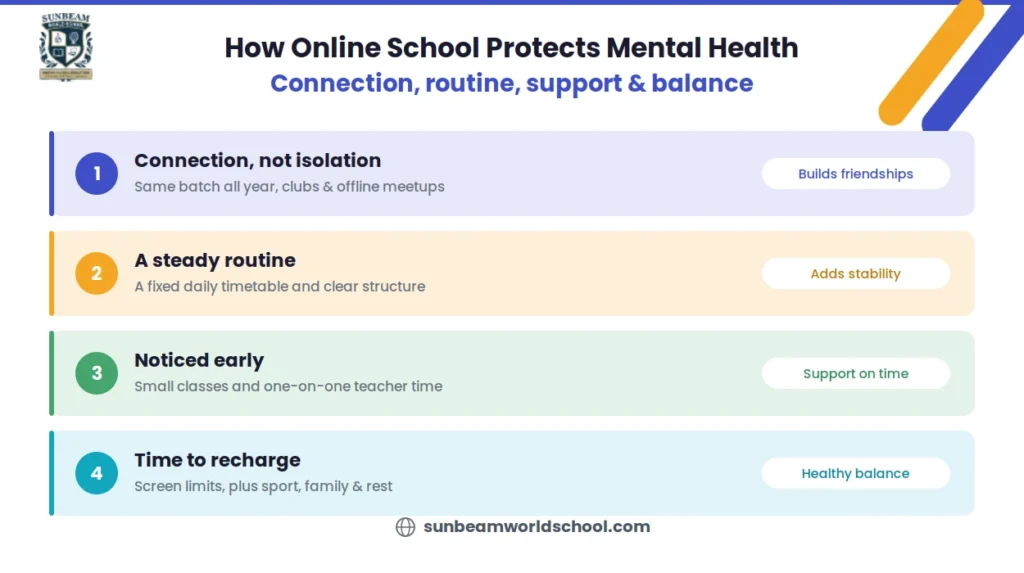
How Online School Protects Mental Health: Connection, Routine, Support & Balance.
Sunbeam World School builds the day around the very things that guard against low mood: connection, routine, early support and balance. The design, not a promise, is what does the work.
- Connection, not isolation. Live classes run with the same batch all year, and clubs and city-wise offline meetups add face-to-face contact, so friendships form rather than fade. Whether a child will make friends in online school is answered by design, not left to chance.
- Routine, not drift. Fixed morning, noon or evening batches give every day a clear shape, one of the strongest protectors of a young person's mood.
- Noticed early. A small live class at a 1:20 teacher ratio, an assistant teacher for doubts, and one-on-one teacher hours mean a child who goes quiet or falls behind is spotted quickly, not lost in a crowd of forty.
- Screens on learning, not scrolling. A structured timetable and recorded lessons keep screen time purposeful, the balance explored in the guide to online school screen time.
- Room to breathe. Saturdays run as activity-based Bagless Learning days, and the hours a physical day loses to commuting come back as time for sport, family and rest.
- Inclusive by design. Trained special educators, adaptive tools and multilingual support mean children who learn differently are supported within the model through special education, not left to cope alone.
None of this replaces professional care when a child needs it. A thoughtfully designed school supports wellbeing; a doctor or mental health professional treats depression. Sunbeam World School's role is to make the school day one that protects a child's mental health rather than strains it, and you can see the community side of that on the school life page.
The Bottom Line
Online school does not cause depression. The school matters more than the format: isolation, screen fatigue, and lost routine are real risks, but they come from a poor setup, not from learning online, and each has a clear fix. For many children who struggled with bullying, anxiety or pressure in a traditional classroom, a calmer, more flexible online school is a real step up.
Choose one that builds in connection, routine, early support and time off the screen, watch for the signs, and seek professional help early if you are worried. This is exactly what Sunbeam World School is designed around, so a child can learn well and feel well at the same time.

Frequently Asked Questions
Does online school cause depression?
-No, online school does not automatically cause depression, but it can raise risk factors like social isolation, loneliness and high stress if it is unstructured. Depression has many interacting causes, and no format creates it alone. Most research linking online learning to low mood is from the pandemic's forced, isolating remote learning, which differs from a chosen, structured online school built to prevent exactly those risks.
Why is online learning said to be bad for mental health?
+Is it normal for school to make you feel low or stressed sometimes?
+How can a student cope with low mood during online classes?
+Is online school good for mental health?
+
In this article
Share this post:


Press and Blogs
Stay updated with our press releases, educational blogs, and more.

Quick Summary The area of rectangle equals its length multiplied by its width (A =...
Quick Summary Sympathy means feeling sorry for someone from your own point of view. Empathy...

Quick Summary Student success motivational quotes are short, memorable lines that can help students stay...