
 Kids Learning
Active Voice and Passive Voice
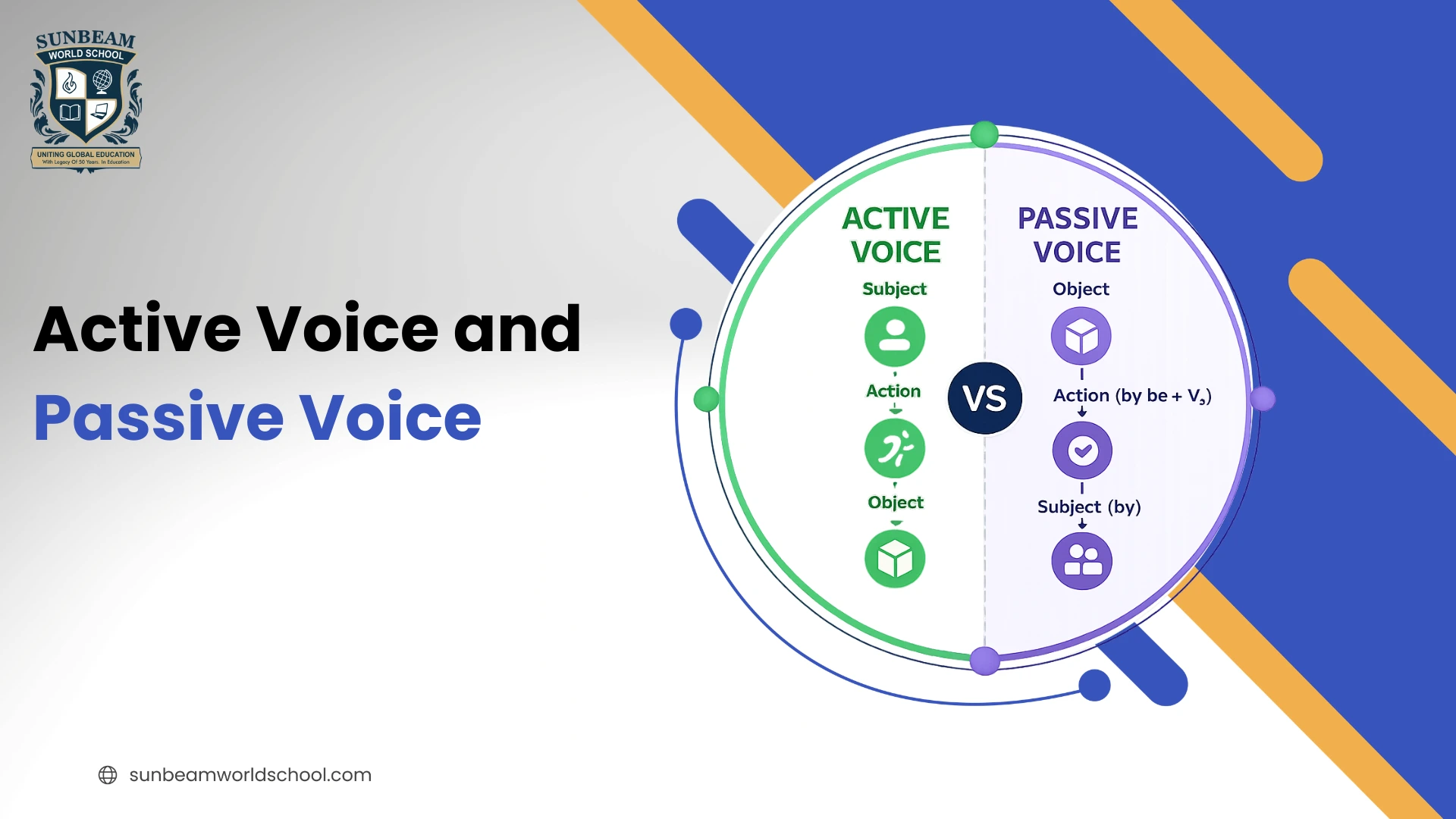
Active and passive voice are two ways of building the same English sentence. In active voice, the subject performs the action. In passive voice, the subject receives it. Both are correct; each has its own purpose.
This guide covers the definition, the difference between the two, the formula, rules for all 12 tenses, 100+ examples, conversion steps, special cases, a worksheet with answers, and 15 FAQs.
| Quick Answer
In active voice, the subject does the action. |
What Is Active Voice?
Active voice is a sentence structure in which the subject performs the action expressed by the verb. In other words, the person, animal, or thing acting comes before the verb and directly carries out the action.
Structure:Subject + Verb + Object
Examples:
- Maya wrote the letter.
- The dog chased the ball.
- The company launched a new product.
- The teacher explained the lesson.
In each sentence, the subject (Maya, the dog, the company, the teacher) is doing the action.
What Is Passive Voice?
Passive voice is a sentence structure in which the subject receives the action of the verb rather than performing it. The focus is placed on the action or the recipient of the action instead of the person or thing carrying it out.
Structure:Subject + Be Verb + Past Participle (+ by + Agent)
Examples:
- The letter was written by Maya.
- The ball was chased by the dog.
- A new product was launched by the company.
- The lesson was explained by the teacher.
In each sentence, the subject (the letter, the ball, a new product, the lesson) receives the action.
Difference Between Active and Passive Voice
A side-by-side comparison of the two voices will give you a clear understanding and effective use of the Active and passive voices. Do not confuse active and passive voice with direct and indirect speech.
| Feature | Active Voice | Passive Voice |
| Focus | The doer (subject) | The receiver (object becomes subject) |
| Sentence order | Subject + Verb + Object | Object + be + V3 + (by + Subject) |
| Verb form | Main verb only | “be” + past participle (V3) |
| Tone | Direct, energetic | Formal, indirect |
| Length | Usually shorter | Usually longer |
| Use when… | The doer is important | The action or receiver matters; doer is unknown or obvious |
| Example | The chef prepared the meal. | The meal was prepared by the chef. |
Rules to be Followed When Converting the Active Voice to the Passive Voice
To convert any active sentence into passive voice, use this structure:
Object + appropriate form of "be" + Past Participle (V3) + by + Subject
Five core rules:
- The object of the active sentence becomes the subject of the passive sentence.
- The subject becomes the agent after "by" — and is dropped when unknown, obvious, or unimportant.
- The main verb changes to its past participle (V3), preceded by the matching form of "be".
- The tense never changes — only the verb form does.
- Pronouns shift: I → me, we → us, he → him, she → her, they → them, who → whom.
Active and Passive Voice Rules for All 12 Tenses
The formula stays the same; only the "be" verb shifts with the tense.
| Tense | Active Structure | Passive Structure | Example Pair |
| Simple Present | S + V1/V1s + O | O + is/am/are + V3 + by + S | She writes a letter. → A letter is written by her. |
| Present Continuous | S + is/am/are + V-ing + O | O + is/am/are + being + V3 + by + S | She is writing a letter. → A letter is being written by her. |
| Present Perfect | S + has/have + V3 + O | O + has/have + been + V3 + by + S | She has written a letter. → A letter has been written by her. |
| Simple Past | S + V2 + O | O + was/were + V3 + by + S | She wrote a letter. → A letter was written by her. |
| Past Continuous | S + was/were + V-ing + O | O + was/were + being + V3 + by + S | She was writing a letter. → A letter was being written by her. |
| Past Perfect | S + had + V3 + O | O + had been + V3 + by + S | She had written a letter. → A letter had been written by her. |
| Simple Future | S + will + V1 + O | O + will be + V3 + by + S | She will write a letter. → A letter will be written by her. |
| Future Perfect | S + will have + V3 + O | O + will have been + V3 + by + S | She will have written a letter. → A letter will have been written by her. |
Note: The three perfect continuous tenses and future continuous are not normally used in the passive — the structure becomes awkward. Rephrase in a different tense instead.
100+ Examples of Active and Passive Voice (By Tense)
Each pair below shows the active sentence on the left and its passive form on the right, grouped by tense.
Simple Present Tense
| Active Voice | Passive Voice |
| She bakes a cake. | A cake is baked by her. |
| He drives the bus. | The bus is driven by him. |
| They clean the classroom. | The classroom is cleaned by them. |
| The teacher checks the homework. | The homework is checked by the teacher. |
| Riya plays the piano. | The piano is played by Riya. |
| We watch the news. | The news is watched by us. |
| Mom prepares breakfast. | Breakfast is prepared by Mom. |
| The mechanic repairs cars. | Cars are repaired by the mechanic. |
| Children love stories. | Stories are loved by children. |
| The dog chases the cat. | The cat is chased by the dog. |
| The chef makes dessert. | Dessert is made by the chef. |
| Farmers grow rice. | Rice is grown by farmers. |
| Birds build nests. | Nests are built by birds. |
| She speaks French. | French is spoken by her. |
| He writes poems. | Poems are written by him. |
Simple Past Tense
| Active Voice | Passive Voice |
| Newton discovered gravity. | Gravity was discovered by Newton. |
| She painted the wall. | The wall was painted by her. |
| The chef cooked dinner. | Dinner was cooked by the chef. |
| He kicked the ball. | The ball was kicked by him. |
| The dog bit the postman. | The postman was bitten by the dog. |
| They built a bridge. | A bridge was built by them. |
| The boy broke the window. | The window was broken by the boy. |
| Mom baked cookies. | Cookies were baked by Mom. |
| The artist drew the portrait. | The portrait was drawn by the artist. |
| She invited her friends. | Her friends were invited by her. |
| They sang a hymn. | A hymn was sung by them. |
| He repaired the computer. | The computer was repaired by him. |
| The driver started the engine. | The engine was started by the driver. |
| She solved the puzzle. | The puzzle was solved by her. |
| The fire destroyed the forest. | The forest was destroyed by the fire. |
Simple Future Tense
| Active Voice | Passive Voice |
| She will finish the report. | The report will be finished by her. |
| He will buy a car. | A car will be bought by him. |
| They will paint the gate. | The gate will be painted by them. |
| Riya will sing a song. | A song will be sung by Riya. |
| The team will win the match. | The match will be won by the team. |
| Mom will prepare dinner. | Dinner will be prepared by Mom. |
| The carpenter will fix the chair. | The chair will be fixed by the carpenter. |
| He will deliver the parcel. | The parcel will be delivered by him. |
| She will write a novel. | A novel will be written by her. |
| They will plant trees. | Trees will be planted by them. |
Present Continuous Tense
| Active Voice | Passive Voice |
| She is reading a book. | A book is being read by her. |
| He is fixing the door. | The door is being fixed by him. |
| They are building a house. | A house is being built by them. |
| Mom is cooking lunch. | Lunch is being cooked by Mom. |
| The dog is chasing a squirrel. | A squirrel is being chased by the dog. |
| Workers are painting the wall. | The wall is being painted by workers. |
| She is teaching the children. | The children are being taught by her. |
| He is driving the truck. | The truck is being driven by him. |
| They are watching a film. | A film is being watched by them. |
| The boy is flying a kite. | A kite is being flown by the boy. |
Past Continuous Tense
| Active Voice | Passive Voice |
| She was writing a letter. | A letter was being written by her. |
| He was painting the fence. | The fence was being painted by him. |
| They were building the bridge. | The bridge was being built by them. |
| Mom was cooking dinner. | Dinner was being cooked by Mom. |
| The boy was kicking the ball. | The ball was being kicked by the boy. |
| Workers were repairing the road. | The road was being repaired by workers. |
| She was decorating the room. | The room was being decorated by her. |
| He was watering the plants. | The plants were being watered by him. |
| They were rehearsing the play. | The play was being rehearsed by them. |
| The dog was chasing the cat. | The cat was being chased by the dog. |
Present Perfect Tense
| Active Voice | Passive Voice |
| She has finished the work. | The work has been finished by her. |
| He has eaten the cake. | The cake has been eaten by him. |
| They have written the report. | The report has been written by them. |
| Mom has prepared lunch. | Lunch has been prepared by Mom. |
| The team has won the cup. | The cup has been won by the team. |
| She has sent the invitation. | The invitation has been sent by her. |
| He has solved the case. | The case has been solved by him. |
| They have planted roses. | Roses have been planted by them. |
| The cat has caught the mouse. | The mouse has been caught by the cat. |
| She has cleaned the kitchen. | The kitchen has been cleaned by her. |
Past Perfect Tense
| Active Voice | Passive Voice |
| She had finished her lunch. | Her lunch had been finished by her. |
| The thief had stolen the jewels. | The jewels had been stolen by the thief. |
| Mom had baked the cake. | The cake had been baked by Mom. |
| He had repaired the bicycle. | The bicycle had been repaired by him. |
| They had built the temple. | The temple had been built by them. |
Future Perfect Tense
| Active Voice | Passive Voice |
| She will have completed the task. | The task will have been completed by her. |
| They will have finished the project. | The project will have been finished by them. |
| He will have written the article. | The article will have been written by him. |
| The team will have won the trophy. | The trophy will have been won by the team. |
| She will have painted the door. | The door will have been painted by her. |
Modal Verbs
With modals (can, could, may, might, should, must, ought to, have to), the structure is: Object + modal + be + V3 + by + Subject.
| Active Voice | Passive Voice |
| She can solve the problem. | The problem can be solved by her. |
| He must finish the homework. | The homework must be finished by him. |
| You should respect elders. | Elders should be respected by you. |
| They may invite us. | We may be invited by them. |
| The driver might damage the car. | The car might be damaged by the driver. |
| You ought to follow the rules. | The rules ought to be followed by you. |
| She could play the violin. | The violin could be played by her. |
| He has to submit the report. | The report has to be submitted by him. |
| Students must wear uniforms. | Uniforms must be worn by students. |
| She would prepare the meal. | The meal would be prepared by her. |
Imperative Sentences
Imperatives use "Let + object + be + V3" or "You are requested to + V1".
| Active Voice | Passive Voice |
| Open the door. | Let the door be opened. |
| Close the window. | Let the window be closed. |
| Help the poor. | Let the poor be helped. |
| Do not waste water. | Water should not be wasted. |
| Please bring my pen. | You are requested to bring my pen. |
Interrogative Sentences
Keep the question word or auxiliary at the front, then apply passive structure.
| Active Voice | Passive Voice |
| Who broke the cup? | By whom was the cup broken? |
| Did she write the letter? | Was the letter written by her? |
| Does he drive the bus? | Is the bus driven by him? |
| Will they finish the work? | Will the work be finished by them? |
| Why did he leave the office? | Why was the office left by him? |
How to Change Active Voice to Passive Voice
Worked example: The chef cooked the meal.
Step 1 — Identify subject, verb, and object. Chef / cooked / meal.
Step 2 — Move the object to the subject position. The meal …
Step 3 — Match the form of "be" to the tense. Simple past, singular → was.
Step 4 — Add the past participle (V3). The meal was cooked …
Step 5 — Add "by" + the original subject (or drop it). The meal was cooked by the chef.
When to Use Active vs Passive Voice
Use active voice when:
- You want clarity, directness, and energy.
- The doer of the action is important.
- You're writing emails, blog posts, instructions, or stories.
Use passive voice when:
- The doer is unknown — My phone was stolen.
- The doer is obvious or irrelevant — English is spoken here.
- You want to emphasise the action or receiver — The patient was rushed to surgery.
- You're writing scientific reports, news, or legal text — The sample was tested at 37°C.
Mix both in academic and journalistic writing. Overusing passive feels detached; overusing active in technical writing sounds informal.
Active and Passive Voice Worksheet
Convert each active sentence into the passive voice. Try them yourself, then check the answers.
- The dog chased the cat.
- She is writing a story.
- They have completed the task.
- He will deliver the parcel tomorrow.
- The students respect their teacher.
- Mother baked the cake.
- Workers are repairing the road.
- The thief had stolen my watch.
- She must finish the assignment.
- Open the gate.
Answers:
- The cat was chased by the dog.
- A story is being written by her.
- The task has been completed by them.
- The parcel will be delivered by him tomorrow.
- The teacher is respected by the students.
- The cake was baked by mother.
- The road is being repaired by workers.
- My watch had been stolen by the thief.
- The assignment must be finished by her.
- Let the gate be opened.
Conclusion
Active and passive voice are essential grammar concepts that help you communicate with clarity and precision. By understanding their rules, structures, and tense changes, you can choose the right voice for any situation and write more effectively.
For more grammar guides and learning resources, explore the educational content from Sunbeam World School, helping students build strong English language skills for academic success.

Frequently Asked Questions
What is the easiest way to identify active and passive voice?
-The easiest way is to look at who performs the action. If the subject does the action, the sentence is in active voice. If the subject receives the action, it is in passive voice. Passive sentences usually contain a form of "be" followed by a past participle.
Why is active voice preferred over passive voice?
+Can every active voice sentence be changed into passive voice?
+What is the formula for converting active voice to passive voice?
+When should passive voice be used in English grammar?
+
In this article
Share this post:


Press and Blogs
Stay updated with our press releases, educational blogs, and more.

Quick Summary Animal sounds are the noises animals make to communicate, warn of danger and...

Quick Summary The area of rectangle equals its length multiplied by its width (A =...

Quick Summary Sympathy means feeling sorry for someone from your own point of view. Empathy...