

Quick Summary The volume of a sphere is found with the formula V = 4/3 πr³, where r is the radius, and the answer is always in cubic units. Using the diameter, the formula becomes V = πd³/6. For example, a sphere with a radius of 7 cm has a volume of about 1437.33 cm³.
The concept of volume helps you understand how much space objects such as footballs, marbles, and globes occupy. The volume of a sphere is an important topic in the Surface Areas and Volumes chapters of NCERT Class 9 and Class 10 Mathematics. To understand the formula better, revisit the area of a circle, which uses the same value of π and radius but calculates a two-dimensional area rather than three-dimensional space.
What Is the Volume of a Sphere?
The volume of a sphere is the amount of space inside it, measured in cubic units such as cm³ or m³, and it depends only on the sphere's radius. A sphere is a perfectly round 3D solid in which every point on the surface is the same distance, called the radius, from the centre, and common spherical shapes include a football, a marble, a globe and a ball bearing.
What Is the Formula for the Volume of a Sphere?
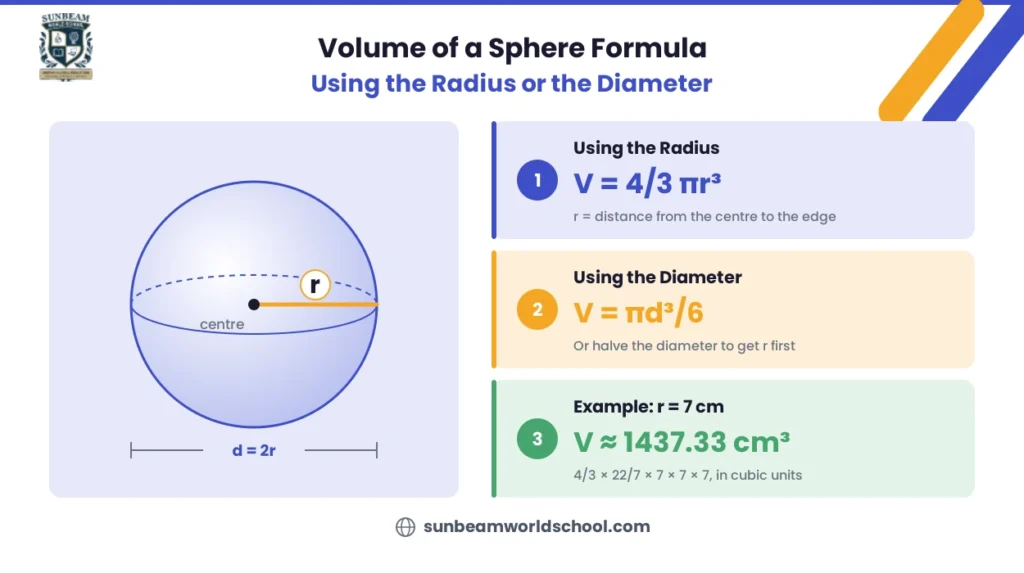
Volume of a sphere formula V = 4/3 πr³
The formula for the volume of a sphere is V = 4/3 πr³, where r is the radius and π is about 3.14 or 22/7. Since the radius is multiplied by itself three times, the answer is always in cubic units, and the same formula is often typed as 4/3 pi r^3.
In Hindi, the sphere ka formula is written as: गोले का आयतन = 4/3 πr³, जहाँ r गोले की त्रिज्या है।
Volume of a Solid Sphere
The volume of a solid sphere is V = 4/3 πr³, because a solid sphere is filled with material all the way to its centre. The same formula gives the volume of a ball, so a football with a radius of 11 cm has a volume of 4/3 × 22/7 × 1331 = 5577.52 cm³. For a sphere that is empty inside, like a metal shell, use the hollow sphere formula below.
How to Calculate the Volume of a Sphere?
To calculate the volume of a sphere, cube the radius, multiply it by π, then multiply by 4 and divide by 3. Here is how it works for a ball with a radius of 3 cm, using π = 3.14:
Step 1: Write the formula. V = 4/3 × π × r × r × r
Step 2: Find the radius. The radius is the distance from the centre of the sphere to its outer edge. Here, r = 3 cm. If the question gives the diameter instead, divide it by 2 to get the radius.
Step 3: Cube the radius. Cubing means multiplying the radius by itself three times: 3 × 3 = 9, and then 9 × 3 = 27.
Step 4: Multiply by π. 27 × 3.14 = 84.78
Step 5: Multiply by 4. 84.78 × 4 = 339.12
Step 6: Divide by 3. 339.12 ÷ 3 = 113.04
Step 7: Write the unit. Volume is measured in cubic units because a sphere has length, width and height, so the answer is 113.04 cm³.
Tip: Multiplying by 4/3 is the same as multiplying by 4 and then dividing by 3, which is easier to do one step at a time.
How to Find the Volume of a Sphere?
To find the volume of a sphere, first work out the radius from whatever the question gives you, then put it into V = 4/3 πr³. The examples below use π = 22/7.
When the Radius Is Given
When the radius is given, put it straight into V = 4/3 πr³. For a sphere with a radius of 4.2 cm:
- Cube the radius: 4.2 × 4.2 × 4.2 = 74.088.
- Multiply by π: 74.088 × 22/7 = 232.848.
- Multiply by 4/3: 232.848 × 4/3 = 310.46 cm³.
When the Diameter Is Given
When the diameter is given, halve it to get the radius, then use the volume formula. For a sphere with a diameter of 42 cm:
- Find the radius: 42 ÷ 2 = 21 cm.
- Cube the radius: 21 × 21 × 21 = 9,261.
- Multiply by 4/3 and π: 4/3 × 22/7 × 9,261 = 38,808 cm³.
The shortcut V = πd³/6 gives the same answer in one step: 22/7 × 74,088 ÷ 6 = 38,808 cm³.
When the Surface Area Is Given
When the surface area is given, use 4πr² = surface area to find the radius first. For a sphere with a surface area of 616 cm²:
- Write the equation: 4 × 22/7 × r² = 616.
- Find r²: r² = 616 × 7 ÷ 88 = 49.
- Find r: r = √49 = 7 cm.
- Find the volume: 4/3 × 22/7 × 343 = 1437.33 cm³.
Volume of a Sphere in Terms of Diameter
The volume of a sphere in terms of diameter is V = πd³/6, because the radius is half the diameter and 4/3 × (d/2)³ simplifies to d³/6. For a sphere with a diameter of 30 cm, V = 22/7 × 27,000 ÷ 6 = 14142.86 cm³.
Volume of Sphere Formula Derivation
The volume of a sphere formula is derived most simply with Archimedes' cylinder and cone method, while Class 12 students can also derive it using integration.
Archimedes' Method
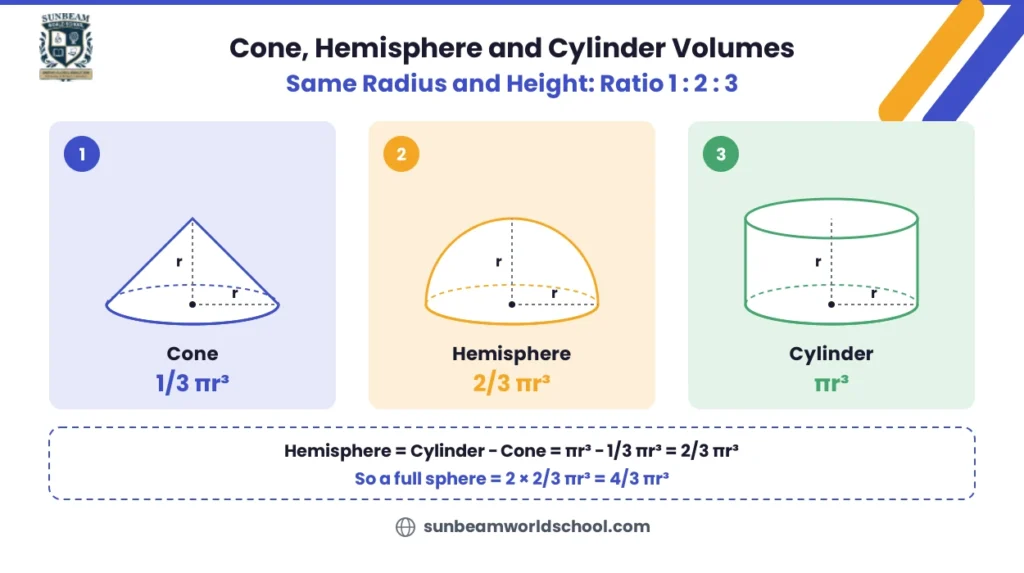
How the volume of a sphere formula is derived
Archimedes showed that a hemisphere's volume equals a cylinder's volume minus a cone's, when all three have the same radius r and height r. The cylinder is πr³ and the cone is 1/3 πr³, so the hemisphere is 2/3 πr³ and the full sphere is twice that, 4/3 πr³. This also means a cone, a hemisphere and a cylinder of the same radius and height have volumes in the ratio 1 : 2 : 3, and a sphere fills exactly 2/3 of the cylinder that just fits around it.
Derivation Using Integration
Integration derives the formula by slicing the sphere into thin circular discs of radius √(r² − x²) and adding their volumes from x = −r to x = r:
V = ∫ π(r² − x²) dx = π(2r³ − 2r³/3) = 4/3 πr³
Derivative of the Volume of a Sphere
The derivative of the volume of a sphere, d/dr (4/3 πr³), equals 4πr², which is exactly its surface area. This happens because increasing the radius by a tiny amount adds a thin shell around the sphere, and the volume of that shell is the surface area multiplied by its thickness.
Volume of a Hemisphere
The volume of a hemisphere is V = 2/3 πr³, which is exactly half the volume of a sphere with the same radius. For a hemisphere with a radius of 21 cm, V = 2/3 × 22/7 × 9,261 = 19,404 cm³.
<!-- Add link to the hemisphere blog here once it is published. -->
Hollow Sphere Formula
The volume of a hollow sphere is V = 4/3 π(R³ − r³), where R is the outer radius and r is the inner radius, and it gives the volume of material in the shell rather than the empty space inside. For a shell with R = 7 cm and r = 3.5 cm, V = 4/3 × 22/7 × (343 − 42.875) = 1257.67 cm³.
How to Find the Radius of a Sphere from Its Volume?
To find the radius of a sphere from its volume, use r = ∛(3V / 4π), which is the volume formula rearranged for r. For a sphere with a volume of 38,808 cm³, r³ = 38,808 × 3 ÷ (4 × 22/7) = 9,261, so r = 21 cm, and rearranging the formula this way uses the same balancing steps as solving algebra equations.
All Sphere Formulas
These are all the sphere and hemisphere formulas a student needs, in one table.
| Quantity | Formula |
|---|---|
| Volume of a sphere | 4/3 πr³ |
| Volume using diameter | πd³/6 |
| Surface area of a sphere | 4πr² |
| Volume of a hemisphere | 2/3 πr³ |
| Curved surface area of a hemisphere | 2πr² |
| Total surface area of a hemisphere | 3πr² |
| Volume of a hollow sphere | 4/3 π(R³ − r³) |
| Volume of a spherical cap (height h) | πh²(3r − h)/3 |
| Circumference of a sphere (great circle) | 2πr |
Solved Examples on Volume of a Sphere
These solved examples use π = 22/7 and cover the sphere questions students search for most.
Find the Volume of a Sphere Whose Radius Is 7 cm
The volume of a sphere whose radius is 7 cm is 1437.33 cm³, since V = 4/3 × 22/7 × 343 = 1437.33.
Find the Volume of a Sphere of Radius 10.5 cm
The volume of a sphere of radius 10.5 cm is 4851 cm³, since V = 4/3 × 22/7 × 1157.625 = 4851.
Find the Volume of a Sphere of Radius 11.2 cm
The volume of a sphere of radius 11.2 cm is 5887.32 cm³, since V = 4/3 × 22/7 × 1404.928 = 5887.32.
Find the Volume of a Sphere Whose Surface Area Is 154 cm²
The volume of a sphere whose surface area is 154 cm² is 179.67 cm³. From 4 × 22/7 × r² = 154, r² = 12.25 and r = 3.5 cm, so V = 4/3 × 22/7 × 42.875 = 179.67.
The Volume of a Sphere of Radius 2r Is
The volume of a sphere of radius 2r is 32/3 πr³, since 4/3 π(2r)³ = 4/3 π × 8r³, which is 8 times the volume of a sphere of radius r.
Common Mistakes When Finding the Volume of a Sphere
The most common mistake when finding the volume of a sphere is using the diameter as the radius, which makes the answer 8 times too big. Two other errors also cost marks often:
- Squaring instead of cubing the radius, which mixes up volume with surface area (4πr²).
- Writing square units, such as cm², when volume is always in cubic units, such as cm³.
Writing the formula, the working and the unit on every line, as you would when you write a maths paper in a board exam, avoids all three.
Volume of a Sphere Practice Questions with Answers
Try these five practice questions using π = 22/7, then check your answers below.
- Find the volume of a sphere of radius 14 cm.
- Find the volume of a sphere with a diameter of 7 cm.
- Find the volume of a hemisphere of radius 3.5 cm.
- A hollow sphere has an outer radius of 5 cm and an inner radius of 3 cm. Find the volume of the material.
- If the radius of a sphere is doubled, how many times larger does its volume become?
Answers: 1. 11498.67 cm³ 2. 179.67 cm³ 3. 89.83 cm³ 4. 410.67 cm³ 5. 8 times
Sphere questions like these appear regularly in school exams, and a full CBSE class 9 maths sample paper gives more practice on surface areas and volumes alongside other chapters.
Conclusion
Understanding the volume of a sphere becomes easier when students learn the formula, identify the given measurements, and apply the correct values step by step. Regular practice helps build confidence in solving geometry problems and applying mathematical concepts to everyday situations.
At Sunbeam World School, students develop this understanding through a logical, concept-based approach that encourages them to explore not just formulas but also the reasoning behind them. Learn more about how the school upholds a logical learning style across subjects.