
 Education
Longitudinal Section of Flower
Quick Summary The longitudinal section (L.S) of a flower is a vertical cut made through the centre of a flower from top to bottom that reveals all its internal parts. It shows the four whorls: calyx (sepals), corolla (petals), androecium (stamens), and gynoecium (pistil/carpel), along with the pedicel, thalamus, ovary, ovules, style, stigma, anther, and filament. The diagram of ls of flower is one of the most important topics in biology for Class 7 through Class 12 and appears regularly in CBSE and ICSE examinations.
The l.s of flower is a foundational concept in plant biology that every student encounters during their school years. When a flower is sliced vertically from the top to the base, it exposes all the internal reproductive and non-reproductive structures in a single view, making it the most effective way to study flower anatomy.
Understanding the ls of flower helps students visualise how pollination, fertilisation, and seed formation happen inside a living plant, and mastering this diagram is essential for scoring well in Class 9 to 12 Science board exams.
What Is the Meaning of L.S of Flower?
The ls of flower meaning is a longitudinal section of a flower, which is a vertical cut made through the centre to reveal its internal flower structure. The word "longitudinal" means lengthwise, so the cut runs from the top (stigma) down to the bottom (pedicel), splitting it into two mirror-image halves.
This cross section of a flower allows students to see:
- All four whorls arranged from outside to inside
- The exact position of each reproductive and non-reproductive part
- How the ovary, style, and stigma connect internally
- Where pollen tubes must travel during fertilisation
Without this section view, many internal structures would remain hidden. The l.s of flower diagram is therefore a mandatory part of biology practicals in most school curricula.
Labeled Diagram of Longitudinal Section of a Flower
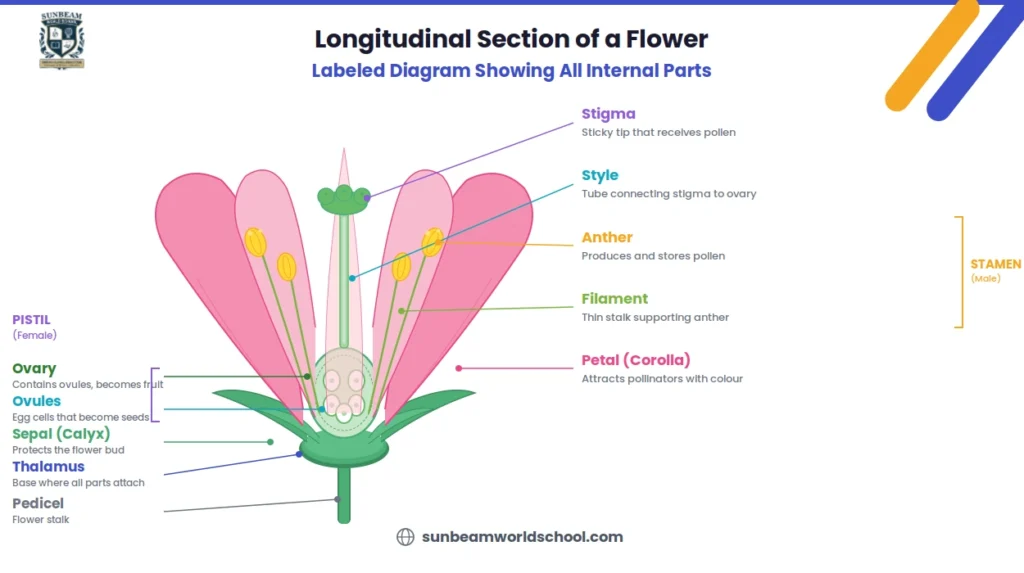
Longitudinal section (L.S) of a flower with all 10 parts labeled
The ls of flower diagram shows every internal and external part arranged exactly as they appear when the flower is cut vertically. A properly drawn ls of flower diagram with labelling includes at least 10 to 12 distinct parts, and having flower parts labeled correctly is the key to scoring full marks in exams.
What Each Part Looks Like in the Diagram
From bottom to top, a simple ls of flower diagram includes:
- Pedicel: The thin vertical stalk at the very bottom of the diagram. It connects the flower to the main stem of the plant and acts as a support structure, holding the flower in position so pollinators can access it easily.
- Thalamus (Receptacle): The slightly swollen, rounded structure sitting directly on top of the pedicel. This is the platform from which all the other flower parts grow outward and upward. Think of it as the foundation of the entire flower.
- Sepals (Calyx): The small, green, leaf-like structures curving outward from the thalamus at the base of the flower. They form the outermost protective layer and were the parts that wrapped tightly around the flower when it was still a closed bud. In the diagram, they appear as the first ring around the base.
- Petals (Corolla): The large, colourful structures sitting just inside the sepals. Petals are wider and more prominent than sepals, and their bright colours and fragrance serve one purpose: attracting pollinators like bees, butterflies, and birds. In the diagram, they form the second and most visually dominant layer.
- Filaments and Anthers (Stamens): Thin, thread-like stalks (filaments) rising from the thalamus, each topped with a small, yellow, oval-shaped structure (anther). The anthers are where pollen is produced and stored. In the diagram, the stamens appear as multiple thin lines with small capsules on top, positioned between the petals and the central pistil.
- Ovary: The swollen, rounded structure at the centre base of the flower, drawn directly above the thalamus. Inside the ovary, small circles represent the ovules. After fertilisation, the ovary develops into a fruit and the ovules become seeds. Some ovary cross-sections are roughly triangular in shape, and students comfortable with concepts like area of a triangle often find it easier to sketch biological diagrams with accurate proportions.
- Style: A long, thin, tube-like structure rising upward from the top of the ovary. It looks like a narrow straw or column in the diagram. Its job is to provide a passage for the pollen tube to travel from the stigma down to the ovary during fertilisation.
- Stigma: The topmost structure of the entire flower, sitting at the tip of the style. It can appear rounded, flat, or branched depending on the flower species (in hibiscus, it is branched into five lobes). The stigma has a sticky surface that captures pollen grains when they land on it during pollination.
Tips for Drawing LS of flower in Exams
For students looking for a flower label diagram, flower parts diagram, flower anatomy diagram, flower structure diagram, structure of flower diagram, or parts of a flower labeled neatly:
- Draw the outline shape first (a tulip-like shape works well)
- Add internal structures one whorl at a time, from outside to inside
- Use neat, horizontal label lines pointing to the exact structure
- Spell every label correctly and write legibly
- Keep proportions realistic (ovary should be smaller than petals)
A flower with labeled parts scores full marks only when every label is correctly spelled and positioned.
Parts of a Flower and Their Functions
The parts of a flower are divided into vegetative (non-reproductive) parts and reproductive parts. Understanding the parts of flower and the anatomy of a flower is the foundation of plant biology. Together, these make up the flower structure and flower anatomy that students study in biology.
Vegetative Parts (Non-Reproductive)
- Sepals (Calyx): Green, leaf-like structures forming the outer part of a flower. They protect the bud before it opens.
- Petals (Corolla): Colourful structures inside the sepals. They attract pollinators through colour, shape, and scent.
- Pedicel: The flower stalk that connects the flower to the stem of the plant.
- Thalamus (Receptacle): The swollen tip of the pedicel where all flower parts are attached.
Reproductive Parts
- Stamen (Male): Consists of the filament and anther. Produces pollen.
- Pistil (Female): Consists of the stigma, style, and ovary. Contains ovules.
- Nectary: Produces nectar to attract pollinating insects and birds.
| Part | Category | Function |
|---|---|---|
| Pedicel | Accessory | Connects the flower to the stem |
| Thalamus | Accessory | Base where all flower parts attach |
| Sepals | Vegetative | Protect the flower bud |
| Petals | Vegetative | Attract pollinators |
| Filament | Male reproductive | Holds the anther in position |
| Anther | Male reproductive | Produces and stores pollen grains |
| Stigma | Female reproductive | Receives pollen during pollination |
| Style | Female reproductive | Connects stigma to ovary |
| Ovary | Female reproductive | Contains ovules, develops into fruit |
| Ovules | Female reproductive | Contain egg cells, develop into seeds |
| Nectary | Accessory | Produces nectar for pollinators |
This table covers the 12 parts of a flower that appear most frequently in exam questions. The flower parts and functions are best memorised alongside a labeled diagram. Interestingly, some of the vegetables we eat daily are actually modified flower parts, like broccoli and cauliflower, which are flower heads harvested before blooming.
Four Whorls of a Flower
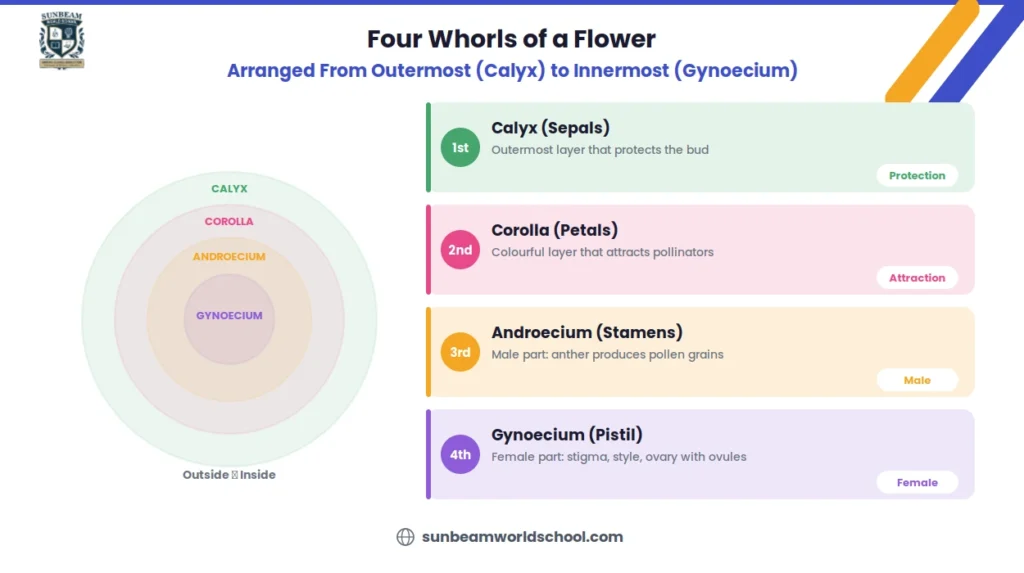
The four whorls of a flower arranged from outermost to innermost
The four whorls of a flower are the four concentric rings of parts arranged from outside to inside. These floral whorls of flower are the structural backbone of every flower diagram.
| Whorl | Name | Parts | Function |
|---|---|---|---|
| 1st (outermost) | Calyx | Sepals | Protects the bud |
| 2nd | Corolla | Petals | Attracts pollinators |
| 3rd | Androecium | Stamens (anther + filament) | Produces pollen (male) |
| 4th (centre) | Gynoecium | Pistil (stigma + style + ovary) | Produces ovules (female) |
A flower that has all four whorls is called a complete flower (examples: hibiscus, rose, lily). A flower missing one or more whorls is called an incomplete flower (examples: corn, grass flowers).
Calyx, Corolla, and the Outer Whorls
The calyx and corolla are the two outer, non-reproductive whorls of a flower that together form the perianth.
Calyx (First Whorl: Sepals)
The calyx is made up of sepals, the small, green, leaf-like structures that wrap around the flower during the bud stage to protect it from damage and drying out.
- Polysepalous: Sepals are free and separate (e.g., mustard)
- Gamosepalous: Sepals are fused together (e.g., hibiscus)
Corolla (Second Whorl: Petals)
The corolla is made up of petals, the colourful, often fragrant structures that attract pollinators like bees, butterflies, and birds.
- Polypetalous: Petals are free and separate (e.g., rose)
- Gamopetalous: Petals are fused together (e.g., morning glory)
In the ls of flower diagram, the calyx appears as the outer part of a flower wrapping around the base, and the corolla sits just inside it. Individual petals are often roughly parallelogram-shaped with rounded edges, which is why biology teachers sometimes ask students to practise drawing basic geometric shapes before attempting floral diagrams.
Stamen: The Male Reproductive Part of a Flower
The stamen is the male part of a flower, also known as the androecium, forming the third whorl. The flower stamen is one of the most recognizable structures in any diagram because of the yellow pollen visible on the anther. A flower can have one or many stamens depending on the species.
Anther
The anther is a yellowish, lobed structure at the top of the stamen. When students ask what part of the flower makes pollen, the answer is the anther, which produces and stores pollen grains containing the male reproductive cells.
Filament
The filament is a thin, thread-like stalk that holds the anther in position and connects it to the thalamus. It has no reproductive function of its own but is essential for positioning the anther where pollinators can access it.
How Male and Female Parts Work Together
The male and female parts of a flower work together during reproduction. When a pollinator visits the flower, pollen from the anther sticks to the pollinator's body and is carried to the stigma of the same or another flower. This process is called pollination. In hibiscus, the stamens are fused into a staminal column that surrounds the style, making the male part of a flower easy to observe in a longitudinal section.
Pistil: The Female Reproductive Part of a Flower
The pistil is the female part of a flower, also called the gynoecium, forming the fourth and innermost whorl. When students study the parts of a flower female reproductive system, they are studying the pistil. The ls of pistil reveals three distinct parts stacked vertically.
Stigma
The stigma flower part sits at the very top of the pistil. The flower stigma has a sticky surface specifically adapted to capture pollen grains during pollination. A flower with stigma visible at the top of the pistil is easy to identify in any ls of flower diagram because it sits at the highest point.
Style
The function of style in flower reproduction is to provide a passage for the pollen tube to travel from the stigma down to the ovary. It is a long, hollow tube that connects the stigma to the ovary.
Ovary and Ovules
The ovary is the swollen base of the pistil that contains ovules. After fertilisation, the ovary develops into a fruit and the ovules develop into seeds. This is the most important structure in terms of reproduction.
What Is the Center of a Flower Called?
The center of a flower is called the pistil (or carpel), the female reproductive organ located at the very centre of the flower. When people ask what is the middle part of a flower called, they are referring to this central structure containing the stigma, style, and ovary.
So what is the yellow center of a flower called? That yellow part is actually the anther of the stamen, covered in yellow pollen grains. The inside of the flower, when viewed in a longitudinal section, reveals:
- Pistil at the absolute centre
- Stamens surrounding the pistil
- Petals surrounding the stamens
- Sepals as the outermost layer
What Are the Reproductive Parts of a Flower?
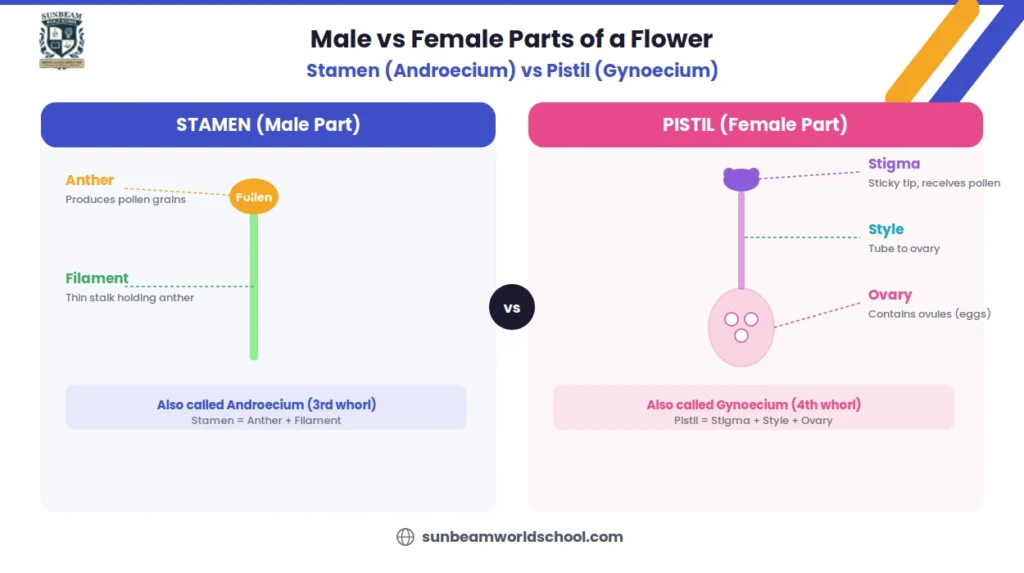
Male vs female parts of a flower
The reproductive parts of a flower are the stamen (male) and the pistil (female). These reproductive organs in flowers are the reason flowers exist, since their primary biological purpose is sexual reproduction.
How Reproduction Happens
- Pollen production: The anther produces pollen grains (male cells)
- Pollination: Pollen is transferred to the stigma by wind, water, or animals
- Pollen tube growth: The pollen grain germinates and sends a tube down the style
- Fertilisation: Male cell fuses with the egg cell inside the ovule
- Seed and fruit formation: The ovule becomes a seed, and the ovary becomes a fruit
The plant reproductive parts of a flower and the flower reproductive system are studied extensively in NCERT Class 10 Science Chapter 7 ("How Do Organisms Reproduce?") and are frequently tested in board exams.
Complete vs Incomplete Flowers
A complete flower has all four whorls: calyx, corolla, androecium, and gynoecium. An incomplete flower is missing one or more whorls.
| Type | Definition | Examples |
|---|---|---|
| Complete | All 4 whorls present | Hibiscus, rose, lily, mustard |
| Incomplete | Missing 1+ whorls | Corn, grass, begonia |
| Bisexual | Both male and female parts | Hibiscus, mustard, rose |
| Unisexual | Only male OR only female | Papaya, watermelon, corn |
A complete flower is always bisexual, but a bisexual flower is not always complete (it could be missing sepals or petals).
Longitudinal Section of Hibiscus Flower
The hibiscus is the standard specimen used for studying the longitudinal section of flower in school biology labs. The ls of flower hibiscus is the most commonly drawn diagram in CBSE and ICSE practicals because it is large, bisexual, and has all four whorls clearly visible.
What You Can Observe in the Hibiscus L.S
- 5 fused sepals forming a gamosepalous calyx
- 5 large, brightly coloured petals forming a polypetalous corolla
- Staminal column where numerous stamens are fused by their filaments into a tube surrounding the style
- Branched five-lobed stigma at the top
- Long style running through the centre of the staminal column
- Five-chambered ovary at the base containing multiple ovules
The hibiscus flower diagram is ideal for studying because every structure is oversized and easy to identify. This makes it perfect for both observation and effective exam preparation.
Why Hibiscus Is Used in Labs
- Large flower size (easy to handle and cut)
- All four whorls clearly visible
- Bisexual (both male and female parts present)
- Available throughout the year in most parts of India
- Clear contrast between vegetative and reproductive parts
How to Draw the Longitudinal Section of a Flower
Drawing the ls of flower diagram is a skill tested in both practicals and written exams. A simple, well-labeled ls of flower diagram simple enough for exams can be drawn in 5 to 7 minutes with practice.
Step-by-Step Drawing Guide
Step 1: Pedicel and Thalamus Draw a short vertical line at the bottom for the pedicel, then a small rounded shape on top for the thalamus.
Step 2: Sepals and Petals Draw small curved structures from the thalamus for sepals (pointing outward), then larger curved structures for petals (inside the sepals).
Step 3: Stamens Inside the petals, draw thin lines (filaments) rising upward with small oval shapes (anthers) on top.
Step 4: Pistil In the centre, draw an oval at the base for the ovary with small circles inside for ovules. From the top of the ovary, draw a thin tube (style) ending in a rounded structure (stigma) at the very top.
Step 5: Label Everything Add neat, horizontal label lines pointing to each structure. Practising diagram-based exam answers with proper labelling is one of the best ways to secure full marks in biology.
What Is the Difference Between L.S and T.S of a Flower?
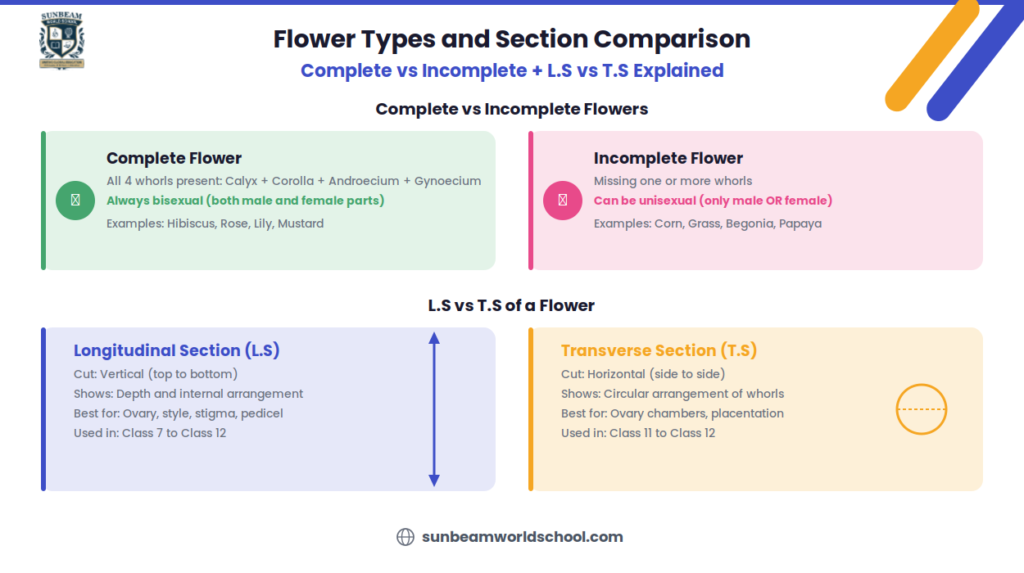
Two key comparisons: Complete vs Incomplete flowers (top) and L.S vs T.S of a flower (bottom)
The difference between LS and TS in biology is the direction of the cut. This is a commonly asked question: what is TS and LS in biology?
| Feature | L.S (Longitudinal Section) | T.S (Transverse Section) |
|---|---|---|
| Cut direction | Vertical (top to bottom) | Horizontal (side to side) |
| View | Depth and internal arrangement | Circular arrangement of whorls |
| Best for studying | Ovary, style, stigma, pedicel position | Number of chambers, placentation |
| Common in exams | Class 7 to 12 | Class 11 to 12 |
| Diagram name | L.S of flower | T.S of ovary / ts of flower diagram |
The transverse section of flower is used to study the number of ovary chambers (locules) and the arrangement of ovules on the placenta.
What Happens During Germination of Pollen on Stigma?
The germination of pollen on stigma is the process that connects pollination to fertilisation. Here is what happens step by step:
- A pollen grain lands on the sticky stigma surface
- It absorbs moisture and nutrients from the stigma
- The pollen grain germinates and grows a pollen tube
- The pollen tube extends downward through the style
- It reaches the ovary and enters an ovule through the micropyle
- The male reproductive cell fuses with the egg cell (fertilisation)
- The zygote forms and begins developing into an embryo
The what part of a flower receives pollen answer is the stigma, and this entire germination process is best understood by studying the longitudinal section of flower because it shows the physical path from stigma through style to ovary. Learning about plant reproduction connects naturally to broader topics like understanding ecosystems and nature.
L.S of Flower Diagram for Class 7 to Class 12
The ls of flower diagram appears in every biology curriculum from Class 7 through Class 12, but the level of detail expected increases with each grade.
| Class | What the Diagram Should Show | Key Focus |
|---|---|---|
| Class 7 | Basic parts: sepals, petals, stamen, pistil | Labels only |
| Class 9 | All parts including pedicel, thalamus, ovules | Labels + basic functions |
| Class 10 | Full labeled diagram for NCERT Chapter 7 | Labels + functions + reproduction |
| Class 11 | Detailed anatomy + floral formula | Morphology of flowering plants |
| Class 12 | Embryology, microsporogenesis, megasporogenesis | L.S of anther + L.S of ovule |
What Each Level Expects
For ls of flower diagram class 9 and ls of flower diagram class 10, students need a neat, fully labeled diagram showing all 10 to 12 parts with clean label lines and one-line function descriptions. Students who practise diagrams daily alongside their textbook reading tend to retain structures far better, and this kind of consistent revision is one of the habits that separates top 1% students from the rest.
For ls of flower diagram class 11 and ls of flower diagram class 12, the diagram must include additional details like placentation type, the number of ovule chambers, the position of the ovary (superior or inferior), and connections to the floral formula.
Floral Diagrams and Floral Formulas
A floral diagram is a circular, schematic representation of a flower as seen from above, showing the number, arrangement, and fusion of each whorl. A floral formula is a symbolic notation that summarises the same information in compact written form.
Example: Hibiscus Floral Formula
Br ⊕ ⚥ K(5) C(5) A(∞) G(5)
| Symbol | Meaning |
|---|---|
| Br | Bracteate (has a bract) |
| ⊕ | Actinomorphic (radial symmetry) |
| ⚥ | Bisexual |
| K(5) | 5 fused sepals |
| C(5) | 5 petals |
| A(∞) | Infinite stamens |
| G(5) | 5 fused carpels, superior ovary |
Floral diagrams and floral formulas are studied in Class 11 biology and are directly related to the l.s of flower because the longitudinal section shows the same parts from a vertical perspective.
Important Terms in a Longitudinal Section of a Flower
Several technical terms appear frequently in l.s of flower diagrams. Mastering scientific terminology early builds strong cognitive skills that benefit students across all subjects.
| Term | Definition |
|---|---|
| Pedicel | Stalk that attaches the flower to the stem |
| Thalamus | Swollen base where all flower parts attach |
| Calyx | Collective term for all sepals |
| Corolla | Collective term for all petals |
| Androecium | Collective term for all stamens |
| Gynoecium | Collective term for the pistil/carpels |
| Placenta | Tissue inside the ovary where ovules attach |
| Locule | A chamber inside the ovary |
| Funicle | Stalk that attaches an ovule to the placenta |
| Micropyle | Tiny opening in the ovule for pollen tube entry |
| Integuments | Protective outer layers of an ovule |
| Embryo sac | Female gametophyte inside the ovule containing the egg cell |
Practice Questions on Longitudinal Section of Flower (With Answers)
Test your understanding of the l.s of flower with these 15 questions covering diagrams, part identification, functions, and exam-style problems. Try answering each one before checking the answer.
Part Identification
Q1. Name the four whorls of a flower from outermost to innermost.
Answer: Calyx (sepals), Corolla (petals), Androecium (stamens), and Gynoecium (pistil/carpels).
Q2. Which part of the flower produces pollen?
Answer: The anther, which is the top part of the stamen, produces and stores pollen grains containing male reproductive cells.
Q3. Name the three parts of the pistil from top to bottom.
Answer: Stigma (sticky tip that receives pollen), Style (tube connecting stigma to ovary), and Ovary (base containing ovules).
Q4. What is the thalamus (receptacle) and where is it located?
Answer: The thalamus is the swollen tip of the pedicel located at the base of the flower. It is the platform from which all other flower parts (sepals, petals, stamens, and pistil) grow outward.
Q5. What is the difference between sepals and petals?
Answer: Sepals are green, leaf-like structures forming the outermost whorl (calyx) that protect the bud. Petals are colourful structures forming the second whorl (corolla) that attract pollinators through colour and scent.
Functions and Processes
Q6. What happens to the ovary and ovules after fertilisation?
Answer: After fertilisation, the ovary develops into a fruit and the ovules develop into seeds. The zygote inside each fertilised ovule grows into an embryo.
Q7. Describe the path a pollen tube takes from pollination to fertilisation.
Answer: The pollen grain lands on the stigma, germinates, and grows a pollen tube that travels down through the style, enters the ovary, and penetrates the ovule through the micropyle to fuse with the egg cell.
Q8. Why are petals brightly coloured in most flowers?
Answer: Petals are brightly coloured to attract pollinating agents like bees, butterflies, and birds. The colour and fragrance of petals guide pollinators toward the reproductive parts of the flower for pollination.
Q9. What is the function of the filament in a stamen?
Answer: The filament is a thin stalk that holds the anther in the correct position so that pollinators can access the pollen easily. It connects the anther to the thalamus.
Diagram-Based Questions
Q10. Draw and label the longitudinal section of a flower showing at least 8 parts.
Answer: The diagram should show (from bottom to top): pedicel, thalamus, sepals, petals, filament, anther, ovary with ovules inside, style, and stigma. All labels should be written horizontally with clean lines pointing to the correct structure.
Q11. In a labeled diagram of the L.S of hibiscus, how many chambers does the ovary have?
Answer: The hibiscus ovary has five chambers (locules), each containing multiple ovules. The stigma is also branched into five lobes, matching the number of ovary chambers.
Q12. What is the key difference between an L.S and a T.S diagram of a flower?
Answer: An L.S (longitudinal section) is a vertical cut from top to bottom showing depth and part arrangement. A T.S (transverse section) is a horizontal cut showing the circular arrangement of whorls and the number of chambers.
Exam-Style Questions
Q13. A flower has sepals, petals, and stamens but no pistil. Is it a complete or incomplete flower? Can it produce seeds?
Answer: It is an incomplete flower because it is missing the gynoecium (pistil). It cannot produce seeds on its own because seeds develop from ovules inside the ovary, which is part of the pistil that this flower lacks.
Q14. Explain why the hibiscus flower is preferred for studying the longitudinal section in biology labs.
Answer: Hibiscus is preferred because it is a large, bisexual, complete flower with all four whorls clearly visible. Its staminal column, branched five-lobed stigma, and five-chambered ovary are oversized and easy to observe, cut, and label during practicals.
Q15. Write the floral formula for hibiscus and explain what each symbol means.
Answer: Br ⊕ ⚥ K(5) C(5) A(∞) G(5). Br means bracteate, ⊕ means actinomorphic (radial symmetry), ⚥ means bisexual, K(5) means five fused sepals, C(5) means five petals, A(∞) means many stamens, and G(5) means five fused carpels with a superior ovary.
Conclusion
The longitudinal section of flower is one of the most visually rich and conceptually important topics in school biology, and mastering it through diagram practice, part-by-part study, and repeated labelling gives students a clear advantage in both theory and practical exams. At Sunbeam World School, biology concepts like these are taught through hands-on dissection activities, detailed diagram practice, and step-by-step guided learning that builds lasting understanding.

Frequently Asked Questions
What is the longitudinal section of a flower?
-The longitudinal section of a flower is a vertical cut made from the top to the bottom, revealing all internal parts including sepals, petals, stamens, pistil, ovary, and ovules. This section shows the four whorls arranged from outside to inside.
What is the difference between TS and LS in biology?
+What are the 12 parts of a flower?
+What is the LS of pistil?
+What is the LS of hibiscus flower?
+What does LS of flower mean?
+What are the calyx and corolla of a flower?
+What is the center of a flower called?
+What part of a flower receives pollen?
+What is a complete flower with examples?
+Why is hibiscus used for studying L.S of flower?
+What is the function of the style in a flower?
+
In this article
Share this post:


Press and Blogs
Stay updated with our press releases, educational blogs, and more.
Quick Summary Animal sounds are the noises animals make to communicate, warn of danger and...

Quick Summary An algebra equation is a maths statement that sets two expressions equal using...

Quick Summary Essential Repeat (ER) in CBSE means a student has not met the passing...