
 Exam
Exam
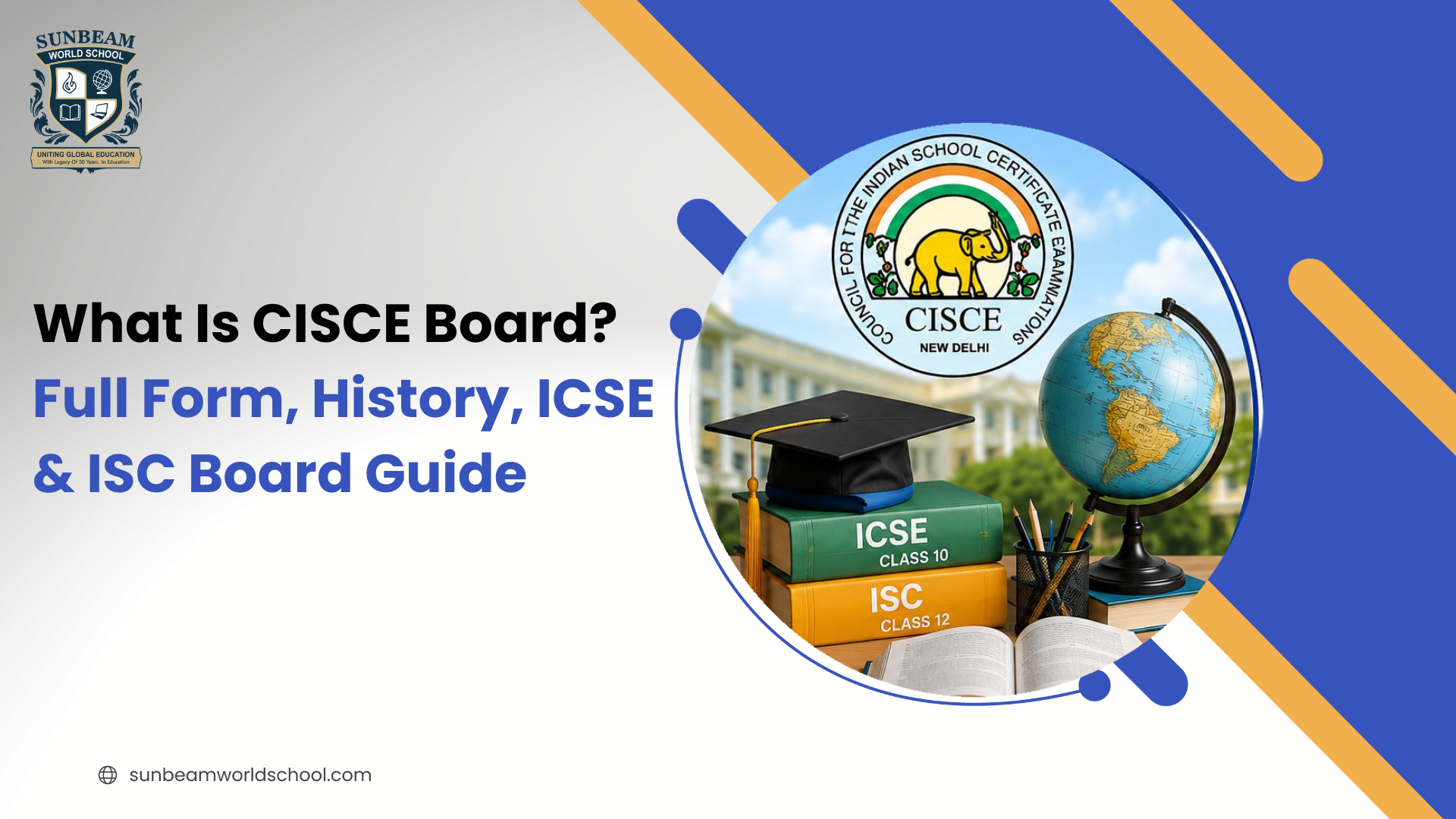
What Is CISCE Board? Full Form, History, ICSE & ISC Board Guide
| CISCE (Council for the Indian School Certificate Examinations) is a private, nationally recognised education board in India that conducts the ICSE (Class 10) and ISC (Class 12) examinations. Known for its strong English curriculum, project-based learning, and application-focused teaching approach, CISCE emphasizes critical thinking, communication skills, and holistic development. With more than 2,600 affiliated schools, the board offers a balanced curriculum across sciences, humanities, languages, and arts, making it a popular choice for students seeking academic depth and global higher education opportunities. |
Choosing the right school board can shape a student's academic journey, career options, and even university opportunities. Among India's major education boards, the Council for the Indian School Certificate Examinations (CISCE) stands out for its strong emphasis on English proficiency, analytical thinking, project-based learning, and a well-rounded curriculum.
Best known for conducting the ICSE (Class 10) and ISC (Class 12) examinations, CISCE is trusted by more than 2,600 schools in India and abroad. Its syllabus is designed to balance languages, sciences, humanities, and creative subjects while encouraging deeper understanding rather than rote memorization.
Let’s learn all about CISCE and how it compares with CBSE to help students and parents make an informed choice.
What Is the CISCE Board?
The CISCE board is the Council for the Indian School Certificate Examinations — a private, national-level board of secondary education in India. It is headquartered in New Delhi and operates autonomously, designing its own curriculum, prescribing its own textbooks and conducting its own exams.
CISCE administers two major examinations every year:
- ICSE — the Indian Certificate of Secondary Education, taken at the end of Class 10.
- ISC — the Indian School Certificate, taken at the end of Class 12.
While CISCE is privately administered, it is fully recognised by the Government of India and its certificates are accepted by universities and education systems across India and abroad. Today, over 2,600 schools in India and several international locations are affiliated with the board.
The board is best known for two things: a deliberately English-medium, conceptually rigorous syllabus, and an unusually balanced learning approach that gives languages, humanities, sciences and the arts equal academic weight.
CISCE Full Form & Key Facts at a Glance
| Fact | Detail |
| Full Form | Council for the Indian School Certificate Examinations (CISCE) |
| Type of Board | Private, national-level, non-governmental board recognised by the Government of India |
| Headquarters | Pragati House, 3rd Floor, 47–48 Nehru Place, New Delhi, India |
| Founded | 1958 |
| Examinations Conducted | ICSE (Indian Certificate of Secondary Education – Class 10), ISC (Indian School Certificate – Class 12), CVE (Certificate of Vocational Education) |
| Medium of Instruction | English (compulsory medium for examinations) |
| Schools Affiliated | More than 2,600 schools in India and overseas |
| ICSE 2026 Candidates | Approximately 2.6 lakh students |
| Official Website | cisce.org |
History and Background of CISCE
The CISCE board was established in 1958, originally as a collaboration between the University of Cambridge Local Examinations Syndicate and the Inter-State Board for Anglo-Indian Education. The idea was simple: create a board that would deliver Cambridge-style, English-medium examinations adapted for Indian schools and Indian learners.
Over the decades, CISCE evolved into a fully autonomous Indian board. It no longer depends on Cambridge — it sets its own syllabus, prescribes its own textbooks, conducts its own exams, and certifies its own students. The board's underlying philosophy, however, has stayed remarkably consistent: thorough, balanced, child-centred education that builds analytical ability rather than rewarding memorization.
That early Cambridge link is also why CISCE certificates have always traveled well internationally — ICSE and ISC holders are recognized by UCAS in the UK and by universities across the USA, Canada, Australia, and Singapore.
CISCE Examinations: ICSE and ISC Explained
CISCE conducts its two flagship examinations at the end of secondary and senior secondary schooling. Each has its own subject grouping, marking pattern and certification.
| Feature | ICSE (Class 10) | ISC (Class 12) |
| Full Form | Indian Certificate of Secondary Education | Indian School Certificate |
| Level | Secondary Education | Senior Secondary Education |
| Total Subjects | Minimum 6 subjects (from Groups I, II, and III) | 4–5 subjects (English + 3 or 4 elective subjects) |
| Theory Paper Marks | 80 marks for most subjects; 100 marks for certain Group III subjects | Typically 70 or 80 marks per theory paper, depending on the subject |
| Internal Assessment | 20 marks per subject through project work, practicals, or coursework | 20–30 marks through practicals, projects, or internal assessments |
| Streams Available | Common curriculum for all students | Science, Commerce, and Humanities streams |
| Pass Criterion | Minimum 35% in English and at least 3 other subjects | Minimum 35% in English and 4 other subjects overall |
ICSE Class 10: Subject Groups, Marks & Pass Criteria
The ICSE syllabus is organized into three subject groups. A student must complete subjects from all three groups, ensuring exposure to languages, humanities, sciences, and a vocational or creative skill.
Group I — Compulsory subjects (all three required)
English (Language & Literature)
Second Language — Hindi, an Indian language, or a modern foreign language
History, Civics & Geography
Group II — Any two subjects
Mathematics
Science (Physics, Chemistry, Biology — combined)
Commercial Studies
Economics
A classical or modern foreign language
Environmental Science
Group III — Any one subject
Computer Applications
Art
Performing Arts
Home Science
Cookery
Fashion Designing
Physical Education
Yoga
Technical Drawing Applications
Marks pattern
Group I and Group II subjects are typically marked out of 100 — split as 80 marks for the written theory paper and 20 marks for internal assessment. Group III subjects carry a similar split (often with a larger practical component).
Pass criteria
To earn the ICSE pass certificate, a candidate must secure a minimum of 35 percent in English plus at least three other subjects — five subjects in total. There is no overall aggregate; the rule is subject-wise.
ISC Class 12: Streams, Subjects & Pass Criteria
ISC is where students specialize. Unlike ICSE's fixed subject groups, ISC gives students considerable freedom to design their own subject combination — within three broad streams.
The three ISC streams
- Science — Physics, Chemistry, Biology / Mathematics / Computer Science
- Commerce — Accounts, Business Studies, Economics, Mathematics or Commerce
- Humanities (Arts) — History, Political Science, Sociology, Psychology, Geography, Economics, Literature
How ISC subject selection works
Every ISC student must take:
- English (compulsory for every stream)
- Three or four elective subjects from the student's chosen stream
- An optional sixth subject (most students opt for one)
Many ISC subjects can be combined across streams, which is why ISC is popular with students aiming for unconventional combinations — for example, a Science student adding Psychology, or a Commerce student adding Mathematics and Computer Science.
Marks pattern
ISC theory papers are usually marked out of 70 or 80 marks, with the remaining 20-30 marks allocated to practicals or project work. English is split into two papers — Language and Literature — together making 100 marks.
Pass criteria
A candidate passes ISC by securing at least 35 percent in English and three other elective subjects. The overall pass certificate requires no fixed aggregate, but most universities use the average of the best four subjects (including English) for admission cut-offs.
CISCE Revised 2026-27 Syllabus
For the 2026-27 academic year, CISCE has issued several syllabus and regulation updates. Students and parents should refer to the latest Regulations and Syllabuses PDF on cisce.org, because older editions remain in circulation. The notable changes include:
- ICSE Class 10 Mathematics — revised weightage in Commercial Arithmetic and Trigonometry chapters.
- ICSE Class 10 Physics — updated practical evaluation, emphasising data analysis over rote tabulation.
- ISC English Literature — new prescribed texts; schools must procure the editions listed in the 2026-27 booklet.
- ISC Computer Science — clearer project submission deadlines and viva-voce weightage.
- Group III subjects (ICSE) — new internal assessment rubrics to standardise project marking across schools.
- NEP 2020 alignment — the syllabus continues to integrate competency-based learning and reduced rote content in line with the National Education Policy.
CISCE Curriculum & Teaching Approach
CISCE's reputation rests on four distinctive features of its teaching approach.
1. English as the medium of instruction
English is the only compulsory language across both ICSE and ISC, and the question papers are notably more demanding than other Indian boards. This builds genuine reading, writing and analytical fluency — a major reason ISC graduates are exempt from English proficiency tests at many overseas universities.
2. Balanced, multidisciplinary content
The board deliberately gives the humanities, the sciences, languages and the arts equal weight. A Class 10 student studying ICSE will encounter history, geography, civics, two languages, mathematics, science and at least one practical subject — rather than narrowing into science early.
3. Internal assessment and project work
Every subject carries a meaningful internal assessment component, usually 20 marks. This includes lab work, research projects, fieldwork and viva-voce — pushing students towards application rather than rote recall.
4. Higher-order, application-based questioning
CISCE question papers traditionally feature longer, more discursive answers and a higher share of application-based problems. The 2026 papers continued the trend of increasing the share of questions that require understanding and critical thinking over direct recall.
Advantages of the CISCE Board
The CISCE Board is known for its well-rounded approach to education, helping students build strong academic foundations while developing essential life skills and subject knowledge.
Comprehensive, Conceptually Deep Syllabus
The CISCE curriculum emphasizes understanding rather than rote memorization. Subjects are taught in depth, encouraging students to develop strong analytical, problem-solving, and application-based skills that support long-term academic success.
Outstanding English Foundation
English is a core focus throughout the CISCE curriculum. Students develop advanced reading, writing, comprehension, and communication skills, which can be beneficial for higher education, competitive examinations, and international opportunities.
Balanced Subject Weighting
Unlike some education boards that prioritize science and mathematics, CISCE gives equal importance to humanities, languages, arts, and sciences. This balanced approach helps students discover their strengths and pursue diverse interests.
Excellent for Creative and Liberal Arts Careers
The board's strong emphasis on languages, literature, social sciences, and project-based learning makes it particularly suitable for students interested in fields such as media, journalism, law, psychology, design, and the arts.
Continuous Evaluation Through Project Work
Internal assessments, practicals, and projects form an important part of the CISCE evaluation system. This reduces dependence on a single final examination and encourages consistent learning throughout the academic year.
International Recognition
ICSE and ISC qualifications are recognised by universities and educational institutions across the world. This makes the board a popular choice for students considering higher education opportunities abroad.
Flexible Subject Choices at ISC Level
ISC students can choose from a wide range of subjects and often combine disciplines across streams. This flexibility allows learners to create academic pathways that align with their interests and future career goals.
Development of Higher-Order Thinking Skills
CISCE examinations often include application-based and analytical questions that encourage critical thinking, reasoning, and creativity. These skills are valuable not only in academics but also in professional and real-world environments.
Challenges of the CISCE Board
The CISCE Board's rigorous curriculum and detailed syllabus can be demanding for some students. Here are a few challenges of CISCE board:
- Heavy, detailed syllabus — Class 10 students juggle six subjects with significant depth in each, which demands disciplined planning.
- High English-language expectations — students from non-English-medium backgrounds may need extra support.
- Limited geographic reach — CISCE schools are concentrated in metros and tier-1 cities, with sparse presence in many rural and tier-3 districts.
- JEE / NEET alignment gap — entrance exams draw mainly from NCERT content, so CISCE students typically need supplementary coaching for top engineering and medical exams (though the 2024-25 Science syllabus realignment has narrowed this gap).
- Generally higher fee structure — CISCE schools often charge more than CBSE or state board schools, due to smaller class sizes and richer co-curricular programmes.
CISCE vs CBSE: Quick Comparison Table
| Parameter | CISCE | CBSE |
| Governing Body | Private, autonomous board recognised by the Government of India | Government board under the Ministry of Education, Government of India |
| Exams Conducted | ICSE (Class 10), ISC (Class 12) | AISSE (Class 10), AISSCE (Class 12) |
| Medium of Instruction | English only | English and Hindi |
| Syllabus Depth | Detailed, comprehensive, and application-oriented | Streamlined, concept-focused, and NCERT-based |
| Subjects in Class 10 | Minimum 6 subjects across three groups | Typically 5 main subjects |
| English Language Emphasis | Very high; separate Language and Literature papers | Moderate emphasis on English |
| Project / Internal Assessment Weightage | Generally 20% per subject | Typically 20% per subject (varies by subject) |
| JEE / NEET Alignment | Indirect; students often require additional NCERT preparation | Directly aligned with NCERT, beneficial for JEE and NEET preparation |
| Number of Affiliated Schools | 2,600+ schools in India and abroad | 27,000+ schools worldwide |
| Best Suited For | Liberal arts, humanities, language-rich learning, and global university admissions | Engineering, medicine, competitive exams, and government entrance tests |
Should You Choose CISCE for Your Child?
CISCE is a strong fit when a family values depth over breadth and is happy to invest in a rigorous, English-medium pathway. The board tends to suit children who:
- Read and write comfortably in English, or are willing to grow into it
- Enjoy projects, research and longer-form writing
- Are interested in liberal arts, humanities, design, media or law
- Are considering undergraduate study abroad
- Prefer continuous assessment over a single high-stakes paper
Families with a clear engineering / medical track in mind, or those who need a less English-intensive curriculum, often find CBSE or a strong state board more practical. Whichever way a family leans, the right approach is to visit prospective schools, look at the subject groupings on offer, and check Group III / elective availability — that is where schools differentiate most.
Conclusion
The CISCE Board is known for its strong academic foundation, emphasis on English proficiency, and application-based learning. Through the ICSE and ISC curricula, students develop critical thinking, communication skills, and subject depth that prepare them for higher education and future careers.
At Sunbeam World School, the CISCE curriculum is delivered through a supportive and engaging learning environment, helping students build confidence, achieve academic excellence, and grow into well-rounded individuals.

Frequently Asked Questions
What is the full form of CISCE?
-CISCE stands for the Council for the Indian School Certificate Examinations. It is a private, national-level education board in India that conducts the ICSE (Class 10) and ISC (Class 12) examinations.
Is CISCE a government board?
+What is the difference between CISCE and ICSE?
+What is the passing criterion in ICSE Class 10?
+How many schools are affiliated with CISCE?
+Is CISCE harder than CBSE?
+Is CISCE recognized internationally?
+What are Group I, II and III subjects in ICSE?
+What are the streams available in ISC Class 12?
+Has CISCE changed the syllabus for 2026-27?
+Does CISCE prepare students for JEE and NEET?
+What is the long form of ICSE?
+Is ICSE the same as CICSE?
+
In this article
Share this post:


Press and Blogs
Stay updated with our press releases, educational blogs, and more.
Quick Summary The area of rectangle equals its length multiplied by its width (A =...

Quick Summary Student success motivational quotes are short, memorable lines that can help students stay...
Quick Summary The area of a square is the total space enclosed within its four...