
Quick Summary A CBSE Class 9 Science paper carries 80 theory marks over three hours, plus 20 marks of internal assessment. For 2026-27 the prescribed book is Exploration, and the 80 marks are split across four units: World of Living 27, Matter 25, Motion Force Work and Sound 23, and Earth as a System 5. Students can also take an optional one-hour Advanced paper of 25 marks.
CBSE Class 9 Science sample papers are the practice papers students use before the half yearly and annual exams, and in 2026-27 the unit structure changed enough that old papers no longer map onto the course. The new NCERT textbook Exploration integrates Physics, Chemistry, Biology and Earth Science into thirteen chapters, and CBSE regrouped the syllabus into four units with a brand new one on Earth as a System. This page gives the current unit-wise marks straight from the CBSE curriculum document, the practical requirement, what the Advanced paper adds, and how to practise for a paper that is now half competency based.
CBSE Class 9 Science 2026-27 at a Glance
| Item | Detail |
|---|---|
| Subject code | 086 |
| Prescribed book | Exploration, 13 chapters |
| Theory paper | 80 marks, 3 hours |
| Internal assessment | 20 marks, including 5 for practical work |
| Units | 4 |
| Highest weightage unit | World of Living, 27 marks |
| Prescribed experiments | 13 |
| Advanced paper | Optional, 25 marks, 1 hour |
CBSE Class 9 Science Sample Paper 2026-27 PDF Download
Download the Sunbeam World School Class 9 Science sample paper below. It is a full 80-mark theory paper built on the unit weightage in the CBSE 2026-27 Science curriculum document and the prescribed Exploration textbook, and it comes with a complete marking scheme. The file is free and needs no sign-up.
| Paper | What is inside | Download |
|---|---|---|
| Class 9 Science Sample Paper 2026-27, Set 1 | 80 marks, 3 hours, competency and case-based questions, with marking scheme | Download PDF |
Print it, write it in one timed sitting, then mark it from the scheme at the end. Pay attention to the case-based questions while marking, since those are where the competency share of the paper is concentrated and where students most often write a correct fact that does not answer the question asked.
Sample papers for the other subjects are linked from our CBSE Class 9 sample papers hub.
What Is the Unit-Wise Marks Distribution for Class 9 Science?
The Class 9 Science theory paper divides its 80 marks across four units, with World of Living carrying the most at 27 marks and the new Earth as a System unit carrying just 5. The figures below come from CBSE's own Class IX Science curriculum document for 2026-27.
| Unit | Unit name | Exploration chapters | Marks |
|---|---|---|---|
| I | World of Living | 2, 3, 11, 12 | 27 |
| II | Matter: Its Nature and Behaviour | 5, 8, 9 | 25 |
| III | Motion, Force, Work and Sound | 4, 6, 7, 10 | 23 |
| IV | Earth as a System | 13 | 5 |
| Total | 80 |
Chapter 1 of Exploration introduces scientific enquiry and is not allotted marks of its own, which surprises students who count thirteen chapters and expect thirteen chunks of the paper. The unit names themselves have changed as well: Sound has been folded into the Motion and Force unit rather than standing alone, and the old Food and Food Production unit is gone, replaced by Earth as a System.
This matters for practice. A paper written for the previous syllabus gives Motion and Force 27 marks and Organization in the Living World 22, almost the reverse of the current balance, and it will include a Food Production section that no longer exists. If a practice paper has those unit names, it predates this session.
Biology now carries the single largest share, through Cell, Tissues, Reproduction and Diversity. Students who find living-world chapters the easiest to read often give them the least revision time, which is the wrong way round when they are worth 27 marks. Our explainers on the food chain and the longitudinal section of a flower are useful for the diagram-heavy parts of this unit.
How Is the Class 9 Science Question Paper Designed?
The Science paper follows CBSE's question paper design of 50% competency focused questions, 20% select response questions and 30% constructed response questions, giving 40, 16 and 24 marks respectively. The paper also carries internal choice in roughly a third of its questions, so students usually have alternatives in the longer answers.
Competency focused questions show up more visibly in Science than in any other subject. They typically open with a short passage, a described experiment or a data table, then ask questions that require reasoning from what is given rather than recall from the chapter. A student who has only memorised definitions will recognise every topic in the paper and still find the questions unfamiliar.
Diagrams carry marks of their own throughout the paper, and a rushed sketch loses them quietly. A labelled diagram drawn in pencil with the parts named clearly is worth the ninety seconds it takes, and it often earns more than a paragraph of description would.
What Are the Class 9 Science Practicals for 2026-27?
CBSE prescribes thirteen experiments for Class 9 Science in 2026-27, each mapped to a specific Exploration chapter, and practical work carries 5 marks within the 20-mark internal assessment. The list covers the standard ground of preparing true solutions and suspensions, separating mixtures, testing laws of motion, measuring density and working with sound.
Because the experiments are chapter-aligned this year, practicals are best done alongside the theory rather than crammed into a block before the assessment. A student who performs the experiment while the chapter is being taught understands the theory better and keeps the record up to date, which is what the 5 marks are actually awarded on. The lab record and the observations matter as much as the activity itself.
How Many Marks Is Internal Assessment in Class 9 Science?
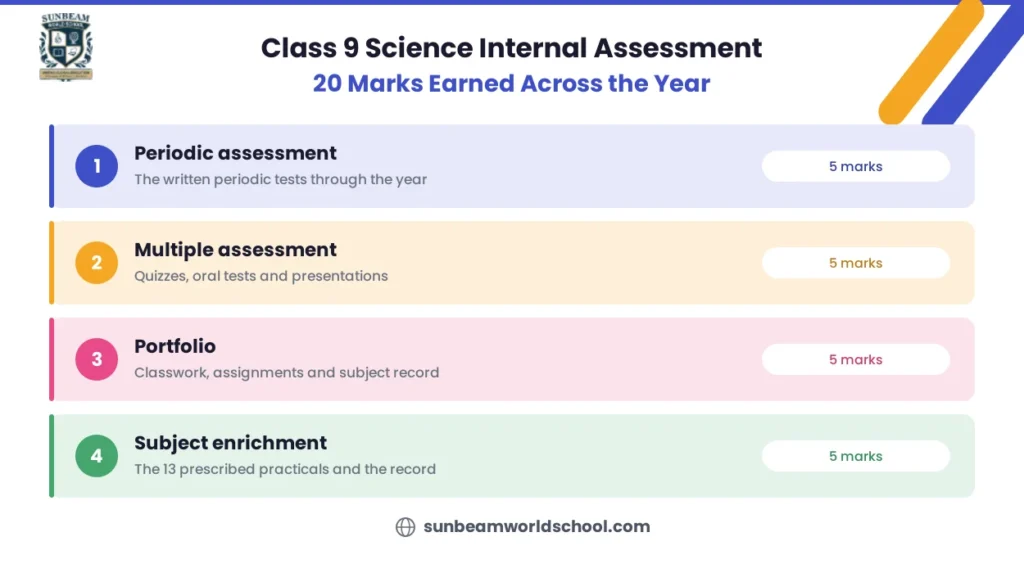
Internal assessment in Science carries 20 marks, made up of four components of 5 marks each as set out in the CBSE curriculum: periodic assessment, multiple assessment, portfolio and subject enrichment through practical work.
- Periodic assessment, 5 marks: the written periodic tests through the session.
- Multiple assessment, 5 marks: quizzes, oral tests, presentations and class activities.
- Portfolio, 5 marks: classwork, assignments and the overall subject record.
- Subject enrichment, 5 marks: the prescribed practical work and its record.
These 20 marks come from work spread across the year, which makes them both the easiest to secure and the easiest to lose. A student who misses periodic tests and submits an incomplete lab file has given away marks that no amount of annual-exam performance can recover.
What Is the Science Advanced Paper in Class 9?
The Science Advanced paper is an optional one-hour paper of 25 marks introduced from 2026-27, written alongside the compulsory 80-mark Standard paper that every student takes. Its marks stay out of the overall aggregate, and a student scoring 50% or more has the advanced qualification recorded separately on the marksheet.
A student can take Advanced in Science, in Maths, in both or in neither, with no eligibility test to clear first. For those who opt in, the preparation is different in kind rather than in amount. The Standard paper rewards full syllabus coverage and three hours of pacing, while the Advanced paper is a dense hour of higher-order questions where a few problems decide the result, so practising another full-length mock is not the way to get ready for it.
Class 9 Science Half Yearly and Periodic Test Papers
A Class 9 Science half yearly paper covers the units taught up to mid-session and is set by the school, usually in September or October, while periodic tests are short written tests of around 20 marks scaled down to 5 for internal assessment. Neither is set by CBSE, which is why their format varies from school to school.
Your own school's past half yearly papers are therefore the most useful practice material available, more so than any paper downloaded from a website, and most schools will share them on request. Students who treat each periodic test as a rehearsal for the annual paper reach the annual exam having already written the format several times, which takes most of the nerves out of it.
How Should a Class 9 Student Practise Science Sample Papers?
A Class 9 student should write three to five full Science papers before the annual exam, each in a single timed three-hour sitting, then spend the next day working through the mistakes. Timed practice is the only reliable way to find out whether a student can finish the numerical sections in Motion and Force and still leave time for the longer biology answers.
Practise the numerical and the descriptive together
Science papers mix calculation with explanation, and students usually find one of the two slower than they expect. Writing a full paper reveals the imbalance, where answering only the questions you enjoy does not. If the numericals in Motion and Sound are eating the clock, that is a pacing problem to solve with practice rather than a knowledge gap to read about.
Treat diagrams as marks, not decoration
Draw diagrams in pencil, label every part asked for, and give them room on the page. Students lose marks on diagrams they could draw perfectly well, simply by squeezing them into a corner or leaving the labels off. The same applies to units in numerical answers, which are part of the answer rather than an optional addition.
Review in patterns, not question by question
Marks tend to be lost in patterns rather than at random, whether that is misreading case based questions, skipping the second part of two-part questions, or running out of time in the last section. Those patterns only become visible across several papers, which is the real argument for writing more than one. Pairing that review with a working method, as set out in how to study effectively, is what turns practice into marks.
Where Can I Get the Official Class 9 Science Syllabus?
The official CBSE Class 9 Science curriculum for 2026-27, containing the unit-wise marks, the question paper design and the full list of thirteen prescribed experiments, is published as a PDF at cbseacademic.nic.in. It is also reachable from CBSE's Curriculum 2026-27 page under Secondary Curriculum Part-I.
That curriculum document plus the NCERT exemplar problems are the most authoritative material available for Science practice. The chapter-wise Exploration PDFs on the NCERT portal are worth opening too, simply to confirm the current chapter list before trusting any practice paper. The full set of official Class 9 material is listed in our guide to CBSE Class 9 sample papers.
Conclusion
Biology quietly carries the largest share of this paper, and the competency questions reward students who can reason from a passage rather than recite a chapter. Write a few full papers under the clock, keep the lab file current, and both halves of the subject look after themselves. For live Science classes and regular practice papers through Class 9, book a free demo session with the Sunbeam World School team.