Quick Summary Even numbers are whole numbers that divide exactly by 2, such as 0, 2, 4, 6 and 8, while odd numbers leave a remainder of 1 when divided by 2, such as 1, 3, 5, 7 and 9. A number is even if its last digit is 0, 2, 4, 6 or 8, and odd if it ends in 1, 3, 5, 7 or 9.
Odd numbers and even numbers are the two groups that every whole number falls into, and spotting the difference is one of the first number patterns children learn, right alongside counting in 2s and comparing numbers with the greater than and less than symbols. This guide to odd even numbers covers the definition, the difference between them, the rules for adding and multiplying them, clear answers for tricky numbers like 0, 1 and 2, a full 1 to 100 list and practice questions with answers.
[Image: Odd vs even numbers comparison infographic. Alt text: "Odd and even numbers definition, last digits and examples"]
What Are Odd and Even Numbers?
Odd and even numbers are the two groups all whole numbers split into: even numbers divide exactly by 2, while odd numbers leave a remainder of 1.
So the definition of odd and even numbers comes down to one test, dividing by 2. If a number can be shared into two equal groups, or arranged in pairs with nothing left over, it is even, and if one is always left over, it is odd. This is why every whole number is either odd or even, never both, and why the pattern simply alternates: 1 is odd, 2 is even, 3 is odd, 4 is even, and so on forever. People often shorten the terms to odd no and even no, but the meaning of odd and even number stays exactly the same.
Odd and Even Numbers in Hindi
In Hindi, even numbers are called सम संख्या (sam sankhya) and odd numbers are called विषम संख्या (visham sankhya). The rules are the same in every language, so a sam sankhya divides exactly by 2 and a visham sankhya leaves a remainder of 1.
What Are Odd Numbers?
Odd numbers are whole numbers that cannot be divided exactly by 2, so they always leave a remainder of 1, such as 1, 3, 5, 7 and 9.
The odd number meaning is easiest to see with objects, since if you try to pair up 7 sweets, you get 3 pairs and 1 sweet left over, and that leftover is what makes 7 odd. Every odd number ends in 1, 3, 5, 7 or 9, so the quickest answer to "what is odd no?" is simply to check the last digit. Odd numbers go on forever, with each one exactly 2 more than the one before it.
Odd Numbers Definition with Examples
An odd number is any whole number that leaves a remainder of 1 when divided by 2, such as 7, because 7 ÷ 2 = 3 with 1 left over.
The same test works for any odd number. For example, 15 ÷ 2 = 7 remainder 1 and 99 ÷ 2 = 49 remainder 1, so both are odd, and in maths odd numbers are often described as numbers that are "one more than an even number".
Examples of Odd Numbers
Examples of odd numbers include 1, 3, 5, 7 and 9 among single digits, 11, 23, 45 and 99 among two-digit numbers, and 101, 357 and 999 among three-digit numbers.
Larger numbers follow the same rule, so 12,345 is odd because it ends in 5, and 4,08,761 is odd because it ends in 1. However long the number is, only its last digit decides whether it is odd.
What Are Even Numbers?
Even numbers are whole numbers that divide exactly by 2 with no remainder, such as 0, 2, 4, 6 and 8.
An even number can always be split into two equal groups or arranged in pairs with nothing left over, so 8 sweets make 4 neat pairs. Every even number ends in 0, 2, 4, 6 or 8, and each one is exactly 2 more than the even number before it.
Even Numbers Definition with Examples
An even number is any whole number that leaves a remainder of 0 when divided by 2, such as 8, because 8 ÷ 2 = 4 exactly.
The same check works for bigger even numbers too, since 26 ÷ 2 = 13 and 100 ÷ 2 = 50, with nothing left over in either case.
Examples of Even Numbers
Examples of even numbers include 0, 2, 4, 6 and 8 among single digits, 10, 26, 72 and 98 among two-digit numbers, and 100, 246 and 888 among three-digit numbers.
Large numbers like 5,000 and 3,47,920 are even because they end in 0, which shows the last digit rule works however big the number gets.
What Is the First Even Number?
The first even number is 0 if you count whole numbers, and 2 if you count only positive numbers, which is why some textbooks say even numbers start from 2.
Both answers are correct for their own number set. 0 is even because it divides by 2 with no remainder, while 2 is the smallest even counting number and the first even number children usually meet.
What Is the Difference Between Odd and Even Numbers?
Odd and even numbers Difference
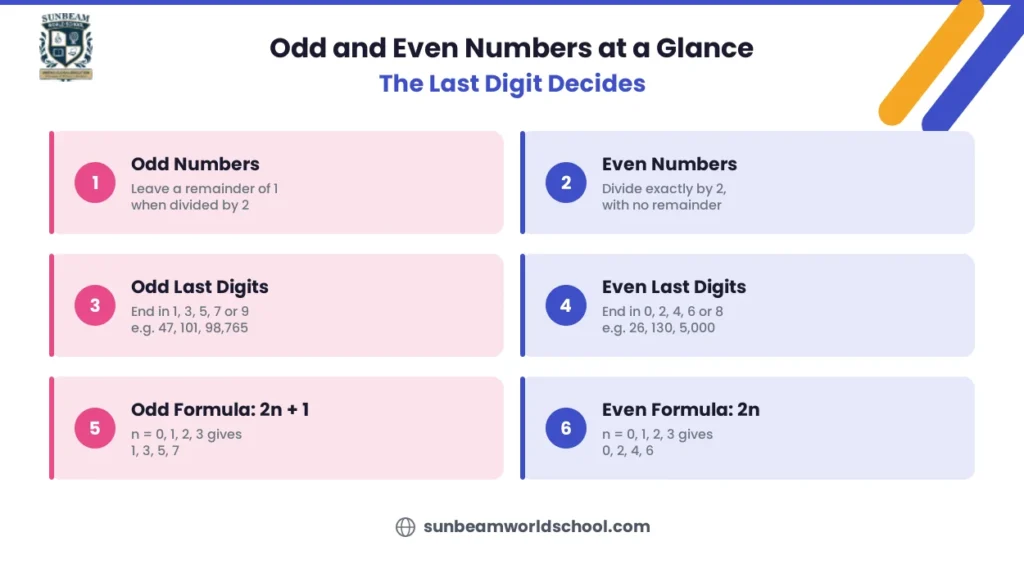
The difference between odd and even numbers is the remainder when divided by 2: even numbers leave 0 and end in 0, 2, 4, 6 or 8. Odd numbers leave 1 and end in 1, 3, 5, 7 or 9.
The table compares odd vs even numbers across ten features, so you can see every difference between odd number and even number in one place.
| Feature | Odd numbers | Even numbers |
|---|---|---|
| Definition | Cannot be divided exactly by 2 | Can be divided exactly by 2 |
| Remainder when divided by 2 | 1 | 0 |
| General form | 2n + 1 | 2n |
| Last digit | 1, 3, 5, 7 or 9 | 0, 2, 4, 6 or 8 |
| Arranged in pairs | One always left over | No leftovers |
| Smallest positive number | 1 | 2 |
| Examples | 3, 15, 27, 101 | 4, 16, 28, 100 |
| Sum of two of the same type | Even (3 + 5 = 8) | Even (4 + 6 = 10) |
| Product of two of the same type | Odd (3 × 5 = 15) | Even (4 × 6 = 24) |
| Zero | 0 is not odd | 0 is even |
How to Find Odd and Even Numbers?
Rules of even and odd numbers
To find odd and even numbers, check the last digit: 0, 2, 4, 6 or 8 means even, and 1, 3, 5, 7 or 9 means odd.
This works for any whole number, however big, because every ten, hundred and thousand is already even, so only the ones digit can change the answer. Here are three ways to check, plus a simple way to explain it to children.
The Last Digit Rule
The last digit rule marks a number even if it ends in 0, 2, 4, 6 or 8, and odd if it ends in 1, 3, 5, 7 or 9.
- Look only at the digit in the ones place.
- If it is 0, 2, 4, 6 or 8, the number is even, so 130 is even.
- If it is 1, 3, 5, 7 or 9, the number is odd, so 47 is odd.
The Divide by 2 Method
The divide by 2 method checks the remainder, so a number is even if the remainder is 0 and odd if the remainder is 1.
For example, 18 ÷ 2 = 9 remainder 0, so 18 is even, while 21 ÷ 2 = 10 remainder 1, so 21 is odd. This method takes longer than the last digit rule, but it shows why the rule works.
Checking Big Numbers
Big numbers are checked the same way, so 2,22,24,52,122 is even because it ends in 2, with no division needed.
In the same way, 98,765 is odd because it ends in 5, and 1,00,000 is even because it ends in 0, which makes the last digit rule the quickest way to identify odd and even numbers of any size.
How to Explain Odd and Even Numbers to Kids
Explain odd and even numbers to kids by pairing up objects: an even number makes perfect pairs, while an odd number always leaves one without a partner.
Try lining up toys, buttons or blocks in pairs, or play a "buddy up" game where children pair off and see whether anyone is left alone. Counting in 2s (2, 4, 6, 8) and skipping every other number on a number line also helps children see the alternating pattern before they learn the last digit rule.
What Is the Formula for Odd and Even Numbers?
The formula for an even number is 2n and the formula for an odd number is 2n + 1, where n is any whole number or integer.
Putting n = 0, 1, 2, 3 into 2n gives the even numbers 0, 2, 4 and 6, while putting the same values into 2n + 1 gives the odd numbers 1, 3, 5 and 7. Some textbooks write the odd number formula as 2n − 1 instead, which gives the same list when n starts at 1. Using a letter like n to stand for any number is often a student's first step into algebra, the same idea behind the algebra equations solved in later classes.
| n | Even number (2n) | Odd number (2n + 1) |
|---|---|---|
| 0 | 0 | 1 |
| 1 | 2 | 3 |
| 2 | 4 | 5 |
| 3 | 6 | 7 |
| 10 | 20 | 21 |
What Are the Rules of Even and Odd Numbers?
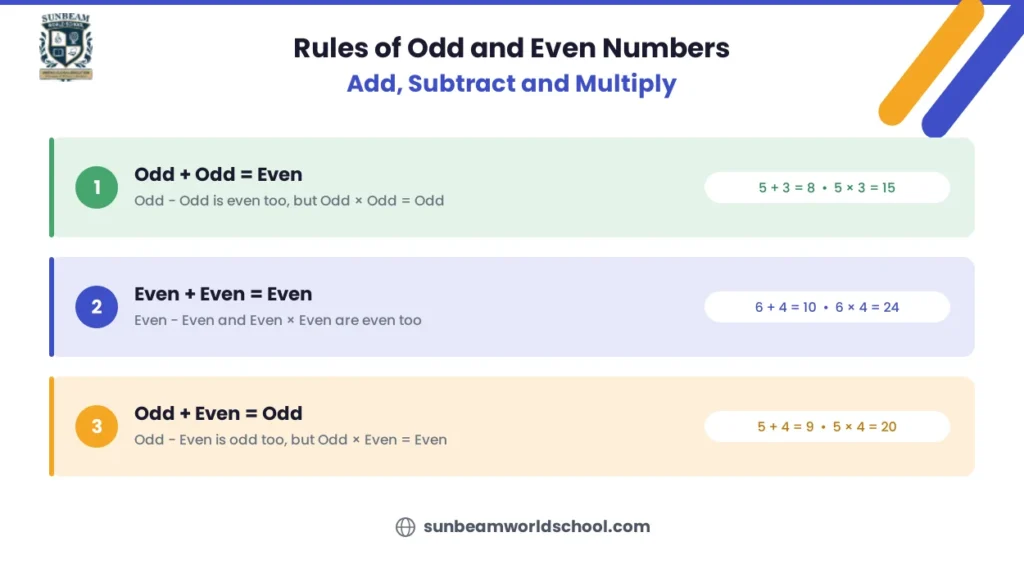
Same-type pairs add or subtract to an even answer, mixed pairs give an odd answer, and a product is odd only when both numbers are odd.
This table brings the rules of even and odd numbers together, with an example in every cell, so all the odd even number rules sit in one place.
| Pair | Addition | Subtraction | Multiplication |
|---|---|---|---|
| Odd and odd | Even (5 + 3 = 8) | Even (5 − 3 = 2) | Odd (5 × 3 = 15) |
| Even and even | Even (6 + 4 = 10) | Even (6 − 4 = 2) | Even (6 × 4 = 24) |
| Odd and even | Odd (5 + 4 = 9) | Odd (5 − 4 = 1) | Even (5 × 4 = 20) |
[Image: Rules of odd and even numbers grid. Alt text: "Rules of even and odd numbers for addition, subtraction and multiplication"]
Adding Odd and Even Numbers
The sum of two odd numbers is always even (3 + 5 = 8), even plus even is even, and odd plus even is odd (7 + 2 = 9).
The reason is the leftover, since each odd number has one item left over after pairing, and when you add odd plus odd, the two leftovers pair up with each other, which is why odd odd even is the rule people remember. When you work out even number plus odd number, there is only one leftover, so the answer stays odd.
Subtracting Odd and Even Numbers
Subtracting follows the addition pattern: odd minus odd and even minus even give even answers, while odd minus even or even minus odd gives an odd answer.
For example, 9 − 3 = 6 and 10 − 4 = 6 are both even, while odd number minus even number gives an odd result, like 9 − 4 = 5, and so does even minus odd, like 10 − 3 = 7.
Multiplying Odd and Even Numbers
Odd times odd is always odd (3 × 5 = 15), while any multiplication that includes an even number is even, so odd x even is even.
For example, 3 × 4 = 12 is even, so a product can only be odd when every number being multiplied is odd. Even a long multiplication like 3 × 5 × 7 × 2 is even, because the single 2 makes the whole product divisible by 2.
Is There a Rule for Dividing Odd and Even Numbers?
There is no fixed rule for dividing odd and even numbers, because the answer can be odd, even or not a whole number at all.
For example, 12 ÷ 4 = 3 is odd, 16 ÷ 4 = 4 is even, and 6 ÷ 4 = 1.5 is not a whole number, so it is neither odd nor even. Each division has to be worked out on its own.
Is 0 an Odd or Even Number?
0 (zero) is an even number, because 0 ÷ 2 = 0 with no remainder, and it fits the even number formula 2n when n = 0.
Two more checks agree, since 0 ends in the digit 0, which the last digit rule marks as even, and it sits between two odd numbers, −1 and 1, just as every even number sits between two odd ones. So whether the question is written as "0 is even or odd" or "o is even or odd", zero is always even.
Is 1 an Odd Number?
Yes, 1 is an odd number, and it is the smallest positive odd number, because 1 ÷ 2 = 0 with a remainder of 1.
1 also fits the odd number formula 2n + 1 when n = 0, and it ends in 1, which the last digit rule marks as odd. One thing that confuses students is that 1 is odd but not prime, since a prime number needs exactly two factors and 1 has only one.
Is 2 Even or Odd?
2 is an even number, because 2 ÷ 2 = 1 with no remainder, and it is the smallest positive even number.
2 is also special because it is the only even prime number, as its only factors are 1 and 2. Every other even number can be divided by 2 as well as by 1 and itself, which is why 2 is the only even number on the list of prime numbers up to 100.
Is 9 Odd or Even? Quick Answers for Common Numbers
9 is an odd number, because it ends in 9 and 9 ÷ 2 = 4 with a remainder of 1.
The table gives quick answers for the numbers people check most often, with the reason for each one.
| Number | Odd or even | Why |
|---|---|---|
| 3 | Odd | Ends in 3, so 3 ÷ 2 leaves a remainder of 1 |
| 4 | Even | Ends in 4, so 4 ÷ 2 = 2 exactly |
| 5 | Odd | Ends in 5, so 5 ÷ 2 leaves a remainder of 1 |
| 6 | Even | Ends in 6, so 6 ÷ 2 = 3 exactly |
| 7 | Odd | Ends in 7, so 7 ÷ 2 leaves a remainder of 1 |
| 8 | Even | Ends in 8, so 8 ÷ 2 = 4 exactly |
| 9 | Odd | Ends in 9, so 9 ÷ 2 leaves a remainder of 1 |
| 10 | Even | Ends in 0, so 10 ÷ 2 = 5 exactly |
| 12 | Even | Ends in 2, so 12 ÷ 2 = 6 exactly |
| 13 | Odd | Ends in 3, so 13 ÷ 2 leaves a remainder of 1 |
| 14 | Even | Ends in 4, so 14 ÷ 2 = 7 exactly |
| 15 | Odd | Ends in 5, so 15 ÷ 2 leaves a remainder of 1 |
| 17 | Odd | Ends in 7, so 17 ÷ 2 leaves a remainder of 1 |
| 20 | Even | Ends in 0, so 20 ÷ 2 = 10 exactly |
| 22 | Even | Ends in 2, so 22 ÷ 2 = 11 exactly |
| 23 | Odd | Ends in 3, so 23 ÷ 2 leaves a remainder of 1 |
| 24 | Even | Ends in 4, so 24 ÷ 2 = 12 exactly |
| 25 | Odd | Ends in 5, so 25 ÷ 2 leaves a remainder of 1 |
| 29 | Odd | Ends in 9, so 29 ÷ 2 leaves a remainder of 1 |
| 30 | Even | Ends in 0, so 30 ÷ 2 = 15 exactly |
| 32 | Even | Ends in 2, so 32 ÷ 2 = 16 exactly |
| 35 | Odd | Ends in 5, so 35 ÷ 2 leaves a remainder of 1 |
| 50 | Even | Ends in 0, so 50 ÷ 2 = 25 exactly |
Odd and Even Numbers 1 to 100
From 1 to 100 there are 50 odd numbers, from 1 to 99, and 50 even numbers, from 2 to 100.
Each group of ten has exactly five odd and five even numbers, which makes the full list easy to check. Writing numbers in a list like this is a good counting exercise too, much like learning Roman numerals 1 to 1000, where the same numbers are written in a completely different way.
Odd Numbers 1 to 100
The odd numbers from 1 to 100 are the 50 numbers ending in 1, 3, 5, 7 or 9, starting at 1 and ending at 99.
| Range | Odd numbers |
|---|---|
| 1 to 10 | 1, 3, 5, 7, 9 |
| 11 to 20 | 11, 13, 15, 17, 19 |
| 21 to 30 | 21, 23, 25, 27, 29 |
| 31 to 40 | 31, 33, 35, 37, 39 |
| 41 to 50 | 41, 43, 45, 47, 49 |
| 51 to 60 | 51, 53, 55, 57, 59 |
| 61 to 70 | 61, 63, 65, 67, 69 |
| 71 to 80 | 71, 73, 75, 77, 79 |
| 81 to 90 | 81, 83, 85, 87, 89 |
| 91 to 100 | 91, 93, 95, 97, 99 |
Even Numbers 1 to 100
The even numbers from 1 to 100 are the 50 numbers ending in 0, 2, 4, 6 or 8, starting at 2 and ending at 100.
| Range | Even numbers |
|---|---|
| 1 to 10 | 2, 4, 6, 8, 10 |
| 11 to 20 | 12, 14, 16, 18, 20 |
| 21 to 30 | 22, 24, 26, 28, 30 |
| 31 to 40 | 32, 34, 36, 38, 40 |
| 41 to 50 | 42, 44, 46, 48, 50 |
| 51 to 60 | 52, 54, 56, 58, 60 |
| 61 to 70 | 62, 64, 66, 68, 70 |
| 71 to 80 | 72, 74, 76, 78, 80 |
| 81 to 90 | 82, 84, 86, 88, 90 |
| 91 to 100 | 92, 94, 96, 98, 100 |
What Are Odd Natural Numbers?
Odd natural numbers are counting numbers not divisible by 2, which are 1, 3, 5, 7, 9 and so on, with 1 as the first.
Natural numbers start from 1, so there are no odd natural numbers below 1, and the even natural numbers start from 2. Odd natural numbers form a series that grows by 2 each time, which is why they are sometimes called the odd number series.
Set of Odd Integers and Even Integers
The set of odd integers is {..., −5, −3, −1, 1, 3, 5, ...}, and the set of even integers is {..., −4, −2, 0, 2, 4, ...}.
In set notation, the set of odd numbers can be written as {2n + 1 : n is an integer} and the set of even numbers as {2n : n is an integer}. Integers include negative numbers and zero, so these sets go on forever in both directions.
Are Negative Numbers Odd or Even?
Negative numbers can be odd or even, and the same rules apply, so −6 is even and −7 is odd.
The last digit rule still works, because −6 ends in 6 and −7 ends in 7. Dividing by 2 gives the same result too, since −6 ÷ 2 = −3 exactly.
What Are Odd Digits?
The odd digits are 1, 3, 5, 7 and 9, and the even digits are 0, 2, 4, 6 and 8.
Since there are ten digits in total, exactly five are odd and five are even, and the last digit of any number tells you which group the whole number belongs to.
What Are Some Fun Facts About Odd and Even Numbers?
Every odd number written in English contains the letter "e", adding odd numbers in order always makes a square number, and 2 is the only even prime.
- Every odd number has an "e": odd numbers always end in one, three, five, seven or nine, and each of these words contains an "e".
- Odd numbers build squares: 1 + 3 = 4, 1 + 3 + 5 = 9 and 1 + 3 + 5 + 7 = 16, so adding the first odd numbers always gives a square number.
- 2 is the only even prime: every other even number has 2 as a factor.
- Odd, even and prime are types of numbers: in mathematics, even, odd and prime are all types of integers, sorted by how they divide.
- A riddle to try: which odd number becomes even when you take away one letter? Seven, because removing the "s" leaves "even".
Odd and Even Numbers Practice Questions with Answers
These eight practice questions test the last digit rule, the formula and the rules for adding and multiplying odd and even numbers, with the answer shown directly below each one.
1. Is 47 odd or even? 47 ends in 7, so it is odd.
2. Is 0 odd or even? 0 ÷ 2 = 0 with no remainder, so it is even.
3. List the odd numbers between 20 and 30. 21, 23, 25, 27 and 29.
4. What is 13 + 17, and is the answer odd or even? 13 + 17 = 30, which is even, because odd + odd is always even.
5. What is 6 × 9, and is the answer odd or even? 6 × 9 = 54, which is even, because any product with an even number is even.
6. Without dividing, is 98,765 odd or even? It ends in 5, so it is odd.
7. Use the formula 2n + 1 to find the odd number when n = 9. 2 × 9 + 1 = 19.
8. How many even numbers are there from 1 to 50? 2, 4, 6 up to 50 gives 25 even numbers.
Questions like these build the number sense that later maths depends on, and students who want to see how number skills appear in exams can move on to the CBSE Class 9 maths sample paper.
Conclusion
Help your child master odd and even numbers by practising with everyday examples. Ask them to identify the last digit of different numbers, sort objects into groups, and classify numbers as odd or even. These simple activities make maths easier to understand and remember. At Sunbeam World School, we encourage children to build strong foundational maths skills through interactive, engaging and personalised learning experiences, helping them approach bigger mathematical concepts with confidence.