 CBSE
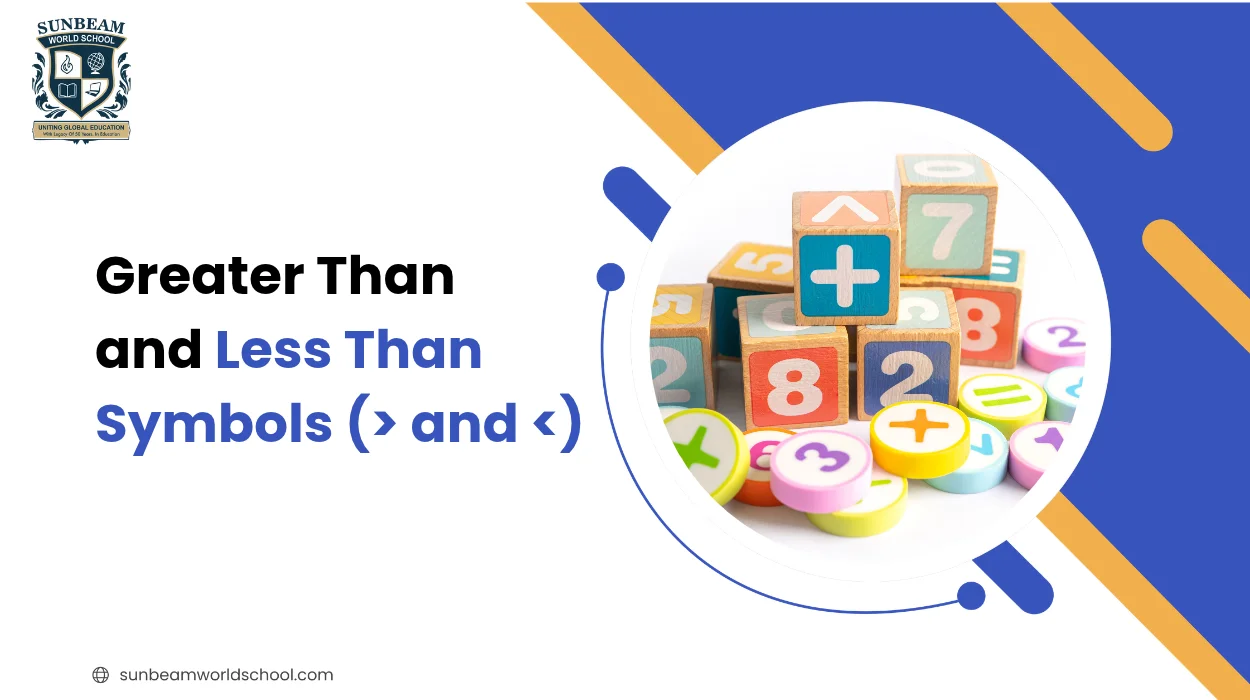
Greater Than and Less Than Symbols (> and <): Meaning, Tricks and Examples
Quick Summary The greater than symbol (>) means the number on the left is bigger, as in 9 > 4, and the less than symbol (<) means the number on the left is smaller, as in 2 < 6. The open side of the symbol always faces the bigger number, and the pointed end always points to the smaller one.
The greater than and less than symbols are two of the first maths signs children learn, and they are also two of the easiest to mix up, even for adults. Whether you search for greater than less than symbols, smaller than and greater than, or more than and less than signs, they all describe the same two marks, > and <. This guide explains the greater than symbol and the less than symbol with meanings and examples, five easy tricks to remember which is which, how to compare whole numbers, decimals, fractions and negative numbers, the related signs ≥, ≤ and ≠, what phrases like "not less than" mean, how to type the symbols, their meaning in Hindi, Tamil and Telugu, and a full worksheet of greater than and less than questions with answers.
[Image: greater-than-and-less-than-symbols.webp, greater than and less than symbols chart with examples 9 > 4 and 2 < 6. Alt text: "Greater than less than symbols picture with examples"]
What Is the Greater Than Symbol (>)?
The greater than symbol (>) shows that the left number is bigger than the right number, so 9 > 4 reads "nine is greater than four". Its wide, open side faces the bigger number.
What is the greater than sign? It is simply another name for the greater than symbol, so the sign of greater than is always >, and the greater than sign in math is used whenever the first of two values is larger. It is also called the more than symbol or the more than sign, and some children call it the bigger than sign, since all these names describe the same idea. The symbol never changes shape, only its direction matters, which is why reading it from left to right is the key to using it correctly.
Greater Than Meaning
Greater than means "larger in value", so a number that is greater than another sits further right on a number line. For example, 15 is greater than 10, written 15 > 10, because 15 is 5 more than 10.
In maths, "greater" always refers to value, not to how long a number looks or how many digits it has after a decimal point. This is why 0.5 is greater than 0.45 even though 0.45 has more digits.
Greater Than Symbol Examples
Greater than symbol examples show the bigger number written first, followed by > and then the smaller number, and every greater than symbol example below follows this pattern.
| Example | Read As |
|---|---|
| 8 > 3 | Eight is greater than three |
| 50 > 25 | Fifty is greater than twenty-five |
| 1,000 > 999 | One thousand is greater than nine hundred ninety-nine |
| 0.7 > 0.07 | Zero point seven is greater than zero point zero seven |
| 3/4 > 1/2 | Three quarters is greater than one half |
| −1 > −5 | Negative one is greater than negative five |
What Is the Less Than Symbol (<)?
The less than symbol (<) shows that the left number is smaller than the right number, so 2 < 6 reads "two is less than six". Its pointed end faces the smaller number.
What is the less than sign? It is the less than symbol, <, also called the less sign, and it is simply the greater than sign turned around, so the same pair of numbers can be written either way. For example, 2 < 6 and 6 > 2 both say exactly the same thing, just starting from a different number. It is also called the smaller than symbol or the lesser than sign.
Less Than in Math (Less Than Meaning in Maths)
Less than in maths means "smaller in value", so a number that is less than another sits further left on a number line. For example, 4 is less than 9, written 4 < 9, because 4 is 5 fewer than 9.
The word "less" is used for amounts and numbers, while "fewer" is often used for things that can be counted, but in maths both are written with the same symbol, <. So the less than sign in math and the less than symbol in math are the same thing.
Less Than Symbol Examples
Less than symbol examples show the smaller number written first, followed by < and then the bigger number. Each less than symbol example and less than sign example below follows this rule.
| Example | Read As |
|---|---|
| 3 < 8 | Three is less than eight |
| 19 < 91 | Nineteen is less than ninety-one |
| 0.25 < 0.3 | Zero point two five is less than zero point three |
| 1/3 < 1/2 | One third is less than one half |
| −6 < −2 | Negative six is less than negative two |
| 0 < 1 | Zero is less than one |
What Are the Symbols for Greater Than and Less Than?
The symbols for greater than and less than are > and <, used with = to show whether one number is bigger, smaller or the same as another.
Together they are called the greater than less than symbols, and each one is also known as a greater than and less than sign. If you have wondered what are the greater than and less than signs, the chart below shows the greater than symbol and less than symbol side by side with the equal sign.
| Symbol | Name | Meaning | Example | Read As |
|---|---|---|---|---|
| > | Greater than | Left number is bigger | 7 > 4 | Seven is greater than four |
| < | Less than | Left number is smaller | 4 < 7 | Four is less than seven |
| = | Equal to | Both numbers are the same | 7 = 7 | Seven is equal to seven |
The English mathematician Thomas Harriot introduced the > and < symbols, and they first appeared in his book on algebra, published in 1631, ten years after his death. Nearly four centuries later, the same two signs are used in every maths classroom and every programming language in the world.
Which Symbol Is Greater Than?
The > symbol is greater than, because its open side is on the left, facing the first number, which is the bigger one. The < symbol is less than, because its pointed end is on the left, pointing at the smaller first number.
So which sign is greater than? It is the > sign, and when someone asks "which is greater" or "which is more", the answer is always the number at the open side of the sign. A quick check is to read the symbol as if it were a word between two numbers. If the wide side meets the first number first, the sentence says "greater than", and if the narrow point meets it first, the sentence says "less than".
Less Than vs More Than
Less than (<) and more than (>) are opposites, since less than means the first number is smaller while more than means the first number is bigger. Switching the order of the numbers always switches the symbol.
| Less Than | More Than | |
|---|---|---|
| Symbol | < | > |
| Pointed end faces | The first number | The second number |
| Example | 3 < 10 | 10 > 3 |
| Opposite statement | 10 > 3 | 3 < 10 |
More Than and Less Than Symbols
More than and less than symbols are the same as greater than and less than symbols, with > meaning more than and < meaning less than. People also call them more than less than signs.
The same idea is sometimes described as smaller than and greater than, or greater than and smaller than, and the symbols never change, only the words used to read them aloud.
How to Remember Greater Than and Less Than Symbols?
You can remember greater than and less than symbols with the alligator trick, where the open mouth eats the bigger number, or the "L for less" trick.
[Image: how-to-remember-greater-than-and-less-than.webp, alligator trick, pointy end trick, L trick, dot trick and hand trick for greater than and less than symbols. Alt text: "How to remember greater than and less than symbols"]
The Alligator Trick
The alligator trick turns the symbol into a hungry alligator's mouth that always opens towards the bigger number, because it wants to eat the larger meal. In 5 < 12, the mouth opens towards 12, so 12 is the bigger number.
This is the most popular trick for young children, and drawing a few teeth inside the symbol makes it easy to remember. Some teachers use a hungry crocodile, a shark or a Pac-Man instead, and they all work the same way.
The Pointy End Trick
The pointy end trick says that the small, pointed tip of the symbol always points at the smaller number, while the wide end faces the bigger number. In 2 < 9, the point touches the 2, so 2 is smaller.
Many older students prefer this trick because it needs no picture, only the simple rule that "small end, small number".
The "L" for Less Than Trick
The "L" trick works because the less than sign (<) looks like a capital L that has been tilted, and L stands for "less". If the symbol looks like an L, it means less than.
The greater than sign cannot be turned into an L in the same way, so whichever symbol is not the L must be greater than. Some teachers call this the "squashed L" trick, and many students find it easier than the alligator.
The Dot Trick
The dot trick uses dots to build the symbol, with two dots placed next to the bigger number and one dot next to the smaller number. Joining the two dots to the single dot draws the correct sign.
For example, to compare 8 and 3, put two dots beside 8 and one dot beside 3, then join them. The lines meet at the single dot, forming 8 > 3, which shows the trick works without remembering any names at all.
The Left Hand Trick
The left hand trick works because your left thumb and index finger, stretched out, make a shape like <, and Left stands for Less. The right hand makes the opposite shape, which is >.
This trick is handy during a test, because hands are always available and the link between "left" and "less" is easy to recall.
Read the Symbol From Left to Right
Reading the symbol from left to right is the final check, because the sign is always read in the same direction as an English sentence. If the first thing you meet is the wide side, read "greater than", and if it is the point, read "less than".
For example, 6 > 1 is read "six is greater than one", while 1 < 6 is read "one is less than six".
How to Use Greater Than and Less Than?
You use greater than and less than by comparing two values, finding which one is bigger, and placing the open side of the symbol towards that bigger value. The method changes slightly for decimals, fractions and negative numbers.
Comparing Whole Numbers
Whole numbers are compared by counting digits first, since a number with more digits is always greater, so 1,250 > 999. If both have the same number of digits, compare them place by place from the left.
For example, to compare 4,561 and 4,516, the thousands (4) and hundreds (5) are the same, but the tens digit is 6 in the first number and 1 in the second. Since 6 > 1, the answer is 4,561 > 4,516.
Comparing Decimals
Decimals are compared by lining up the decimal points and comparing digits from the left, adding zeros to make the decimal places equal. For example, 0.3 becomes 0.30, so 0.25 < 0.30.
This is where many students go wrong, since 0.25 looks bigger than 0.3 because 25 is bigger than 3. Adding the zero shows the truth clearly, because 25 hundredths is less than 30 hundredths.
Comparing Fractions
Fractions with the same denominator are compared by their numerators, so 5/8 > 3/8. Fractions with different denominators are first changed to a common denominator, so 2/3 and 3/4 become 8/12 and 9/12, showing 2/3 < 3/4.
Another quick method is to change both fractions into decimals. Since 2/3 is about 0.67 and 3/4 is 0.75, the answer is the same, 2/3 < 3/4.
Comparing Negative Numbers
Negative numbers are compared by their distance from zero, and the negative number closer to zero is always the greater one, so −1 > −3. Every negative number is also less than zero and less than every positive number.
This feels backwards at first, since 3 is bigger than 1, but owing ₹3 is worse than owing ₹1. Thinking of temperatures also helps, because −1°C is warmer than −3°C.
How Much Less Than?
How much less than asks for the difference between two numbers, found by subtracting, so 4 is 5 less than 9 because 9 − 4 = 5.
The less than symbol only tells you which number is smaller, while "how much less than" tells you by how much. For example, 12 < 20, and 12 is 8 less than 20.
Is This Greater Than or Less Than?
To decide if a number is greater than or less than another, check which one sits further right on a number line, because that one is greater.
- Is 3 greater than 2? Yes, 3 > 2.
- Is 2 greater than 5? No, 2 < 5.
- Is 7 greater than 5? Yes, so 7 is greater than 5, written 7 > 5.
- Is −2 greater than −6? Yes, −2 > −6, because −2 is closer to zero.
- Is 0.4 greater than 0.35? Yes, 0.40 > 0.35.
Using a Number Line
A number line shows comparisons clearly, because any number to the right of another is greater and any number to the left is less. On a number line, 5 sits to the right of 2, so 5 > 2, and −4 sits to the left of −1, so −4 < −1.
[Image: greater-than-less-than-number-line.webp, number line from −5 to 5 showing that numbers on the right are greater. Alt text: "Greater than and less than on a number line"]
What Are Greater Than or Equal To (≥) and Less Than or Equal To (≤) Symbols?
The greater than or equal to symbol (≥) means the left value is bigger than or the same as the right value, so x ≥ 2 includes 2. The less than or equal to symbol (≤) means the left value is smaller than or the same, so y ≤ 5 includes 5.
| Symbol | Name | Meaning | Example |
|---|---|---|---|
| > | Greater than | Bigger than | 9 > 4 |
| < | Less than | Smaller than | 4 < 9 |
| = | Equal to | The same as | 6 = 6 |
| ≥ | Greater than or equal to | Bigger than or the same as | x ≥ 18 |
| ≤ | Less than or equal to | Smaller than or the same as | y ≤ 100 |
| ≠ | Not equal to | Not the same as | 2 + 2 ≠ 5 |
[Image: comparison-symbols-chart.webp, chart of the six comparison symbols >, <, =, ≥, ≤ and ≠ with meanings and examples. Alt text: "Greater than, less than, equal to and not equal to symbols chart"]
Greater than, less than and equal to are the three basic comparisons, and the ≥ and ≤ signs simply join greater than or less than with equal to. These six signs are called inequality symbols, except for the equal sign, and they are used in algebra to describe a range of possible answers instead of one exact answer. For example, 5 ≥ 2 is true because 5 is larger than 2, and 5 ≥ 5 is also true because 5 is equal to 5.
What Does a Greater or Less Than Sign With a Line Under It Mean?
A greater or less than sign with a line under it means "or equal to", so ≥ means greater than or equal to. In the same way, ≤ means less than or equal to, and the extra line comes from half of the equal sign.
The French mathematician Pierre Bouguer is credited with first using these combined symbols in 1734. Today they appear on everything from exam pass marks to speed limits.
What Is the Not Equal To Sign (≠)?
The not equal to sign (≠) shows that two values are different, without saying which one is bigger, as in 2 + 2 ≠ 5. It is drawn as an equal sign with a slanted line through it.
Use ≠ when you only need to say that two things do not match. If you want to show which value is bigger, use > or < instead.
What Does Not Less Than Mean?
The not less than meaning is "the same or more", so "not less than 33" is written as ≥ 33 and includes 33 itself. In the same way, "not more than 50" means ≤ 50.
Word problems often use phrases instead of symbols, so learning to turn each phrase into the right sign is an important skill.
| Phrase | Symbol | Example |
|---|---|---|
| Greater than, more than, above, exceeds | > | More than 10 people: p > 10 |
| Less than, fewer than, below, under | < | Under 5 years: age < 5 |
| At least, not less than, minimum | ≥ | At least 18 years: age ≥ 18 |
| At most, not more than, no more than, maximum | ≤ | No more than 60 km/h: speed ≤ 60 |
| Is equal to, is the same as | = | Exactly 12: n = 12 |
| Is not equal to, is different from | ≠ | Not zero: n ≠ 0 |
What Is Greater Than but Less Than?
Greater than but less than describes a number between two values, so "greater than 5 but less than 10" is written 5 < x < 10. Neither 5 nor 10 is included.
The whole numbers that fit 5 < x < 10 are 6, 7, 8 and 9. If both ends should be included, write 5 ≤ x ≤ 10 instead, which adds 5 and 10 to the list.
What Do Greater Than and Less Than Signs Mean With One Number?
A greater than or less than sign with one number means any value above or below it, so >1000 means more than 1000 and <10 means less than 10. The number itself is not included.
This short form is common on price tags, medical reports, job forms and data tables, where there is no number on the left side of the sign.
Greater Than 10 Symbol and Less Than 10 Symbol
The greater than 10 symbol is written >10 and means any value above 10, while the less than 10 symbol is written <10 and means any value below 10. Neither one includes 10 itself.
Greater Than 1000 Symbol and Less Than 1000 Symbol
The greater than 1000 symbol is >1000 and means more than one thousand, while the less than 1000 symbol is <1000 and means fewer than one thousand. To include 1000, use ≥1000 or ≤1000.
| Written As | Meaning |
|---|---|
| <1 year | Less than one year |
| <5 | Less than 5 |
| >50 | More than 50 |
| ≤100 | 100 or less |
| ≥18 | 18 or more |
| >1000 | More than 1000 |
What Are the Greater Than and Less Than Symbols Called?
The greater than and less than symbols are called inequality signs or comparison symbols in maths, and relational or comparison operators in computer programming. Their shapes are also known as angle brackets or chevrons.
In everyday speech they are also called the greater sign and less sign, the greater and smaller sign, the greater and lesser symbol, the greater or less symbols, the smaller than sign, or simply the bigger sign in maths. Some writers call them sideways carets, because they look like the caret symbol (^) turned on its side. In computer code, the same characters are used to compare values, so a program might check whether score > 40 before printing "Pass".
Bigger Than Smaller Than Sign
The bigger than smaller than sign is another name for the greater than and less than symbols, where > means bigger than and < means smaller than. Young children often learn the words bigger and smaller before greater and less.
Some people also call it the more or less sign, but the symbols are exactly the same, so 8 > 3 can be read "8 is bigger than 3" or "8 is greater than 3".
How to Type Greater Than and Less Than Symbols?
You type the greater than symbol with Shift and the full stop key (.), and the less than symbol with Shift and the comma key (,). The ≥, ≤ and ≠ signs need a shortcut or copy and paste.
| Symbol | Windows | Mac | Word (type code, then Alt + X) | HTML |
|---|---|---|---|---|
| > | Shift + . | Shift + . | 003E | > |
| < | Shift + , | Shift + , | 003C | < |
| ≥ | Alt + 242 (number pad) | Option + . | 2265 | ≥ |
| ≤ | Alt + 243 (number pad) | Option + , | 2264 | ≤ |
| ≠ | Copy and paste | Option + = | 2260 | ≠ |
You can also copy the symbols straight from here:
What Is the Greater Than and Less Than Symbol in Hindi?
In Hindi, the greater than symbol (>) is read "से बड़ा" (se bada) or "से अधिक" (se adhik), and less than (<) is "से छोटा" (se chhota). So 9 > 4 is read "9, 4 से बड़ा है".
Less than can also be read "से कम" (se kam). The symbols themselves are the same in every language, so only the way they are read aloud changes.
Less Than Meaning in Tamil
Less than in Tamil is "விட குறைவு" (vida kuraivu) or "விட சிறியது" (vida siriyathu), while greater than is "விட பெரியது" (vida periyathu) or "விட அதிகம்" (vida athigam). The symbols < and > stay exactly the same.
Less Than Meaning in Telugu and Greater Than Meaning in Telugu
Less than in Telugu is "కంటే తక్కువ" (kante takkuva) and greater than is "కంటే ఎక్కువ" (kante ekkuva). For sizes, "కంటే చిన్నది" (kante chinnadi) means smaller than and "కంటే పెద్దది" (kante peddadi) means bigger than.
What Mistakes Do Students Make With Greater Than and Less Than Symbols?
The most common mistakes are writing the symbol the wrong way round, comparing negative numbers by size alone and misreading decimals such as 0.25 and 0.3. Each one is easy to fix with a quick check.
| Mistake | Wrong | Correct | Quick Fix |
|---|---|---|---|
| Flipping the symbol | 8 < 3 | 8 > 3 | Wide side faces the bigger number |
| Ignoring the minus sign | −3 > −1 | −3 < −1 | Closer to zero is greater |
| Reading decimals as whole numbers | 0.25 > 0.3 | 0.25 < 0.3 | Add zeros: 0.25 < 0.30 |
| Comparing fraction numerators only | 2/3 > 3/4 | 2/3 < 3/4 | Use a common denominator |
| Using > for "at least" | age > 18 | age ≥ 18 | "At least" includes the number |
Mixing up the symbols is not just a children's problem, since many adults still reach for the alligator trick every time they meet > or <. Picking one trick and using it every single time is the best way to make the direction automatic.
Where Are Greater Than and Less Than Symbols Used in Real Life?
Greater than and less than symbols are used in real life on price limits, age rules, speed limits, exam pass marks, medical reports and computer programs. Any rule that sets a minimum or maximum can be written with them.
- Shopping: a "free delivery on orders > ₹499" offer means the order must be more than ₹499.
- Age rules: voting needs age ≥ 18, and "children under 5 travel free" means age < 5.
- Roads: a speed limit of 50 km/h means speed ≤ 50.
- Exams: a pass mark of 33 means marks ≥ 33.
- Health: blood reports often show normal ranges such as "<100" or ">40".
- Coding: programs use > and < to make decisions, such as showing a warning when battery < 20.
In Which Class Do Students Learn Greater Than and Less Than?
Students usually learn greater than and less than in Class 1 or Class 2, starting with "more" and "less", then the > and < symbols. They first use the symbols for numbers up to 100, then return to them for larger numbers, decimals and fractions in later primary classes.
In CBSE schools, students compare integers on a number line in Class 6 and Class 7, and they study linear inequalities, which use >, <, ≥ and ≤, in Class 11. Learning the symbols well early on makes all of these later topics much easier, whether a child studies in a classroom or through homeschooling with an online school.
Greater Than Less Than Examples (Solved)
The greater than less than examples below compare whole numbers, decimals, fractions, negative numbers and word problems, with the reason for every answer.
This sample of less than and greater than examples includes each type of question students meet in tests.
Example 1: Compare 47 ___ 74 Answer: 47 < 74. Both numbers have two digits, so compare the tens digit first. 4 tens is less than 7 tens, so 47 is less than 74.
Example 2: Compare 562 ___ 526 Answer: 562 > 526. The hundreds digits are the same (5), so move to the tens digit. 6 tens is greater than 2 tens, so 562 is greater than 526.
Example 3: Compare 0.25 ___ 0.3 Answer: 0.25 < 0.3. Write 0.3 as 0.30 so both decimals have two decimal places. 25 hundredths is less than 30 hundredths, so 0.25 is less than 0.3, even though 25 looks bigger than 3.
Example 4: Compare 5/8 ___ 3/8 Answer: 5/8 > 3/8. The denominators are the same, so compare the numerators. 5 is greater than 3, so 5/8 is greater than 3/8.
Example 5: Compare 2/3 ___ 3/4 Answer: 2/3 < 3/4. Change both fractions to the same denominator, 12. 2/3 becomes 8/12 and 3/4 becomes 9/12, and 8/12 is less than 9/12.
Example 6: Compare −3 ___ −1 Answer: −3 < −1. On a number line, −3 sits further left than −1, and numbers further left are always smaller. The negative number closer to zero is the greater one.
Example 7: Compare 6 + 7 ___ 4 × 3 Answer: 6 + 7 > 4 × 3. Work out each side first. 6 + 7 = 13 and 4 × 3 = 12, and 13 is greater than 12.
Example 8: Riya scored 78 marks and Aman scored 87 marks. Who scored more? Answer: Aman, because 87 > 78. This can also be written as 78 < 87, which reads "78 is less than 87".
Example 9: "You must be at least 18 years old to vote." Write this with a symbol. Answer: age ≥ 18. "At least" means the value can be 18 or more, so it needs the greater than or equal to sign.
Example 10: "Children under 5 travel free." Write this with a symbol. Answer: age < 5. "Under" means less than, and a child who is exactly 5 does not travel free, so the sign is < and not ≤.
Example 11: Find the whole numbers that are greater than 4 but less than 9. Answer: 5, 6, 7 and 8. This is written as 4 < x < 9. Neither 4 nor 9 is included, because the signs are strict and not "or equal to".
Example 12: Is 100 < 99 true or false? Answer: False. 100 is greater than 99, so the correct statement is 100 > 99.
Greater Than and Less Than Questions (Worksheet With Answers)
The greater than and less than questions below move from easy to harder across 10 exercises, with a full answer key at the end. They work well as a printable greater than and less than symbol worksheet.
Free Printable: Download the greater than and less than worksheet with answers (PDF).
Exercise 1: Fill in >, < or = (Whole Numbers)
- 15 ___ 17
- 89 ___ 98
- 304 ___ 340
- 1,000 ___ 999
- 72 ___ 72
- 4,561 ___ 4,516
- 0 ___ 9
- 250 ___ 205
- 6,009 ___ 6,090
- 10,000 ___ 9,999
Exercise 2: Compare the Decimals
- 0.5 ___ 0.45
- 3.07 ___ 3.7
- 12.5 ___ 12.50
- 0.09 ___ 0.1
- 4.75 ___ 4.58
- 1.001 ___ 1.01
Exercise 3: Compare the Fractions
- 3/7 ___ 5/7
- 1/2 ___ 1/3
- 2/5 ___ 4/10
- 5/6 ___ 7/9
- 3/4 ___ 0.7
- 1/4 ___ 0.25
Exercise 4: Compare the Negative Numbers
- −2 ___ 1
- −5 ___ −8
- −10 ___ −2
- 0 ___ −4
- −1.5 ___ −1
- −7 ___ 7
Exercise 5: Work Out Each Side, Then Compare
- 8 + 5 ___ 15 − 3
- 6 × 4 ___ 30 − 6
- 45 ÷ 5 ___ 2 × 5
- 7² ___ 50
- 100 − 37 ___ 9 × 7
- Half of 40 ___ a quarter of 100
Exercise 6: Write Each Sentence Using a Symbol
- x is greater than 7.
- y is at most 20.
- Your age must be at least 18.
- The speed must be no more than 60 km/h.
- The price is less than ₹500.
- Marks must be not less than 33.
- The number is not equal to 0.
- The temperature is between 20 and 30 degrees, not including 20 or 30.
Exercise 7: True or False?
- 9 > 6
- 0.6 < 0.06
- −3 > −2
- 5 ≥ 5
- 2/3 > 3/5
- 12 ≤ 11
- 7 ≠ 7
- 1,000 > 999
Exercise 8: Arrange the Numbers Using < or >
- Write in ascending order using <: 45, 12, 78, 33, 9
- Write in descending order using >: 0.4, 0.04, 0.44, 4.0
- Write in ascending order using <: −3, 5, 0, −7, 2
- Write in descending order using >: 1/2, 1/3, 3/4, 1/6
Exercise 9: Word Problems
- Meera has 24 stickers and Kabir has 42 stickers. Write a comparison using < or >.
- A lift can carry at most 8 people. Write this as an inequality. Can 9 people ride together?
- A pen costs ₹15, a pencil costs ₹8 and an eraser costs ₹5. Compare the prices using >.
- Shimla is at −3°C and Manali is at −6°C. Which place is colder? Write it using <.
- Students need at least 33 marks to pass. Rohan scored 32. Did he pass? Write the pass mark as an inequality.
- Child tickets are for children under 12. Can a 12-year-old buy a child ticket?
Exercise 10: Find the Numbers
- Write all the whole numbers greater than 3 and less than 8.
- What is the smallest whole number that makes x > 15 true?
- What is the largest whole number that makes x < 100 true?
- Write all the whole numbers that make x ≤ 4 true.
- Which of these numbers make 4 < x ≤ 9 true: 2, 5, 9, 12?
Answer Key
Exercise 1: 1. < 2. < 3. < 4. > 5. = 6. > 7. < 8. > 9. < 10. >
Exercise 2: 1. > (0.50 > 0.45) 2. < (3.07 < 3.70) 3. = 4. < (0.09 < 0.10) 5. > 6. < (1.001 < 1.010)
Exercise 3: 1. < 2. > 3. = (4/10 = 2/5) 4. > (15/18 > 14/18) 5. > (0.75 > 0.7) 6. =
Exercise 4: 1. < 2. > 3. < 4. > 5. < 6. <
Exercise 5: 1. > (13 > 12) 2. = (24 = 24) 3. < (9 < 10) 4. < (49 < 50) 5. = (63 = 63) 6. < (20 < 25)
Exercise 6: 1. x > 7 2. y ≤ 20 3. age ≥ 18 4. speed ≤ 60 5. price < 500 6. marks ≥ 33 7. n ≠ 0 8. 20 < t < 30
Exercise 7: 1. True 2. False (0.6 > 0.06) 3. False (−3 < −2) 4. True 5. True (10/15 > 9/15) 6. False 7. False 8. True
Exercise 8: 1. 9 < 12 < 33 < 45 < 78 2. 4.0 > 0.44 > 0.4 > 0.04 3. −7 < −3 < 0 < 2 < 5 4. 3/4 > 1/2 > 1/3 > 1/6
Exercise 9: 1. 24 < 42, so Kabir has more. 2. people ≤ 8. No, 9 people cannot ride, because 9 > 8. 3. 15 > 8 > 5 4. Manali is colder, because −6 < −3. 5. No. 32 < 33, and the pass mark is marks ≥ 33. 6. No. 12 is not less than 12, so a 12-year-old does not get a child ticket.
Exercise 10: 1. 4, 5, 6, 7 2. 16 3. 99 4. 0, 1, 2, 3, 4 5. 5 and 9
Short daily practice like this, followed by checking every wrong answer, builds accuracy far faster than long weekend sessions, a habit shared by top 1% students. In exams, writing the full comparison, such as 2/3 = 8/12 < 9/12 = 3/4, also shows the working that examiners give marks for, as explained in how to write the maths paper in the board exam.
Conclusion
Comparing numbers becomes easier when children remember one simple rule: the open side faces the greater number, while the pointed end faces the smaller number. With regular practice and the right guidance, your child can build strong mathematical skills and approach every comparison with confidence. Explore how personalized learning at Sunbeam World School makes learning maths more engaging and meaningful.

Frequently Asked Questions
What is the greater than symbol?
-The greater than symbol is >, and it shows that the number on the left is bigger than the number on the right. For example, 9 > 4 means nine is greater than four, with the wide open side facing the bigger number.
What is the less than symbol?
+Which is greater than and which is less than?
+How do you remember greater than and less than?
+What does ≥ mean?
+What does >1000 mean?
+What does not less than mean?
+What is the greater than symbol called?
+Is 3 greater than or less than 5?
+
In this article
Share this post:


Press and Blogs
Stay updated with our press releases, educational blogs, and more.
Quick Summary The periodic table of elements is a chart of all 118 known chemical...
Quick Summary The area of a circle is equal to πr², where r is the...

Quick Summary Common words that start with V include very, visit, voice, value, vase, van,...