
 CBSE
CBSE
What Is Metaphor? Definition, Meaning, Types & 100+ Metaphor Examples
Quick Summary A metaphor is a way of describing one thing by calling it something else, without using "like" or "as." This simple metaphor definition matches the metaphor meaning found in every dictionary. It creates a picture in your mind, such as "he has a heart of gold" or "time is a thief." This guide answers what is metaphor and covers the four types of metaphors. It also gives you more than 100 metaphor examples for everyday life, kids, students, and literature.
Metaphors are all around us, and common metaphors show up in daily conversation more often than people realize. You have probably used one today without even noticing. Maybe you said you were "drowning in homework," or called your little brother a "tornado" after he messed up his room. Once you know what a metaphor is, you start spotting examples of metaphors everywhere, in songs, movies, and everyday stories. With a little practice, you can even spot a metaphor in a sentence within seconds.
Let's get started and learn everything about metaphors!
What Is Metaphor?
The metaphor definition in simple words is a figure of speech that says one thing is another thing, even though this is not literally true. This same idea sits behind the metaphor meaning you will find in most dictionaries, and it is the easiest way to define metaphor for a young reader.
A metaphor does not use "like" or "as" to make its comparison. Instead, it states the comparison directly, so "my room is a disaster zone" feels stronger than simply saying "my room is messy." If you search for the definition of the metaphor online, most sources describe this same idea in slightly different words, so do not worry if the exact phrasing looks different from one dictionary to the next.
Metaphors work because our brains understand pictures faster than plain facts. When you hear "the classroom was a zoo," you instantly picture noise and chaos, even though there are no animals in the room. This is why writers, teachers, and even your friends use metaphors so often. They make a sentence easier to picture and easier to remember.
The word "metaphor" itself comes from the Greek word "metaphora," meaning "to transfer" or "to carry over," since a metaphor carries the qualities of one thing over onto another. This is the same definition of metaphor that most English textbooks and teachers use, even when the wording changes slightly from book to book.
How Is a Metaphor Different From a Simile?
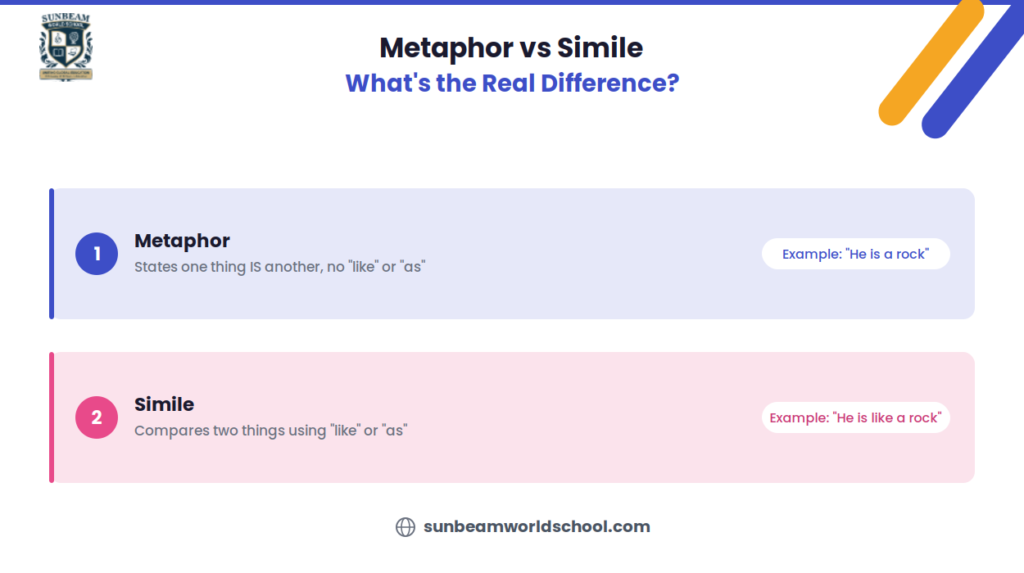
Metaphor vs simile: the only real difference is the words "like" and "as."
A metaphor says one thing is another thing, while a simile compares two things using "like" or "as." For Example: "Her voice is music" is a metaphor. "Her voice sounds like music" is a simile. Both sentences mean something similar, but the metaphor feels more direct and confident.
Students often mix up metaphors and similes because they do almost the same job. A simple trick is to look for the words "like" or "as." If you find them, it is a simile. If the sentence just says one thing is another, it is a metaphor. So the next time someone asks you what does metaphor mean, remember it is the version without "like" or "as."
What Are the Different Types of Metaphors?
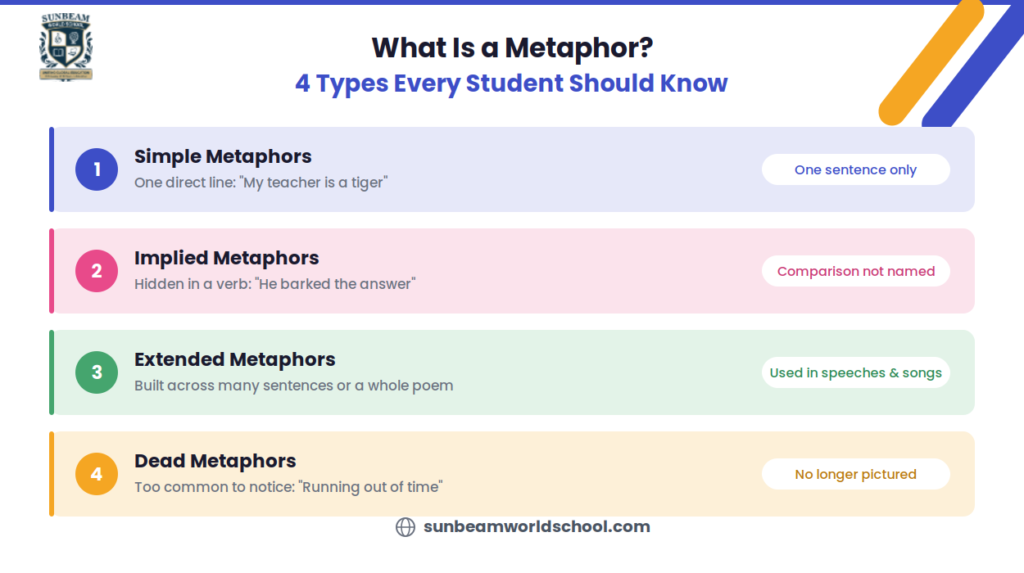
The four types of metaphors: simple, implied, extended, and dead.
There are four main types of metaphors: simple, implied, extended, and dead. Each type is grouped by how clearly the comparison is made and how long it continues in a piece of writing.
Simple Metaphors
A simple metaphor makes a direct comparison in one short sentence. It follows the pattern "one thing is another thing." Sentences like "my teacher is a tiger" or "this test is a mountain" are simple metaphors. The comparison is easy to spot because it is stated clearly and does not continue any further.
Examples of simple metaphors:
- "My teacher is a tiger in the classroom." – she is strict and a little intimidating.
- "This test is a mountain." – the test feels hard to get through.
- "Her smile is sunshine." – her smile makes people feel warm and happy.
- "The playground is a warzone at recess." – recess feels loud and chaotic.
Implied Metaphors
An implied metaphor never names the thing it is comparing something to. Instead, it hints at the comparison through a verb or a description. In the sentence "he barked the instructions," the word "barked" hints that he spoke sharply, like a dog, even though a dog is never mentioned. Implied metaphors take a bit more practice to notice, since the comparison hides inside the words instead of being stated outright.
Examples of implied metaphors:
- "He barked the instructions." – he spoke sharply and loudly, the way a dog barks.
- "She floated across the room." – she moved smoothly and gracefully, like something floating.
- "He swallowed his pride." – he accepted something difficult without arguing back.
- "The idea sparked in her mind." – a new thought suddenly appeared, like a spark catching fire.
Many implied metaphors, like the dog comparison above, borrow behavior from animals, so a child who already knows their animal names in English usually spots these hidden comparisons much faster.
Extended Metaphors
An extended metaphor is a single comparison that a writer keeps building on across several sentences or even a whole poem. Instead of using the comparison once, the writer adds new details to it each time. Extended metaphors show up often in speeches, songs, and stories, since they let a writer explore one idea from many different angles.
Example of an extended metaphor:
"Life is a race." Some runners sprint ahead early, hoping to finish first. Others pace themselves slowly, saving their energy for the long stretch ahead. In the end, every runner still crosses the same finish line, just at a different speed. Notice how the comparison to a race continues across four sentences, instead of stopping after the first one.
When a metaphor is extended across an entire poem, essay, or book instead of just a few sentences, it is sometimes called a controlling metaphor, since it controls the imagery of the whole piece. Teachers who study metaphors closely, and who follow a more formal metaphor literary definition, also use two special terms for the two halves of any comparison: the tenor is the real subject being described, and the vehicle is the image used to describe it. In "life is a race," life is the tenor and race is the vehicle.
Dead Metaphors
A dead metaphor is a comparison that used to feel fresh but has been repeated so often that people no longer notice it as figurative language. Phrases like "running out of time" or "the leg of a table" are dead metaphors, since most people understand them literally today. Mixing two dead metaphors together, like "we will cross that bridge once the ball is in our court," can create a sentence that makes no sense at all.
Examples of dead metaphors:
- "Running out of time." – originally pictured time like sand in an hourglass, now just means "no time left."
- "The leg of a table." – no one pictures an actual leg anymore, just the table part.
- "Falling in love." – no one pictures an actual fall, just the feeling of love starting.
- "Breaking the ice." – no one pictures real ice, just easing a bit of social tension.
What Are Some Common Metaphor Examples in Everyday Life?
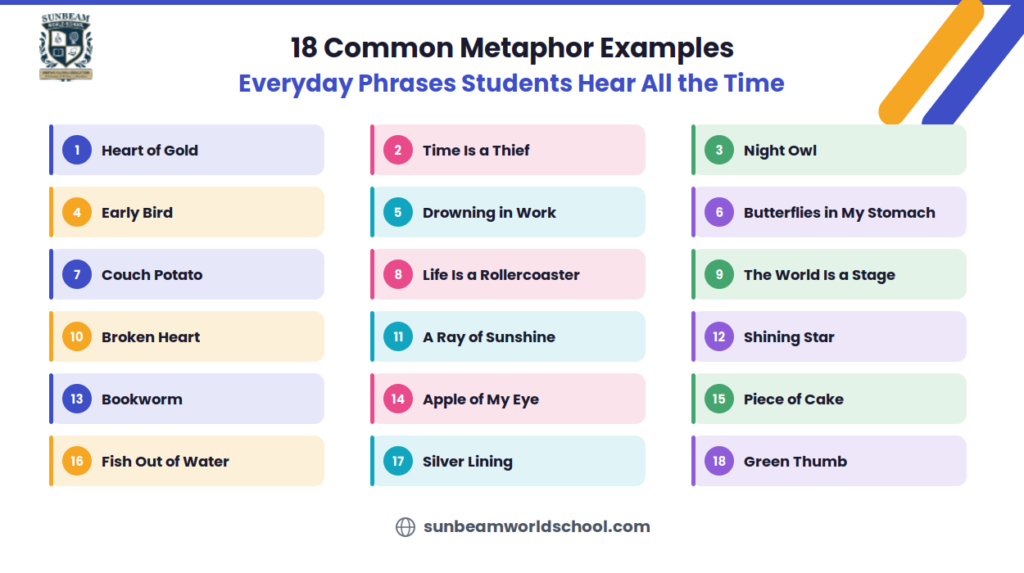
18 common metaphors students hear and use every day
So what are the metaphors people reach for most often in daily life? Common metaphors describe feelings, time, and personality in a way that is easy to picture. Here are 40 metaphors people use every day, along with what each one really means.
- Heart of gold – a very kind and generous person.
- Time is a thief – time quietly takes away our moments.
- Night owl – someone who stays up very late.
- Early bird – someone who wakes up very early.
- Drowning in work – feeling completely overwhelmed by tasks.
- Butterflies in my stomach – feeling nervous before something big.
- Couch potato – someone who sits around and does very little.
- Life is a rollercoaster – life has many sudden ups and downs.
- The world is a stage – life feels like one long performance.
- Music to my ears – something that sounds very pleasant to hear.
- Short fuse – someone who gets angry very quickly.
- That test was a breeze – the test felt very easy.
- The classroom was a zoo – the room was noisy and messy.
- Broken heart – deep sadness after losing someone or something.
- Icy stare – a cold and unfriendly look.
- A ray of sunshine – someone who brings happiness to others.
- Blanket of snow – snow covering the ground smoothly and evenly.
- Shining star – someone who is talented and admired by others.
- My mind is a maze – my thoughts feel tangled and confusing.
- A lightbulb moment – a sudden and clear new idea.
- Heart of stone – someone who shows very little emotion.
- Black sheep of the family – someone very different from the rest.
- Bookworm – someone who loves reading books.
- Time flies – time seems to pass by very quickly.
- Walking dictionary – someone who knows a huge number of words.
- Apple of my eye – someone who is greatly loved and cherished.
- My life is an open book – I hide nothing from others.
- Wall around his heart – someone who avoids showing their feelings.
- Words cut deep – words that hurt someone's feelings badly.
- A piece of cake – a task that is very easy to do.
- Fish out of water – feeling uncomfortable in an unfamiliar place.
- Sea of troubles – a huge number of problems all at once.
- Ball of energy – someone who is very lively and active.
- Silver lining – a small piece of hope inside a bad situation.
- Storm of emotions – a sudden rush of strong feelings.
- Melting pot – a place where many cultures mix together.
- Green thumb – someone who is skilled at growing plants.
- A roadblock – something that stops progress on a task.
- Window of opportunity – a short time when something becomes possible.
- The calm before the storm – a quiet moment before something big happens.
What Are Good Metaphor Examples for Kids and Students?
Metaphors for kids usually describe school life, family, and everyday feelings in a fun way. Here are 30 metaphor examples that students can use and enjoy, whether they are working on a simple metaphor sentence in grade 3 or putting together a metaphor example for a 5th grade English project.
- My backpack is a mountain – the backpack feels very heavy.
- Homework is a monster – homework feels big and scary.
- My brother is a tornado – he moves around messily and fast.
- The playground is my castle – the playground feels like her kingdom.
- My teacher is a walking encyclopedia – the teacher knows a lot.
- Exam week is a marathon – exam week feels long and tiring.
- My little sister is a chatterbox – she talks constantly.
- The library is a treasure chest – the library is full of good books.
- My best friend is my sunshine – she makes me happy.
- The school bell is an alarm clock – it tells everyone it's time to move.
- My brain is a sponge – I soak up new information quickly.
- The football field is a battlefield – the game feels intense and competitive.
- My report card is my mirror – it reflects how hard I studied.
- The new kid is a mystery – nobody knows much about him yet.
- My puppy is a bundle of joy – the puppy makes everyone smile.
- Recess is my oxygen – recess time feels necessary and refreshing.
- My locker is a black hole – things go in and never come out.
- Grandma's kitchen is a bakery – it always smells like fresh bread.
- My dad is my hero – I admire him greatly.
- The science lab is a mad scientist's lair – it feels messy and exciting.
- My little brother is my shadow – he follows me everywhere.
- Reading is a window – it lets me see new worlds.
- Math class is a puzzle – it takes patience to solve every problem.
- My friend group is a family – we support each other closely.
- The school bus is a rollercoaster – the ride feels bumpy and fun.
- My imagination is a rocket ship – it takes me anywhere I want.
- Winter break is a vacation island – it feels relaxing and far from school.
- Art class is my happy place – I feel calm and creative there.
- My coach is a drill sergeant – he pushes the team hard during practice.
- Bedtime is the enemy – I never want it to arrive.
Practicing metaphors like these is a fun way to build everyday English skills, since a child learns to describe feelings in a more colorful and confident way. Building this kind of vocabulary works well alongside other early English topics like fruit names in English, since both skills come from the same habit of noticing and describing the world a child sees every day.
What Are Famous Metaphor Examples in Literature and Poetry?
Writers and poets have used metaphors for hundreds of years to make their ideas more powerful, and the same is true for songs about metaphors, where a single striking comparison can carry an entire chorus. Here are 20 well-known metaphors from literature, explained in simple terms.
- Shakespeare compared the whole world to a stage, with every person playing a part, in his play As You Like It.
- In Romeo and Juliet, Shakespeare compared Juliet to the sun to show how she lit up Romeo's world.
- Emily Dickinson described hope as a small bird that keeps singing inside a person's heart, no matter what happens.
- Robert Frost's poem about two roads splitting apart is often read as a metaphor for choosing between two paths in life.
- Langston Hughes compared a dream that keeps getting delayed to fruit left drying out in the sun.
- Sylvia Plath used a fig tree to represent all the different choices and futures a young woman could pick from.
- Maya Angelou compared a caged bird's song to the voice of someone who longs to be free.
- George Orwell described confusing political language as a thick fog that hides the truth from readers.
- John Donne compared two lovers to the two legs of a drawing compass, always connected even when apart.
- William Wordsworth described his own mind as a large house filled with countless memories.
- Toni Morrison compared memory to a flooding river that always finds its way back to old paths.
- The phrase "the iron curtain" became a famous metaphor for the divide between Eastern and Western Europe.
- The phrase "the American dream" is a metaphor for the idea that hard work can lead to a better life.
- Journalists often use "the White House" as a metaphor for the entire executive branch of the American government.
- Writers often describe grief as an ocean, since it can feel endless and impossible to see across.
- Poets often compare love to a flame, since it can warm a person or burn them, depending on how it is handled.
- War poems often compare a soldier's fear to a heavy stone carried silently through every battle.
- Fairy tales often use a dark forest as a metaphor for facing something unknown and frightening.
- Song lyrics often compare a broken relationship to shattered glass that can never be fully repaired.
- Motivational speakers often call failure a stepping stone, meaning it helps a person move closer to success.
How Can You Identify a Metaphor in a Sentence?
You can identify a metaphor by following two simple steps: check what is being compared, then check the wording used to make that comparison. Once you get used to this two-step check, spotting a metaphor becomes almost automatic.
Step 1: Look for two unrelated things being compared.
Read the sentence and ask what two things are being placed side by side. In "the news hit him hard," the two things being compared are "news" and "a physical hit," even though a piece of news cannot actually hit anyone.
Step 2: Check whether the words "like" or "as" are used.
If the sentence uses "like" or "as" to join the comparison, it is a simile, not a metaphor. If the comparison is stated directly, with no "like" or "as," it is a metaphor. Since "the news hit him hard" has no "like" or "as," it passes the test and counts as a metaphor.
Try the same two steps on this sentence: "her patience is a deep well." Step 1 shows that "patience" is being compared to "a deep well." Step 2 shows there is no "like" or "as" anywhere in the sentence. Both checks confirm it is a metaphor, meaning her patience runs very deep and does not run out easily.
Practicing this two-step check on sentences from books, songs, or even everyday conversation is one of the fastest ways to get comfortable with metaphors, and it works well alongside other grammar and sentence-structure practice that students already do in English class. Once you understand what is metaphor at its core, simply one thing described as another, these two checks become almost automatic.
Why Are Metaphors Important in Communication and Writing?
So what are metaphors for, exactly? Metaphors are important because they help people explain difficult ideas using pictures the reader already understands. A good metaphor can turn a hard concept into something simple, memorable, and easy to picture in seconds, which is why they show up in classrooms, speeches, songs, and everyday conversation alike.
Metaphors are useful in four main ways:
Explanation
Metaphors connect a new or difficult idea to something the reader already knows, which makes learning faster and less confusing. Saying "the human heart is a pump" helps a student picture how blood moves through the body, without needing a science diagram to understand the basic idea first.
Creativity
Metaphors let a writer describe something in a fresh, original way instead of using a plain, predictable sentence. Instead of writing "the city was busy," a writer might say "the city was a beehive," which paints a much more interesting picture using the same number of words.
Emotion
Metaphors help a reader feel something, since a strong image often carries more feeling than a plain fact ever could. Saying "grief is an ocean" communicates the size and weight of sadness far more powerfully than simply saying "I feel very sad."
Imagery
Metaphors create a clear picture in the reader's mind, which makes the writing far easier to remember later. A sentence like "her laughter was a bell ringing through the room" stays in a reader's memory much longer than "she laughed loudly."
Together, these four uses are why metaphors show up so often in school essays, novels, and even casual conversation. A student who understands why metaphors work is not just memorizing a grammar rule. They are learning a tool that makes their own writing clearer, more original, and more memorable.
How Can You Craft an Effective Metaphor?
You can craft an effective metaphor by keeping the comparison clear, familiar, and closely related to your topic. A strong metaphor should feel natural, not forced, and it should help the reader understand your point faster, not slower.
If you are ever stuck for metaphor ideas, start with a strong feeling or a task you are describing, then ask what everyday object or scene shares that same feeling. Here are a few simple tips for building better metaphors:
- Keep it relevant: make sure the comparison actually connects to what you are describing.
- Avoid clichés: phrases like "time is money" are overused and lose their power.
- Use familiar images: compare new ideas to things your reader already knows well.
- Stick to one idea: do not combine two different comparisons in the same sentence.
- Think about your audience: choose an image that makes sense for the age and experience of your reader.
Practicing metaphors regularly is a natural next step once a child already has strong basic writing habits, since figurative language works best when the sentence structure around it is already solid.
What Are Common Pitfalls and Misinterpretations of Metaphors?
The most common pitfall with metaphors is mixing two unrelated comparisons together in the same sentence, which confuses the reader instead of helping them. A sentence like "we will burn that bridge when we get there" mixes two different metaphors and ends up making no sense at all.
Other common mistakes include:
- Using tired clichés, such as "a sea of problems," which no longer feels fresh or interesting.
- Being too vague, so the reader cannot tell what is actually being compared.
- Taking a metaphor too literally, which can lead to real confusion, especially for very young readers.
- Using culture-specific images, since a metaphor about snow or money may not make sense to every reader.
- Overusing metaphors, which can make writing feel cluttered instead of clear.
Exercises to Identify and Create Metaphors
Reading one more example of a metaphor rarely beats trying it yourself, so the fastest way to master metaphors is to practice spotting and building them, not just read about them. Try the metaphor challenge below, work through all six rounds, and check your answers at the end to see how many you got right.
Metaphor Challenge: 6 Questions Away to Master Metaphors
1: Spot the Metaphor "Her smile lit up the entire room." What two things are being compared in this sentence?
2: Spot the Metaphor "His temper is a volcano ready to erupt." What does this metaphor tell you about his mood?
3: Simile Switch "The lake was a mirror this morning." Turn this metaphor into a simile by adding "like" or "as."
4: Find the Hidden Comparison "He barked the answer without thinking." This is an implied metaphor. What animal is being compared to him, even though it is never named?
5: Level Up a Sentence "The city was busy." This sentence is correct, but plain. Rewrite it as a stronger metaphor, using an image like a beehive, an anthill, or a racetrack.
6: Create Your Own Finish this sentence using a metaphor instead of a plain description: "My mood today is ___."
Check Your Answers
- 1: Her smile is being compared to a light, showing how much happiness it brought to the room.
- 2: His temper is being compared to a volcano, meaning his anger is building up and could explode at any moment.
- 3: "The lake was like a mirror this morning" or "the lake was as still as a mirror this morning."
- 4: The sentence compares him to a dog, since the word "barked" suggests speaking sharply and loudly.
- 5: A strong answer might be "the city was a beehive of activity," since it paints a busier, more vivid picture.
- 6: There is no single right answer here. Any metaphor that skips "like" or "as" and directly compares your mood to something else, such as "my mood today is a thundercloud" or "my mood today is a sunny beach," counts as a win.
Try rerunning this challenge with a sibling, classmate, or parent, and see who can invent the most original metaphor till 6 question. Turning grammar practice into a quick game like this is often the difference between a student who memorizes a rule and a student who actually enjoys using it.
Why Do Metaphors Matter for a Student's Reading and Writing Skills?
Metaphors matter because they teach students to look past the literal meaning of words, which is a skill used in reading comprehension, essay writing, and everyday conversation. A student who understands that "drowning in work" does not involve real water is also better at reading tone and emotion in a passage.
Metaphors also help students write more vivid sentences without using too many extra words. Instead of writing "I was very nervous," a student can write "butterflies took over my stomach," which is shorter, clearer, and far more memorable to a reader.
How Can Parents Help Children Practice Metaphors at Home?
Parents can help by turning metaphor practice into a game instead of a worksheet, since children pick up figurative language faster through play and conversation. A simple way to start is asking your child to describe their day using one metaphor, such as "school today was a rollercoaster."
Reading picture books, song lyrics, and even sports commentary together is another easy way to spot metaphors in real life, since commentators often describe a fast player as "lightning" or a strong defense as "a wall." Families using an online homeschool routine can easily fit in short, playful metaphor activities like these between regular subjects, the same way they would weave in other essential everyday conversations like good touch and bad touch, rather than treating either topic as a separate, stand-alone lesson.
Conclusion
Now that you know a clear metaphor definition and 100+ metaphor examples, it's time to use these metaphors in your day-to-day communication. Practice spotting a metaphor, from song lyrics to sports commentary to bedtime stories. This habit of looking past the literal meaning of words is one of the most useful skills a child can build early on, alongside learning other language basics like active and passive voice to make writing clearer and more confident.
At Sunbeam World School, English concepts like metaphors, grammar, and vocabulary are taught in the same simple way this guide explains them, through real examples, everyday language, and small live classes where a child can ask questions the moment something feels confusing.
Certified teachers break down each new idea step by step, so students build genuine understanding instead of memorizing rules they will forget after the exam. With a 2:20 teacher-student ratio and live doubt-clearing built into every class, a student who struggles with figurative language today gets the personal attention needed to feel confident with it tomorrow.

Frequently Asked Questions
What is a metaphor in simple words?
-Metaphor is a way of describing one thing by directly calling it something else, without using "like" or "as." It creates a strong picture in the reader's mind, which makes an idea, feeling, or situation far easier to understand and remember.
What are 10 examples of metaphors?
+What are some easy metaphor examples for kids?
+What is the difference between a metaphor and a simile?
+What are the four types of metaphors?
+What is a dead metaphor?
+Why do writers use metaphors instead of stating things directly?
+What are 5 examples of metaphors?
+What are some funny metaphor examples?
+Is "I slept like a baby" a simile or a metaphor?
+How do you say "I love you" using a metaphor?
+What are some famous metaphor examples from books?
+What is a metaphor synonym?
+Why do we use metaphors in everyday language?
+
In this article
Share this post:


Press and Blogs
Stay updated with our press releases, educational blogs, and more.
Quick Answer CBSE On-Screen Marking (OSM) is a digital evaluation system where scanned copies of answer...

Quick Summary 300+ essay topics for students, sorted by grade from Class 3 to Class...
Quick Summary Activity-Based Learning (ABL) is a teaching approach in which children learn concepts through...