

 Education
What is UDISE & Why It Matters for Your Child’s School
Quick Answer: UDISE stands for Unified District Information System for Education. It's the Indian government's national database of every recognized school, teacher, and student, run by the Ministry of Education. Every school gets an 11-digit UDISE code, a permanent ID that acts as proof the school is officially recognized. You can look up any school's UDISE code for free on the official UDISE+ portal.
Most parents and teachers first encounter the word "UDISE" on an admission form, a transfer certificate, or a scholarship application, and it's rarely explained anywhere. This guide breaks it down simply: what UDISE actually is, what a UDISE code means for your child's school, and what school staff need to know before they touch the portal.
What Does UDISE Stand For?
UDISE stands for Unified District Information System for Education. In simple terms, it's the government's way of keeping one national record of every school in the country, along with details about its students, teachers, and facilities.
Before UDISE existed, this data was a mess. In the 1990s, the government ran a system called DISE (District Information System for Education) to track primary schools, and a separate system called SEMIS to track secondary schools. Having two disconnected systems meant duplicate records, inconsistent numbers between states, and no single reliable answer to a basic question like "how many schools are there in India right now." In 2012-13, the Ministry of Education merged DISE and SEMIS into one system and called it UDISE, unified, because for the first time, primary and secondary school data lived in the same place.
Today, UDISE is the single official source of school-education statistics in India, covering everything from a school's building condition to its dropout rates.
What is UDISE+?
UDISE plus is the modern, online version of UDISE. The "+" isn't just branding; it marks a real shift in how the system works.
The original UDISE ran on paper forms. Once a year, schools filled out physical Data Capture Formats and submitted them up the chain, district to state to center, which meant the government's picture of Indian schools was always months out of date by the time it was compiled. In 2018-19, the Ministry of Education launched UDISE+ to move this entire process online. Schools now enter their data directly into a digital portal, corrections happen in real time instead of waiting for the next annual cycle, and the system can flag inconsistent or suspicious data (like a "functional" toilet count that doesn't match a school's known size) far faster than a paper form ever could.
In everyday use, people say "UDISE" and "UDISE+" almost interchangeably now, since UDISE+ has fully replaced the old paper process. If you see either term on a document, they're referring to the same underlying government database.
What is a UDISE Code?
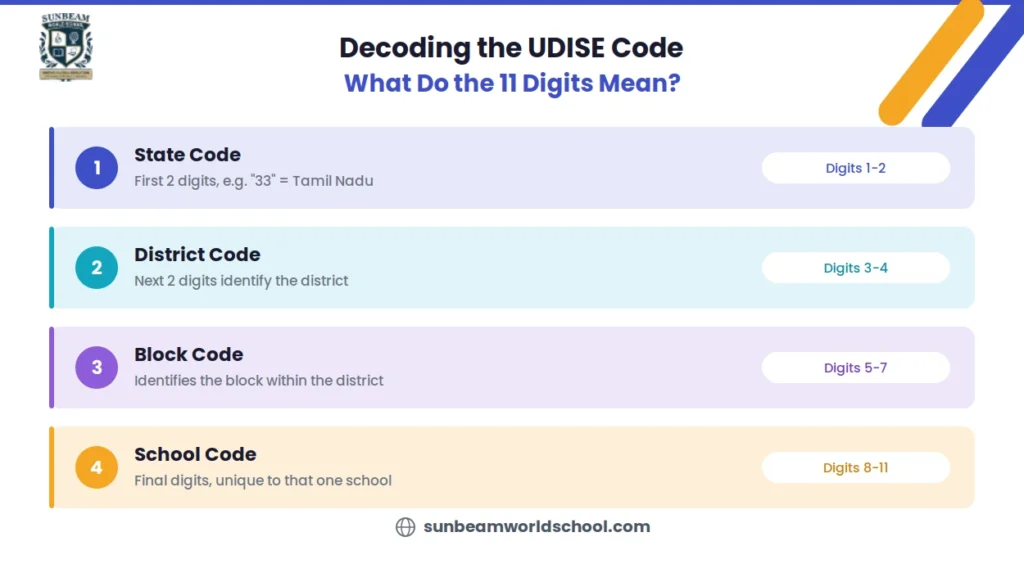
Understanding the UDISE code
A UDISE code is an 11-digit ID number assigned to every recognized school in India. Think of it as a school's permanent identity card. Once issued, it doesn't change, even if the school changes its name, its management, or expands its campus.
The 11 digits aren't random. They're built in layers, so the code itself tells you something about where the school is:
- The first 2 digits identify the state (for example, schools in Tamil Nadu start with "33").
- The next 2 digits identify the district.
- The remaining digits step down through block and then the individual school.
So a UDISE code isn't just a random ID, it's a decodable address, right down to the specific school, once you understand the pattern.
Important distinction: a UDISE code identifies a school, not a student. If you're looking for a student's individual ID instead, that's called a PEN (Permanent Education Number), which works completely differently, it's auto-generated and can't be decoded geographically the way a UDISE code can. We've covered PEN numbers in detail in our separate guide on what a PEN number is, if that's what you're actually trying to find. There's also a third, similarly-numbered document identifier worth knowing, the certificate number printed on a CBSE Class 10 marksheet, which is different again from both a UDISE code and a PEN.
Why Should Parents Care About a School's UDISE Code?
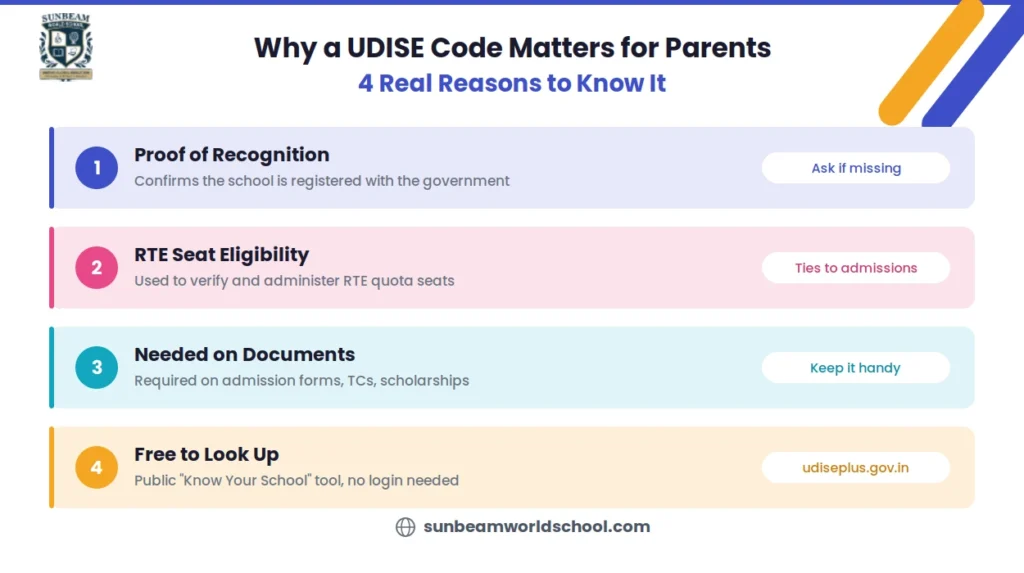
Why does the UDISE code matter for parents?
A UDISE code isn't just bureaucratic trivia; it has real stakes attached to it:
- It's tied to official recognition. A school with a valid, active UDISE code is registered with the government's education data system. If a school can't produce one, or gives you a code that doesn't match on the public portal, that's worth asking follow-up questions about before you enroll your child.
- It affects RTE (Right to Education) seat eligibility. Schools use their UDISE registration as part of how RTE quota seats and related benefits get administered and verified.
- It shows up on real documents your child will need. Admission forms, transfer certificates, and several scholarship applications ask for the school's UDISE code, so it's worth knowing where to find it before you're filling out a form under a deadline. If your child is moving from a regular school to an online school or the reverse, this is one of the first documents the new school will want on file.
- You can look it up yourself, for free. The official UDISE+ portal has a public "Know Your School" search tool. You don't need a login or any special access, just the school's name and rough location, to pull up its registered UDISE code and basic details.
What School Data Actually Goes Into UDISE+ Every Year?
If you're a teacher or school administrator encountering this for the first time, here's what the system actually asks for, broken into its three core areas:
- School Profile & Facilities: Classroom counts, building condition, WASH (water, sanitation, hygiene) infrastructure, library and ICT (computer/internet) availability. This is the data that ends up shaping government infrastructure funding decisions.
- Teacher Module: Teacher qualifications, subject specializations, training records, and staffing counts, used to track teacher-student ratios nationally.
- Student Module (SDMS): Enrollment numbers, attendance, and individual student records, including the generation of each student's PEN and, for many schools now, their APAAR ID as well.
This isn't a one-time setup. It's an annual reporting cycle, meaning schools are expected to review and update this data every year, not just enter it once and forget it. Data that goes stale, like a facility marked "functional" that's actually broken, or enrollment numbers that haven't been updated after a batch of transfers, can create real downstream problems, since this is the same data used to plan funding and staffing at the district and state level.
What is a UDISE User ID?
A UDISE User ID is simply the login credential given to authorized school staff to access the UDISE+ portal and enter or update their school's data. It's easy to confuse this with the school's UDISE code, but they're not the same thing: the UDISE code identifies the school itself and is public information, while the User ID is a private login credential tied to a specific staff member, used only for accessing the portal to submit data.
Common Points of Confusion With UDISE Understanding
A few terms around UDISE get mixed up constantly, so it's worth clearing them up directly:
- UDISE Code vs. UDISE Number: These are the same thing. Some people search for one term, some search for the other, but there's no actual difference; both refer to the same 11-digit school ID.
- UDISE Code vs. PEN: A UDISE code identifies a school. A PEN identifies a student. They're both 11-digit numbers, which is exactly why they get confused, but they track completely different things.
- UDISE Code vs. EMIS Number: Some CBSE documents also reference an EMIS number, which is a state-level education tracking ID, separate from a school's national UDISE code, though both trace back to the same DISE-era origins.
- UDISE Code vs. the old DISE Code: If you're looking at an older document (pre-2012), you may see a reference to a "DISE code" instead. This was the predecessor system before DISE and SEMIS were merged into UDISE, so an old DISE code isn't necessarily still valid; the school's current identifier is its UDISE code.
Conclusion
UDISE can feel like just another government acronym until you actually need it, checking whether a school is properly recognized, filling out an admission form, or applying for a scholarship that asks for a UDISE code you've never heard of. Understanding what it is and what it tracks means you're not caught off guard when it shows up, whether your child is starting school at the right age for the first time or transferring between schools mid-way through their education.
At Sunbeam World School, our UDISE registration and code are kept up to date and available to parents on request, so families never have to wonder whether our records are in order. If you have questions about our school's UDISE code or recognition status, our administrative office is happy to help.

Frequently Asked Questions
What is the full form of UDISE code?
-The full form of UDISE code comes from UDISE itself, Unified District Information System for Education. A UDISE code specifically refers to the 11-digit school identification number generated within this system, confirming a school's official recognition status.
What is the use of a UDISE code?
+What is a UDISE registration form?
+What is a UDISE user ID used for?
+What is the difference between a UDISE code and a UDISE number?
+What is the difference between UDISE and UDISE+?
+
In this article
Share this post:


Press and Blogs
Stay updated with our press releases, educational blogs, and more.

Quick Summary Animal sounds are the noises animals make to communicate, warn of danger and...

Quick Summary An algebra equation is a maths statement that sets two expressions equal using...

Quick Summary Essential Repeat (ER) in CBSE means a student has not met the passing...