
 Kids Learning
100+ Simple English Sentences for Kids And Beginners
Want your child to become fluent in English with confidence? The journey starts today with simple sentences and everyday conversations. Instead of memorizing difficult words, children learn faster when they speak naturally about their daily routines, school, family, feelings, and playtime.
Here are 100+ simple English sentences for kids. These easy English sentences make learning interactive, fun, and practical while helping kids build strong communication skills from an early age.
Let’s get started!
Why is learning English sentences important for kids?
Learning to speak in sentences is the step where a child moves from knowing words to actually communicating. Single words name things, but sentences let a child ask, explain, and connect with people. Further improve the child’s spelling and handwriting with Dictation words in English.
Five reasons it matters:
1. It builds real communication
A child who says "I want water" is understood at once. Words on their own leave adults guessing. Sentences turn needs and ideas into something others can act on.
2. It grows Grammar & vocabulary
Learning "book" alone is one word. Learning "I read my book" fixes the word inside a pattern the child can reuse with "toy," "bag," or "lunch." Words stick better inside sentences than on flashcards.
3. It prepares a child for reading and writing
Reading is understanding sentences, not just decoding letters. A child who already speaks in simple sentences finds early reading and writing far easier, because the structure is already familiar.
4. It builds confidence
A child who can introduce themselves or ask a question speaks up in class and with new people. That confidence feeds back into more practice, and more practice means faster progress.
5. It supports every other subject
Maths problems, science questions, and instructions all arrive as sentences. Strong sentence skills early on help a child follow lessons across the whole curriculum, whichever pathway they study.
For Example:
A child who only knows the word "help" can point and hope. A child who can say "Can you help me, please?" gets a clear answer and learns that language gets results. That small win is what keeps a beginner talking.
Starting early matters too, start with fruit names, vegetable names, or animal names. The years from four to eight are when children pick up sentence patterns most naturally, so daily practice with simple sentences pays off for years.
100+ English Sentences For Kids
Fun, easy, and everyday English sentences to help kids speak confidently, improve vocabulary, and communicate naturally in school and daily life. Start learning English with Rhyming words and then move to simple sentences.
1.Simple Sentences About My Daily Routine
These help children describe the things they do every day.
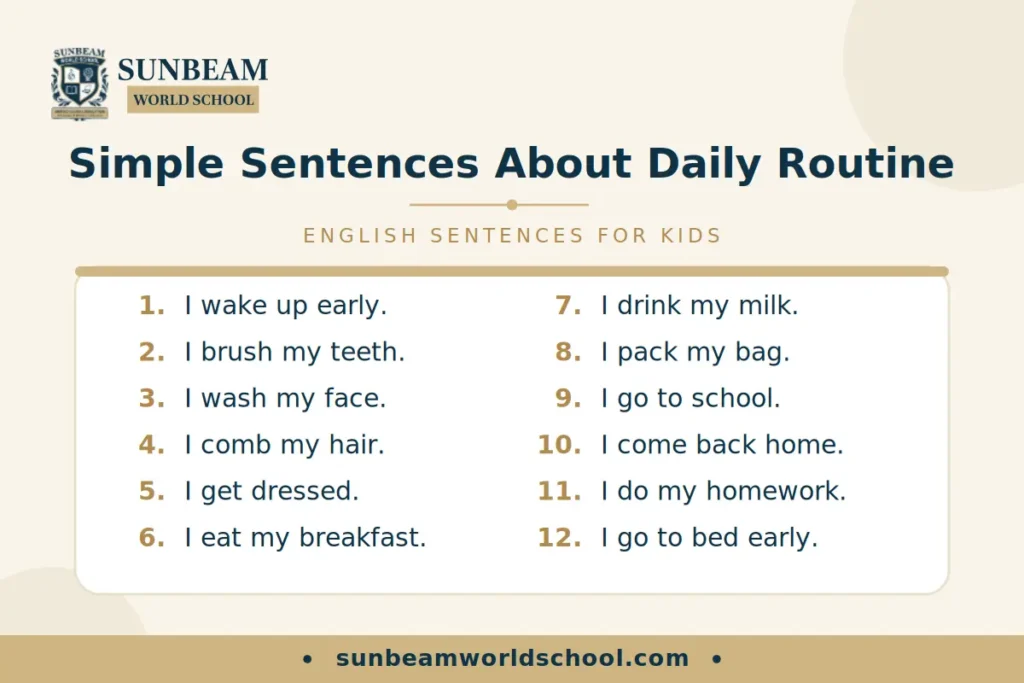
Daily routine English sentences for kids and beginners.
- I wake up early.
- I brush my teeth.
- I wash my face.
- I comb my hair.
- I get dressed.
- I eat my breakfast.
- I drink my milk.
- I pack my bag.
- I go to school.
- I come back home.
- I do my homework.
- I go to bed early.
2. Easy Sentences for Kids to Introduce Themselves
Perfect for a child meeting classmates and teachers for the first time.
- My name is ______.
- I am ______ years old.
- I live in ______.
- I am a boy. (or: I am a girl.)
- I have one brother.
- I have one sister.
- My favourite colour is blue.
- My favourite fruit is a banana.
- I like to draw.
- I like to sing.
- I want to be a pilot.
- I love my family.
3. Small Sentences About School and Learning
Simple lines children can use in the classroom.
- This is my school.
- My school is fun.
- This is my classroom.
- My teacher is kind.
- I carry my school bag.
- I read my book.
- I write neatly.
- I listen to my teacher.
- I raise my hand.
- I answer the question.
- May I go to the washroom?
- We learn together.
4. Simple Sentences About Family and Home
These help kids talk about the people they live with.
- This is my mother.
- This is my father.
- I love my grandparents.
- We eat together.
- We play together.
- My home is clean.
- I help at home.
- I tidy my room.
- I water the plants.
- I feed my pet.
- My family is happy.
5. Short Sentences About Animals
Talking about animals builds vocabulary and observation.
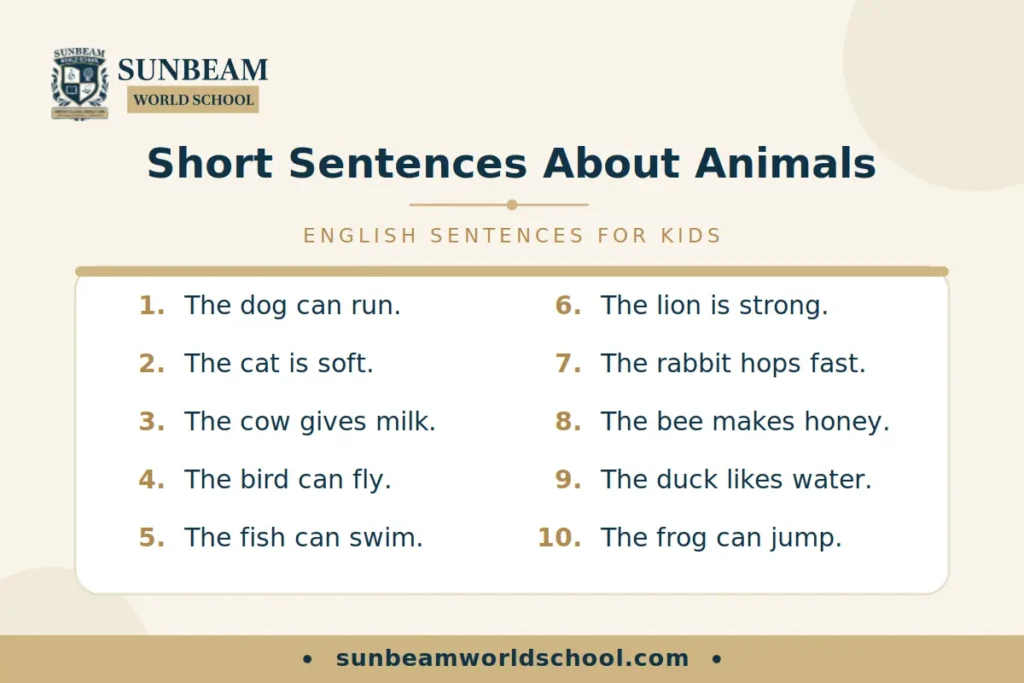
Easy animal sentences for kids to practice English speaking.
- The dog can run.
- The cat is soft.
- The cow gives milk.
- The bird can fly.
- The fish can swim.
- The lion is strong.
- The rabbit hops fast.
- The bee makes honey.
- The duck likes water.
- The frog can jump.
6. Easy Sentences About Nature and Weather
Everyday lines about the world outside.
- The sun is bright.
- The sky is blue.
- The moon shines at night.
- It is raining today.
- The wind is cool.
- The tree is tall.
- The flower is pretty.
- It is sunny outside.
- The stars are bright.
- I like the rainbow.
7. Sentences That Teach Good Habits and Manners
Short lines that pair language with values.
- I say please.
- I say thank you.
- I say sorry.
- I share my toys.
- I wash my hands.
- I keep my room clean.
- I tell the truth.
- I help my friends.
- I throw litter in the bin.
- I wait for my turn.
8. Simple Sentences to Express Feelings
These teach children to name an emotion clearly.
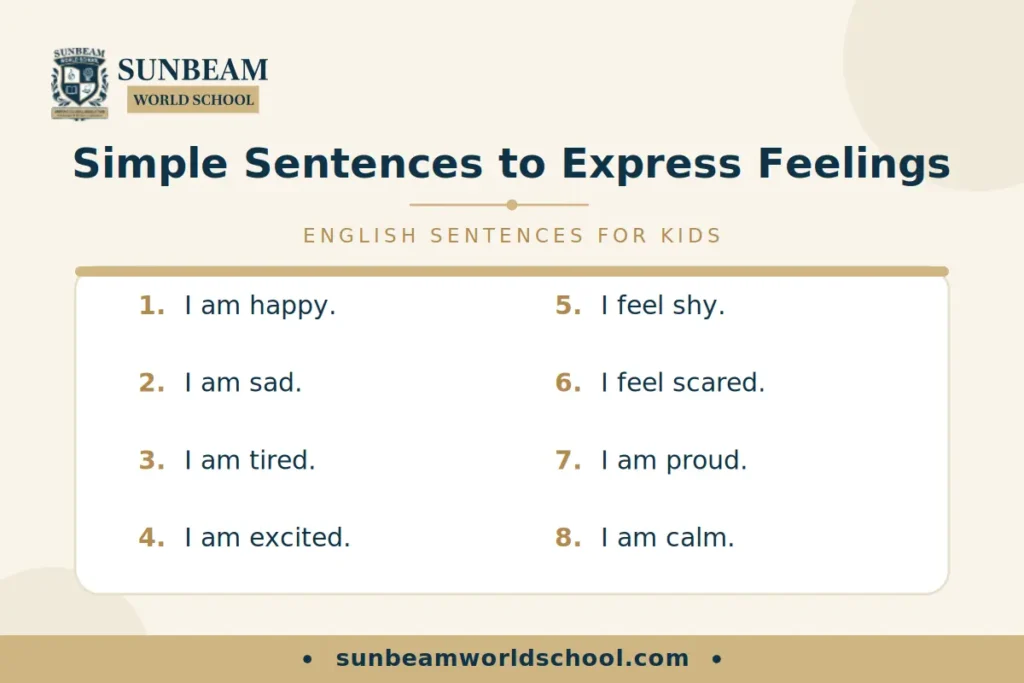
Easy English sentences for kids to express feelings.
- I am happy.
- I am sad.
- I am tired.
- I am excited.
- I feel shy.
- I feel scared.
- I am proud.
- I am calm.
9. Action Sentences for Kids to Practice
Great for movement games and reading aloud.
- I can run.
- I can jump.
- I can clap.
- I can sing.
- I can dance.
- I can hop.
- I can read.
- I can write.
- I can count.
- I can swim.
10. Polite Sentences for Everyday Use
The small phrases that make a child sound confident and kind.
- Please help me.
- Thank you very much.
- Excuse me.
- May I come in?
- May I sit here?
- Can you help me, please?
- Sorry, I am late.
- After you.
11. Simple Sentences About Food and Eating
Everyday lines for meals and snacks.
- I am hungry.
- I am thirsty. (You want something to drink.)
- I like apples.
- I eat my vegetables.
- The soup is hot.
- I drink water.
- May I have some more? (A polite way to ask for extra food.)
- I finish my food.
- I like sweet things.
- Please pass the salt. (You ask someone to hand you the salt.)
12. Easy Sentences About Colours, Shapes, and Numbers
Great for early learning games.
- The apple is red.
- The grass is green.
- The ball is round.
- The box is square.
- I have two hands.
- I can count to ten.
- This is a big circle.
- That is a small star.
- I see three birds.
- My shirt is yellow.
13. Short Sentences About My Body and Health
Simple lines to name body parts and stay well.
- These are my hands.
- This is my nose.
- I have two eyes.
- I can touch my toes.
- I feel well. (You are healthy and not sick.)
- I feel sick.
- I rest when I am tired.
- I cover my mouth when I cough. (This keeps germs away from others.)
- I drink water every day.
- I sleep at night.
14. Simple Sentences About Playtime and Friends
Lines for games, toys, and making friends.
- This is my friend.
- Let us play together. (You ask someone to play with you.)
- I like my toys.
- We share the ball.
- I win the game.
- I lose the game. (You did not win, and that is okay.)
- It is your turn.
- We have fun.
- Do you want to play?
- I am happy with my friends.
15. Small Sentences About Things Around My Home
Naming common objects builds vocabulary fast.
- This is a chair.
- That is a table.
- The door is open.
- The light is on.
- I sit on the sofa.
- The clock is on the wall.
- My bed is soft.
- The window is clean.
- I open the box.
- The cup is empty. (There is nothing in the cup.)
16. Easy Questions Kids Can Ask
Question sentences help children speak up. (Natural internal link to the interrogative sentences page.)
- What is your name?
- How are you?
- Where is my bag?
- Can I help you?
- What time is it?
- May I go outside?
- Who is at the door?
- Why is the sky blue?
- What is for lunch?
- Where do you live?
17. Sentences About Days, Months, and Time
Everyday lines for talking about when things happen.
- Today is Monday.
- Tomorrow is Tuesday. (Tomorrow means the day after today.)
- It is morning.
- It is night now.
- My birthday is in May.
- We go to school on weekdays. (Weekdays are Monday to Friday.)
- I rest on the weekend.
- The year has twelve months.
- It is time for bed.
- See you tomorrow.
How do you make learning sentences fun?
Children learn sentences best through play, short stories, not drills. When a sentence becomes a game, a child repeats it many times without noticing the practice.
Simple ways to make it fun:
- Act it out. Turn the action sentences into charades. One child says "I can hop" and the others hop.
- Play I Spy. Use the object and colour sentences. "I spy something red" leads straight to "The apple is red."
- Role-play the polite lines. Set up a pretend shop and practise "May I have some more?" and "Thank you very much."
- Sing them. Set a routine or feelings sentence to a simple tune. Rhythm helps memory.
- Make a sticker chart. One sticker for each topic finished. Ten stickers earns a small reward.
- Run a sentence of the day. Stick one sentence on the fridge each morning and use it all day.
The aim is repetition that feels like play. A child who laughs while saying "The frog can jump" will remember it far longer than one who copied it ten times.
Worksheets For Learning Sentences In English
When kids learn playfully, they grasp quickly, and the whole learning process becomes seamless. Make your child practice these worksheets for better understanding.
Worksheet 1: Fill in the Blank (Daily Routine)
Write the missing word. Use the word bank.
Word bank: bag, teeth, wake, eat, milk, school, homework, bed
- I ______ up early.
- I brush my ______.
- I ______ my breakfast.
- I drink my ______.
- I pack my ______.
- I go to ______.
- I do my ______.
- I go to ______ early.
Worksheet 2: Unscramble the Sentence
Put the words in the correct order. Add a capital letter and a full stop.
- teeth / brush / I / my
- can / fly / bird / The
- am / I / happy
- milk / gives / cow / The
- my / love / I / family
- sky / blue / is / The
- run / can / I
- hands / wash / I / my
Worksheet 3: Choose the Correct Word
Circle the right word.
- The sun is ( bright / brush ).
- I ( am / is ) happy.
- The cat ( is / are ) soft.
- I ( like / likes ) apples.
- This ( is / are ) my school.
- The fish can ( swim / sing ).
- I say ( please / plate ).
- It is ( raining / running ) today.
Worksheet 4: Complete the Sentence About Yourself
Fill in your own answer. There is no wrong answer here.
- My name is ______.
- I am ______ years old.
- I live in ______.
- My favourite colour is ______.
- My favourite fruit is ______.
- I like to ______.
- I want to be a ______.
- I feel ______ today.
Worksheet 5: Fix the Sentence
Each line has no capital letter and no full stop. Rewrite it correctly.
- the dog can run
- i am proud
- we play together
- the moon shines at night
- i say thank you
- the flower is pretty
Worksheet 6: Match the Two Halves
Write the correct letter next to each number.
- The bee makes ______ a. water.
- The duck likes ______ b. honey.
- I brush my ______ c. teeth.
- The lion is ______ d. strong.
- I feed my ______ e. pet.
Worksheet 7: Read-Aloud Practice
Read each sentence out loud three times. Tick the box when you are done.
[ ] I wake up early.
[ ] The cat is soft.
[ ] I am happy.
[ ] May I come in?
[ ] Thank you very much.
[ ] I can count to ten.
[ ] The sky is blue.
[ ] I wait for my turn.
Answer Key
Worksheet 1: 1. wake, 2. teeth, 3. eat, 4. milk, 5. bag, 6. school, 7. homework, 8. bed
Worksheet 2: 1. I brush my teeth. 2. The bird can fly. 3. I am happy. 4. The cow gives milk. 5. I love my family. 6. The sky is blue. 7. I can run. 8. I wash my hands.
Worksheet 3: 1. bright, 2. am, 3. is, 4. like, 5. is, 6. swim, 7. please, 8. raining
Worksheet 4: open answers (accept any sensible word)
Worksheet 5: 1. The dog can run. 2. I am proud. 3. We play together. 4. The moon shines at night. 5. I say thank you. 6. The flower is pretty.
Worksheet 6: 1-b, 2-a, 3-c, 4-d, 5-e
Worksheet 7: speaking task, no written answers
Conclusion
Simple English sentences help children build strong communication skills from an early age. Daily practice through conversations, games, reading, and role-play makes learning natural and enjoyable for young learners.
At Sunbeam World School, we believe that strong language foundations play a key role in a child’s academic and personal growth, helping students become confident communicators for the future.
FAQs
1. What are simple English sentences for kids?
Simple English sentences for kids are short and easy sentences used in daily life to help children improve speaking, vocabulary, communication, and confidence. These sentences teach kids how to express thoughts, ask questions, and interact naturally in English.
2. Why should kids learn English sentences early?
Learning English sentences early helps children:
- Speak confidently in daily conversations
- Improve vocabulary and pronunciation
- Develop reading and writing skills
- Communicate better in school and social situations
- Understand sentence structure naturally
3. How can kids learn English sentences faster?
Kids learn English sentences faster through:
- Daily speaking practice
- Interactive games and storytelling
- Read-aloud activities
- Worksheets and sentence exercises
- Role-play conversations
- Repetition in everyday situations
What are the best daily use English sentences for kids?
Some common daily use English sentences for kids include:
- I wake up early.
- I go to school.
- Thank you very much.
- May I come in?
- I am happy today.
- Can you help me, please?
4. How many English sentences should kids practice daily?
Children should practice 5–10 simple English sentences daily. Regular speaking and listening practice improves fluency and confidence more effectively than memorizing too many sentences at once.
5. What activities make English learning fun for kids?
The best activities for learning English sentences include:
- Flashcards
- Storytelling
- Singing rhymes
- Role-play games
- Sentence matching worksheets
- Picture-based learning
- Classroom speaking activities
6. Can worksheets improve English speaking skills?
Yes, worksheets help children improve sentence formation, vocabulary, grammar, reading, and writing skills. Interactive worksheets also make learning more engaging and easier to remember.
7. How can parents help children speak English confidently?
Parents can help by:
- Speaking simple English at home
- Encouraging daily conversations
- Reading English storybooks together
- Praising small speaking efforts
- Practicing common daily sentences regularly

In this article
Share this post:


Press and Blogs
Stay updated with our press releases, educational blogs, and more.

Quick Summary You can improve your child’s writing skills by making writing a regular part...
Quick Summary The 12 months name in English are January, February, March, April, May, June,...

Quick answer: India has 28 states and 8 union territories in 2026, making 36 capitals...