
 Kids Learning
Masculine and Feminine Gender in English: 100+ Words, Rules, Examples & Exercises
Masculine and Feminine Gender in EnglishMasculine and feminine gender in English are noun categories used to show whether a person or animal is male or female. Masculine gender refers to males, while feminine gender refers to females. Examples of Feminine and Masculine Words
|
Masculine and feminine gender in English are noun categories that show whether a person or animal is male or female. Masculine gender names males (king, actor, lion). Feminine gender names females (queen, actress, lioness). English also has common gender for nouns that work for both sexes (child, friend, teacher) and neuter gender for things with no gender (book, table, car).
This guide covers 100+ masculine and feminine words in English, the 8 rules for changing a masculine noun to its feminine form, 40 animal pairs, sentence examples, and short practice exercises with answers.
What is Gender in English Grammar?
In English grammar , gender is a way to classify nouns and pronouns based on whether they refer to males, females, both, or neither. English has four genders.
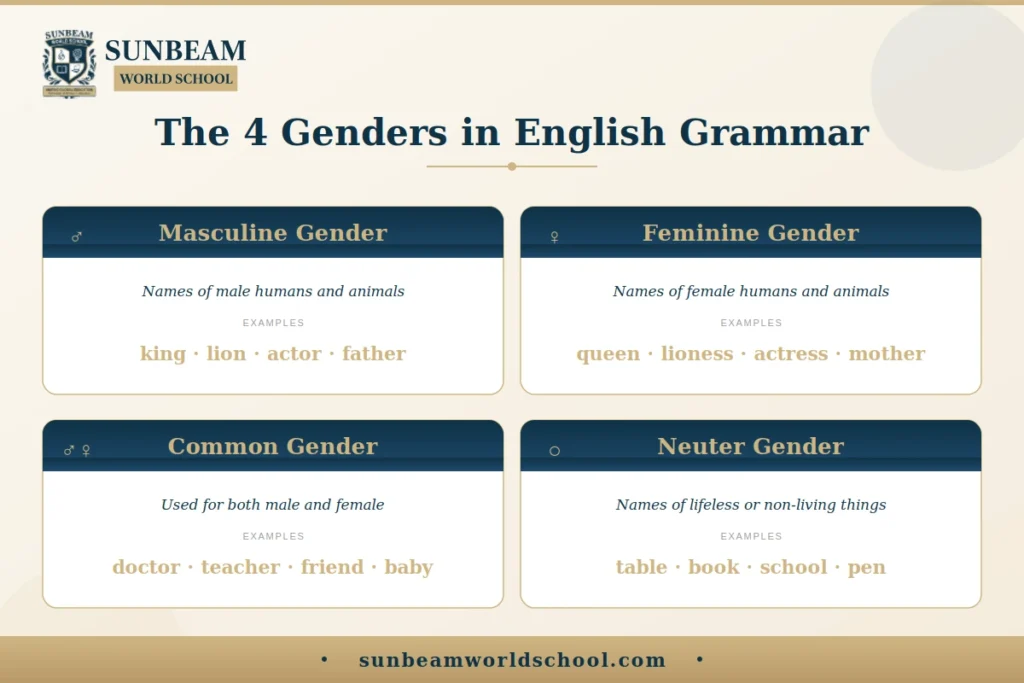
Learn the genders in English grammar—masculine, feminine, common, and neuter—with simple definitions and examples.
Masculine gender refers to male persons or animals.
For Example: man, boy, father, uncle, king, actor, lion, rooster.
Feminine gender refers to female persons or animals.
For Example: woman, girl, mother, aunt, queen, actress, lioness, hen.
Common gender is used for nouns that can refer to both males and females.
For Example: child, parent, friend, teacher, student, doctor, baby, cousin.
Neuter gender refers to objects, places, and ideas that have no sex.
For Example: book, table, chair, car, tree, phone, school, idea.
Unlike French, Spanish, or Hindi, English assigns gender only to nouns about people and animals. Objects in English are neuter, which makes the rules simpler for learners to follow.
Masculine Gender: Definition and Examples
Masculine gender is the grammatical category used for nouns that name male people or animals. Common examples include man, boy, father, king, actor, and lion. In a sentence, masculine nouns are usually paired with the pronouns he, him, or his.
Feminine Gender: Definition and Examples
Feminine gender is the grammatical category used for nouns that name female people or animals. Common examples include woman, girl, mother, queen, actress, and lioness. In a sentence, feminine nouns are usually paired with the pronouns she, her, or hers.
Top 100 Masculine and Feminine Words
Below is a complete list of 100 masculine and feminine words in English, grouped into five categories for easier learning. Students learning masculine and feminine nouns should also practice related English grammar topics like direct and indirect speech and sentence transformation.
People and Relationships
| Masculine | Feminine |
| Man | Woman |
| Boy | Girl |
| Father | Mother |
| Son | Daughter |
| Brother | Sister |
| Husband | Wife |
| Uncle | Aunt |
| Nephew | Niece |
| Grandfather | Grandmother |
| Grandson | Granddaughter |
| Bachelor | Spinster |
| Bridegroom | Bride |
| Gentleman | Lady |
| Father-in-law | Mother-in-law |
| Son-in-law | Daughter-in-law |
| Brother-in-law | Sister-in-law |
| Godfather | Godmother |
| Stepfather | Stepmother |
| Stepson | Stepdaughter |
| Stepbrother | Stepsister |
| Sir | Madam |
| Mr. | Mrs. |
| Boyfriend | Girlfriend |
| Widower | Widow |
| Cousin (male) | Cousin (female) |
Royalty and Titles
| Masculine | Feminine |
| King | Queen |
| Prince | Princess |
| Emperor | Empress |
| Duke | Duchess |
| Count | Countess |
| Baron | Baroness |
| Earl | Countess |
| Viscount | Viscountess |
| Marquis | Marchioness |
| Sultan | Sultana |
| Czar | Czarina |
| Knight | Dame |
| Heir | Heiress |
| Master | Mistress |
| Landlord | Landlady |
Professions
| Masculine | Feminine |
| Actor | Actress |
| Waiter | Waitress |
| Host | Hostess |
| Author | Authoress |
| Poet | Poetess |
| Manager | Manageress |
| Steward | Stewardess |
| Conductor | Conductress |
| Instructor | Instructress |
| Hunter | Huntress |
| Tailor | Seamstress |
| Shepherd | Shepherdess |
| Mayor | Mayoress |
| Headmaster | Headmistress |
| Salesman | Saleswoman |
| Chairman | Chairwoman |
| Policeman | Policewoman |
| Businessman | Businesswoman |
| Fireman | Firewoman |
| Postman | Postwoman |
Mythology and Religion
| Masculine | Feminine |
| God | Goddess |
| Hero | Heroine |
| Wizard | Witch |
| Priest | Priestess |
| Monk | Nun |
| Sorcerer | Sorceress |
| Prophet | Prophetess |
| Giant | Giantess |
| Abbot | Abbess |
| Patron | Patroness |
Animals and Birds
| Animal | Masculine | Feminine |
| Lion | Lion | Lioness |
| Tiger | Tiger | Tigress |
| Leopard | Leopard | Leopardess |
| Bear | Bear | She-bear |
| Wolf | Wolf | She-wolf |
| Fox | Fox | Vixen |
| Dog | Dog | Bitch |
| Cattle | Bull | Cow |
| Cattle (young) | Bullock | Heifer |
| Horse | Stallion | Mare |
| Sheep | Ram | Ewe |
| Deer | Stag | Doe |
| Pig | Boar | Sow |
| Goat | Billy goat | Nanny goat |
| Donkey | Jack | Jenny |
| Cat | Tomcat | Queen |
| Rabbit | Buck | Doe |
| Duck | Drake | Duck |
| Goose | Gander | Goose |
| Chicken | Rooster | Hen |
| Peafowl | Peacock | Peahen |
| Swan | Cob | Pen |
| Falcon | Tiercel | Falcon |
| Elephant | Bull elephant | Cow elephant |
| Whale | Bull whale | Cow whale |
| Seal | Bull seal | Cow seal |
| Camel | Bull camel | Cow camel |
| Ox | Ox | Cow |
| Hare | Buck | Doe |
| Antelope | Buck | Doe |
8 Rules to Change Masculine to Feminine
There are eight common rules for forming the feminine gender from the masculine gender in English. Learning these rules helps you guess the feminine form of new words.
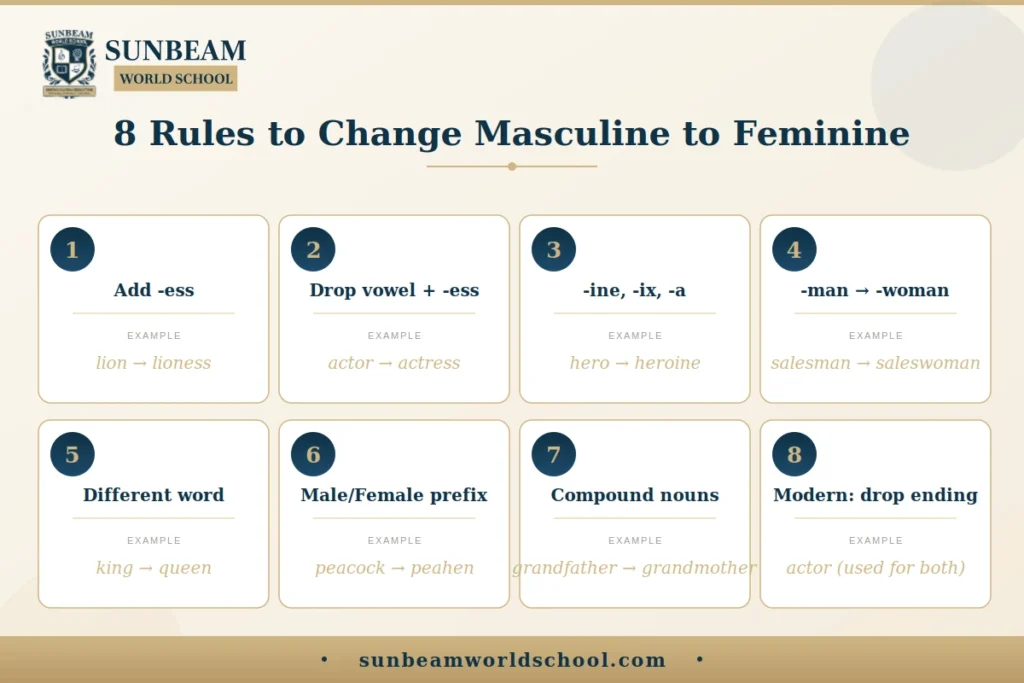
Understand the common rules for changing masculine nouns into feminine nouns in English grammar.
Rule 1: Add -ess to the masculine noun.
The simplest rule. Just attach -ess at the end.
For Example: Author → Authoress, Host → Hostess, Lion → Lioness, Poet → Poetess, Giant → Giantess.
Rule 2: Drop the last vowel before adding -ess.
When a masculine noun ends in -er, -or, or -e with a vowel before it, drop the vowel and add -ess.
For Example: Actor → Actress, Waiter → Waitress, Tiger → Tigress, Hunter → Huntress, Conductor → Conductress.
Rule 3: Add -ine, -ix, -a, or -enne.
Some feminine forms use endings borrowed from Latin, French, or Italian.
For Example: Hero → Heroine, Czar → Czarina, Sultan → Sultana, Executor → Executrix, Comedian → Comedienne.
Rule 4: Change -man to -woman in compound nouns.
For nouns ending in -man, replace -man with -woman.
For Example: Chairman → Chairwoman, Salesman → Saleswoman, Policeman → Policewoman, Businessman → Businesswoman, Postman → Postwoman.
Rule 5: Use a completely different word.
Many common pairs use unrelated words for masculine and feminine.
For Example: King → Queen, Uncle → Aunt, Bull → Cow, Bachelor → Spinster, Monk → Nun, Bridegroom → Bride.
Rule 6: Add male/female, he-/she-, or boy/girl as a prefix.
For animals and some other nouns where a single word does not exist, add a gender word.
For Example: Male elephant → Female elephant, He-goat → She-goat, He-bear → She-bear, Boyfriend → Girlfriend.
Rule 7: Change one part of a compound noun.
In compound nouns built from family or title words, only the gendered part changes.
For Example: Grandfather → Grandmother, Stepson → Stepdaughter, Landlord → Landlady, Son-in-law → Daughter-in-law, Headmaster → Headmistress.
Rule 8: Modern English drops many feminine endings.
In current usage, many feminine forms ending in -ess are dropping out of formal writing. The masculine form is now used for both sexes.
For Example: Actor (used for both), Author, Poet, Doctor, Manager, Editor. Words like authoress and poetess are now considered dated.
Masculine and Feminine of Animals
Animals often have unique masculine and feminine names that look nothing like each other. This section lists 40 animal name pairs along with the name of their young, which is a common follow-up question students search for.
| Animal | Masculine | Feminine | Young |
| Lion | Lion | Lioness | Cub |
| Tiger | Tiger | Tigress | Cub |
| Leopard | Leopard | Leopardess | Cub |
| Cheetah | Cheetah | She-cheetah | Cub |
| Bear | Bear | She-bear | Cub |
| Wolf | Wolf | She-wolf | Pup |
| Fox | Fox | Vixen | Kit |
| Dog | Dog | Bitch | Puppy |
| Cat | Tomcat | Queen | Kitten |
| Cattle | Bull | Cow | Calf |
| Bullock | Bullock | Heifer | Calf |
| Buffalo | Bull buffalo | Cow buffalo | Calf |
| Horse | Stallion | Mare | Foal |
| Donkey | Jack | Jenny | Foal |
| Mule | Jack mule | Jenny mule | Foal |
| Sheep | Ram | Ewe | Lamb |
| Goat | Billy goat | Nanny goat | Kid |
| Deer | Stag | Doe | Fawn |
| Antelope | Buck | Doe | Calf |
| Rabbit | Buck | Doe | Kit |
| Hare | Buck | Doe | Leveret |
| Pig | Boar | Sow | Piglet |
| Wild Pig | Boar | Sow | Piglet |
| Elephant | Bull elephant | Cow elephant | Calf |
| Camel | Bull camel | Cow camel | Calf |
| Whale | Bull whale | Cow whale | Calf |
| Seal | Bull seal | Cow seal | Pup |
| Walrus | Bull walrus | Cow walrus | Calf |
| Kangaroo | Buck/Boomer | Doe/Flyer | Joey |
| Chicken | Rooster | Hen | Chick |
| Duck | Drake | Duck | Duckling |
| Goose | Gander | Goose | Gosling |
| Swan | Cob | Pen | Cygnet |
| Peafowl | Peacock | Peahen | Peachick |
| Turkey | Tom | Hen | Poult |
| Pigeon | Cock | Hen | Squab |
| Falcon | Tiercel | Falcon | Eyas |
| Eagle | Male eagle | Female eagle | Eaglet |
| Owl | Male owl | Female owl | Owlet |
| Fish | Male fish | Female fish | Fry |
Some animals have no separate masculine or feminine name in common English. For these, we add male or female in front, or use he- and she-. For example: male zebra, female zebra, male giraffe, female giraffe.
Common Gender and Neuter Gender
Beyond masculine and feminine, English has two more gender categories that every learner should know.
Common Gender
Common gender is used for nouns that refer to both males and females. These words do not change based on the person's sex.
For Example: child, parent, friend, cousin, neighbour, student, teacher, doctor, baby, citizen, relative, leader, singer, writer, artist, athlete, owner, guest, visitor, partner.
In sentences, common gender nouns use the pronouns he, she, or they depending on who is being talked about.
For Example: The teacher said she would mark the papers tonight. My cousin lost his phone at the park.
Neuter Gender
Neuter gender is used for objects, places, ideas, and things that have no sex. These nouns take the pronoun it.
For Example: book, table, chair, car, tree, house, school, idea, river, mountain, computer, phone, road, building, garden, song, dream, country, music, time.
Neuter gender is the largest group of nouns in English. Almost every object you see around you is neuter.
A quick way to identify gender:
- If the noun is a male person or animal → masculine
- If the noun is a female person or animal → feminine
- If the noun can be male or female → common
- If the noun is a thing, place, or idea → neuter
Gender-Neutral Language in Modern English
English has changed in the last 50 years. Many feminine forms ending in -ess or -ress are now considered old-fashioned or unnecessary. Writers and teachers today prefer gender-neutral words that describe the job or role without showing the person's sex.
This shift matters because language shapes how people think about who can do which job. Calling every firefighter a fireman makes it harder to imagine a woman in the role.
The table below shows the older gendered word and the modern gender-neutral version most newspapers, schools, and workplaces now use.
| Old Gendered Word | Modern Gender-Neutral Word |
| Fireman | Firefighter |
| Policeman | Police officer |
| Postman / Mailman | Postal worker / Mail carrier |
| Chairman | Chairperson / Chair |
| Salesman | Salesperson / Sales representative |
| Businessman | Businessperson |
| Spokesman | Spokesperson |
| Waiter / Waitress | Server |
| Steward / Stewardess | Flight attendant |
| Actress | Actor (used for both) |
| Authoress | Author (used for both) |
| Poetess | Poet (used for both) |
| Manageress | Manager (used for both) |
| Headmaster / Headmistress | Head teacher / Principal |
| Workman | Worker |
| Cameraman | Camera operator |
| Mankind | Humankind / People |
| Man-made | Artificial / Machine-made |
| Forefathers | Ancestors |
| Layman | Layperson / Non-expert |
Words like actor, author, poet, and doctor are now used for both men and women in formal writing. Forms like poetess and authoress are rarely seen in modern books and newspapers.
For students preparing for English exams, both forms are accepted as correct. For writing in 2026, the gender-neutral word is the safer and more respectful choice.
Masculine and Feminine in Sentences
Reading masculine and feminine words in real sentences helps you understand how to study Grammar effectively . Below are 10 example sentences showing common pairs in context.
- The king ruled the country wisely, and the queen supported every decision.
- My father is a doctor, and my mother is a teacher.
- The actor won the best male award, while the actress won for her supporting role.
- The lion roared loudly as the lioness guarded her cubs.
- My uncle and aunt visited us last weekend from London.
- The bridegroom waited at the altar while the bride walked down the aisle.
- The host welcomed the guests, and the hostess served the dinner.
- The prince rode his horse while the princess watched from the balcony.
- The rooster crows every morning, and the hen lays eggs in the coop.
- The headmaster spoke at assembly, and the headmistress handed out the prizes.
Practice Exercises
Try these exercises to test your understanding. Answers are given at the end.
Exercise A: Write the Feminine
- King
- Actor
- Lion
- Uncle
- Bridegroom
- Host
- Wizard
- Nephew
- Hero
- Duke
- Stallion
- Rooster
- Monk
- Father-in-law
- Salesman
Exercise B: Write the Masculine
- Queen
- Duchess
- Mare
- Niece
- Witch
- Lioness
- Empress
- Heroine
- Bride
- Goddess
- Aunt
- Hen
- Vixen
- Headmistress
- Daughter
Exercise C: Identify the Gender (masculine, feminine, common, or neuter)
- Doctor
- Goddess
- Pen
- Brother
- Friend
- Tiger
- School
- Mother
- Cousin
- Table
- Princess
- Baby
- Tree
- Waiter
- Student
Answers
Exercise A: Queen, Actress, Lioness, Aunt, Bride, Hostess, Witch, Niece, Heroine, Duchess, Mare, Hen, Nun, Mother-in-law, Saleswoman
Exercise B: King, Duke, Stallion, Nephew, Wizard, Lion, Emperor, Hero, Bridegroom, God, Uncle, Rooster, Fox, Headmaster, Son
Exercise C: Common, Feminine, Neuter, Masculine, Common, Masculine, Neuter, Feminine, Common, Neuter, Feminine, Common, Neuter, Masculine, Common
Conclusion
Understanding masculine and feminine gender in English improves vocabulary, sentence formation, grammar accuracy, and overall communication skills. From common word pairs like king–queen and actor–actress to modern gender-neutral terms such as firefighter and chairperson, learning these forms helps students use English more confidently in speaking and writing.
Regular practice through reading, writing exercises, flashcards, and sentence building makes it easier to remember gender pairs and grammar rules. At Sunbeam World School , students are encouraged to strengthen their English foundation through practical grammar learning and interactive activities that build confidence both inside and outside the classroom.

Frequently Asked Questions
What are feminine and masculine words in English?
-Feminine and masculine words in English are nouns that show the gender of a person or animal. Masculine words name males, such as king, lion, actor, and father. Feminine words name females, such as queen, lioness, actress, and mother. English uses gender mainly for living beings, unlike languages such as Hindi or French where objects also have gender.
Are there any words that can be both masculine and feminine?
+Are there animals with only one common name?
+How can students practice feminine and masculine words at home?
+
In this article
Share this post:


Press and Blogs
Stay updated with our press releases, educational blogs, and more.

Quick Summary Animal sounds are the noises animals make to communicate, warn of danger and...

Quick Summary The area of rectangle equals its length multiplied by its width (A =...
Quick Summary Sympathy means feeling sorry for someone from your own point of view. Empathy...