
 Kids Learning
Singular and Plural Words: Rules, List, and 200+ Examples
________________________________
| Quick Answer: Singular and plural words show the number of a noun. A singular noun names one person, place, thing, or idea (book, cat, child). A plural noun names two or more (books, cats, children).
Most plurals are formed by adding -s or -es to the singular noun, but English has irregular plurals (mouse → mice), spelling-change plurals (man → men), and same-form nouns (sheep, deer, fish) that follow different rules. |
Singular and plural words show the number of a noun. A singular noun names one person, place, thing, or idea, while a plural noun names two or more. For example, book becomes books, child becomes children, and leaf becomes leaves.
Most plural nouns are formed by adding -s or -es, but some follow special spelling rules or irregular forms. If you are also confused about understanding singular and plural nouns, do not worry!
In this guide, you will learn singular and plural rules, 200+ examples, irregular nouns, sentence examples, worksheets, and practice exercises with answers that will improve your understanding.
Let’s get started!
Singular NounDefinition: A singular noun is a word that names exactly one person, place, thing, or idea. Examples: book, cat, child, woman, school, apple, idea In a sentence: The book is on the table. Plural NounDefinition: A plural noun is a word that names two or more persons, places, things, or ideas. Examples: books, cats, children, women, schools, apples, ideas In a sentence: The books are on the table. |
How Singular Nouns Become Plural
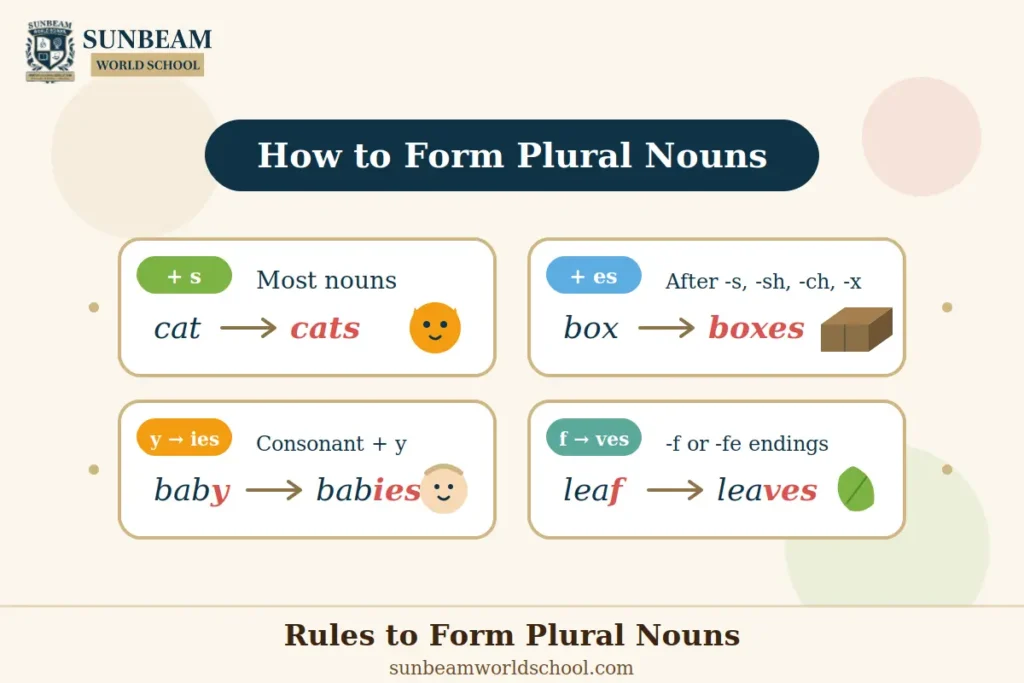
Master the 4 key rules to form plural nouns in English - with clear examples for every pattern.
A noun becomes plural when it refers to more than one. English uses four ways to do this:
Singular and Plural Rules Chart
| Rule | Singular | Plural |
| Add -s | cat | cats |
| Add -es | box | boxes |
| Change y to ies | baby | babies |
| Change f to ves | leaf | leaves |
| Irregular | child | children |
| Same form | sheep | sheep |
- Add -S
Most nouns become plural by adding -s.
For Example:
Cat becomes cats.
Book becomes books. - Add -ES
Nouns ending in s, ss, sh, ch, x, or z usually take -es.
For Example:
Box becomes boxes.
Dish becomes dishes. - Change -Y to -IES
If a noun ends in a consonant + y, change the y to ies.
For Example:
Baby becomes babies.
City becomes cities. - Change -F or -FE to -VES
Some nouns ending in -f or -fe change to ves in the plural form.
For Example:
Leaf becomes leaves.
Knife becomes knives. - Change the Spelling
Some nouns change a vowel inside the word.
For Example:
Man becomes men.
Foot becomes feet. - Use a Different Word
A few nouns use a completely different plural form.
For Example:
Child becomes children.
Person becomes people. - Keep the Same Form
Some nouns do not change at all in the plural form.
For Example:
Sheep stays sheep.
Deer stays deer. - Use Latin or Greek Plural Forms
Some words borrowed from Latin or Greek change differently in the plural form.
For Example:
Cactus becomes cacti.
Phenomenon becomes phenomena.
The verb in the sentence has to match the noun. A singular noun needs a singular verb. A plural noun needs a plural verb. This rule is called subject-verb agreement.
For Example:
The child is playing. (singular noun + singular verb)
The children are playing. (plural noun + plural verb)
Singular and Plural Words List A to Z
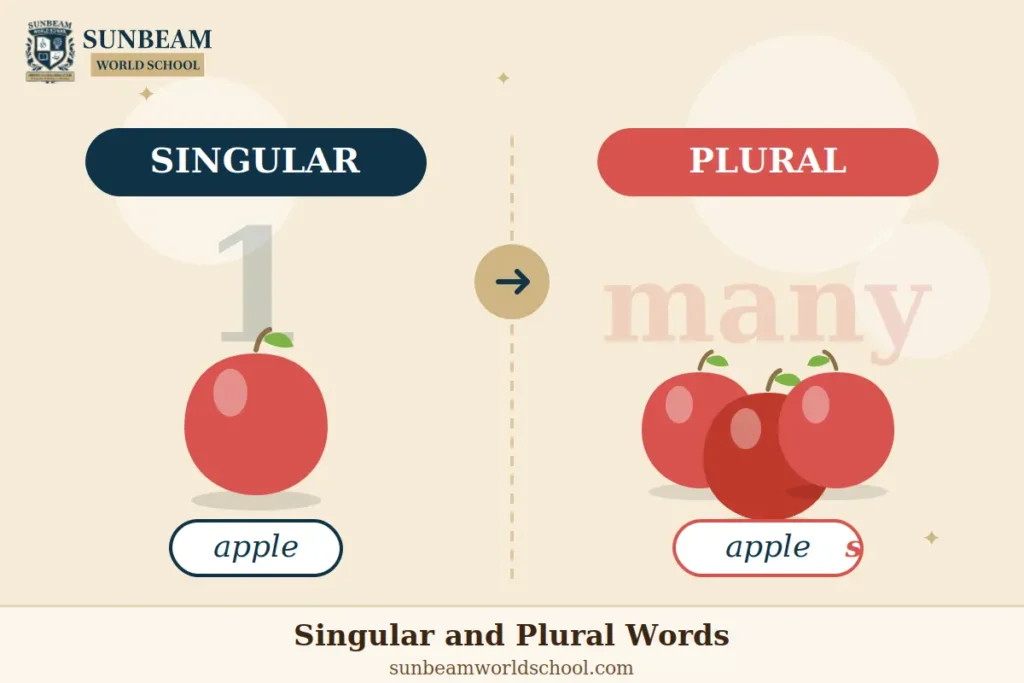
Learn the difference between singular and plural nouns: one apple is singular, while multiple apples are plural.
| Singular | Plural | Singular | Plural |
| Apple | Apples | Knife | Knives |
| Ant | Ants | Lady | Ladies |
| Arm | Arms | Leaf | Leaves |
| Aunt | Aunts | Lion | Lions |
| Baby | Babies | Loaf | Loaves |
| Ball | Balls | Man | Men |
| Banana | Bananas | Mango | Mangoes |
| Bat | Bats | Match | Matches |
| Bed | Beds | Monkey | Monkeys |
| Bird | Birds | Mouse | Mice |
| Book | Books | Nail | Nails |
| Box | Boxes | Nose | Noses |
| Boy | Boys | Ox | Oxen |
| Bus | Buses | Pan | Pans |
| Cake | Cakes | Party | Parties |
| Calf | Calves | Pen | Pens |
| Car | Cars | Pencil | Pencils |
| Cat | Cats | Person | People |
| Chair | Chairs | Photo | Photos |
| Child | Children | Piano | Pianos |
| City | Cities | Potato | Potatoes |
| Class | Classes | Queen | Queens |
| Cow | Cows | Quiz | Quizzes |
| Cup | Cups | Rabbit | Rabbits |
| Day | Days | Radio | Radios |
| Deer | Deer | Rose | Roses |
| Desk | Desks | School | Schools |
| Dish | Dishes | Sheep | Sheep |
| Doctor | Doctors | Shelf | Shelves |
| Dog | Dogs | Ship | Ships |
| Dress | Dresses | Shoe | Shoes |
| Ear | Ears | Star | Stars |
| Egg | Eggs | Story | Stories |
| Elephant | Elephants | Student | Students |
| Eye | Eyes | Table | Tables |
| Family | Families | Teacher | Teachers |
| Finger | Fingers | Tomato | Tomatoes |
| Fish | Fish | Tooth | Teeth |
| Flower | Flowers | Toy | Toys |
| Foot | Feet | Tree | Trees |
| Fox | Foxes | Umbrella | Umbrellas |
| Friend | Friends | Uncle | Uncles |
| Girl | Girls | Van | Vans |
| Goose | Geese | Watch | Watches |
| Half | Halves | Wife | Wives |
| Hand | Hands | Wolf | Wolves |
| Hat | Hats | Woman | Women |
| Horse | Horses | X-ray | X-rays |
| House | Houses | Year | Years |
| Key | Keys | Zoo | Zoos |
This list covers all the major plural rules in one place: regular -s plurals (book, cat, dog), -es plurals (box, bus, dish), -ies plurals (baby, city, lady), -ves plurals (calf, knife, wolf), irregular plurals (child, foot, mouse), and same-form nouns (deer, fish, sheep). Students can practice these rules further with our dedicated lists of animals name in English for kids and fruit names in English for kids, which provide more singular and plural examples for everyday use.
List of Irregular Singular and Plural Nouns
Irregular plural nouns do not follow the regular -s, -es, or -ies rules. Instead, they change spelling internally, use a completely different word, or take an ending borrowed from Latin or Greek. There is no single rule for these, so they have to be memorized.
Irregular Plural Nouns Examples-Learn the most common ones with Sunbeam World School.
Here is a list of common irregular singular and plural nouns in English.
| Singular | Plural | Singular | Plural |
| Child | Children | Foot | Feet |
| Man | Men | Tooth | Teeth |
| Woman | Women | Mouse | Mice |
| Person | People | Goose | Geese |
| Ox | Oxen | Louse | Lice |
| Cactus | Cacti | Analysis | Analyses |
| Focus | Foci | Crisis | Crises |
| Fungus | Fungi | Thesis | Theses |
| Nucleus | Nuclei | Diagnosis | Diagnoses |
| Alumnus | Alumni | Basis | Bases |
| Phenomenon | Phenomena | Datum | Data |
| Criterion | Criteria | Medium | Media |
| Bacterium | Bacteria | Index | Indices |
| Mother-in-law | Mothers-in-law | Father-in-law | Fathers-in-law |
Nouns That Are the Same in Singular and Plural
Some English nouns have the same spelling in both singular and plural forms. Others always appear in plural form, and a few look plural but are treated as singular. The table below covers all three groups.
| Type | Examples | Example Sentence |
| Same in both forms | Sheep, Deer, Fish, Aircraft, Species, Series, Salmon, Trout, Moose | One deer is grazing. Three deer are grazing. |
| Always plural in form | Scissors, Trousers, Jeans, Glasses, Pliers, Pajamas, Binoculars | My scissors are sharp. |
| Plural in form, singular in meaning | News, Mathematics, Physics, Economics, Politics, Measles | The news is interesting. |
Tip: For fish, both fish and fishes are correct. Use fish when referring to a general group, and fishes when referring to different species.
Singular and Plural Words by Class
Singular and plural words for kids are introduced gradually from Class 1 to Class 8. Younger students learn simple regular plurals first. Higher classes move on to irregular plurals, words borrowed from Latin and Greek, and compound nouns. The lists below are grouped by grade level so students can practice the words most relevant to their class.
Singular and Plural Words for Class 1 and Class 2
Class 1 and Class 2 students focus on simple one-syllable nouns with regular -s plurals.
| Singular | Plural | Singular | Plural |
| Cat | Cats | Book | Books |
| Dog | Dogs | Pen | Pens |
| Ball | Balls | Apple | Apples |
| Boy | Boys | Bus | Buses |
| Girl | Girls | Baby | Babies |
Singular and Plural Words for Class 3, Class 4, and Class 5
Class 3 to Class 5 students learn -es plurals, -ies plurals, -ves plurals, and common irregular plurals.
| Singular | Plural | Singular | Plural |
| Fox | Foxes | Story | Stories |
| Mango | Mangoes | Knife | Knives |
| Leaf | Leaves | Wolf | Wolves |
| Family | Families | Child | Children |
| Tooth | Teeth | Mouse | Mice |
Singular and Plural Words for Class 6, Class 7, and Class 8
Class 6 to Class 8 students cover Latin and Greek irregular plurals, in-law compounds, and academic vocabulary.
| Singular | Plural | Singular | Plural |
| Phenomenon | Phenomena | Datum | Data |
| Analysis | Analyses | Medium | Media |
| Criterion | Criteria | Crisis | Crises |
| Alumnus | Alumni | Bacterium | Bacteria |
| Mother-in-law | Mothers-in-law | Thesis | Theses |
Singular and Plural Sentence Examples
The verb and other words in a sentence change when a noun shifts from singular to plural. Here are paired sentence examples that show how subject-verb agreement works in everyday English.
| Singular Sentence | Plural Sentence |
| The box is heavy. | The boxes are heavy. |
| A bird sings beautifully. | The birds sing beautifully. |
| One baby is sleeping. | Two babies are sleeping. |
| A leaf has fallen from the tree. | Many leaves have fallen from the tree. |
| The child plays in the park. | The children play in the park. |
| A woman teaches my class. | Three women teach my class. |
| The mouse runs across the floor. | The mice run across the floor. |
| The sheep grazes in the field. | The sheep graze in the field. |
Note: Even when the noun spelling stays the same (such as sheep, deer, or fish), the verb still changes based on whether the meaning is singular or plural.
Common Mistakes to Avoid with Singular and Plural Words
Even strong students make these mistakes. Knowing them makes them easier to avoid in writing and exams.
Mistake 1. Adding -s to Irregular Plurals
Irregular nouns do not take -s. The full word changes instead.
Incorrect: childs, mans, foots, tooths
Correct: children, men, feet, teeth
Mistake 2. Making Uncountable Nouns Plural
Uncountable nouns like information, furniture, advice, and luggage have no plural form.
Incorrect: I have many information.
Correct: I have a lot of information.
Mistake 3. Using an Apostrophe to Make a Plural
An apostrophe shows possession, not plurality. To make a plural, just add -s or -es.
Incorrect: The apple's are red.
Correct: The apples are red.
Mistake 4. Wrong Plural for In-Law Compounds
In compound nouns ending in -in-law, the first word becomes plural, not the last.
Incorrect: My sister-in-laws are visiting.
Correct: My sisters-in-law are visiting.
Mistake 5. Wrong Verb with Singular or Plural Nouns
A singular noun takes a singular verb. A plural noun takes a plural verb.
Incorrect: The children is playing.
Correct: The children are playing.
Singular and Plural Words Practice Exercises with Answers
Use this worksheet to practise the rules covered above. The answer key is given at the end.
Exercise A. Write the Plural Form
Write the correct plural for each singular noun.
- city
- fox
- baby
- tooth
- leaf
- child
- sheep
- potato
- bus
- mango
- wolf
- man
- boy
- mouse
- story
Exercise B. Multiple Choice Questions
Choose the correct option.
- What is the plural of mouse?
a) mouses b) mice c) mices - Which sentence is correct?
a) The childrens are playing. b) The children are playing. c) The childs are playing. - The plural of knife is:
a) knifes b) knives c) knife - What is the plural of deer?
a) deers b) deer c) deeres - Which is the correct plural?
a) womans b) women c) womens - The plural of photo is:
a) photoes b) photos c) photoses - What is the plural of bus?
a) bus b) buss c) buses - Which sentence is correct?
a) The scissors is sharp. b) The scissors are sharp. c) The scissor are sharp.
Exercise C. Fill in the Blanks
Fill in the blank with the correct plural form of the noun in brackets.
- The two ____ are playing in the park. (child)
- I bought three ____ from the market. (potato)
- Many ____ have fallen from the tree. (leaf)
- The ____ are eating grass in the field. (sheep)
- She brushes her ____ twice a day. (tooth)
- The farmer keeps two ____ on his farm. (ox)
- Three ____ are flying in the sky. (goose)
- My ____ are very sharp. (knife)
Answer Key
Exercise A: 1. cities 2. foxes 3. babies 4. teeth 5. leaves 6. children 7. sheep 8. potatoes 9. buses 10. mangoes 11. wolves 12. men 13. boys 14. mice 15. stories
Exercise B: 1. b) mice 2. b) The children are playing. 3. b) knives 4. b) deer 5. b) women 6. b) photos 7. c) buses 8. b) The scissors are sharp.
Exercise C: 1. children 2. potatoes 3. leaves 4. sheep 5. teeth 6. oxen 7. geese 8. Knives
Download Singular and Plural Words PDF
Download the free singular and plural words PDF for offline practice and revision. The PDF includes:
- 100 singular and plural words list (A to Z)
- All six rules for forming plural nouns
- Irregular plural nouns list
- Practice worksheet with answer key
It works for students from Class 1 to Class 8 across CBSE, IGCSE, American, Australian, and NIOS curricula.
Conclusion
Mastering singular and plural words takes practice. Use the rules, the A to Z list, and the worksheet in this guide regularly to build accuracy in writing and exams. Bookmark this page for quick revision and download the PDF for offline study.
At Sunbeam World School, English grammar is part of the core curriculum for every student across our CBSE, Cambridge IGCSE, American, Australian, and NIOS pathways.

Frequently Asked Questions
What are singular and plural words?
-Singular and plural words show the number of a noun. A singular noun names one person, place, thing, or idea. A plural noun names two or more. For example, book is singular and books is plural.
What is the difference between singular and plural?
+How do you form plural nouns in English?
+What is the plural of mouse?
+What is the plural of child?
+What are irregular plural nouns?
+What are nouns that have the same singular and plural form?
+Do uncountable nouns have a plural form?
+How do you make nouns ending in -y or -f plural?
+What is subject-verb agreement with singular and plural nouns?
+
In this article
Share this post:


Press and Blogs
Stay updated with our press releases, educational blogs, and more.

Quick Summary Animal sounds are the noises animals make to communicate, warn of danger and...

Quick Summary The area of rectangle equals its length multiplied by its width (A =...
Quick Summary Sympathy means feeling sorry for someone from your own point of view. Empathy...