
 Education
5+3+3+4 Education System Explained: NEP 2020 Stages & Complete Guide
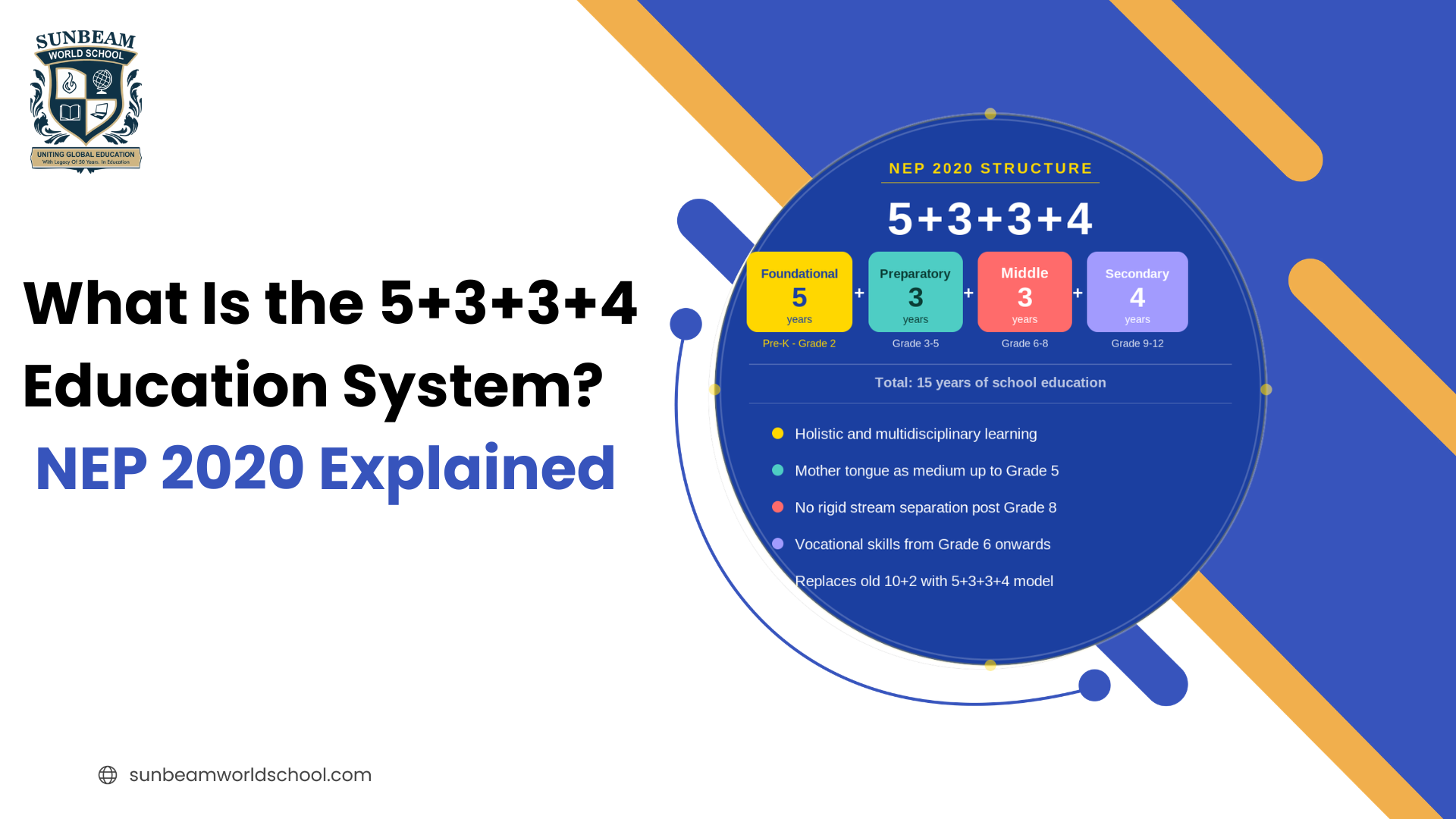
| Quick answer: The 5+3+3+4 education system is India's new school structure under the National Education Policy (NEP) 2020. It splits 15 years of schooling into four stages aligned with how children learn — Foundational (5 yrs, ages 3-8), Preparatory (3 yrs, ages 8-11), Middle (3 yrs, ages 11-14), and Secondary (4 yrs, ages 14-18) and replaces the 1986 10+2 framework with a flexible, competency-based model. |
| Duration (Years) | Stage | Age Group | Classes Covered |
| 5 Years | Foundational Stage | 3–8 years | Pre-school, Balvatika, Classes 1–2 |
| 3 Years | Preparatory Stage | 8–11 years | Classes 3–5 |
| 3 Years | Middle Stage | 11–14 years | Classes 6–8 |
| 4 Years | Secondary Stage | 14–18 years | Classes 9–12 |
India's education system is undergoing its biggest transformation in decades. Introduced under the National Education Policy (NEP) 2020, the 5+3+3+4 education structure replaces the traditional 10+2 model with a more flexible, child-centric approach that aligns learning with different stages of development.
From formal pre-school education to multidisciplinary subject choices and competency-based learning, the new framework aims to prepare students for the demands of the modern world.
Let’s explore the 5+3+3+4 system, its stages, key benefits, latest updates, and how it differs from the old 10+2 structure.
What Is the 5+3+3+4 Education System?
The 5+3+3+4 education system is India's new school structure introduced by the National Education Policy (NEP) 2020. It restructures the previous 10+2 framework into four developmental stages aligned with how children actually learn from age 3 to age 18:
- Foundational Stage — 5 years (ages 3-8): 3 years of pre-school + Classes 1-2
- Preparatory Stage — 3 years (ages 8-11): Classes 3-5
- Middle Stage — 3 years (ages 11-14): Classes 6-8
- Secondary Stage — 4 years (ages 14-18): Classes 9-12
The numbers refer to the duration in years of each stage. The most important change from earlier systems is that three years of Early Childhood Care and Education (ECCE) are now formally part of school education — instead of starting at age 6, the school journey now starts at age 3.
The 5+3+3+4 system is the school-education arm of NEP 2020, and its day-to-day form in classrooms is shaped by two newer documents: the National Curriculum Framework for the Foundational Stage (NCF-FS 2022) and the National Curriculum Framework for School Education (NCF-SE 2023).
Why Was the Old 10+2 System Replaced?
The 10+2 structure was introduced in 1986 and stayed largely unchanged for nearly four decades. It worked for an earlier generation, but three big issues forced a rethink:
- Early childhood was invisible, children from ages 3-6 — the years cognitive science calls the most important for brain development — were outside the school system. The 5+3+3+4 framework brings them in.
- Stages didn't match how children learn. An 8-year-old and a 14-year-old were both lumped into "primary/upper-primary" with little change in pedagogy. The new four-stage model reflects what developmental psychology tells us: each phase needs its own teaching style.
- Exams rewarded memory, not understanding. Board exams, particularly at Class 10 and 12, encouraged rote learning. The reformed assessment under NEP 2020 emphasizes competency, application, and analysis.
The 5+3+3+4 model also opens the door to flexibility, flexible subject combinations, multiple entry and exit points in higher classes, and a phased move away from the rigid Science / Commerce / Arts streams.
The Four Stages of 5+3+3+4 Explained
| Stage | Duration | Age Group | Classes Covered | Core Focus |
| Foundational Stage | 5 Years | 3–8 Years | Pre-school (3 years) + Classes 1–2 | Play-based learning, foundational literacy and numeracy |
| Preparatory Stage | 3 Years | 8–11 Years | Classes 3–5 | Discovery-based and structured learning |
| Middle Stage | 3 Years | 11–14 Years | Classes 6–8 | Subject understanding, critical thinking, and vocational exposure |
| Secondary Stage | 4 Years | 14–18 Years | Classes 9–12 | Multidisciplinary learning, flexible subject choices, and career preparation |
1. Foundational Stage (5 years · ages 3-8)
The Foundational Stage covers three years of pre-school — delivered through Anganwadis, Balvatikas attached to primary schools, and stand-alone pre-schools — followed by Class 1 and Class 2. It is the first time formal Indian schooling officially begins at age 3.
The pedagogy is play-based and activity-based. Children learn through stories, songs, art, games and conversation rather than worksheets. The aim is set by the NIPUN Bharat Mission: every child should achieve Foundational Literacy and Numeracy (FLN) by Class 3 — meaning they can read with comprehension and do basic arithmetic confidently.
There are no formal marks or summative exams at this stage. Teachers track each child through a Holistic Progress Card covering language, motor skills, social-emotional growth and curiosity.
2. Preparatory Stage (3 years · ages 8-11)
The Preparatory Stage spans Classes 3 to 5. Children transition from play-based to structured discovery-based learning — still hands-on, but now with proper textbooks, notebooks and time-tabled subjects.
Reading, writing, mathematics and a second language take centre stage, with environmental studies and the arts running alongside. Computational thinking is introduced in a gentle, age-appropriate form.
The first school-based summative assessment sits at the end of Class 3 — designed to check whether FLN has been achieved and to flag children who need extra support before they move on. PARAKH Rashtriya Sarvekshan 2024 sampled Grade 3 students nationally to monitor exactly this transition.
3. Middle Stage (3 years · ages 11-14)
The Middle Stage covers Classes 6 to 8 — historically a stretch where Indian students often disengage. NEP 2020 tries to fix that with three deliberate moves:
- Subject teaching by specialist teachers — Mathematics, Science, Social Science, three languages and Computer Science / coding.
- Mandatory vocational exposure from Grade 6 — every student samples carpentry, gardening, electrical work, pottery, or local crafts as part of a 10-day "bagless period."
- Experiential and project-based learning in every subject, supported by school-level assessments at the end of Class 5 and Class 8.
4. Secondary Stage (4 years · ages 14-18)
The Secondary Stage covers Classes 9 to 12 as a single four-year block, instead of being split into "secondary" and "senior secondary" as it used to be. The big shift here is flexibility:
- Students take a wider mix of subjects, drawing freely across Science, Commerce and Humanities — for example, Physics with Economics and Psychology.
- Two cycles of board examinations can be offered each year (CBSE has confirmed this from 2026-27), with students free to keep the better score.
- Vocational education and life-skill courses continue alongside academic subjects.
- Class 11 and 12 are no longer fenced off as a separate "+2" silo.
Subjects Taught at Each Stage
| Stage | Core Subjects / Activities |
| Foundational Stage (Pre-school + Classes 1–2) | Language and storytelling, early numeracy, art and craft, music and movement, physical activities, and social-emotional play-based learning |
| Preparatory Stage (Classes 3–5) | First language (mother tongue/regional language), second language, Mathematics, Environmental Studies, Art Education, Physical Education, and basic computational thinking |
| Middle Stage (Classes 6–8) | Three languages (including one Indian language), Mathematics, Science, Social Science, ICT and coding, Art Education, Vocational Education, and Physical & Health Education |
| Secondary Stage (Classes 9–12) | Two languages, Mathematics and computational thinking, Science (Physics, Chemistry, Biology), Social Sciences and Humanities, Commerce subjects, Vocational courses, Art Education, and Physical Education with flexible subject choices and multidisciplinary combinations |
5+3+3+4 vs 10+2: Side-by-Side Comparison
| Aspect | 5+3+3+4 System (NEP 2020) | 10+2 System (1986 Policy) |
| Structure | 5 + 3 + 3 + 4 years across four developmental stages | 10 years of general schooling + 2 years of higher secondary education |
| Age Coverage | 3–18 years | 6–18 years |
| Pre-school Education | Formally included within the schooling framework | Not included in the formal education structure |
| Teaching Approach | Play-based, discovery-driven, and competency-focused learning | Primarily textbook-based learning with greater emphasis on memorisation |
| Assessment System | Continuous assessment through competency-based evaluations, Holistic Progress Card (HPC), and PARAKH framework | Annual examinations with major focus on Class 10 and Class 12 board exams |
| Class 10 & 12 Board Exams | Multiple opportunities; students can retain their best score | Single annual examination with one high-stakes attempt |
| Subject Choice in Classes 11–12 | Flexible multidisciplinary combinations across subjects and streams | Fixed Science, Commerce, and Arts streams |
| Vocational Education | Introduced from Grade 6 with hands-on learning and internships | Optional and offered in a limited manner |
| Medium of Instruction | Mother tongue/regional language preferred up to Class 5 | No specific national policy |
| Report Card Format | Holistic Progress Card focusing on overall development and competencies | Marks-based report card focused mainly on academic performance |
| Teacher Qualification | Four-year Integrated B.Ed. (ITEP) targeted as the minimum qualification by 2030 | Two-year B.Ed. qualification |
| Public Spending Goal | Target of 6% of GDP on education | Historically around 3–4% of GDP |
NCF-FS 2022 & NCF-SE 2023: The Curriculum Frameworks
The 5+3+3+4 system gives the school structure. Two further documents translate that structure into actual classroom curriculum:
NCF-FS 2022 — the National Curriculum Framework for the Foundational Stage, covering ages 3-8. It sets out learning outcomes, age-appropriate methods and assessment for pre-school and Classes 1-2.
NCF-SE 2023 — the National Curriculum Framework for School Education, covering the full 5+3+3+4 structure including the Preparatory, Middle and Secondary stages.
This is why parents and teachers sometimes hear about "the new curriculum", strictly speaking, that means the introduction to the 2020 curriculum as expressed through NCF-FS 2022 and NCF-SE 2023, with NEP 2020 sitting above as the policy charter. NCERT then writes textbooks that implement these frameworks.
Assessment Reform: PARAKH, Two Board Exams & the HPC
Assessment is where NEP 2020 is most visibly different from what came before. Three reforms in particular are reshaping how students are evaluated.
1. PARAKH — the National Assessment Centre
PARAKH (Performance Assessment, Review and Analysis of Knowledge for Holistic Development) was set up as an independent unit of NCERT to standardise assessments across CBSE, CISCE and state boards. Its first major exercise — the PARAKH Rashtriya Sarvekshan 2024, held on 4 December 2024 — assessed approximately 22.94 lakh students across 75,565 schools in Grades 3, 6 and 9. These grades are not random: they mark the end-points of the Foundational, Middle and early Secondary stages.
2. Two board exams a year
NEP 2020 recommends that Class 10 and Class 12 board examinations be conducted twice a year, with students free to keep the better attempt. CBSE has formally confirmed it will adopt this pattern from the 2026-27 academic session. CISCE is preparing to follow.
3. The Holistic Progress Card (HPC)
The HPC replaces the traditional marks-only report card. It includes:
- Cognitive performance across subjects
- Social-emotional learning
- Physical and motor development
- Self-assessment by the student
- Peer and parent inputs
PARAKH has now released a Digital Holistic Progress Card, which makes it possible to maintain this richer record at scale across schools.
NCERT 2026-27 Textbook Rollout: What's Changing
On 17 March 2026, NCERT issued an official advisory laying out a phased textbook rollout aligned with NCF-SE 2023. Here's how it stands for the 2026-27 academic session:
| Grade | 2026–27 Status | What Changes |
| Classes 1–8 | New NCERT textbooks already implemented | Fully aligned with the National Curriculum Framework for Foundational Stage (NCF-FS 2022) and National Curriculum Framework for School Education (NCF-SE 2023) |
| Class 9 | New NCERT textbooks introduced in 2026–27 | New English textbook "Kaveri" replaces "Beehive" and "Moments" |
| Classes 10 & 11 | Existing NCERT textbooks continue | Introduction of revised textbooks postponed to the 2027–28 academic session |
| Class 12 | Existing NCERT textbooks continue | New NCERT textbooks expected to be introduced from the 2028–29 academic session |
| Note on naming: Several new NCERT books carry Indian-language titles to signal a cultural reset — examples include Kaveri (Class 9 English) and Poorvi (Class 6 English). Both feature a more balanced mix of Indian and global authors. |
Implementation Timeline & State Adoption
The 5+3+3+4 system is being rolled out in phases — the target year for full nationwide implementation is 2040. Key milestones so far:
| Year | Milestone |
| 2020 | National Education Policy (NEP) 2020 approved by the Union Cabinet |
| 2021 | Uttarakhand becomes the first state to adopt the 5+3+3+4 school structure |
| 2022 | National Curriculum Framework for Foundational Stage (NCF-FS 2022) released |
| 2023 | National Curriculum Framework for School Education (NCF-SE 2023) released for the full school structure |
| 2024 | PARAKH Rashtriya Sarvekshan conducted nationwide, covering approximately 22.94 lakh students |
| 2024–25 | New NCERT textbooks introduced for Classes 3 and 6, including the "Poorvi" English textbook |
| 2025–26 | Revised NCERT textbooks expanded across Classes 1–8 |
| 2026–27 | New NCERT textbooks introduced for Class 9; CBSE begins implementation of two board examinations per year |
| 2027–28 | Revised NCERT textbooks scheduled for Classes 10 and 11 |
| 2030 | Target year for universal access to quality Early Childhood Care and Education (ECCE) and adoption of the 4-year Integrated Teacher Education Programme (ITEP) as the standard teacher qualification |
| 2040 | Target year for full implementation of NEP 2020 across India |
States leading the early adoption include Uttarakhand, Maharashtra, Madhya Pradesh, Karnataka, Andhra Pradesh and Telangana. Most other states are now in the textbook-transition phase, with state councils (SCERTs) actively adapting NCERT materials to local languages and contexts.
Advantages of the 5+3+3+4 System
The 5+3+3+4 education structure aligns learning with a child's developmental stages, making education more engaging, flexible, and age-appropriate.
-
Early Childhood Education Becomes Part of Formal Schooling
One of the most significant changes introduced by the 5+3+3+4 model is the formal inclusion of children aged 3-6 years within the education system. Previously, pre-primary education existed largely outside the formal school framework, leading to variations in quality and learning outcomes. By integrating three years of pre-school into the Foundational Stage, the new system strengthens literacy, numeracy, communication, and social skills during the most critical years of brain development.
-
Learning Stages Match Child Development
The new structure is based on developmental psychology rather than administrative convenience. Each stage is designed around how children naturally learn at different ages. Younger children learn through play and exploration, while older students gradually move toward conceptual understanding, analytical thinking, and specialized learning. This age-appropriate approach makes education more engaging and effective.
-
Reduced Examination Pressure
Traditional board examinations often placed enormous pressure on students because performance depended on a single annual test. Under NEP 2020, students will have multiple opportunities to take board exams, and their best score can be retained. This reduces stress, encourages continuous improvement, and allows students to focus on genuine learning rather than exam preparation alone.
-
Greater Flexibility in Subject Selection
The 5+3+3+4 system promotes multidisciplinary education by removing rigid barriers between Science, Commerce, and Arts streams. Students can choose subject combinations based on their interests and career goals. For example, a student can study Mathematics alongside Music, or Physics alongside Economics, creating a more personalized learning experience.
-
Strong Focus on Vocational and Life Skills
Vocational education is introduced from Grade 6 onwards, exposing students to practical skills and real-world applications. Areas such as coding, financial literacy, agriculture, carpentry, gardening, entrepreneurship, and local crafts become part of the learning experience. This helps students develop employable skills and understand career options from an early age.
-
Promotion of Mother-Tongue Learning
NEP 2020 recommends using the mother tongue or regional language as the medium of instruction up to at least Class 5. Research shows that children learn concepts more effectively in a language they understand well. This approach improves comprehension, classroom participation, and foundational learning outcomes while reducing dropout rates.
-
Holistic Student Assessment
The traditional marks-focused report card is being replaced by the Holistic Progress Card (HPC). Instead of evaluating students solely on examination scores, the HPC assesses academic achievement, creativity, communication skills, problem-solving abilities, teamwork, and socio-emotional development. This provides a more complete picture of a student's growth and potential.
-
Improved Assessment Standards Across Boards
The introduction of PARAKH (Performance Assessment, Review and Analysis of Knowledge for Holistic Development) aims to create consistent assessment standards across CBSE, CISCE, and state boards. This will improve transparency, reduce disparities in evaluation methods, and make student performance more comparable nationwide.
Challenges in Implementing the 5+3+3+4 System
Schools, parents, and policymakers must work together to ensure a smooth transition across all stages of learning to overcome the below challenges:
-
Infrastructure and Resource Gaps
Successful implementation requires adequate classrooms, pre-school facilities, laboratories, libraries, and digital infrastructure. Many schools, particularly in rural and underserved areas, still face shortages of basic educational resources. Bridging these gaps will require substantial investment and long-term planning.
-
Teacher Training and Upskilling
The new framework demands a shift from rote teaching to competency-based, experiential learning. Teachers need training in modern pedagogical methods, technology integration, multidisciplinary teaching, and student-centered assessment. Although the four-year Integrated Teacher Education Programme (ITEP) is expected to become the standard qualification by 2030, extensive professional development is needed for existing teachers.
-
Curriculum and Textbook Transition
Implementing a completely new educational structure requires updating curricula, textbooks, lesson plans, assessments, and teaching materials. Schools must adapt to revised NCERT books and competency-based learning models, particularly during the transition period between 2026 and 2028. Managing this change smoothly remains a significant challenge.
-
Parent and Community Awareness
Many parents are familiar with the traditional 10+2 system and may find the new structure confusing. Concepts such as developmental stages, flexible subject choices, competency-based assessments, and Holistic Progress Cards require clear communication. Schools will need to actively engage parents to ensure understanding and support.
-
Financial Requirements
NEP 2020 recommends increasing public spending on education to 6% of GDP. Achieving this target is essential for improving infrastructure, teacher training, technology adoption, and educational quality. However, sustaining such investment across all states remains a major policy and budgetary challenge.
-
Managing Multiple Board Examinations
The proposal to conduct board examinations more than once a year offers benefits to students but also increases administrative complexity. Education boards must develop larger question banks, strengthen examination security, train additional evaluators, and accelerate result processing. Ensuring fairness and consistency across multiple exam cycles will require robust systems and careful planning.
What Parents Should Know
If your child is currently in school in 2026, here is what is most relevant to you:
- Pre-school matters now. Choose a school that runs Balvatika classes or partners with a quality ECCE feeder.
- Class 9 students entering 2026-27 will study new NCERT textbooks; don't buy older editions of guidebooks for these classes.
- Class 10 and Class 11 in 2026-27 continue with existing books — no rush to switch.
- Board exams may run twice a year from 2026-27 onwards in CBSE; plan revision cycles accordingly.
- Holistic Progress Cards will replace conventional report cards over time. Read each section, not just the marks.
- Vocational exposure from Class 6 is a feature, not a distraction — encourage your child to engage with it.
Conclusion
The 5+3+3+4 education system marks a significant shift towards holistic, flexible, and skill-focused learning in India. By aligning education with children's developmental needs and promoting multidisciplinary growth, it aims to better prepare students for higher education and future careers.
At Sunbeam World School, we embrace these progressive educational reforms to provide students with a strong academic foundation, practical skills, and a nurturing environment for lifelong success.

Frequently Asked Questions
What is the 5+3+3+4 education system in India?
-The 5+3+3+4 education system is the new school structure introduced under India's National Education Policy (NEP) 2020. It divides 15 years of school education into four developmental stages — Foundational (5 years, ages 3-8), Preparatory (3 years, ages 8-11), Middle (3 years, ages 11-14) and Secondary (4 years, ages 14-18) — and replaces the older 10+2 system.
What does 5+3+3+4 stand for?
+Why was the 10+2 system replaced?
+What is the foundational stage in the 5+3+3+4 system?
+What changes for Class 9 in 2026-27?
+Will board exams change under the 5+3+3+4 system?
+What is PARAKH and how does it fit into the 5+3+3+4 system?
+Are rigid streams (Science, Commerce, Arts) abolished in NEP 2020?
+What subjects are taught at each stage?
+What is the Holistic Progress Card (HPC)?
+When will the 5+3+3+4 system be fully implemented in India?
+Which states have adopted the 5+3+3+4 system first?
+What is the difference between NCF-FS 2022 and NCF-SE 2023?
+Does the 5+3+3+4 system make pre-school compulsory?
+Are JEE and NEET affected by the 5+3+3+4 system?
+
In this article
Share this post:


Press and Blogs
Stay updated with our press releases, educational blogs, and more.

Quick Summary Animal sounds are the noises animals make to communicate, warn of danger and...
Quick Summary An algebra equation is a maths statement that sets two expressions equal using...

Quick Summary Essential Repeat (ER) in CBSE means a student has not met the passing...