 Kids Learning
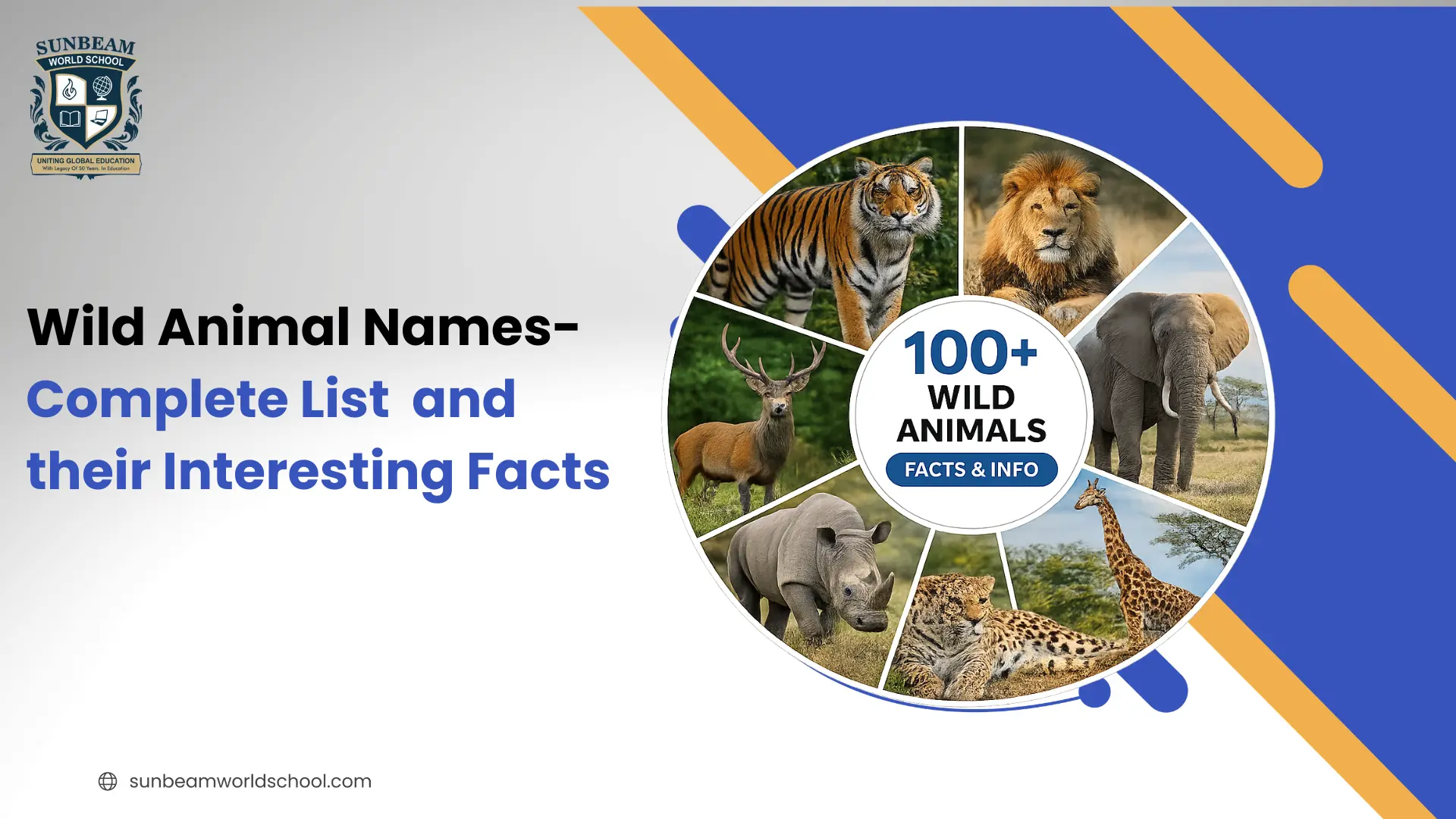
Wild Animal Names: A Complete List of 100+ Wild Animals and Their Interesting Facts
| Wild animal names refer to animals that live and survive in their natural habitats without human domestication. These animals are found across forests, grasslands, deserts, mountains, oceans, and polar regions, where they play essential roles in maintaining ecological balance. Common wild animals include lions, tigers, elephants, giraffes, wolves, bears, zebras, crocodiles, dolphins, and eagles.
Wild animals can be grouped into categories such as mammals, birds, reptiles, amphibians, and marine animals. Each species has unique characteristics, scientific classifications, habitats, diets, and survival adaptations. For example, the cheetah is the fastest land animal, the blue whale is the largest animal on Earth, and the African elephant is the largest land mammal. |
Wild animals are creatures that live and survive in their natural habitat without depending on humans. From dense rainforests and open savannas to deep oceans and frozen poles, the planet is home to millions of wild species — each with its own name, behavior, and survival story. This guide brings together a clear, organized list of 100+ wild animal names in English, grouped by category, with the scientific name and one interesting fact for each.
Whether you're a student building a school project, a parent teaching kids, a quiz enthusiast, or simply an animal lover, you'll find this list easy to scan and packed with facts. We've also added bonus sections on wild animal group names (collective nouns), baby animal names, and a quick A-to-Z reference.
What Are Wild Animals?Wild animals are animals that live, feed, and reproduce in nature on their own, without being tamed or controlled by humans. They keep their natural instincts and play a vital role in their ecosystems — as predators, prey, pollinators, or seed-spreaders. This makes them different from domestic animals such as dogs, cats, cows, and chickens, which have been bred over generations to live with people. |
body { font-family: 'Poppins', sans-serif; background:#f4f6fa; padding:40px 20px; margin:0; }
.wrap { max-width: 760px; margin: 0 auto; }
.label { font-size:13px; font-weight:600; color:#6b7280; text-transform:uppercase; letter-spacing:0.08em; margin-bottom:12px; }
.note { background:#fff; border:1px dashed #cbd5e1; padding:14px 18px; border-radius:10px; font-size:14px; color:#475569; margin-top:24px; }
code { background:#eef2f7; padding:2px 6px; border-radius:4px; font-size:13px; }

How young learners explore the wild at Sunbeam World School
In a recent live class, a Our Primary student journeyed through the wild — from tigers and tapirs to pangolins and polar bears — using an interactive habitat map and live Q&A with their teacher. They grouped animals by habitat, picked up new vocabulary, and uncovered surprising facts that turned a textbook list into a real adventure.
This insight reflects a real classroom experience at Sunbeam World School.
100K+ Students Worldwide
30+ Countries Served
1.Big Cats & Wild Cats
The world's most powerful feline hunters — from roaring big cats to small, stealthy wildcats.
- Lion (Panthera leo)
Known as the "king of the jungle," lions are the only cats that live in large social groups called prides, and a male's roar can be heard up to 5 miles away.
- Tiger (Panthera tigris)
The largest of all wild cats, every tiger has a unique stripe pattern — like a human fingerprint — and the stripes even mark its skin, not just its fur.
- Leopard (Panthera pardus)
Incredibly strong climbers, leopards often haul prey heavier than themselves up into trees to keep it away from lions and hyenas.
- Cheetah (Acinonyx jubatus)
The fastest land animal on Earth, the cheetah can accelerate from 0 to 60 mph in just three seconds.
- Jaguar (Panthera onca)
The largest cat in the Americas, the jaguar has the strongest bite of any big cat relative to its size and often kills by piercing the skull.
- Cougar (Puma / Mountain Lion) (Puma concolor)
Despite its size, the cougar can't roar — instead it purrs like a house cat and can leap more than 18 feet into a tree.
- Snow Leopard (Panthera uncia)
Perfectly built for cold mountains, the snow leopard uses its thick 3-foot tail as a balancing pole and as a blanket while it sleeps.
- Lynx (Lynx lynx)
Famous for its tufted ears and wide, snowshoe-like paws, the lynx is a quiet hunter that mainly preys on hares.
- Bobcat (Lynx rufus)
Named for its short "bobbed" tail, this adaptable North American cat can survive in forests, deserts, and even suburbs.
- Caracal (Caracal caracal)
With its dramatic black ear tufts, the caracal can leap up to 10 feet straight up to swat birds out of the air.
- Serval (Leptailurus serval)
The serval has the longest legs relative to body size of any cat, helping it pounce on prey hidden in tall grass.
- Ocelot (Leopardus pardalis)
This small, beautifully spotted cat is an excellent swimmer — unusual for a feline — and hunts mostly at night.
2.Wild Dogs & Other Canines
Highly social pack hunters and clever, adaptable foxes found across the globe.
- Gray Wolf (Canis lupus)
The ancestor of the domestic dog, the gray wolf lives in tight family packs and uses howls to communicate across long distances.
- African Wild Dog (Lycaon pictus)
Also called the painted dog, it has one of the highest hunting success rates of any predator — over 70% of its hunts succeed.
- Red Fox (Vulpes vulpes)
The most widespread wild carnivore on Earth, the red fox can hear a mouse squeak from about 100 feet away.
- Arctic Fox (Vulpes lagopus)
Its fur turns from brown in summer to snow-white in winter, and it can survive temperatures as low as −58°F (−50°C).
- Coyote (Canis latrans)
Remarkably adaptable, coyotes now thrive in major cities and are known for their eerie group "yip-howls."
- Dingo (Canis familiaris dingo)
Australia's wild dog, the dingo can rotate its wrists like a human, helping it open doors and climb fences.
- Jackal (Canis aureus)
Clever opportunists, jackals usually mate for life and defend a shared territory as a pair.
- Spotted Hyena (Crocuta crocuta)
Though dog-like, hyenas are more closely related to cats; their bone-crushing jaws are among the strongest of any mammal.
3.Bears
Powerful, intelligent mammals ranging from Arctic ice to bamboo forests.
- Brown Bear (Grizzly) (Ursus arctos)
Despite weighing up to 1,500 pounds, a grizzly can run faster than 30 mph over short distances.
- Polar Bear (Ursus maritimus)
The largest land carnivore, the polar bear has black skin under its clear, hollow fur, which helps it absorb the sun's warmth.
- American Black Bear (Ursus americanus)
Excellent climbers and swimmers, black bears can smell food from over a mile away.
- Giant Panda (Ailuropoda melanoleuca)
A panda eats up to 40 pounds of bamboo a day and has a "pseudo-thumb" — an extended wrist bone — to grip the stalks.
- Sloth Bear (Melursus ursinus)
This shaggy Asian bear is a termite specialist, using its lips like a vacuum to suck insects out of their mounds.
- Sun Bear (Helarctos malayanus)
The smallest bear species, the sun bear has an extremely long tongue — up to 10 inches — for reaching honey and insects.
4.Primates
Our closest animal relatives — intelligent, social, and full of personality.
- Gorilla (Gorilla gorilla)
The largest living primate, a silverback gorilla is several times stronger than a human yet is mostly gentle and plant-eating.
- Chimpanzee (Pan troglodytes)
Chimps share about 98% of their DNA with humans and make and use tools, such as stripped twigs to "fish" for termites.
- Orangutan (Pongo pygmaeus)
These red-haired apes spend almost their entire lives in trees and build a fresh sleeping nest from branches every night.
- Baboon (Papio anubis)
Baboons live in troops of up to several hundred and have a complex social system built on grooming and alliances.
- Mandrill (Mandrillus sphinx)
The world's largest monkey, the mandrill is famous for the vivid red and blue colors on the male's face.
- Gibbon (Hylobates lar)
Acrobatic swingers, gibbons can move through the treetops at up to 35 mph by brachiating arm-over-arm.
- Ring-tailed Lemur (Lemur catta)
Found only in Madagascar, these lemurs hold "stink fights," rubbing their tails with scent and waving them at rivals.
- Howler Monkey (Alouatta palliata)
Among the loudest land animals, a howler's calls can carry up to 3 miles through dense rainforest.
5.Large Herbivores & Giants
The enormous grazers and browsers that shape entire landscapes.
- African Elephant (Loxodonta africana)
The largest land animal, an African elephant's trunk has around 40,000 muscles and can pick up a single blade of grass or uproot a tree.
- Asian Elephant (Elephas maximus)
Smaller than its African cousin, the Asian elephant is highly intelligent and can recognize itself in a mirror.
- White Rhinoceros (Ceratotherium simum)
The second-largest land mammal, the white rhino's horn is made of keratin — the same material as human fingernails.
- Black Rhinoceros (Diceros bicornis)
Despite poor eyesight, the black rhino has an excellent sense of smell and a pointed, hooked lip for browsing leaves.
- Hippopotamus (Hippopotamus amphibius)
One of Africa's most dangerous animals, the hippo can hold its breath underwater for about five minutes and "sweats" a red, sunscreen-like fluid.
- Giraffe (Giraffa camelopardalis)
The tallest animal on Earth, the giraffe has the same number of neck bones as a human — just seven — only much larger.
- Plains Zebra (Equus quagga)
No two zebras share the same stripe pattern, which may help confuse predators and biting flies.
- Wildebeest (Connochaetes taurinus)
Each year over a million wildebeest take part in the Great Migration, one of the largest animal movements on the planet.
- Cape Buffalo (Syncerus caffer)
Nicknamed "Black Death," this unpredictable bovine is known to defend herd members and fend off lion attacks.
- American Bison (Bison bison)
The largest land animal in North America, bison can run up to 35 mph and jump fences over 6 feet high.
6.Deer, Antelope & Hoofed Animals
Graceful, fast-footed grazers built for the chase.
- Moose (Alces alces)
The largest deer species, a bull moose's antlers can span 6 feet, and moose are surprisingly strong swimmers.
- Elk (Wapiti) (Cervus canadensis)
During the autumn rut, male elk produce a high-pitched "bugle" call that echoes across valleys.
- Reindeer (Caribou) (Rangifer tarandus)
The only deer in which both males and females grow antlers, reindeer can see ultraviolet light to spot food in snow.
- White-tailed Deer (Odocoileus virginianus)
When alarmed, it raises its tail to flash a white underside, warning other deer of danger.
- Gazelle (Gazella dorcas)
Built for speed and endurance, gazelles "pronk" — leaping high into the air — to signal fitness to predators.
- Impala (Aepyceros melampus)
An impala can leap up to 10 feet high and 30 feet long in a single bound to escape predators.
- Greater Kudu (Tragelaphus strepsiceros)
Male kudus carry magnificent spiral horns that can grow over 5 feet long.
- Pronghorn (Antilocapra americana)
The fastest land animal in the Americas, the pronghorn can sustain 55 mph over long distances.
- Ibex (Capra ibex)
This wild mountain goat scales near-vertical cliffs and dam walls in search of mineral-rich salt.
7.Marsupials
Pouched mammals, most famously from Australia.
- Red Kangaroo (Osphranter rufus)
The largest marsupial, a red kangaroo can cover 25 feet in a single hop and reach speeds over 35 mph.
- Koala (Phascolarctos cinereus)
Koalas sleep up to 20 hours a day because their eucalyptus-leaf diet provides very little energy.
- Wombat (Vombatus ursinus)
Wombats produce cube-shaped droppings — the only animal known to do so — which keep their scent markers from rolling away.
- Tasmanian Devil (Sarcophilus harrisii)
This feisty marsupial has one of the strongest bites for its size and makes a chilling screech when threatened.
- Wallaby (Notamacropus rufogriseus)
A smaller relative of the kangaroo, the wallaby uses its strong tail as a balancing tripod when resting.
- Opossum (Didelphis virginiana)
North America's only marsupial, the opossum famously "plays dead" and is highly resistant to snake venom.
8.Small & Medium Wild Mammals
Clever, resourceful animals that survive almost everywhere.
- Raccoon (Procyon lotor)
Famous for their "masked" faces, raccoons have extremely sensitive front paws and often dunk food in water before eating.
- Badger (Meles meles)
Badgers dig vast underground tunnel systems called setts that can be used by families for many generations.
- River Otter (Lontra canadensis)
Playful and agile, otters have dense fur with up to a million hairs per square inch to stay warm in water.
- Beaver (Castor canadensis)
Nature's engineer, the beaver builds dams that create wetlands; its teeth never stop growing and are orange from iron.
- Skunk (Mephitis mephitis)
A skunk can spray its foul defensive musk accurately up to 10 feet to ward off predators.
- Porcupine (Erethizon dorsatum)
A single porcupine can carry around 30,000 quills, which detach easily when a predator gets too close.
- Hedgehog (Erinaceus europaeus)
When frightened, a hedgehog rolls into a tight ball, protecting itself with up to 7,000 spines.
- Armadillo (Dasypus novemcinctus)
Covered in bony armor plates, the nine-banded armadillo can hold its breath and walk along the bottom of streams.
- Meerkat (Suricata suricatta)
Meerkats take turns as lookouts, standing upright on their hind legs to scan the sky for eagles and other threats.
- Mongoose (Herpestes edwardsii)
Quick and fearless, the mongoose is famous for its ability to fight and kill venomous snakes like cobras.
- Wild Boar (Sus scrofa)
The ancestor of domestic pigs, the wild boar has an exceptional sense of smell and tusks used for defense and digging.
- Warthog (Phacochoerus africanus)
Warthogs often reverse into burrows so their tusks face outward, ready to defend against predators.
- Giant Anteater (Myrmecophaga tridactyla)
Toothless but mighty, the anteater's sticky tongue can flick up to 150 times a minute, eating tens of thousands of ants daily.
- Pangolin (Manis javanica)
The only mammal fully covered in scales, the pangolin rolls into an armored ball when threatened.
- Three-toed Sloth (Bradypus variegatus)
So slow that algae grows on its fur, the sloth descends from its tree only about once a week.
- Red Squirrel (Sciurus vulgaris)
Squirrels plant thousands of trees each year by burying nuts and forgetting where many of them are.
- Bat (Order Chiroptera)
The only mammals capable of true flight, many bats navigate in total darkness using echolocation.
9.Marine Mammals
Air-breathing giants and acrobats of the ocean.
- Blue Whale (Balaenoptera musculus)
The largest animal that has ever lived, the blue whale's heart alone can be the size of a small car.
- Humpback Whale (Megaptera novaeangliae)
Males sing complex songs that can last for hours and travel great distances through the ocean.
- Orca (Killer Whale) (Orcinus orca)
Actually the largest member of the dolphin family, orcas hunt in coordinated pods and have distinct family "dialects."
- Bottlenose Dolphin (Tursiops truncatus)
Highly intelligent, dolphins use signature whistles as "names" to identify one another.
- Sea Lion (Zalophus californianus)
Unlike true seals, sea lions can rotate their hind flippers forward to "walk" on land.
- Walrus (Odobenus rosmarus)
A walrus uses its long tusks to haul its heavy body onto ice and to break breathing holes.
- Manatee (Trichechus manatus)
Gentle "sea cows," manatees are herbivores that can eat up to a tenth of their body weight in plants each day.
- Sea Otter (Enhydra lutris)
Sea otters hold hands while sleeping so they don't drift apart, and they use rocks as tools to crack open shellfish.
10.Reptiles
Cold-blooded survivors, from ancient crocodiles to giant snakes.
- Saltwater Crocodile (Crocodylus porosus)
The largest living reptile, the "saltie" has the most powerful bite ever measured in a living animal.
- Nile Crocodile (Crocodylus niloticus)
A devoted parent despite its reputation, the female carefully carries her hatchlings to water in her mouth.
- American Alligator (Alligator mississippiensis)
A conservation success story, the alligator can go through 2,000–3,000 teeth in its lifetime.
- Komodo Dragon (Varanus komodoensis)
The world's largest lizard, the Komodo dragon delivers a venomous bite that lowers a victim's blood pressure.
- King Cobra (Ophiophagus hannah)
The longest venomous snake, the king cobra mainly eats other snakes and can "stand" a third of its body upright.
- Green Anaconda (Eunectes murinus)
One of the heaviest snakes on Earth, the anaconda is a constrictor that squeezes prey rather than using venom.
- Reticulated Python (Malayopython reticulatus)
The longest snake in the world, it can exceed 20 feet and has heat-sensing pits to detect warm-blooded prey.
- Green Sea Turtle (Chelonia mydas)
Sea turtles can navigate across entire oceans and return to the very beach where they hatched to lay eggs.
- Chameleon (Chamaeleo chamaeleon)
A chameleon's eyes move independently, and it changes color mainly to communicate mood and temperature.
- Iguana (Iguana iguana)
Green iguanas have a "third eye" on top of their heads that senses light and helps detect predators from above.
11.Wild Birds
Masters of the sky — and a few that rule the ground.
- Bald Eagle (Haliaeetus leucocephalus)
The national bird of the United States, the bald eagle can spot prey from up to 3 miles away.
- Golden Eagle (Aquila chrysaetos)
A powerful hunter, the golden eagle can dive at over 150 mph when chasing prey.
- Peregrine Falcon (Falco peregrinus)
The fastest animal on Earth, the peregrine reaches more than 200 mph in its hunting dive.
- Great Horned Owl (Bubo virginianus)
Its ears are set at different heights, letting it pinpoint prey by sound alone in total darkness.
- Ostrich (Struthio camelus)
The largest and fastest-running bird, the ostrich lays the biggest egg of any living bird.
- Flamingo (Phoenicopterus roseus)
Flamingos get their pink color from pigments in the algae and shrimp they eat — they're born gray.
- Scarlet Macaw (Ara macao)
These brilliant parrots can live for 50 years or more and mate for life.
- Toucan (Ramphastos toco)
A toucan's oversized bill is surprisingly light and helps it regulate body temperature.
- Emperor Penguin (Aptenodytes forsteri)
Males huddle together through the brutal Antarctic winter, balancing a single egg on their feet for two months.
- Vulture (Gyps fulvus)
Nature's clean-up crew, vultures have stomach acid strong enough to neutralize deadly bacteria in carcasses.
12.Amphibians
Animals that live both in water and on land.
- Poison Dart Frog (Dendrobates tinctorius)
Their bright colors warn predators that their skin carries some of the most potent natural toxins known.
- American Bullfrog (Lithobates catesbeianus)
A bullfrog's deep "jug-o-rum" call can be heard up to half a mile away.
- Axolotl (Ambystoma mexicanum)
This salamander can regrow lost limbs, parts of its heart, and even portions of its brain.
- Giant Salamander (Andrias davidianus)
The largest amphibian in the world, it can grow nearly 6 feet long and breathes mostly through its skin.
Wild Animal Group Names
One of the most fascinating parts of wild animal names is what we call a group of them. A group of wild animals often has its own special name, called a collective noun. Here are some of the most well-known examples:
Common collective nouns for groups of wild animals.
| Animal | Group Name |
| Lion | Pride |
| Wolf | Pack |
| Elephant | Herd |
| Monkey | Troop |
| Crow | Murder |
| Tiger | Streak / Ambush |
| Whale | Pod |
| Giraffe | Tower |
| Zebra | Dazzle |
| Owl | Parliament |
| Fox | Skulk |
| Rhinoceros | Crash |
| Hyena | Cackle |
| Kangaroo | Mob |
Baby Wild Animal Names
Baby wild animals, the young ones, also have their own names. Here's a quick reference to the names of baby wild animals, also learn about vegetable names, and make your kids smart.
Names of baby (young) wild animals.
| Adult Animal | Baby Name |
| Lion / Tiger / Bear / Fox | Cub |
| Elephant / Rhinoceros / Giraffe | Calf |
| Deer | Fawn |
| Kangaroo | Joey |
| Wolf / Otter | Pup |
| Gorilla / Monkey | Infant |
| Eagle / Owl | Eaglet / Owlet |
| Frog | Tadpole |
| Zebra / Horse | Foal |
| Hare | Leveret |
Wild Animal Names List A to Z
Looking for a fast, alphabetical list of wild animal names? Here's a handy A-to-Z reference you can use for school, quizzes, or vocabulary practice. Make your kids learn about various fruit names.
| Letter | Animals |
| A | Alligator, Anteater, Armadillo |
| B | Bear, Bison, Buffalo |
| C | Cheetah, Cobra, Crocodile |
| D | Deer, Dolphin, Dingo |
| E | Eagle, Elephant, Elk |
| F | Fox, Flamingo, Frog |
| G | Gorilla, Giraffe, Gazelle |
| H | Hippopotamus, Hyena, Hedgehog |
| I | Iguana, Impala, Ibex |
| J | Jaguar, Jackal |
| K | Kangaroo, Koala, Komodo Dragon |
| L | Lion, Leopard, Lynx |
| M | Moose, Mongoose, Meerkat |
| N | Newt |
| O | Orangutan, Otter, Ostrich |
| P | Panda, Penguin, Pangolin |
| Q | Quokka |
| R | Rhinoceros, Raccoon, Reindeer |
| S | Snake, Sloth, Squirrel |
| T | Tiger, Toucan, Turtle |
| U | Uakari |
| V | Vulture |
| W | Wolf, Whale, Wombat |
| X | Xerus |
| Y | Yak |
| Z | Zebra |
body { font-family: 'Poppins', sans-serif; background:#f4f6fa; padding:40px 20px; margin:0; }
.wrap { max-width: 760px; margin: 0 auto; }
.label { font-size:13px; font-weight:600; color:#6b7280; text-transform:uppercase; letter-spacing:0.08em; margin-bottom:12px; }
.note { background:#fff; border:1px dashed #cbd5e1; padding:14px 18px; border-radius:10px; font-size:14px; color:#475569; margin-top:24px; }
code { background:#eef2f7; padding:2px 6px; border-radius:4px; font-size:13px; }
How young learners explore the wild at Sunbeam World School
In a recent live class, a Our Primary student journeyed through the wild — from tigers and tapirs to pangolins and polar bears — using an interactive habitat map and live Q&A with their teacher. They grouped animals by habitat, picked up new vocabulary, and uncovered surprising facts that turned a textbook list into a real adventure.
This insight reflects a real classroom experience at Sunbeam World School.
100K+ Students Worldwide
30+ Countries Served
Wild Animals vs. Domestic Animals
Wild animals live freely in nature, find their own food, and have not been tamed — examples include lions, tigers, deer, and eagles. Domestic animals have been bred over many generations to live alongside humans for food, work, or companionship — examples include dogs, cats, cows, goats, and chickens. The key difference is dependence: wild animals survive on their own instincts, while domestic animals rely on humans for care and shelter.
Conclusion
Wild animals showcase the incredible diversity and beauty of nature, from the fastest hunters and largest mammals to unique reptiles and colorful birds. Learning about their names, behaviors, and habitats helps us appreciate the importance of wildlife conservation.
For more educational resources, informative guides, and student-friendly learning content, explore the knowledge hub at Sunbeam World School.

Frequently Asked Questions
What are wild animals?
-Wild animals are animals that live and reproduce in their natural habitat without depending on humans for food, shelter, or survival. Unlike domestic animals, they are not tamed and keep their natural instincts and behaviors.
What is the most dangerous wild animal?
+What is the fastest wild animal?
+What is a group of wild animals called?
+What is the difference between wild and domestic animals?
+What is the largest wild animal in the world?
+