
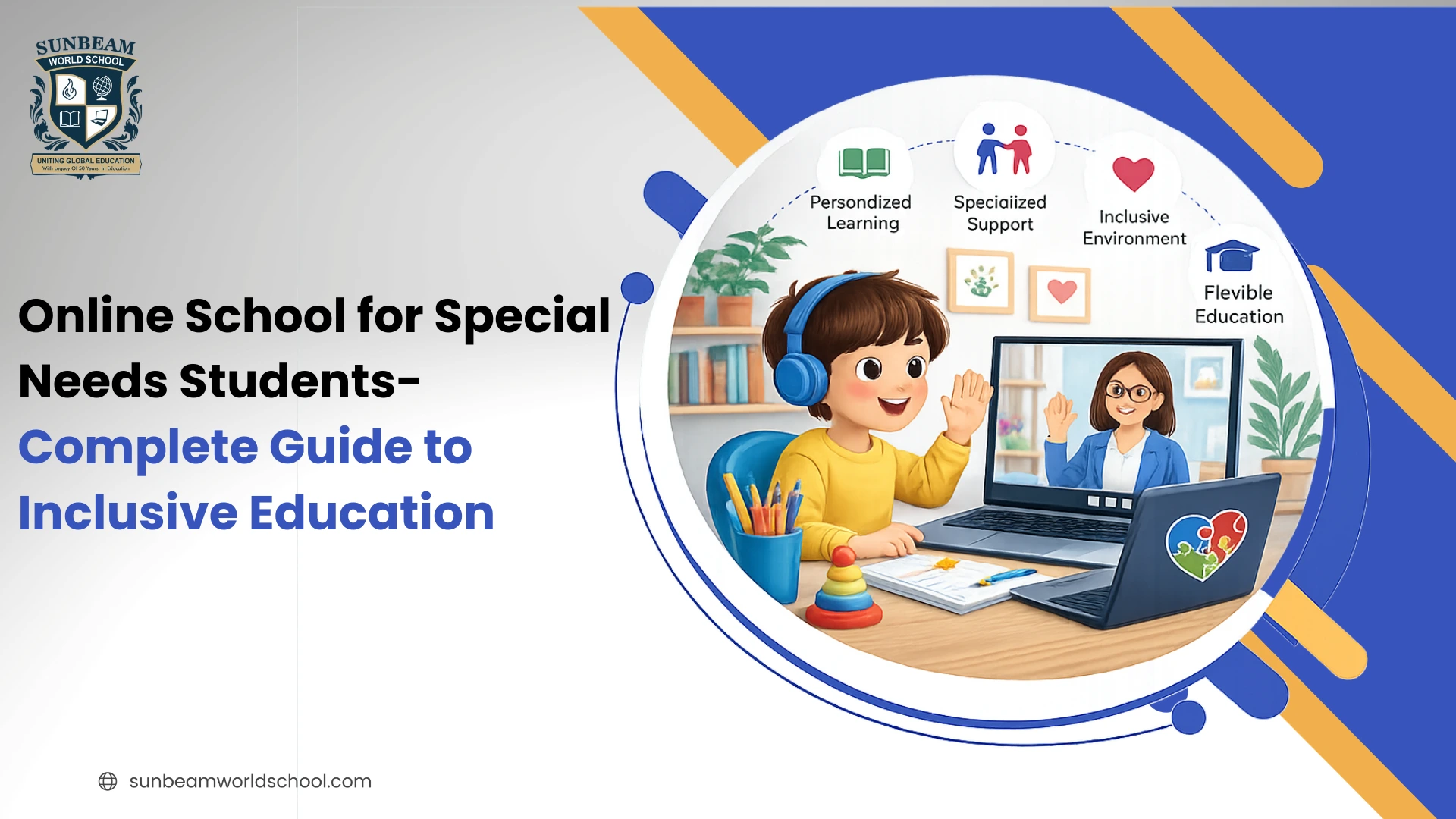
 Special Need Students
Online School for Special Needs Students: A Complete Guide to Inclusive Education
Online School for Special Needs StudentsOnline schools for special needs students provide flexible, personalised learning environments designed to support children with ADHD, autism, dyslexia, and other learning differences. Unlike traditional classrooms, they use Individualized Education Plans (IEPs), assistive technology, and adaptive teaching methods to match each child’s pace and needs. Inclusive online education focuses on equity over equality, ensuring every student receives the support required to participate and succeed. Benefits include a controlled learning environment, reduced social pressure, flexible scheduling, and better parent involvement, making it easier for children to learn without stress. |
Let’s start with something most education guides won’t say out loud:
the traditional classroom was never designed for every child.
Rows of desks. Fixed schedules. One teacher managing 30+ students. A system built for uniformity—expecting every child to learn the same way, at the same pace.
But what if your child doesn’t?
If they need more time to process.
If they struggle with noise, pressure, or social dynamics.
If they learn differently—not less.
For children with ADHD, autism, dyslexia, and other learning differences, school can quietly become a place of frustration instead of growth. And over time, that frustration gets misunderstood as lack of ability.
But this is not the truth! Infact, it’s a mismatch between the child and the environment. That’s where online inclusive education is changing everything.
Instead of forcing children to adapt to rigid systems, modern online schools are building flexible, personalised learning environments that adapt to the child, how they think, process, and thrive.
Let’s learn how!
| This guide is for parents, caregivers, and educators navigating special needs education in India and globally. Every child deserves to learn without limits, and the right school can make that real. |
What Is Inclusive Education?
| Inclusive education is a learning approach where students of all abilities learn together in the same environment, with personalised support to meet their individual needs. It ensures equal access, flexible teaching methods, and a supportive system that helps every child participate, progress, and succeed. |
The word "inclusive" gets used a lot in education circles, and like many education buzzwords, it risks losing its meaning through overuse. So let's be precise.
Inclusive education does not mean putting children with special needs into a mainstream classroom and hoping for the best. That is called integration, and it is not the same thing. True inclusion means redesigning the learning environment, the teaching approach, the assessments, and the culture of the school so that every child, regardless of their neurological differences, learning style, or disability, can participate, belong, and progress.
Think of it this way. A ramp at the entrance of a building doesn't make a building inclusive, it just removes one barrier. Real accessibility means the whole building was designed with every human body in mind. Inclusive education works the same way: it considers the full range of human learning from the very beginning, not as an afterthought.
| The UN Convention on the Rights of Persons with Disabilities defines inclusive education as a system where all learners can access quality education together, with appropriate supports, in the environment that is best for their individual needs — with no child excluded on the basis of disability. |
Which Children Benefit From Inclusive Online Education?
Inclusive education benefits all children — including neurotypical students, who learn empathy, adaptability, and collaboration by learning alongside peers with different abilities. But it is especially transformative for children with the following learning differences and conditions:
ADHD
Children with Attention Deficit Hyperactivity Disorder often struggle with rigid structures, long sitting periods, and transitions. Online school allows shorter focused sessions, movement breaks, and a distraction-controlled environment — dramatically improving focus and engagement.
Autism Spectrum Disorder (ASD)
Many autistic children experience sensory overload, social anxiety, and communication differences in crowded classrooms. Learning from a familiar home environment with consistent routines, visual supports, and 1:1 attention reduces stress and builds confidence.
Dyslexia & Dyscalculia
Children with dyslexia (reading difficulties) or dyscalculia (maths difficulties) benefit enormously from text-to-speech tools, audio-based learning, extended time, and multi-sensory instruction — all of which are far easier to implement consistently in an online setting.
Other Learning Differences
Children with dysgraphia, anxiety disorders, hearing or visual impairments, cerebral palsy, epilepsy, chronic illness, or emotional and behavioural challenges also benefit significantly, any condition that makes a standard classroom environment difficult to navigate.
It's also worth noting that many children carry a diagnosis without their parents' knowledge, simply because they've never been formally assessed. If your child is bright but struggles consistently with reading, attention, maths, handwriting, social cues, or emotional regulation, it is worth speaking with an educational psychologist, because the right identification opens the door to the right support.
Why Online School Is Often Better for Special Needs Students
This might be the most important thing in this entire guide: for many children with learning differences, online school is not the second-best option. It is the best option. Here is why that is true — and why it is backed by what we know about how neurodivergent children learn best:
Controlled Environment
No sensory overload from crowded corridors, unpredictable noise, or fluorescent lighting. The child learns in a space they are comfortable in.
Flexible Pacing
Lessons can be revisited, paused, and replayed. A child who needs more time to process is never left behind by a class that has moved on.
Reduced Social Pressure
Children who struggle with social anxiety or peer dynamics can focus entirely on learning without the added stress of navigating playground politics.
Personalised Attention
Smaller online class sizes and 1:1 sessions mean teachers can genuinely know each student and adapt instruction in real time.
Assistive Tech Built In
Screen readers, speech-to-text, text enlargement, and other tools are native to digital platforms — not awkward add-ons.
Parent Involvement
Parents can observe, support, and collaborate in real time — something virtually impossible in a traditional school day.
| Research consistently shows that when students with learning differences receive appropriate support, inclusive learning environments produce better academic and social outcomes than segregated special schools. The key phrase is "appropriate support" — which is exactly where online inclusive schools, when done well, have a significant structural advantage. |
Legal Rights of Special Needs Children in India
If you have ever been told by a school that they "don't have the facilities" for your child, or been advised to look for a "special school" instead, here is what you need to know: Indian law is on your side.
The Rights of Persons with Disabilities (RPWD) Act, 2016
The RPWD Act significantly expanded India's legal framework for children with disabilities. Crucially, it broadened the definition of "disability" to include specific learning disabilities such as dyslexia, dyscalculia, and dysgraphia — conditions that were often left out of older legislation. Key provisions include:
- The right to inclusive education at all levels — elementary through higher education
- Mandatory provision of assistive technologies and trained support staff in schools
- A 5% reservation of seats in aided and government higher education institutions for students with benchmark disabilities
- Prohibition of discrimination in admissions on the basis of disability
The Right to Education (RTE) Act, 2009
The RTE Act guarantees free and compulsory education for all children between 6 and 14 years of age, including children with disabilities. Schools must accommodate the needs of students with learning differences, including adapting teaching methods and ensuring teacher training for inclusion.
NEP 2020 and Inclusive Education
India's National Education Policy 2020 places equity and inclusion at the centre of its vision. It calls for early screening of learning disabilities, personalised support systems, and the removal of systemic barriers to education for neurodivergent children. The policy actively encourages online and flexible learning models as tools for extending inclusive education to every child in India.
| If a school refuses admission to your child: You have the right to escalate formally. The RPWD Act includes a complaints mechanism. Organisations like Action for Autism (New Delhi) and Vidya Sagar (Chennai) provide legal advice and parent support for navigating school admission challenges under this legislation. |
What Is an IEP and How Do You Build One?
An Individualized Education Plan (IEP) is one of the most powerful tools available to a child with special needs, and one of the most misunderstood. It is not a medical document, a diagnosis report, or a list of limitations. It is a roadmap: a forward-looking, collaboratively built plan that sets clear goals, identifies the specific supports the child needs, and holds the school accountable for delivering them.
A well-constructed IEP answers four essential questions:
- Where is this child right now, academically and developmentally?
- Where do we want them to be in the next 6–12 months?
- What specific supports, accommodations, and teaching strategies will help them get there?
- How will we measure whether it's working?
1. Assessment and Identification
A formal assessment by an educational psychologist or specialist identifies the child's learning profile — their strengths, areas of difficulty, and any diagnoses. This forms the evidence base for everything that follows.
2. Collaborative Planning Meeting
Parents, teachers, the child (where appropriate), and any specialists (speech therapist, occupational therapist, shadow teacher) meet to discuss the assessment findings and agree on learning goals.
3. Setting SMART Goals
Goals are written to be Specific, Measurable, Achievable, Relevant, and Time-bound. "Improve reading" is not a goal. "By March, the student will read Grade 4 passages at 80 words per minute with 85% comprehension accuracy" is a goal.
4. Documenting Accommodations
The IEP lists every accommodation the child needs: extra time on tests, preferential seating, audio instructions, reduced written output, visual timetables, modified assignments. Every teacher who works with this child follows these accommodations.
5. Review and Revision
An IEP is a living document. It should be reviewed at least once per term and updated as the child grows, reaches goals, or encounters new challenges. A good IEP evolves alongside the child.
| Parent tip: You are a full and equal participant in your child's IEP process. You have the right to request an IEP meeting, disagree with proposed goals, and ask for revisions. The IEP cannot be finalised without your signature. Bring your own notes, observations, and priorities to every meeting. |
Assistive Technology for Special Needs Students
Technology, when thoughtfully deployed, is one of the most democratising forces in special needs education. The right tool can remove a barrier that has been holding a child back for years. Here are the categories that make the biggest difference:
Text-to-Speech (TTS)
Converts written text to spoken audio, giving dyslexic students full access to written content without the barrier of decoding.
Speech-to-Text
Allows students with dysgraphia or motor difficulties to dictate responses instead of writing, removing a barrier to expressing knowledge.
Visual Schedules
Digital visual timetables reduce anxiety for autistic students by making the day predictable. Transitions become manageable rather than overwhelming.
Focus Timers (Pomodoro)
Structured work-and-break cycles support ADHD students in managing attention. Visible countdowns make time feel concrete rather than abstract.
Gamified Learning Apps
Platforms using game mechanics for learning keep ADHD and reluctant learners engaged through reward loops, progress tracking, and interactive challenges.
AI-Personalised Curriculum
AI platforms adapt content difficulty, pacing, and modality in real time based on how the student is performing — a dynamic IEP in software form.
What makes online schools uniquely powerful here is that these tools are native to the digital learning environment. A text-to-speech reader in a traditional classroom means a child with a separate device, drawing attention to their difference. In an online school, it is simply a feature of the platform that every student has access to.
Traditional School vs Online Inclusive School: An Honest Comparison
We are not suggesting online school is perfect for every child with every kind of special need. But for the majority of children with learning differences, the comparison is instructive:
| Dimension | Traditional Classroom | Online Inclusive School |
| Sensory Environment | Often overwhelming — noise, crowds, unpredictability | Controlled by family — familiar, calm, adjustable |
| Pacing | Fixed for all students — keep up or fall behind | Flexible — lessons replayable, pace adjustable per child |
| IEP Implementation | Inconsistent — depends heavily on individual teachers | Systematic — accommodations tracked across all sessions |
| Teacher-to-Student Ratio | High (30–40:1) — individual attention is rare | Low — smaller groups, 1:1 sessions possible |
| Assistive Technology | Add-on — often stigmatizing, inconsistently available | Native to platform — invisible, always available |
| Social Development | High exposure, but often stressful for special needs students | Different context — requires intentional peer activity design |
| Parent Visibility | Very limited — parents excluded from day-to-day learning | High — parents can observe, support, and collaborate |
| Physical Safety / Bullying Risk | Higher risk — children with differences are frequent targets | Significantly reduced in structured online environments |
| Geographic Accessibility | Limited to local schools — quality varies enormously | Accessible from anywhere with an internet connection |
5 Myths About Online Schooling for Special Needs Students
Many parents hesitate to choose online education due to common misconceptions. In reality, inclusive online schools are designed to support diverse learning needs through personalized teaching, structured support, and flexible environments. Let’s separate fact from fiction.
| Myth | Reality |
| Children with special needs can't learn online — they need in-person interaction. | Many children with special needs learn better online because it removes environmental and social pressures. Quality online schools still provide meaningful live interaction in a less overwhelming format. |
| My child needs a specialist school — mainstream learning is not suitable. | Research shows many students with learning differences perform better in inclusive environments with proper support. Specialist schools can help, but they are not always necessary. |
| An IEP is only for severely disabled children. | Any child needing personalized support—whether for ADHD, dyslexia, anxiety, or processing differences—can benefit from an IEP. It’s a tool for personalization, not severity. |
| Online schools offer a lesser quality of education for these students. | A well-designed online inclusive school with trained educators, structured IEPs, small class sizes, and assistive tech can deliver higher-quality education than many traditional classrooms. |
| Letting my child learn from home will make them dependent and isolated. | Structured online learning with group activities, peer interaction, and extracurriculars builds independence and confidence. Many students thrive socially in smaller, intentional communities. |
How to Choose an Online School for Your Special Needs Child
Not all online schools are the same — and for a child with special needs, the difference between a thoughtful, inclusive programme and a generic online school with no special education capacity can be profound. Here is what to look for and ask about:
Dedicated special education programme
Does the school have a specific, structured programme for students with learning differences? Is it a real programme with trained staff and defined processes, or just a line on the website?
IEP capability
Can the school develop and implement an Individualized Education Plan for your child? Who will be responsible for it, and how is it monitored across subjects?
Teacher training in special education
Are teachers trained in working with ADHD, autism, dyslexia, and other learning differences? Ask specifically about training hours, certifications, and ongoing professional development.
Class sizes and 1:1 support
What is the maximum class size? Is 1:1 or small group tutoring available? For many special needs students, the class size question is non-negotiable.
Flexible scheduling
Can sessions be adjusted to accommodate energy levels, therapy appointments, or difficult days? Rigidity is often the enemy of special needs students' wellbeing.
Parent communication
How frequently and in what format does the school communicate with parents? Is there a key contact person who knows your child personally?
Assessment approach
Are assessments modified for your child's needs? Can they demonstrate knowledge through different formats — oral, video, practical — rather than written exams only?
Board recognition
Does the school's qualification have national and international recognition? For Indian families, look for NIOS, CBSE-aligned, or other boards that provide pathways regardless of learning profile.
How Sunbeam World School’s Online Special Education Programme Actually Works
When evaluating online schools for children with special needs, the real question is not whether support exists, but how deeply it is integrated into everyday learning.
Many schools mention inclusion. Few design their entire system around it.
Sunbeam World School is one of the platforms that has taken a structured, inclusive-first approach, where special education is not treated as an add-on, but as a core part of how learning is delivered.
1. A Truly Inclusive Classroom Model
Instead of separating students with learning differences, Sunbeam follows an inclusive classroom approach.
Students learn alongside peers in live online classes, while receiving:
- Individualised attention
- Adapted teaching strategies
- Continuous academic support
This ensures that children are not isolated from mainstream education, while still getting the help they need to succeed.
2. Personalised Learning That Adapts to the Child
No two learners are the same, and this is especially true for children with special needs.
- Flexible pacing based on the child’s learning speed
- Modified assignments to reduce cognitive overload
- Alternative ways to demonstrate understanding (oral, visual, project-based)
This allows students to stay engaged without the pressure of “keeping up” with the class.
3. Trained Educators Who Understand Learning Differences
One of the biggest gaps in traditional schooling is the lack of specialised teacher training.
- Teachers are trained in working with ADHD, autism, dyslexia, and other learning differences
- They adapt instruction in real time based on student responses
- Support is integrated into daily teaching—not provided as a separate intervention
This creates a learning environment where children feel understood, not judged.
4. Structured Yet Flexible Learning Environment
For many special needs students, predictability plays a key role in learning success.
The programme offers:
- Clear daily routines
- Guided lessons with consistent structure
- A calm, distraction-controlled online setting
At the same time, flexibility is built in—so students can take breaks, revisit lessons, or adjust schedules when needed.
5. Built-In Assistive Tools and Accessibility
Unlike traditional classrooms where support tools can feel like an afterthought, Sunbeam integrates accessibility directly into the learning experience.
- Visual aids and structured content delivery
- Audio-supported learning
- Digital tools that make reading, writing, and comprehension easier
Because these tools are part of the platform, they are consistent, accessible, and stigma-free.
6. Holistic Development Beyond Academics
A strong special education programme goes beyond academics—and Sunbeam reflects that.
The focus includes:
- Building confidence and independence
- Encouraging participation in group activities
- Supporting emotional and social development
Parents are also kept closely involved through regular updates and communication, creating a collaborative support system around the child.
Who This Programme Is Best Suited For
Sunbeam World School’s special education programme is thoughtfully designed for children who may not thrive in conventional classroom settings but flourish with the right support and structure.
It is particularly well-suited for students who:
- Feel overwhelmed by the pace, noise, or social pressures of traditional schools
- Require personalised attention and the flexibility to learn at their own pace
- Benefit from a structured yet low-pressure learning environment
- Thrive in inclusive settings where they are supported, understood, and encouraged to grow
For these learners, the right environment doesn’t just improve academic performance, it builds confidence, independence, and a genuine love for learning.
Conclusion
If there’s one thing to take away from this guide, it’s this:
Your child does not need to be “fixed” to fit into a system. The system needs to fit your child.
For too long, children with learning differences have been asked to adjust, to sit still, keep up, and perform in environments that were never built for them. And when they struggle, the system calls it a limitation.
But when the environment changes, everything changes.
Confidence replaces anxiety.
Curiosity replaces resistance.
Progress replaces frustration.
That’s the promise of inclusive online education done right.
If you’re looking for a school that truly understands diverse learners, Sunbeam World School offers a thoughtfully designed online learning environment where:
- Individual learning needs are recognised and supported
- IEP-based personalised education is implemented consistently
- Experienced educators guide each child with care and expertise
- Flexibility and structure exist in the right balance
If you’re ready to explore a learning environment where your child is supported, understood, and empowered to succeed, special education online could be the step that changes everything.

Frequently Asked Questions
What is inclusive education for special needs students?
-Inclusive education means every child — regardless of their learning differences, disabilities, or neurodevelopmental conditions — is welcomed into a mainstream learning environment with the specific support they need to thrive. True inclusion goes beyond physical access: it means adapted teaching, individualised learning plans, assistive tools, and a school culture that genuinely values diversity of minds.
Can children with special needs attend online school in India?
+What is an IEP and does my child with ADHD or autism need one?
+What are the benefits of online school for children with ADHD?
+What legal rights do special needs children have in India?
+How do online schools support students with dyslexia?
+
In this article
Share this post:


Press and Blogs
Stay updated with our press releases, educational blogs, and more.
Quick Answer: ADD and ADHD are not two different conditions. ADD was the diagnostic term...
Fun, age-based games for children with autism at home help develop communication, motor skills, emotional...
Dyslexia, a common learning disability, affects a person’s ability to read, write, and spell regardless...