
 CBSE
CBSE
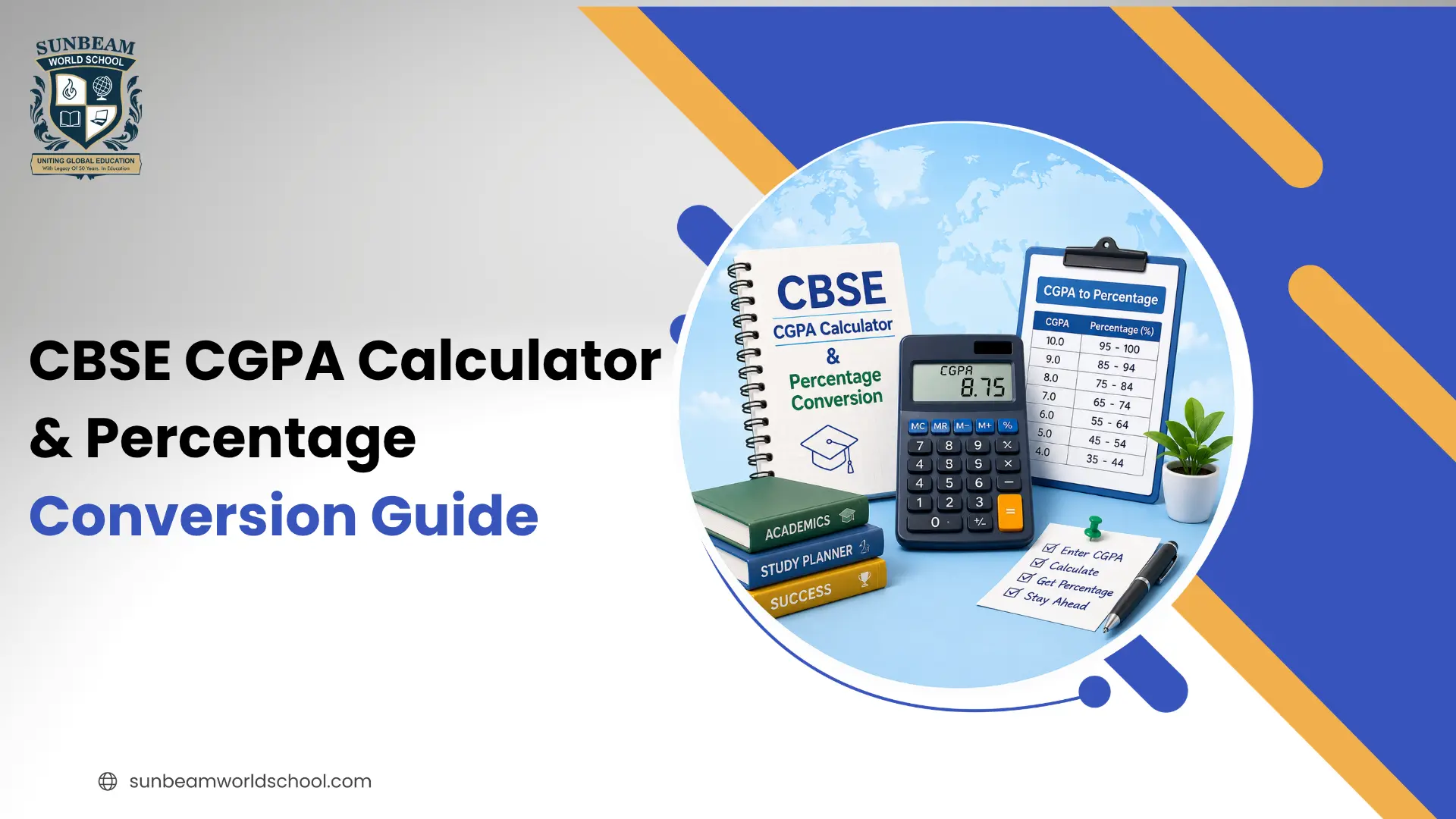
CBSE CGPA Calculator & Percentage Conversion Guide
If you've ever stared at your CBSE report card and wondered, "but what does 8.4 CGPA actually mean in percentage?" you're not alone. Thousands of students face the same question every year, especially when college admissions and job applications ask for a percentage figure.
In this guide, we'll break down exactly what CGPA is, how it's calculated, how to convert CGPA into marks and percentage, and, most importantly, give you an interactive CGPA calculator you can use right now, no pen or paper needed.
What is CGPA Score?
CGPA stands for Cumulative Grade Point Average. It is the average of grade points a student earns across all their main subjects — and it's the official metric used by the Central Board of Secondary Education (CBSE) to represent a student's overall academic performance.
Instead of publishing your actual marks, CBSE assigns a grade (like A1, B2, or C1) to each subject, which corresponds to a specific grade point value. Your CGPA is simply the average of those grade point values across your five main subjects.
| Quick fact: The 6th additional subject (if taken) is excluded from CGPA calculation. Only the five main subjects count. However, if your 6th subject grade is better than one of your main subjects, it can replace the lowest-scoring main subject. |
The CGPA system was introduced to reduce exam-related stress and move away from a marks-centric culture. The philosophy is to give students a range-based evaluation rather than penalizing them for every single mark lost.
How to Calculate CGPA Step-by-Step
Calculating CBSE CGPA is simpler than most students think. Here's exactly how to do it:
Step-1 Find your Grade Points for each subject
Look at your report card. Each subject will show a letter grade (like A1, B2, etc.) which maps to a grade point value from 1 to 10. Use the grade table below to find your GP for each subject.
Step-2 Add up the grade points of your 5 main subjects
Simply total the grade point values. For example: 9 + 8 + 7 + 8 + 8 = 40
Step-3 Divide the sum by 5
CGPA = Total Grade Points ÷ 5. In this example: 40 ÷ 5 = 8.0 CGPA
| CGPA = (GP₁ + GP₂ + GP₃ + GP₄ + GP₅) ÷ 5
GP = Grade Points for each subject (out of 10) This formula is specific to CBSE. Different universities use different CGPA systems — some on a 4-point scale, others on a 10-point scale. Always confirm which system applies to your institution. |
Free CGPA Calculator
Use our interactive calculator below. You can either enter your subject-wise grade points, or directly enter your CGPA to find the equivalent percentage.
Converting CGPA to Percentage
The official CBSE formula to convert CGPA to percentage is very straightforward:
| Percentage = CGPA × 9.5
Official formula as per CBSE guidelines |
So if your CGPA is 8.0, your approximate percentage is 76% (8.0 × 9.5 = 76). This multiplier of 9.5 is set by CBSE based on the midpoint of each grade range.
Quick Reference: CGPA to Percentage CBSE Conversion
| CGPA | Percentage | Approx. Band |
| 10.0 | 95% | Outstanding |
| 9.0 | 85.5% | Excellent |
| 8.0 | 76% | Very Good |
| 7.0 | 66.5% | Good |
| 6.0 | 57% | Average |
| 5.0 | 47.5% | Below Average |
| 4.0 | 38% | Pass |
CBSE Grade Points Table
Here's the complete CBSE grading scale that maps letter grades to grade points and converts CGPA into marks:
| Grade | Grade Points (GP) | Marks Range | % (Indicative) |
| A1 | 10 | 91 – 100 | 95% |
| A2 | 9 | 81 – 90 | 85.5% |
| B1 | 8 | 71 – 80 | 76% |
| B2 | 7 | 61 – 70 | 66.5% |
| C1 | 6 | 51 – 60 | 57% |
| C2 | 5 | 41 – 50 | 47.5% |
| D | 4 | 33 – 40 | 38% |
| E1 | Fail | 21 – 32 | Improvement Exam |
| E2 | Fail | 00 – 20 | Improvement Exam |
The subject-wise indicative percentage of marks is calculated as: GP × 9.5
Merits & Demerits of the CGPA System
Like any evaluation method, the CGPA calculator for class 10 CBSE system has its fans and critics. Here's an honest look at both sides:
| Merits | Demerits |
| Reduces exam anxiety and pressure on students | Masks actual performance — two students with the same CGPA may differ by 9 marks |
| Encourages broader learning, not just rote memorization | Doesn't differentiate between a 91 and a 100 |
| Identifies strengths and weaknesses across subjects | Can reduce motivation for high achievers |
| Keeps actual marks confidential — less comparison culture | CGPA-to-percentage conversion is approximate, not exact |
| Aligned with global grading practices | Some colleges don't accept CGPA and require mark sheets |
Conclusion
Understanding your CGPA score is more than just converting numbers into percentages; it helps students evaluate their academic performance with clarity and confidence. Whether you're preparing for college admissions, scholarship applications, or simply trying to understand your report card better, knowing how the CBSE grading system works can make the process much less confusing.
While the CGPA system reduces academic pressure and promotes a broader learning approach, students should also understand its limitations, especially when converting grades into exact percentages. Using the official CBSE formula and grade tables can help you interpret your scores accurately and make informed academic decisions.
At Sunbeam World School, we believe education should focus not only on marks but also on overall growth, critical thinking, and confidence-building. By helping students understand systems like CGPA early on, schools can encourage healthier learning habits and better academic planning for the future.

Frequently Asked Questions
What does CGPA stand for?
-CGPA stands for Cumulative Grade Point Average. In the CBSE grading system, it measures a student’s overall academic performance by calculating the average grade points scored across all main subjects. CGPA is commonly used to evaluate student results and convert grades into percentages.
Is 9.8 CGPA a good score?
+Can I calculate CGPA if my report card shows marks, not grades?
+Why does CBSE multiply CGPA by 9.5 for percentage?
+Is the 6th subject included in CGPA calculation?
+Does CGPA differ from GPA?
+What is 8 CGPA in percentage?
+What is 9.8 CGPA in percentage?
+
In this article
Share this post:


Press and Blogs
Stay updated with our press releases, educational blogs, and more.

Quick Summary Essential Repeat (ER) in CBSE means a student has not met the passing...

Quick Summary: The main difference in has vs. have is the subject. Has is used...

Quick Summary A metaphor is a way of describing one thing by calling it something...