
Quick Summary Class 9 sample papers are the fastest way to turn syllabus knowledge into exam marks, because they train timing, question interpretation and presentation under real exam conditions. Every main subject carries 80 theory marks over three hours plus 20 marks of internal assessment. For 2026-27, Class 9 has moved to new NCERT textbooks, and Maths and Science now run at two levels, a compulsory 80-mark Standard paper and an optional 25-mark Advanced paper, so choosing practice papers that match the current syllabus matters more than usual.
CBSE Class 9 sample papers are the practice papers students use to prepare for half yearly and annual exams, and they are the single most effective preparation tool available in Class 9. Reading a chapter builds knowledge, while writing a paper builds the ability to use that knowledge inside three hours and under pressure.
This guide covers the 2026-27 exam pattern and marking scheme, what has changed in each subject this session, where to find official CBSE and NCERT material, and how to practise so that the marks follow. If you are still weighing boards for your child, it helps to first understand why CBSE works well for most Indian families.
CBSE Class 9 Sample Papers 2026-27 at a Glance
| Question | Short answer |
|---|---|
| What sample papers train | Timing, question interpretation and presentation |
| Who sets the Class 9 annual paper? | The school, following the CBSE curriculum |
| Official CBSE material | Subject curriculum documents and skill subject papers on cbseacademic.nic.in |
| Marks per subject | 80 theory + 20 internal assessment = 100 |
| Paper duration | 3 hours |
| Question paper composition | 50% competency focused, 20% MCQ, 30% short and long answer |
| Passing marks | 33% per subject, counting theory and internal together |
| Big change in 2026-27 | New NCERT books for Maths, Science, English, Hindi and Social Science |
| Maths and Science levels | Standard 80 marks compulsory, Advanced 25 marks optional |
CBSE Class 9 Sample Paper PDF Download: Official Sources
The documents below are the official CBSE and NCERT material for Class 9, all free to download and all carrying more authority than any third-party practice paper. The subject curriculum PDF is the most valuable of them, because it contains the official question paper design and marks distribution that every school paper is built from, which means it tells you exactly what shape the exam will take.
Class 9 Sample Paper Guides by Subject
Each subject has its own paper structure, its own new textbook and its own marks distribution this session, so the detail sits on a page of its own. Every subject page carries its own full 80-mark Sunbeam sample paper with a marking scheme, free and with no sign-up, and the PDF for each is linked in the last column below. All of these sit on one CBSE page, Curriculum 2026-27. Open Secondary Curriculum Part-I, then pick your subject, since CBSE publishes a separate PDF for each Class IX subject.
| Subject | What its guide covers | Paper PDF |
|---|---|---|
| Class 9 Maths sample paper | Ganita Manjari unit marks, Geometry at 25, the Advanced paper, maths lab | Download PDF |
| Class 9 Science sample paper | Exploration unit marks from the CBSE document, 13 practicals, Advanced paper | Download PDF |
| Class 9 English sample paper | Kaveri, the 20, 30 and 30 split, R1 and R2 levels, writing formats | Download PDF |
| Class 9 Social Science sample paper | The integrated book, themes covered, source-based questions, map work | Download PDF |
| Class 9 Hindi sample paper | Ganga, the 14, 16, 30 and 20 split, Hindi A and B, grammar topics | Download PDF |
Official Class 9 sample question papers with marking schemes
CBSE publishes sample question papers for the Class 9 skill subjects, and each one comes with its own marking scheme.
| Paper | Includes | Download |
|---|---|---|
| Class IX skill subjects, codes 401 to 420 | Sample question paper and marking scheme for each subject | CBSE Skill Education sample papers |
New NCERT textbooks and exemplars
Chapter-wise PDFs of the 2026-27 books are free on the NCERT portal, and the exemplar problems for Maths and Science are the closest thing to an official question bank for Class 9.
| Resource | Why it helps with practice |
|---|---|
| Class 9 textbook PDFs (Ganita Manjari, Exploration, Kaveri, Ganga, Sharada) | Confirms the current chapter list before you trust any practice paper |
| NCERT exemplar problems, Maths and Science | Harder application questions of the kind the competency section now favours |
Both are on the NCERT textbook portal at ncert.nic.in, by selecting Class 9 and the subject.
What Are CBSE Class 9 Sample Papers?
CBSE Class 9 sample papers are model question papers that follow the same pattern, section layout and marks distribution as the actual Class 9 exam, so students can practise under real conditions before the paper itself. A good sample paper tells a student three things at once: how many questions to expect, how the 80 marks are spread across question types, and how long each section should take.
Parents and students search for these papers under many different names, including ninth class exam paper, Class IX sample question paper, 9th standard model question paper, or simply model paper class 9, and all of them refer to the same thing. The term also covers several different kinds of paper in practice, which is worth untangling. Some sample papers come from CBSE itself, some are set by schools as mid term or pre-annual papers, and most of what circulates online is written by publishers and coaching sites. All three can be useful, but they carry very different authority, and a student should know which one they are holding.
How to Choose the Right Class 9 Sample Paper
The best Class 9 sample paper is the one that matches your school's paper most closely, which means your own school's previous half yearly and annual papers come first, ahead of anything downloaded. Schools frame the Class 9 paper from the CBSE curriculum and the prescribed NCERT books, so a past paper from your own school shows you the format, the question style and the weightage your child will actually face.
After that, three things make a practice paper worth using. It should name the current 2026-27 textbooks or chapter titles, follow the 80-mark structure with the official question paper design, and come with answers so the paper can be marked properly afterwards. A paper that fails any of these is still useful for individual questions, but not as a full timed mock.
Official CBSE Sample Papers for Class 9 Skill Subjects
CBSE publishes official sample question papers along with marking schemes for Class 9 skill subjects, on the Skill Education sample paper section of cbseacademic.nic.in. For the 2026-27 session these cover the 400-series subject codes, and each paper comes with its own marking scheme, which is exactly the kind of detail practice papers usually leave out.
| Code | Skill subject | Code | Skill subject |
|---|---|---|---|
| 401 | Retail | 411 | Banking and Insurance |
| 402 | Information Technology | 412 | Marketing and Sales |
| 403 | Security | 413 | Health Care |
| 404 | Automotive | 414 | Apparel |
| 405 | Introduction to Financial Markets | 415 | Multi Media |
| 406 | Introduction to Tourism | 416 | Multi Skill Foundation Course |
| 407 | Beauty and Wellness | 417 | Artificial Intelligence |
| 408 | Agriculture | 418 | Physical Activity Trainer |
| 409 | Food Production | 419 | Data Science |
| 410 | Front Office Operations | 420 | Electronics and Hardware |
If your child has opted for Information Technology, Artificial Intelligence or any other skill subject as their sixth subject, this is the one place where a genuine CBSE Class 9 paper with an official marking scheme is available, and it is free.
New NCERT Class 9 Books 2026-27
NCERT has replaced the Class 9 textbooks for the 2026-27 session under the National Curriculum Framework, so sample papers written for the old books test chapters that are no longer prescribed in the same form. Chapters have been rewritten, reordered and in several cases merged, which means a practice paper from two or three years ago can look reasonable and still send a student revising the wrong material.
| Subject | Earlier book | New book for 2026-27 |
|---|---|---|
| Mathematics | Mathematics | Ganita Manjari |
| Science | Science | Exploration |
| English | Beehive and Moments | Kaveri |
| Hindi | Kshitij, Kritika, Sparsh and Sanchayan | Ganga |
| Social Science | History, Geography, Civics and Economics as four books | Understanding Society: India and Beyond, in parts |
| Sanskrit | Shemushi | Sharada |
The Social Science change is the largest, since four separate books have been pulled into one integrated title released in parts, and Science has absorbed topics into differently named chapters. Before downloading any Class 9 practice paper this year, check that it names the new books or at least the current chapter titles, and treat anything that lists the old chapter numbering as out of date. The wider shift behind these changes is explained in our overview of the CBSE new curriculum.
CBSE Class 9 Exam Pattern and Marking Scheme 2026-27
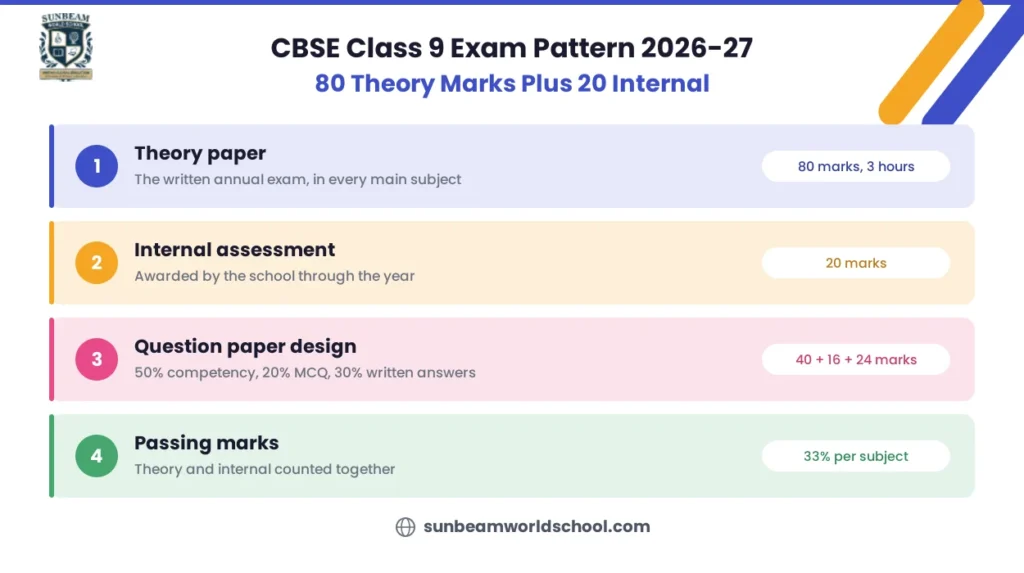
Every main subject in Class 9 carries 80 theory marks and 20 marks of internal assessment
The CBSE Class 9 exam pattern for 2026-27 gives every main subject 80 marks for the annual theory paper and 20 marks for internal assessment, adding up to 100 marks per subject, with three hours for the written paper. CBSE's own curriculum documents label this year Class IX, so a paper or syllabus file marked Class IX is the same thing as Class 9. The structure is the same one Class 10 follows, which is deliberate, since the ninth class is designed as the year that prepares students for the board pattern.
How Are the 80 Theory Marks Divided?
The 80 theory marks in a Class 9 paper follow CBSE's question paper design of 50% competency focused questions, 20% select response questions and 30% constructed response questions. Competency focused questions are the ones that place a concept in a situation, as multiple choice questions, case based questions or source based integrated questions, and they now carry half the paper.
| Question type | Share of paper | Marks out of 80 |
|---|---|---|
| Competency focused (MCQ, case based, source based) | 50% | 40 |
| Select response type (MCQ) | 20% | 16 |
| Constructed response (short and long answer) | 30% | 24 |
The practical effect is that memorising answers no longer carries a student very far, since roughly half the paper asks them to apply a concept to something they have not seen before. A student who only revises definitions and solved examples will read the paper and find it unfamiliar, even when they know the chapter well.
What Counts in the 20 Marks of Internal Assessment?
Internal assessment carries 20 marks in each subject and is awarded by the school across four components of 5 marks each, through the year rather than in one exam. The CBSE curriculum for 2026-27 sets these as pen and paper tests, multiple assessment, portfolio, and a fourth component that changes with the subject.
- Pen and paper tests (5 marks): class tests and periodic tests conducted in written form.
- Multiple assessment (5 marks): quizzes, oral tests, debates, class discussions, presentations and similar activities.
- Portfolio (5 marks): classwork, assignments, self and peer assessment, and overall achievement in the subject.
- Subject specific component (5 marks): listening and speaking skills in languages, practical or lab work in Science, maths lab activity in Mathematics, and map or project work in Social Science.
These 20 marks are the easiest in the whole subject to secure and the most commonly thrown away, because they depend on turning up, submitting notebooks on time and taking small classroom tasks seriously. A student who ignores them spends the rest of the year trying to make up marks in the hardest place to find them.
What Are the Passing Marks in Class 9?
A Class 9 student needs 33% to pass each subject, which works out to 33 marks out of the combined 100. Schools calculate the subject result by adding the annual exam score out of 80 to the internal assessment score out of 20, and most schools also expect a minimum showing in each part rather than a pass carried entirely by one of them. Because the arithmetic trips up a lot of parents, we have worked through it in detail in passing marks out of 80 in CBSE.
What Are the Standard and Advanced Levels in Class 9 Maths and Science?
From the 2026-27 session, Class 9 Maths and Science are offered at two levels, with a compulsory Standard paper of 80 marks over three hours and an optional Advanced paper of 25 marks over one hour. Every student sits the Standard paper, and a student who wants to go further can add the Advanced paper in Maths, in Science, in both, or in neither.
| Standard | Advanced | |
|---|---|---|
| Who takes it | Every student, compulsory | Optional, by choice |
| Marks and time | 80 marks, 3 hours | 25 marks, 1 hour |
| Counts in the aggregate | Yes | No |
| What it tests | The prescribed syllabus | Higher-order thinking and deeper application |
| Subjects | Maths and Science | Maths, Science, both or neither |
The Advanced score does not go into the overall aggregate. Instead, a student who scores 50% or more in it has the advanced qualification recorded separately on the marksheet, so there is no downside to attempting it and nothing lost by skipping it. CBSE has also discontinued the old Mathematics Basic and Mathematics Standard split from this session, so the Standard and Advanced structure replaces it rather than sitting alongside it.
For practice, this means a student taking an Advanced paper needs two different kinds of preparation in that subject. The Standard paper rewards syllabus coverage and timing across three hours, while the Advanced paper is a short, dense hour where a handful of harder questions carry everything, so a full-length mock is the wrong preparation for it. The first Class 10 board exams under this structure fall in 2028, which is the cohort entering Class 9 now.
Class 9 Half Yearly Question Paper vs Annual Exam Paper
A Class 9 half yearly paper covers only the portion taught up to the middle of the session and is usually set for 80 marks or a reduced total, while the annual exam paper covers the full year's syllabus for 80 marks. Both are set by the school, which is why half yearly papers vary much more between schools than annual papers do.
| Half yearly or mid term | Annual exam | |
|---|---|---|
| When | Usually September to October | Usually February to March |
| Syllabus | First half of the course | Full year, with weight on the second half |
| Typical marks | 80, or a reduced total converted by the school | 80 |
| Set by | The school | The school |
| Counts towards | School records and often internal assessment | The final Class 9 result |
Periodic tests sit below both of these. They are short written tests held through the year, often for 20 marks and scaled down to 5, and they feed the internal assessment rather than the final paper. Schools set them subject by subject, and a Class 9 Maths periodic test is usually the first one students look for, since it is normally a single unit rather than the whole course. Students who treat periodic tests as practice for the bigger papers tend to walk into the annual exam having already written the pattern several times.
CBSE Class 9 Maths Sample Paper
A Class 9 Maths sample paper runs for 80 marks across the six units of Ganita Manjari, with Geometry carrying the heaviest weight at 25 marks, Algebra next at 20, and a question mix that now leans towards application. The full unit-wise breakdown is in our Class 9 Maths sample paper guide. Practice here should be about showing the working clearly and finishing inside three hours, not about collecting more and more solved examples.
The most common loss of marks in Class 9 Maths is not wrong answers but poor presentation, since steps that are skipped cannot be awarded marks even when the final answer is right. The habits that protect those marks are the same ones that matter in the board exam two years later, which is why it is worth reading how to write a maths paper in a board exam before the next mock. Students should also practise the maths lab activity that carries 5 internal marks, rather than treating it as separate from exam preparation. A CBSE Class 9 Maths periodic test is worth practising separately from the full paper, since it covers one unit in about an hour and rewards accuracy over stamina. Students who have opted for Maths Advanced should add a separate set of harder application questions to their practice, because the 25-mark paper is not a shorter version of the Standard one.
CBSE Class 9 Science Sample Paper
A Class 9 Science sample paper carries 80 theory marks covering the Physics, Chemistry and Biology content now integrated in Exploration, plus 5 internal marks for practical work. Because the new book reorganises familiar topics into new chapters, students should map their practice paper questions back to the current chapter list rather than assuming the old sequence still holds. The unit-wise marks, straight from the CBSE curriculum document, are in our Class 9 Science sample paper guide.
Competency focused questions dominate Science more visibly than other subjects, often as a short passage or an experiment description followed by questions that require reasoning rather than recall. Diagrams matter as well, since a labelled diagram frequently carries marks of its own, and a rushed sketch loses them quietly. Practising a full paper in one timed sitting is the only reliable way to find out whether a student can finish the numerical sections and still have time for the longer answers. Those taking Science Advanced should practise the optional 25-mark paper separately, since one hour on higher-order questions is a different test of nerve from three hours on the full syllabus.
CBSE Class 9 English Sample Paper
A Class 9 English sample paper follows a three-section pattern of Reading Skills for 20 marks, Writing Skills and Grammar for 30 marks, and Language through Literature for 30 marks, giving 80 marks in total. This is a change from the earlier 20, 20 and 40 split, and it is set out in full in our Class 9 English sample paper guide. The Literature section now draws on Kaveri, which merges what used to be two separate books, so a student practising from older papers may prepare passages that are no longer prescribed.
English rewards practice more directly than any other subject, because the Reading and Writing sections test skills rather than content, and both improve with repetition. Students should write the full letter, article or paragraph under timed conditions instead of planning it mentally, since word limits and handwriting speed only become real on paper. In languages the fourth internal component is listening and speaking, split between the two, which means classroom participation genuinely counts.
CBSE Class 9 Social Science (SST) Sample Paper
A Class 9 Social Science sample paper, usually called an SST paper by students, carries 80 marks and now draws on the single integrated book Understanding Society: India and Beyond, in place of the four separate History, Geography, Civics and Economics textbooks. Map work remains a distinct component, so students should keep practising on a blank outline map rather than only reading the chapters. Source-based questions and structured written answers carry most of the marks here, as our Class 9 SST sample paper guide sets out. The SST half yearly paper is the one families look for most often, because the mid-session portion in Social Science is large and students want to see how much of it a school actually sets.
This is the subject where the 2026-27 change hits hardest, because the integrated book does not simply staple the four old books together and the question paper follows the new structure. Any practice paper divided neatly into four old-style sections is a signal that it predates this session. Source based questions, where students read an extract or interpret a chart and answer from it, are a large part of the competency component here, and they are best practised with the book closed.
CBSE Class 9 Hindi Sample Paper
A Class 9 Hindi sample paper carries 80 marks split into unseen comprehension 14, practical grammar 16, textbook 30 and creative writing 20, with Ganga now the single prescribed book. Both Hindi A and Hindi B follow this structure, as set out in our Class 9 Hindi sample paper guide. Students should still check which course their school has entered them for, since the grammar syllabus inside Section B differs between the two courses, which means a Hindi A paper and a Hindi B paper are not interchangeable.
Grammar and writing sections in Hindi are the most scoring part of the paper and the most neglected, since students often spend their revision time on literature alone. Working through the letter, paragraph, dialogue and notice formats and grammar exercises in short daily stretches lifts marks faster than another reading of the prose chapters.
How to Attempt the Class 9 Question Paper
Students should spend the first ten minutes reading the whole paper, mark the questions they can answer confidently, and then write in the order the paper is numbered, keeping answers in sequence so the examiner can follow them. The reading time is not wasted time, since it prevents the common pattern of spending too long on one long answer and leaving easy marks unattempted at the end.
A few habits consistently separate a clean answer sheet from a messy one:
- Number every answer exactly as the paper does, and start each one on a new line rather than running them together.
- Leave a blank line between answers so the examiner is never guessing where one ends.
- Show working in Maths and Science, because method marks exist and cannot be given for a bare answer.
- Draw diagrams in pencil, label them, and give them the space they need.
- Attempt every question, since there is no negative marking and a partly correct answer can still earn marks.
- Keep ten minutes at the end to check that nothing has been skipped and that the question numbers match.
Students should also write at least two full papers by hand before the exam, because handwriting speed and hand fatigue are real constraints that no amount of mental revision reveals.
What Should a Class 9 Answer Sheet Look Like?
A Class 9 answer sheet should follow the presentation conventions every CBSE examiner expects, because marks are awarded on what the examiner can find and follow. A well presented answer sheet is ruled into a single column, carries the question number in the left margin, keeps answers in the paper's own order, and uses the back of a page only when a diagram needs the room.
Within an answer, the marks follow the structure as much as the content. Students should underline key terms and final answers with a single line rather than highlighting or boxing them in colour, write units in every numerical answer, and keep each point of a multi-mark answer on its own line so an examiner awarding four marks can find four points. Rough work in Maths belongs in a clearly marked margin or at the end, never mixed into the answer itself.
What Are the Benefits of Solving CBSE Sample Papers for Class 9?
Solving sample papers turns known syllabus into exam performance, by training a student in timing, question interpretation and presentation, which are the three places marks are usually lost by students who do know the material. Reading a chapter builds knowledge, and writing a paper builds the ability to use that knowledge inside three hours and under pressure.
The real gain shows up in self-assessment. A paper written honestly under timed conditions produces a list of weak topics that is far more accurate than a student's own sense of what they find difficult, and that list is what revision should follow. Marks also tend to be lost in patterns rather than at random, whether that is running out of time, misreading case based questions or skipping diagrams, and patterns only become visible across several papers. Pairing that feedback with a working revision method, as set out in how to study effectively, is what converts practice into improvement.
A first mock score is often lower than a student expects, and this is normal rather than a verdict. What matters is the response to it, and our guide to handling exam failure is worth reading with a child who has just had a discouraging paper.
How Many Sample Papers Should a Class 9 Student Solve?
A Class 9 student should aim for three to five full papers per subject before the annual exam, with the first written as soon as the syllabus is roughly complete rather than in the final week. Quality of review matters far more than quantity, and a single paper that is marked carefully and corrected teaches more than four papers written and left unchecked.
A workable rhythm is one full paper per week in the two months before the exam, rotating subjects, with the day after each paper spent on the mistakes it exposed. Students should also write at least one paper in the actual exam slot, starting at the same time of day, since alertness at nine in the morning is not the same as alertness at nine at night. For students in online school, where the timetable is more flexible, keeping this discipline is the main thing that makes self-paced practice work, something covered in more depth in the power of self discipline in student life.
Where to Find Class 9 Previous Year Question Papers and Practice Papers
The most useful Class 9 previous year question papers are the ones from your own school, since the school sets the paper and its past papers are the closest guide to what is coming. Parents should ask the class teacher or the school office for the last two or three years of half yearly and annual papers, which many schools share on request or through their portal.
Beyond that, the sources worth using are the CBSE curriculum document for the subject, which gives the official question paper design and marks distribution, the Skill Education sample paper page for skill subjects, and NCERT exemplar problems for Maths and Science. Publisher practice papers and education websites add useful volume, as long as the 2026-27 book names are checked first. Papers labelled for the old syllabus, or dated to sessions before 2026-27, should be used only for individual questions rather than as full mock papers.
Class 9 Entrance Exam and Admission Test Sample Papers
Schools that admit students into Class 9 usually set their own entrance test covering Maths, Science and English at the Class 8 level, rather than the Class 9 syllabus, so preparation should focus on consolidating the previous year's work. There is no common or official Class 9 entrance paper, since each school designs its own, and the best preparation is a strong grasp of Class 8 fundamentals plus familiarity with a timed objective paper.
Families applying mid-session or moving between boards should ask the school directly what the test covers, how long it runs and whether it includes an interview, because these vary widely. At Sunbeam World School the admissions team shares this detail with parents before the assessment, so no child sits a paper without knowing its shape.
How Does Class 9 Prepare a Student for the Class 10 Boards?
Class 9 prepares a student for the Class 10 boards by using the same 80 plus 20 structure, the same question paper design and much of the conceptual base that Class 10 builds on, which makes it the year to fix habits rather than the year to coast. Students who learn to write a full paper in three hours, keep internal assessment marks safe and revise from their own mistakes arrive in Class 10 already knowing how to sit a board-style exam.
The content link is just as direct, particularly in Maths and Science, where Class 10 chapters assume the Class 9 groundwork is secure. A student who leaves Class 9 with shaky algebra or an unclear grasp of motion and force spends part of Class 10 relearning it, under far more time pressure, while the board calendar moves on.
Conclusion
The most useful Class 9 sample paper is the one that matches the new NCERT books, gets written under a clock and then gets marked honestly. Do that a few times and Class 9 becomes the year your child learns how to sit an exam, not just how to pass one. For structured practice, live teachers and regular mock tests, book a free demo session with the Sunbeam World School team.