
 Education
Area of a Square: Formula, How to Find It, and Solved Examples
Quick Summary The area of a square is the total space enclosed within its four equal sides, calculated using the square area formula A = side × side = s², where s is the side length. For example, a square with a 5 cm side has an area of 25 cm². You can also find the area of square using the diagonal (A = d²/2) or the perimeter (A = (P/4)²).
The area of a square is one of the most fundamental concepts in geometry, and students encounter it as early as Class 5 in the CBSE curriculum. Whether you are solving homework problems, preparing for board exams, or working through competitive entrance papers, knowing how to find area of a square is essential.
This guide covers every formula, walks you through step-by-step calculations, and includes solved area of a square example problems that match the exact questions people search for online, from "What is the area of a 4 cm square?" to "How do you find the area using the diagonal?"
If your child is building foundational maths skills through an online learning environment, topics like area of square and perimeter form the core of geometry at the primary and middle school level.
What Is the Area of a Square?
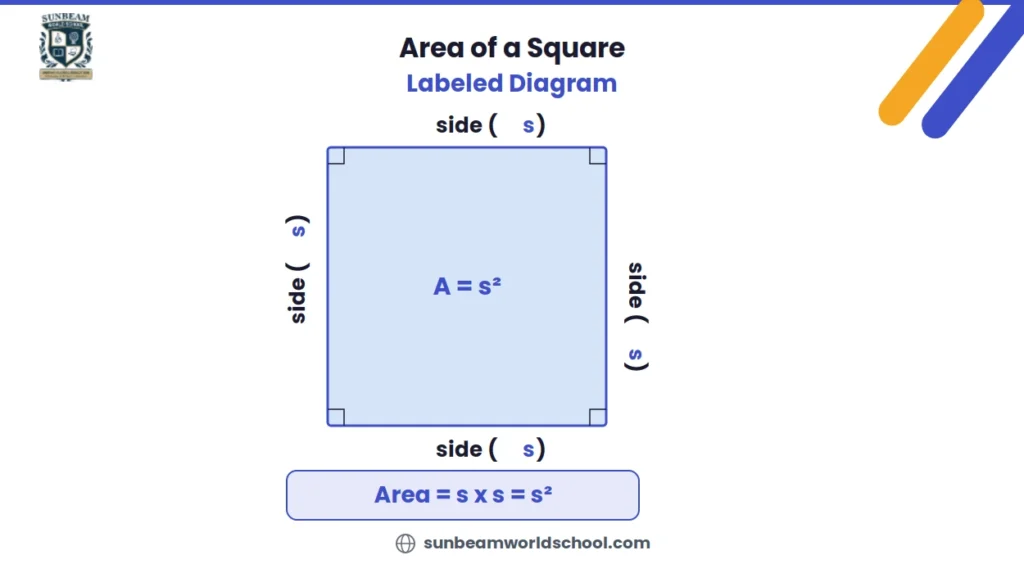
A square has four equal sides (s) and four right angles.
The area of a square is the measure of the two-dimensional space enclosed inside its four equal sides, expressed in square units such as cm², m², or ft². In simple terms, the area of square is the number of unit squares that can fit inside the shape without any gaps or overlaps.
A square is a special quadrilateral where all four sides are equal in length and all four angles are exactly 90 degrees. Because of these equal sides, finding area of squares is straightforward: you only need to know the length of one side. This is different from a rectangle, where you need both the length and the width, which is why the area of a square length times width version simplifies to just side times side.
Area is always measured in square units because you are multiplying one length by another, which gives you a two-dimensional measurement. When you say "25 square centimetres," you are describing a flat surface that could be covered by 25 tiny squares, each measuring 1 cm on every side. This is also why people often ask "is area squared?" and the answer is yes, the unit is always squared.
Key Properties of a Square
Before jumping into the formulas, it helps to know the basic properties of a square, since each property connects directly to how the area is calculated.
- All four sides are equal in length.
- All four interior angles are 90° (right angles).
- The two diagonals are equal in length and bisect each other at 90°.
- The diagonal of a square = s√2 (this is where the diagonal formula comes from).
- The perimeter = 4 × side (this is where the perimeter formula comes from).
- A square is both a rectangle (all angles 90°) and a rhombus (all sides equal), which means every formula that works for rectangles or rhombuses also applies to squares.
These properties are why a single measurement is enough to calculate everything about a square: its area, perimeter, diagonal, and even the radius of an inscribed or circumscribed circle.
What Is the Square Area Formula?
The square area formula is A = s², where A stands for area and s stands for the length of one side. This single area formula for square is the foundation for every calculation, and all other formulas (the area of square by diagonal formula and the square area formula perimeter method) are derived from it. You can also write this as the area equation A = side × side, which means the same thing.
All Area of a Square Formulas at a Glance
Given Formula Example (value = 5) Side (s) A = s² 5² = 25 sq. units Diagonal (d) A = d² / 2 5² / 2 = 12.5 sq. units Perimeter (P) A = (P / 4)² (20 / 4)² = 25 sq. units Inscribed circle radius (r) A = 4r² 4 × 5² = 100 sq. units
Using Side Length (A = s²)
The most common and direct method to find the area of a square multiplies the side length by itself. If a square has a side of 7 cm, the area is 7 × 7 = 49 cm². This works because a square is essentially a grid of unit squares arranged in equal rows and columns, and the formula of area of a square simply counts every unit square in that grid.
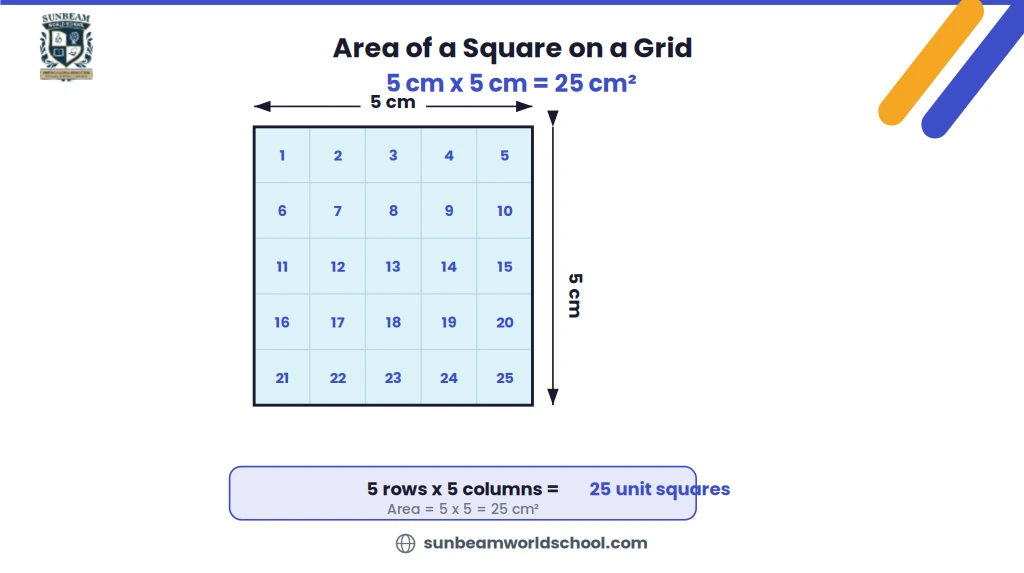
A square with a side of 5 cm contains exactly 25 unit squares
Steps to follow:
- Measure or identify the side length (s).
- Multiply it by itself: A = s × s.
- Write the answer in square units (cm², m², in², ft²).
This is what most students learn first when they encounter the area of square formula in Class 5 and 6.
Using Diagonal (A = d²/2)
When you need to find area of square using diagonal instead of the side, the area equals the diagonal squared divided by two. This area of square by diagonal formula comes from the relationship between a square's side and its diagonal: since the diagonal of a square is s√2, squaring both sides and rearranging gives A = d²/2.
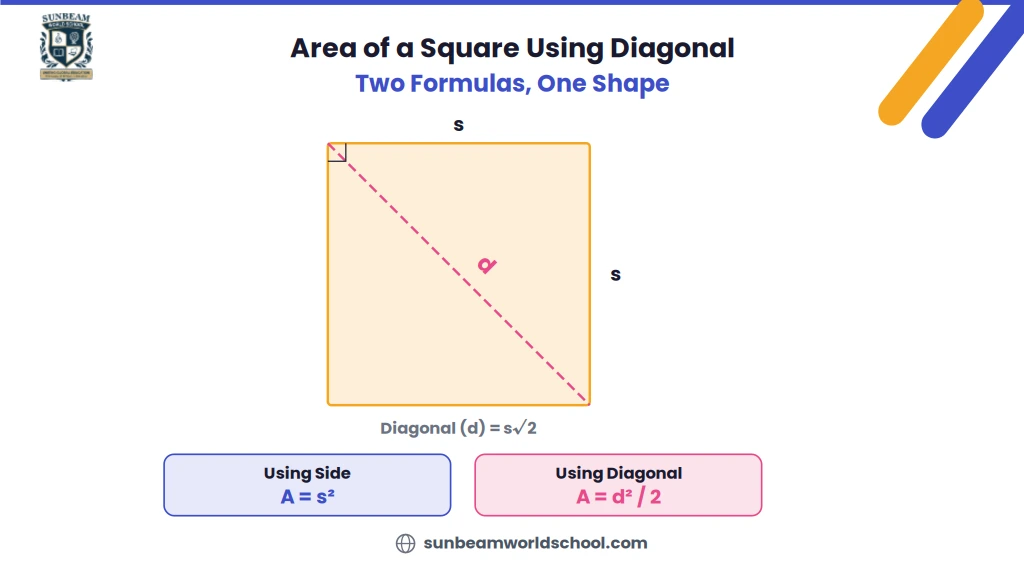
When the diagonal (d) is known instead of the side, use the formula A = d²/2.
Steps to follow:
- Identify the diagonal length (d).
- Square it: d × d.
- Divide by 2: A = d²/2.
- Write the answer in square units.
For example, if the diagonal is 10 cm, the area = 100/2 = 50 cm². This is a very common area of a square equation that appears in Class 7 and above.
Using Perimeter (A = (P/4)²)
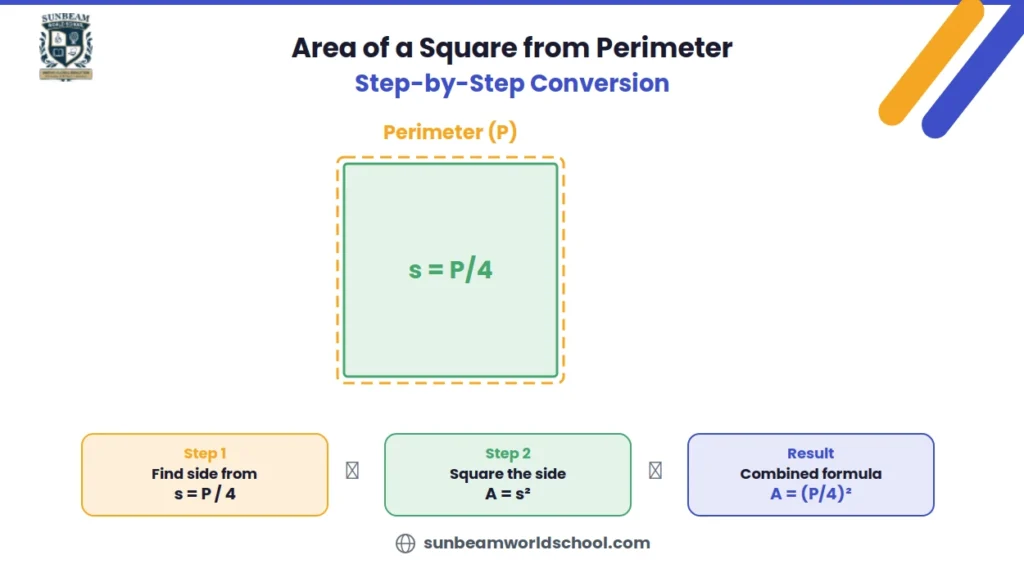
The combined formula is A = (P/4)².
If you only have the perimeter and need to find the area of a square with perimeter, divide it by 4 to get the side length, then square the result. Since the perimeter of a square is 4 × s, dividing by 4 gives you the side, and then you apply the standard square area formula perimeter method: A = (P/4)².
Steps to follow:
- Divide the perimeter by 4 to find the side: s = P/4.
- Square the side: A = s².
- Write the answer in square units.
For example, if the perimeter is 24 cm, the side = 24/4 = 6 cm, and the area = 36 cm².
Using the Inscribed Circle Radius (A = 4r²)
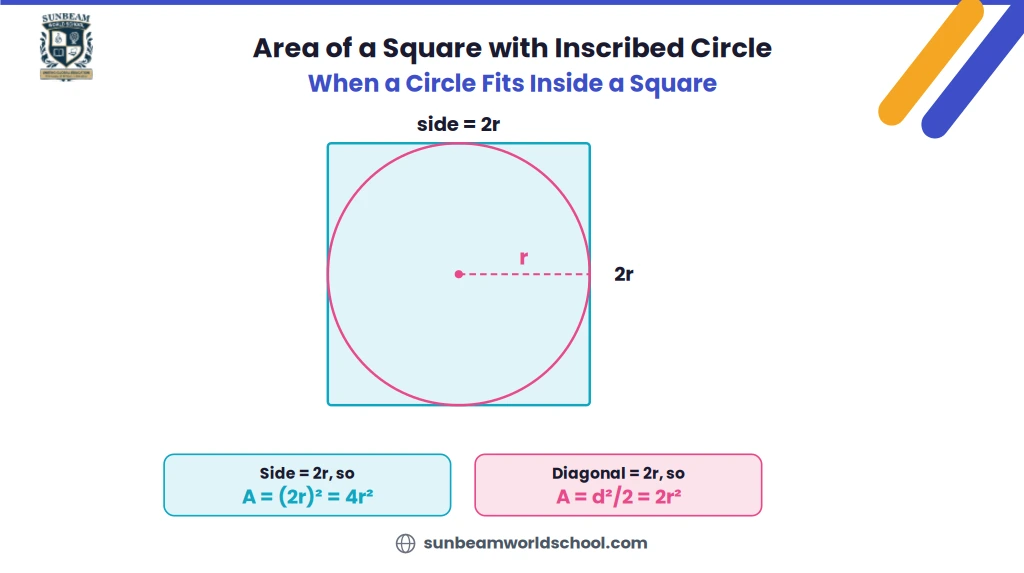
When a circle is inscribed inside a square, the side equals 2r
When a circle is inscribed inside a square (touching all four sides), the radius of that circle equals half the side of the square. So the area of square in a circle relationship works like this: the side is 2r, and the area becomes (2r)² = 4r². You can also approach this as the square area formula with angle, since an inscribed or rotated square involves angular relationships with the circle. This formula is useful in competitive maths problems where the given information is a circle, not the square directly.
How Do You Find the Area of a Square Step by Step?
Learning how to find the area of a square comes down to identifying which measurement you have (side, diagonal, or perimeter), selecting the matching formula, plugging in the value, and expressing the result in square units. If you have ever searched "how to find area" or "how to find the area," this section will give you a clear method.
Step 1: Check what is given. Look at the problem and note whether you have the side length, the diagonal, or the perimeter. Each one leads to a different formula for area of square.
Step 2: Pick the right formula. Use A = s² for side length, A = d²/2 for diagonal, or A = (P/4)² for perimeter. Knowing what is the formula for area of square that matches your given information is the key step.
Step 3: Substitute and calculate. Replace the variable with the number you have. Whether you are learning how to calculate area of a square for the first time or revising for exams, this step is just arithmetic.
Step 4: Write the answer in square units. If the side was in centimetres, the area is in cm². If it was in metres, the area is in m². Forgetting to square the unit is one of the most common mistakes when students try to compute area of a square.
Common mistakes to avoid:
- Confusing area with perimeter. The perimeter and area of square are different things: perimeter is the total distance around the outside (measured in cm, m), while area is the space inside (measured in cm², m²).
- Forgetting to square the unit. Writing "25 cm" instead of "25 cm²" is technically incorrect and will cost marks in exams.
- Using the wrong formula for the given information. If a problem gives you the diagonal and you try to use A = s², you will get the wrong answer.
How to get the area of a square quickly: if someone gives you any one measurement (side, diagonal, or perimeter), you can always find the area. Whether you want to know how to find area of square for a Class 6 homework problem or how to compute area of a square for an entrance exam, the method is exactly the same. One number is all you need.
Understanding these formulas clearly is especially valuable for students preparing for board exams and competitive entrance tests where geometry questions carry significant weight.
Why Is Area Measured in Square Units?
Area is measured in square units because it represents a two-dimensional surface, and you calculate it by multiplying two lengths together, which produces a "squared" result. This is the core reason why people ask "is area squared?" and "is area always squared?" and the answer to both is yes.
When you multiply centimetres by centimetres, the mathematical unit becomes cm × cm = cm², just like multiplying numbers gives you a product. This is not just a naming convention. It reflects what you are physically measuring: the number of 1 × 1 unit squares that can tile the surface without gaps. The area of square is 9 cm² when the side is 3 cm because you can physically lay out 9 tiny squares (each 1 cm × 1 cm) in a 3 × 3 grid inside it.
This is also why we say "square feet" or "square metres" when talking about rooms, land, or any flat surface, which answers the common question "why is area square feet?" The "square" in "square centimetres" is not just a word; it describes the shape of the unit you are counting with. And no, is surface area squared or cubed? Surface area is squared (like cm²) because it measures a flat surface, while volume is cubed (like cm³) because it measures three-dimensional space.
For younger students in Classes 5 and 6, teachers often use graph paper to make this visual. Students draw the square on the grid, count the unit squares inside, and see that the count matches s × s. This hands-on method is a great way to build intuition before moving to the abstract area of a square formula, and it forms part of the primary school maths curriculum at most schools.
What Is the Difference Between the Area of a Square and a Rectangle?
A square is a special case of a rectangle where the length and the width are equal, so the area of square and rectangle formulas are closely related. The rectangle formula A = length × width simplifies to A = side × side (s²) for a square.
For a rectangle, you need two measurements: the length (l) and the width (w). The area formula is A = l × w. For a square, since l = w = s, the formula naturally becomes A = s × s = s². This is why the area of a square length times width approach gives the same result, since both length and width are the same number. You can think of a square as an area of rectangular square where both dimensions happen to be equal.
| Property | Square | Rectangle |
|---|---|---|
| Sides | All 4 sides equal | Opposite sides equal |
| Formula | A = s² | A = l × w |
| Measurements needed | 1 (side) | 2 (length and width) |
| Perimeter | 4s | 2(l + w) |
| Diagonal | s√2 | √(l² + w²) |
This distinction matters in word problems. If a question says "a rectangular plot measures 10 m by 10 m," you can treat it as a square because both dimensions are equal, and the area is simply 100 m². Once you are comfortable with both formulas, the next step is learning how to calculate the area of a triangle, since triangles are what you get when you cut a square or rectangle along its diagonal.
How Are Perimeter and Area of a Square Related?
The perimeter of a square is the total length of its boundary (P = 4s), while the area is the space enclosed inside (A = s²). The perimeter and area of square are related through the side length: if you know one, you can always find the other. This is the idea behind the square area formula perimeter method.
To go from perimeter to area: divide the perimeter by 4 to get the side, then square it. To go from area to perimeter: take the square root of the area to get the side, then multiply by 4.
Example: A square garden has a perimeter of 32 m. What is its area? Side = 32/4 = 8 m. Area = 8² = 64 m².
Reverse example: A square tile has an area of 49 cm². What is its perimeter? Side = √49 = 7 cm. Perimeter = 4 × 7 = 28 cm.
One important thing to remember is that perimeter is measured in simple units (cm, m) while area is measured in square units (cm², m²). They describe fundamentally different things: one is a length, the other is a surface. A square area formula calculator online can help you verify these calculations instantly, but knowing the method is what matters in exams.
What Are Some Solved Examples of Area of a Square?
Solved area of a square example problems are the fastest way to master the formula. Below is a quick-reference table for the most commonly searched specific values, followed by 12 exam-level problems solved in full detail, showing every step the way your teacher expects it in a board exam or competitive test. Use these to practise how to find area of a square in every scenario.
Quick Answers to Common PAA Questions
| Question | Working | Answer |
|---|---|---|
| What is the area of a 4 cm square? | A = 4 × 4 | 16 cm² |
| What is the area of a 2 × 2 square? | A = 2 × 2 | 4 square units |
| What is the area of a 4 × 4 square? | A = 4 × 4 | 16 square units |
| What is the area of a 5 × 5 square? | A = 5 × 5 | 25 square units |
| What is the area of a 10 cm square? | A = 10 × 10 | 100 cm² |
Now, here are the detailed exam-style solved examples.
Example 1: Find the Area of a Square from Its Diagonal
Question: The diagonal of a square is 14 cm. Find the area of a square using the diagonal formula.
Solution:
Given: Diagonal of the square (d) = 14 cm
To find: Area of the square
Formula: When the diagonal is given, Area = d²/2
Step 1: Square the diagonal.
d² = 14 × 14 = 196
Step 2: Divide by 2.
A = 196 / 2 = 98
Answer: The area of the square is 98 cm².
Why does this formula work? The diagonal of a square splits it into two right-angled triangles. Using the Pythagorean theorem, d = s√2, so s = d/√2. Substituting into A = s² gives A = d²/2.
Example 2: Find the Area of a Square from Its Perimeter
Question: A square park has a perimeter of 36 cm. How to calculate square area?
Solution:
Given: Perimeter of the square (P) = 36 cm
To find: Area of the square
Step 1: Find the side length using the perimeter formula.
Perimeter of a square = 4 × side
36 = 4 × s
s = 36 / 4
s = 9 cm
Step 2: Now use the area formula.
A = s² = 9 × 9 = 81
Answer: The area of the square is 81 cm².
Example 3: Area When the Side Is Less Than 1
Question: A square tile has a side of 0.5 cm. What is its area?
Solution:
Given: Side of the square (s) = 0.5 cm
To find: Area
Formula: A = s²
A = 0.5 × 0.5 = 0.25
Answer: The area of the square is 0.25 cm².
Notice that when the side is less than 1, the area will always be smaller than the side length itself. This is because multiplying a fraction by itself gives a smaller number (0.5 × 0.5 = 0.25, which is less than 0.5). This is a common point of confusion, and it was a real discussion topic on Reddit where students asked how the area of a square can be "less than the side."
Example 4: Real-World Tiling Problem
Question: A square room measures 5 metres on each side. Square tiles of side 25 cm are used to cover the floor. How many tiles are needed?
Solution:
Given: Side of the room = 5 m, Side of each tile = 25 cm = 0.25 m
To find: Number of tiles needed
Step 1: Find the area of the room.
Area of room = s² = 5 × 5 = 25 m²
Step 2: Find the area of one tile.
Area of one tile = 0.25 × 0.25 = 0.0625 m²
Step 3: Divide the room area by the tile area.
Number of tiles = 25 / 0.0625 = 400
Answer: 400 tiles are needed to cover the floor.
Example 5: Comparing Area of a Square and a Rectangle with Equal Perimeters
Question: The perimeter of a rectangle is equal to the perimeter of a square. If the side of the square is 6 feet and the length of the rectangle is 9 feet, find the width of the rectangle and the ratio of the area of the square to the area of the rectangle.
Solution:
Given: Side of the square = 6 ft, Length of the rectangle = 9 ft
To find: Width of the rectangle; Ratio of areas
Step 1: Find the perimeter of the square.
Perimeter of square = 4 × side = 4 × 6 = 24 ft
Step 2: Since the perimeters are equal, the perimeter of the rectangle is also 24 ft. Find the width.
Perimeter of rectangle = 2 × (length + width)
24 = 2 × (9 + w)
12 = 9 + w
w = 3 ft
Step 3: Find the area of the square.
Area of square = 6 × 6 = 36 sq. ft
Step 4: Find the area of the rectangle.
Area of rectangle = length × width = 9 × 3 = 27 sq. ft
Step 5: Find the ratio.
Ratio = Area of square : Area of rectangle = 36 : 27 = 4 : 3
Answer: The width of the rectangle is 3 ft, and the ratio of the area of the square to the area of the rectangle is 4 : 3.
Key takeaway: Among all rectangles with the same perimeter, the square always has the largest area. This is a classic exam concept.
Example 6: Finding the Side When Area Is Given (Reverse Problem)
Question: The area of a square field is 144 m². Find the length of its side and its perimeter.
Solution:
Given: Area of the square = 144 m²
To find: Side length and perimeter
Step 1: Find the side using the area formula (work backwards).
A = s²
144 = s²
s = √144
s = 12 m
Step 2: Find the perimeter.
P = 4 × s = 4 × 12 = 48 m
Answer: The side of the square is 12 m and the perimeter is 48 m.
Example 7: Area of a Square Inscribed in a Circle
Question: A square is inscribed in a circle of radius 7 cm. Find the area of the square.
Solution:
Given: Radius of the circle (r) = 7 cm
To find: Area of the inscribed square
Step 1: The diagonal of the inscribed square equals the diameter of the circle.
Diagonal (d) = 2 × r = 2 × 7 = 14 cm
Step 2: Apply the area of square by diagonal formula.
A = d²/2 = (14 × 14) / 2 = 196 / 2 = 98
Answer: The area of the square inscribed in the circle is 98 cm².
Example 8: Painting Cost Word Problem
Question: The side of a square wall is 12 m. What is the cost of painting it at the rate of Rs 8 per sq. m?
Solution:
Given: Side of the wall = 12 m, Cost of painting = Rs 8 per m²
To find: Total cost of painting
Step 1: Find the area of the wall.
A = s² = 12 × 12 = 144 m²
Step 2: Multiply the area by the rate per square metre.
Total cost = 144 × 8 = Rs 1,152
Answer: The total cost of painting the wall is Rs 1,152.
Example 9: How Does the Area Change When the Side Doubles?
Question: The side of a square is 5 cm. If the side is doubled, how many times does the area increase?
Solution:
Given: Original side (s) = 5 cm, New side = 2 × 5 = 10 cm
To find: How many times the area increases
Step 1: Find the original area.
Original area = 5 × 5 = 25 cm²
Step 2: Find the new area.
New area = 10 × 10 = 100 cm²
Step 3: Find how many times the area increased.
100 / 25 = 4
Answer: When the side of a square is doubled, the area becomes 4 times the original.
General rule: If the side is multiplied by n, the area is multiplied by n². This is because A = s², so A_new = (ns)² = n²s². Doubling the side gives 2² = 4 times the area. Tripling gives 3² = 9 times.
Example 10: Side Decreased by 50%, Find Percentage Decrease in Area
Question: If each side of a square is decreased by 50%, then by what percentage is the area of the square decreased?
Solution:
Given: Each side is decreased by 50%
To find: Percentage decrease in area
Step 1: Let the original side be s. The original area = s².
Step 2: The new side after a 50% decrease = s - 50% of s = s - 0.5s = 0.5s.
Step 3: The new area = (0.5s)² = 0.25s².
Step 4: Find the decrease in area.
Decrease = Original area - New area = s² - 0.25s² = 0.75s²
Step 5: Find the percentage decrease.
Percentage decrease = (Decrease / Original area) × 100
= (0.75s² / s²) × 100
= 75%
Answer: The area of the square decreases by 75%.
Key takeaway: When the side is halved (decreased by 50%), the area does not halve. It drops to one-quarter of the original, which is a 75% decrease. This is because area depends on the square of the side, so percentage changes in the side get amplified in the area. This is a frequently asked question in competitive exams.
Example 11: Square Path Around a Garden (Border/Pathway Problem)
Question: A square garden has a side of 20 m. A path 2 m wide runs around the outside of the garden. Find the area of the path.
Solution:
Given: Side of the garden = 20 m, Width of the path = 2 m
To find: Area of the path alone
Step 1: Find the side of the outer square (garden + path on both sides).
Outer side = 20 + 2 + 2 = 24 m
Step 2: Find the area of the outer square.
Outer area = 24 × 24 = 576 m²
Step 3: Find the area of the inner square (the garden).
Inner area = 20 × 20 = 400 m²
Step 4: Subtract to find the area of the path.
Area of path = 576 - 400 = 176 m²
Answer: The area of the path is 176 m².
This type of "border" or "pathway" problem is a favourite in CBSE Class 7 and 8 exams. The key is to recognise that the path forms a frame, and its area equals the outer area minus the inner area.
Example 12: Wire Bent into a Square vs a Circle
Question: A wire is 40 cm long. It is first bent into a square. Then the same wire is bent into a circle. Which shape encloses more area? (Use π = 3.14)
Solution:
Given: Length of wire = 40 cm
To find: Which shape has more area
When bent into a square:
Perimeter = 40 cm, so side = 40/4 = 10 cm
Area of square = 10 × 10 = 100 cm²
When bent into a circle:
Circumference = 40 cm, so 2πr = 40
r = 40 / (2 × 3.14) = 40 / 6.28 = 6.37 cm
Area of circle = πr² = 3.14 × 6.37 × 6.37 = 127.39 cm²
Answer: The circle encloses more area (127.39 cm²) than the square (100 cm²) using the same length of wire.
Key takeaway: Among all shapes with the same perimeter, the circle always has the largest area. This is a classic competitive exam question that appears in Olympiads and entrance tests.
Example 13: Area When Side Is an Algebraic Expression
Question: If the side of a square is (3x + 2) cm, find the polynomial that represents the area of the square.
Solution:
Given: Side of the square (s) = (3x + 2) cm
To find: Area in terms of x
Formula: A = s²
A = (3x + 2)²
Using the algebraic identity (a + b)² = a² + 2ab + b²:
A = (3x)² + 2(3x)(2) + (2)²
A = 9x² + 12x + 4
Answer: The area of the square is (9x² + 12x + 4) cm².
This type of problem appears in Class 8 and 9 when algebra and geometry overlap. The keyword "polynomial that represents the area of a square" is a common search query, and the method is always the same: substitute the algebraic expression into A = s² and expand using identities.
Example 14: Algebraic Modeling of a Flower Bed and Pathway
Question: The total area of a square flower bed and the pathway around it in square feet can be modeled by the expression (x + 25)(x + 6), where x is the width of the pathway in feet. This expression can also be written as x² + 31x + 150. What does the quantity x² + 31x represent in the expression?
Solution:
Given: Total area = (x + 25)(x + 6) = x² + 31x + 150, where x = width of pathway
To find: What x² + 31x represents
Step 1: Expand and understand each part of the expression.
Total area = x² + 31x + 150
Step 2: Identify the constant term.
The constant 150 represents the area when the pathway width is 0 (that is, the flower bed alone with no pathway). This is the area of just the flower bed: 150 sq. ft.
Step 3: The remaining terms x² + 31x represent everything that is not the flower bed.
x² + 31x = Total area - Area of flower bed = Area of the pathway alone
Step 4: Verify by substituting x = 0.
When x = 0: Total area = 0 + 0 + 150 = 150 sq. ft (just the flower bed, no pathway). This confirms that 150 is the flower bed and x² + 31x is the pathway.
Answer: The quantity x² + 31x represents the area of the pathway alone (in square feet), excluding the flower bed.
This type of algebraic modeling question is common in higher-level competitive exams and standardised tests. It requires students to interpret parts of a polynomial expression geometrically, connecting algebra with real-world area concepts.
These types of area of square problems appear regularly in CBSE maths for Classes 5 through 10, and practising them builds the confidence needed for more complex geometry later on.
Practice Problems on Area of a Square
Test your understanding with these area of square problems. Try solving each one on your own before checking the answers below.
Problem 1: Find the area of a square whose side is 11 cm.
Problem 2: The perimeter of a square is 52 m. What is its area?
Problem 3: The diagonal of a square measures 20 cm. Calculate its area.
Problem 4: A square garden has an area of 225 m². What is the length of each side?
Problem 5: Two square plots have sides of 6 m and 8 m respectively. Find the side of a single square whose area equals the sum of the areas of both plots.
Problem 6: A square sheet of paper has a side of 30 cm. A small square of side 5 cm is cut from each corner. What is the remaining area?
Problem 7: The cost of fencing a square field at Rs 15 per metre is Rs 1,200. Find the area of the field.
Problem 8: A circle is inscribed inside a square of side 10 cm. Find the area of the square that is not covered by the circle. (Use π = 3.14)
Answers:
Problem 1: A = 11 × 11 = 121 cm²
Problem 2: Side = 52/4 = 13 m. Area = 13 × 13 = 169 m²
Problem 3: A = d²/2 = (20 × 20)/2 = 400/2 = 200 cm²
Problem 4: Side = √225 = 15 m
Problem 5: Area of first square = 6² = 36 m². Area of second square = 8² = 64 m². Total area = 36 + 64 = 100 m². Side of new square = √100 = 10 m
Problem 6: Area of full sheet = 30 × 30 = 900 cm². Area of each cut corner = 5 × 5 = 25 cm². Area of 4 corners = 4 × 25 = 100 cm². Remaining area = 900 - 100 = 800 cm²
Problem 7: Perimeter = Total cost / Rate per metre = 1200/15 = 80 m. Side = 80/4 = 20 m. Area = 20 × 20 = 400 m²
Problem 8: Area of square = 10 × 10 = 100 cm². Radius of inscribed circle = 10/2 = 5 cm. Area of circle = π × r² = 3.14 × 25 = 78.5 cm². Uncovered area = 100 - 78.5 = 21.5 cm²
Where Is the Area of a Square Used in Real Life?
The area of a square is not just a textbook formula. It appears in everyday situations whenever you need to measure or cover a flat, equal-sided surface, and recognising these applications helps students understand why the formula matters.
Floor tiling: When you buy square tiles for a room, you calculate the area of the floor (length × width) and the area of one tile (side × side), then divide to find how many tiles are needed. This is exactly what Example 4 in this guide demonstrates.
Wall painting: Painters charge per square metre or per square foot. To estimate the cost, you calculate the area of each wall. If the wall is square-shaped, the area is simply s².
Land measurement: Agricultural plots, residential sites, and playground areas are often measured in square metres or square feet. A square plot with a side of 50 m has an area of 2,500 m², which is exactly one-quarter of a hectare.
Carpet and flooring: Before buying carpet for a square room, you need to know the area so you can order the right quantity. A 4 m × 4 m room needs 16 m² of carpet.
Photo frames and art canvases: Square photo frames and canvases are sold by size (8 × 8 inches, 12 × 12 inches). The area tells you how much glass, backing material, or canvas is needed.
Garden beds and paving: Square garden beds are popular because they are easy to build and measure. Knowing the area helps you calculate how much soil, mulch, or gravel to buy.
These applications make the area of a square one of the most practical formulas a student will ever learn, and they regularly appear as word problems in CBSE and ICSE exams from Class 5 onwards.
How Does Area of Square Appear in Class 5, 6, 7, and 10?
The area of square appears in the CBSE curriculum starting from Class 5, with increasing complexity at each level, building from counting unit squares to applying the area of a square equation in coordinate geometry and proofs.
Class 5 and Class 6 Level
At this stage, students learn the basic area of square formula class 5 and class 6 version: A = s². They practise it with whole numbers, and teachers often use grid paper so students can count unit squares and verify their calculation visually. The area of square class 6 syllabus introduces word problems where students either find the area from a given side or work backwards to find the side from a given area.
Class 7 Level
The diagonal formula (A = d²/2) is introduced, and students start working with problems that combine area and perimeter. Word problems become more common, such as calculating how much carpet is needed for a square room or how many tiles fit in a square courtyard. This is also the stage where students learn how area formulas connect across shapes, since the same base-times-height logic behind the parallelogram area formula builds directly on what they already know about squares and rectangles.
Class 10 Level
At the secondary level, the square area formula class 10 version shows up in coordinate geometry (finding the area when the vertices are given as coordinates) and in problems involving circles inscribed inside or circumscribed around squares. Students also encounter proofs that connect the Pythagorean theorem to the diagonal formula.
This progression means that mastering the basic formula for area of a square early creates a strong foundation for every level that follows. Students enrolled in structured online schooling programmes often benefit from revisiting these fundamentals through interactive lessons and visual tools.
Where Did the Formula for Area of a Square Come From?
The formula of area of square, A = s², comes from the basic definition of area: the number of unit squares that fit inside a shape. For a square, this count naturally equals the side length multiplied by itself, which is what the formula of area of a square expresses.
Imagine a square with a side of 3 units. You can lay out 3 unit squares in the first row. Since the square has 3 rows (because all sides are equal), the total number of unit squares is 3 × 3 = 9. This is exactly what s² means: s rows of s unit squares each.
This idea is ancient, the Babylonians used area calculations for land measurement over 4,000 years ago, and the concept of "squaring" a number literally comes from the geometric act of forming a square with that side length. When we say "5 squared equals 25," we are describing a square with side 5 that contains 25 unit squares inside it. The area of square is simply the visual expression of what squaring a number means.
The diagonal formula (A = d²/2) was derived later using the Pythagorean theorem. Since the diagonal of a square splits it into two right-angled triangles, and each triangle has legs equal to the side of the square, the relationship d = s√2 follows directly. Rearranging and substituting gives the formula for area of square using the diagonal: A = d²/2, which saves you the step of calculating the side first.
How Do You Find the Area of a Tilted or Rotated Square?
Learning how to find the area of a tilted square drawn on a grid requires a different approach, since you cannot simply count rows and columns when the sides do not align with the grid lines.
Sometimes in exam questions, a square is rotated at an angle on a coordinate grid. This is related to the square area formula with angle concept. In this case, use one of these two approaches:
Approach 1: Use the diagonal. Measure the horizontal and vertical distances between opposite corners. If those distances are the same (which they will be for a square rotated 45 degrees), that measurement is your diagonal. Then apply A = d²/2.
Approach 2: Enclose and subtract. Draw a larger, axis-aligned square around the tilted square. Calculate the area of the larger square, then subtract the four right-angled corner triangles. The remainder is your tilted square's area.
Both methods give the same result. Approach 1 is faster when the diagonal is easy to measure, while Approach 2 works well when the vertices have clear grid coordinates.
How Can You Calculate the Area of a Square in Square Metres?
To calculate area of a square in square metres, simply ensure that the side length is measured in metres before applying the formula A = s², and the result will automatically be in m². This also answers "why is area square feet?" for those working in imperial units: the logic is identical, just with feet instead of metres.
If the side is given in a different unit, convert it first. For example, if the side is 200 cm, convert to metres by dividing by 100: 200 cm = 2 m. Then the area is 2 × 2 = 4 m².
Quick conversion reference:
- 1 m = 100 cm, so 1 m² = 10,000 cm²
- 1 m = 1,000 mm, so 1 m² = 1,000,000 mm²
- 1 km = 1,000 m, so 1 km² = 1,000,000 m²
- 1 ft = 0.3048 m, so 1 ft² = 0.0929 m²
The most common mistake here is converting the unit only once instead of twice. For instance, if 1 m = 100 cm, then 1 m² = 100 × 100 = 10,000 cm², not 100 cm². Always remember: when you square the length, you also square the conversion factor. A square area formula calculator can be helpful for quick conversions, but understanding the method matters more.
Building strong study habits and mathematical precision early on helps students avoid these unit-conversion errors throughout their academic career.
What Is the Surface Area of a Square?
The surface area of a square technically refers to the same thing as the area of a square in two dimensions: A = s². However, when people search for "surface area of a square" or "surface area of square," they usually mean the surface area of a cube, which is a three-dimensional object made of six square faces.
The surface area of a cube is 6 × s², since a cube has 6 identical square faces. So if each face has a side of 4 cm, the surface area = 6 × 16 = 96 cm².
To clarify the common question "is surface area squared?" the answer is yes, surface area is always in squared units (cm², m²) because it still measures a flat surface, even though it wraps around a 3D object. Volume, on the other hand, is measured in cubed units (cm³, m³). This distinction answers the frequently asked question "is area squared or cubed?" as well: area (including surface area) is always squared, volume is always cubed.
If you are looking for the surface area for a square as a single flat shape, it is simply A = s², the same as the regular area formula.
Conclusion
The area of a square comes down to one clean formula, A = s², and every variation (diagonal, perimeter, inscribed circle) is just a different path back to the same calculation. Master the basics covered here, practise the solved examples, and this topic will never trip you up in an exam.
Explore more maths concepts and structured learning resources at Sunbeam World School.

Frequently Asked Questions
What is the formula for the area of a square?
-The formula for the area of a square is A = s², where s represents the length of one side. If you are wondering what's the formula for a square area, this area square formula means you multiply the side by itself and express the answer in square units such as cm², m², or ft².
How do you find the area of a square using the diagonal?
+Is area always expressed in squared units?
+What is the difference between area and perimeter of a square?
+Can you find the area of a square if only the perimeter is given?
+How many unit squares fit inside a square?
+What is the area of a square inscribed in a circle?
+How do you use a square area formula calculator?
+What is the formula for the centroid of a square?
+If each side of a square is decreased by 50%, by what percentage does the area decrease?
+
In this article
Share this post:


Press and Blogs
Stay updated with our press releases, educational blogs, and more.

Quick Summary The English language contains over 500 words that start with Y, including everyday...

Quick Summary The most common words that start with I include ice, idea, image, important,...

Quick Summary The longitudinal section (L.S) of a flower is a vertical cut made through...