

 Education
How to Become a Straight A Student: 31 Proven Habits of Top 1% Students
Quick Summary You become a straight A student, and a genuinely good student, by studying smarter, not longer. A top 1% student uses active recall to test themselves instead of rereading notes, they use spaced repetition to space study sessions out instead of cramming, and build simple daily habits like planning time and focusing fully in class. If you are looking to become 1% of the studnet, follow this system consistently and you will get straight A's without burning out.
If you have searched for how to get straight A's, how to be a good student, or how to become a top 1% student, you have probably come across a lot of generic advice and very little that actually works. This guide is different. It breaks down the exact, proven habits, like active recall, spaced repetition, and real focus in class, that top students actually use to get straight A's, become a genuinely good student in every subject, and build a study system that keeps working long after one exam is over.
What Does It Mean to Be a Top 1% or A* Student?
Being a top 1% or A* student means you consistently perform better than almost everyone else in your class, not because you are naturally smarter, but because you have built better habits around how you learn. A straight A student focuses on getting the highest possible grades, while a top 1% student goes a step further and builds a complete system for learning that keeps working term after term.
The good news is that this is not a fixed trait some people are born with. It is a set of habits anyone can build, one small change at a time. The rest of this guide breaks those habits down so you can start using them today.
What Are the Core Study Habits of Every Top Student?
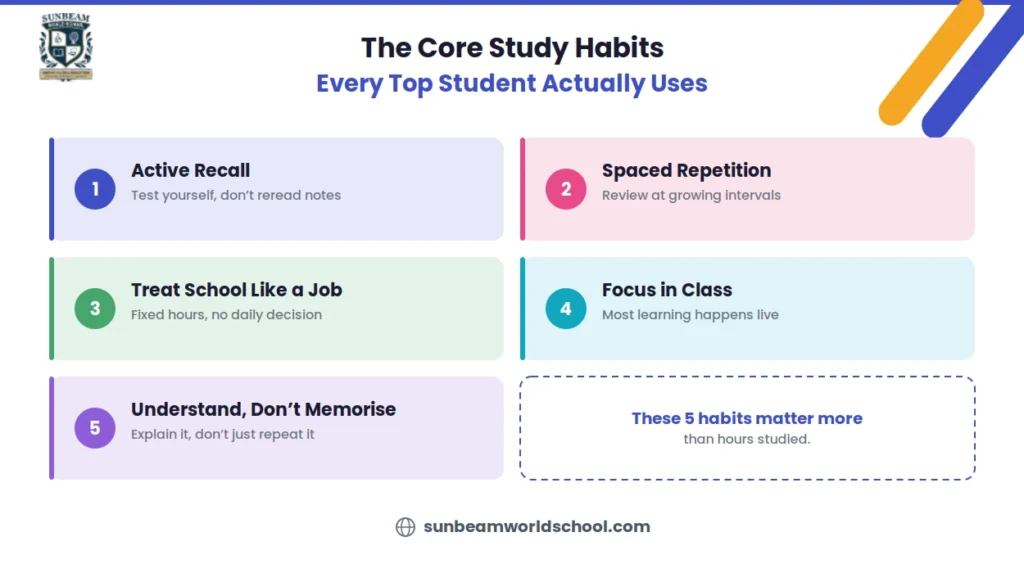
Infographic listing the 5 core study habits of top students.
Ask any student who consistently tops their class what they actually do differently, and you will rarely hear "I study for six hours a day." What you will hear is some version of the five habits below. These are not tips picked up from a motivational poster. They are the actual mechanics behind how top students turn hours of effort into results, and each one comes with a specific way to practise it, a mistake that quietly undoes it, and a way to tell whether you are doing it right.
Active Recall
Active recall means forcing your brain to produce an answer from memory, rather than simply recognising it on a page. This is the single biggest difference between students who feel like they know the material and students who can actually prove it under exam conditions. Rereading and highlighting feel productive because the words look familiar as you go over them, but familiarity is not the same as being able to recall something with your book closed. Active recall closes that gap by making you retrieve the information yourself, which is a harder mental task and, because of that difficulty, builds a far stronger memory of it.
How to actually do it:
- Blurting. After studying a topic, close every book and notebook, take a blank sheet of paper, and write down everything you remember about it, in any order. Only after you have genuinely run out of memory should you check your notes and see what you missed.
- Practice questions without peeking. Work through past papers or end-of-chapter questions with your notes physically out of reach, not just closed beside you. The temptation to glance over is strong, and it quietly turns a recall exercise back into a recognition one.
- Teach it out loud. Explain the topic as if you were teaching it to a younger student who has never heard of it. The moment you get stuck or start using vague phrases like "and then this thing happens" is exactly the moment you have found a gap worth reviewing.
- Flashcards, used correctly. A flashcard only works as active recall if you say the answer out loud or write it down before flipping it over. Flipping straight away to check is rereading with extra steps.
The mistake that undoes it: Treating rereading, highlighting, or copying notes over neatly as "studying." These feel like effort and look productive, but none of them require your brain to retrieve anything, so none of them build the kind of memory you need in an exam.
Example: Say you have just finished a chapter on the causes of World War I. Instead of rereading the chapter a second time, close the book and blurt out every cause you can remember onto a blank page, with a short explanation of each. Only then open your notes to check what you missed and add it in a different colour, so you can see at a glance what you actually knew versus what you are relearning. Do this again two days later using only the blank page, and you will usually find the gaps have already started shrinking on their own.
Spaced Repetition
Spaced repetition means deliberately spreading your review of a topic across days and weeks instead of repeating it several times in one sitting. The reason this matters comes down to how forgetting actually works. Once you learn something new, your memory of it drops fastest in the first day or two, then levels off. If you review the material right before you would have forgotten it, you reset that decline and each future review holds for longer than the last. This means the gaps between reviews should grow over time: a day, then a few days, then a week, then a few weeks, rather than staying fixed.
How to actually do it:
- Build a simple review calendar. When you first learn a topic, write down three or four future dates to revisit it, roughly following a 1, 3, 7, 14-day pattern. A basic notebook or phone calendar works fine, you do not need special software.
- Use a box system for flashcards. Keep flashcards in groups. Cards you get right move to a group you review less often, and cards you get wrong move back to a group you review daily, so your time naturally concentrates on what you actually find difficult instead of what you have already mastered.
- Review before a test, not just the night before it. If a test is three weeks away, that is three weeks of spaced reviews you can schedule in advance, not one long cramming session the evening before.
The mistake that undoes it: Reviewing everything at the same frequency, or only reviewing right before a test. Reviewing something you already know well is a poor use of time, and reviewing something for the first time the night before an exam is cramming with a different name.
Example: If you learn 20 new vocabulary words on Monday, briefly test yourself again on Tuesday, sort out the ones you got wrong, retest those on Thursday, and then test the full list again the following Monday, you are far more likely to still know them a month later than if you had only studied them once, the night before a quiz. The total study time across both approaches is similar. The results are not.
Treating School Like a Job
Top students treat school like a role with fixed hours and non-negotiable commitments, not something they get to whenever the mood strikes. This does not mean studying every free hour of the day. It means removing the daily decision of whether to start, because that decision, made fresh every single evening, is where most study time quietly disappears.
How to actually do it:
- Set a fixed study block, not a vague intention. "I'll study tonight" gets skipped constantly. "I study from 5 to 7pm on weekdays" is a real commitment you can plan around and stick to.
- Have one dedicated place to work. Studying at a desk trains your brain to switch into focus mode faster over time, the same way a specific location trains a habit in any other part of life.
- Plan the week before it starts. On Sunday or Monday, list every deadline, test, and assignment coming up, then assign each one to a specific block of time. This is what actually prevents the last-minute scramble, not motivation.
- Protect rest days on purpose. A fixed schedule includes fixed time off. Rest that is planned in advance keeps you consistent far longer than rest you only take once you are already burnt out.
The mistake that undoes it: Waiting to feel motivated before starting. Motivation is unreliable and tends to show up after you begin working, not before. A fixed schedule works precisely because it does not depend on how you feel that day.
Example: Instead of deciding each evening whether or when to study, block out the same one or two hours every weekday, say 5 to 7pm, at the same desk, and treat that time the way you would treat a shift at a part-time job, something you simply show up for. After two or three weeks, most students report that starting no longer feels like a decision at all. It just happens, because the time is already blocked out.
Focusing in Class
Most of the actual learning in any subject happens while a teacher is explaining it live, not later while you are rereading a textbook at home. A student who is genuinely focused during a 40-minute lesson can walk away needing very little revision on that topic. A student who was present but not really listening ends up relearning the entire lesson from scratch later, which takes far longer than paying attention the first time would have.
How to actually do it:
- Take notes in your own words, not copied word for word. Writing something in your own phrasing forces you to process it as you go, rather than just transcribing sounds into text.
- Ask the question the moment it comes up. A small doubt left unaddressed in a 9am lesson usually turns into a much bigger gap by the time you sit down to review it that evening.
- Sit where distraction is hardest, not easiest. Where you sit and who is next to you has a bigger effect on focus than most students expect.
- Do a two-minute pre-read before class when you can. Skimming the topic title and headings before the lesson starts gives your brain a rough map to slot new information into, which makes it far easier to follow along in real time.
The mistake that undoes it: Copying down exactly what is on the board or slide without engaging with it. This creates notes that look complete but were never actually processed, which is why rereading them later often feels like learning the material for the first time.
Example: Two students sit through the same maths lesson. One writes the steps of a new method in their own words and asks a question the moment a step feels unclear. The other copies the board accurately but does not really follow the logic behind it. The first student typically needs little to no extra revision on that topic. The second ends up relearning most of it from scratch at home, at a fraction of the depth, and often makes the exact same mistake on the next test that they made the first time round.
Understanding Over Memorizing
Understanding a concept means you can explain it in your own words, apply it to a problem you have never seen, and reconstruct it even if you forget the exact original wording. Memorising means you can repeat something correctly only if it is asked in exactly the same way you learned it. This difference does not usually matter on simple recall questions, but it is exactly what separates students who do well on straightforward tests from students who do well on tests with unfamiliar, twisted, or multi-step questions, which is where most of the marks in higher-level exams actually sit.
How to actually do it:
- Use the Feynman approach. Pick a concept, then explain it in the simplest possible language, as if to a much younger student. Whenever you reach for a technical term you cannot simplify, or a step you cannot justify, that is the exact gap in your understanding, and now you know precisely what to go back and fix.
- Connect new material to something you already know. New information sticks far better when it is linked to an existing idea in your head rather than floating on its own. Asking "what does this remind me of" is often enough to create that link.
- Solve the same type of problem with different numbers or contexts. If you can only solve a problem when it looks exactly like the example in your notes, you have memorised a pattern, not understood a method.
- Ask yourself "why" one more time than feels necessary. Understanding is usually just memorising with one extra "why" attached, repeated until you hit a genuine explanation instead of another fact.
The mistake that undoes it: Relying on a memorised formula, definition, or answer template without knowing why it works. This holds up fine until a question is phrased slightly differently than expected, at which point the memorised version has nothing to fall back on.
Example: A student who has memorised the sentence "photosynthesis converts sunlight into energy" may freeze if asked why a plant kept in a dark cupboard slowly dies, since that exact question never appeared in their notes. A student who actually understands the concept can reason through it on the spot, explaining that without light the plant cannot produce the energy it needs, and can apply the same underlying logic to a completely different question about a plant grown under coloured glass, because they understood the mechanism rather than memorising one sentence about it.
Individually, each of these habits helps. Used together, they compound. Active recall tells you what you do not know yet, spaced repetition makes sure you do not forget it again, a fixed schedule guarantees the time actually gets used, focus in class shrinks how much revision you need in the first place, and real understanding makes everything you learn transferable rather than disposable. This is the actual system behind "studying smarter," not a slogan.
What Kind of Student Are You Right Now?
For every question, pick the answer closest to how you actually study, not how you wish you studied, then check your result underneath.
Active Recall
1. When you study for a test, what do you actually do?
A) I mostly reread my notes or textbook.
B) I sometimes test myself, but usually only right before the test.
C) I regularly close my notes and test myself on what I remember.
2. After finishing a topic, how do you check what you actually remember?
A) I do not really check, I just assume I know it if it looks familiar.
B) I skim back through my notes to see if it "rings a bell."
C) I try to explain or write it out from memory, then compare it to my notes.
3. When you get a practice question wrong, what happens next?
A) I read the correct answer and move straight on to the next question.
B) I glance at why I got it wrong, but rarely go back to it later.
C) I note down why I got it wrong and test myself on that exact gap again later.
Spaced Repetition
4. How do you review material after you first learn it?
A) I mostly only look at it again the night before a test.
B) I review it again once or twice, but with no real pattern.
C) I have a rough plan to revisit it several times, spaced out over days or weeks.
5. When a test is three weeks away, when do you start reviewing for it?
A) In the last day or two before the test.
B) Roughly a week before, in one or two longer sessions.
C) Straight away, with short reviews spread across the full three weeks.
6. A month after learning something, how much do you usually still remember?
A) Very little, unless I happened to use it again recently.
B) Some of it, but a lot has faded.
C) Most of it, because I keep coming back to it every so often.
Consistency
7. How do you actually find time to study?
A) I study whenever I happen to feel like it or remember to.
B) I try to have a routine, but it falls apart most weeks.
C) I have a fixed time most days that I stick to, even when I do not feel motivated.
8. What happens in a week when you are busy or unmotivated?
A) Studying is usually the first thing that gets dropped.
B) I still do some, but far less than planned.
C) I still get through most of my planned study, because it is already scheduled in.
9. Do you plan your study time in advance, or decide as you go?
A) I mostly decide in the moment, day by day.
B) I have a loose weekly plan, but I often ignore it.
C) I plan the week ahead and treat those blocks as fixed.
Focus in Class
10. What happens during your lessons in class?
A) I mostly just copy down whatever is on the board or slide.
B) I pay attention most of the time, but rarely ask questions.
C) I take notes in my own words and ask questions as soon as something is unclear.
11. When something is unclear during a lesson, what do you usually do?
A) I let it go and hope it makes sense later.
B) I make a mental note to look it up afterwards, but often forget to.
C) I ask about it there and then, or write it down to follow up immediately after class.
12. After a normal day of lessons, how much revision does that material usually need?
A) A lot, it often feels like I am learning it for the first time again.
B) A moderate amount, I remember some of it but not all.
C) Very little, since I already processed most of it during the lesson.
Understanding Over Memorizing
13. What happens when a question is worded differently than you practised it?
A) I usually get stuck, because I mostly remember answers, not reasoning.
B) I can sometimes work it out, but it takes me a while.
C) I can usually still work it out, because I understand why the answer is correct.
14. Can you explain what you just learned to someone else, in your own words?
A) Not really, I would mostly be repeating my notes.
B) Roughly, though I would stumble on some parts.
C) Yes, and I could probably answer their follow-up questions too.
15. When you use a formula, rule, or method, do you know why it works?
A) Not usually, I just know how to apply it.
B) Sometimes, for the ones I have used a lot.
C) Generally yes, I understand the reasoning behind it, not just the steps.
How to read your results: Look at your answers in groups of three, one group per habit, rather than as one combined score. For each habit, notice which letter you picked most often across its three questions.
- Mostly C's in a group: That habit is already working well for you. Use the "How to actually do it" tips in the matching section above to sharpen it further.
- Mostly B's in a group: You have the right instincts for that habit, but not yet the consistency. The habit is there, it just is not reliable yet.
- Mostly A's in a group: That is very likely your weakest habit, and the one quietly costing you the most marks.
Whichever habit came back mostly A's, that is exactly where to start. Go back to that section above and work through it properly, since fixing your single weakest habit will move your grades far more than polishing one that is already working.
How Do You Get Straight A's? A Step-by-Step Guide to Getting an A in Every Subject
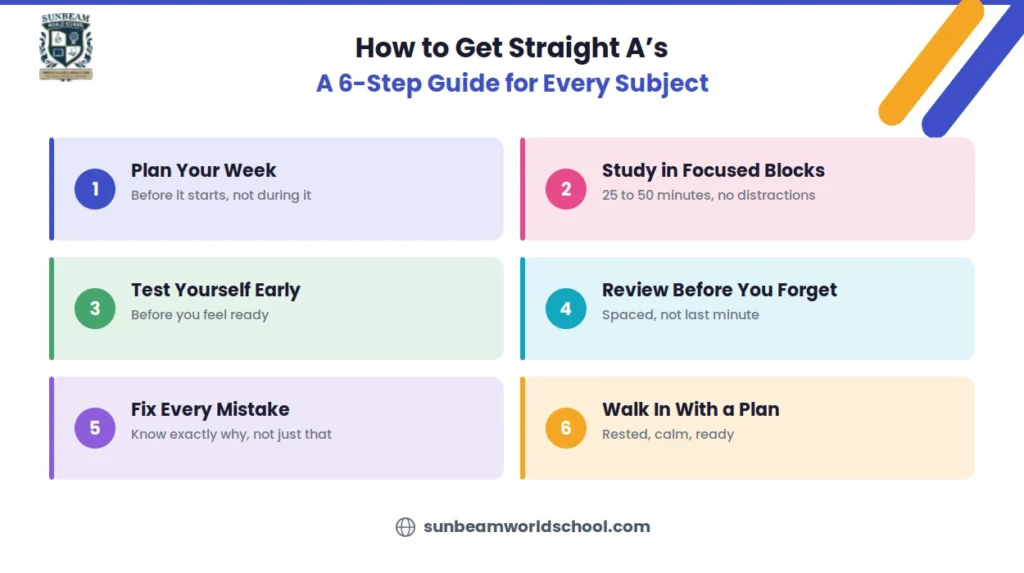
The 6-step process top students actually follow, from planning to test day.
If you have ever searched how to get straight A's, how to get an A, or how to get all A's in a single subject, the honest answer is the same every time: you get there with a repeatable process, not a burst of last-minute effort. The six steps below are the actual sequence top students follow, from the start of a topic through to the day of the test itself, and each one builds on the last.
Step 1: Plan your week before it starts. Every Sunday or Monday, write down every test, assignment, and deadline coming up that week, then block out specific times to work on each one. This single habit removes most of the panic that leads to cramming, because by the time a deadline is close, you have already been chipping away at it for days instead of discovering it at the last minute.
Example: On Sunday evening, you see you have a history essay due Thursday and a maths test on Friday. Instead of leaving both until Wednesday night, you block Monday and Tuesday evenings for the essay, and Wednesday and Thursday for spaced maths review, so neither one turns into a scramble.
Step 2: Study in focused blocks, not long stretches. Choose one subject or topic, remove distractions like your phone, and work for 25 to 50 minutes before taking a short break. This is far more effective than several unfocused hours spent switching between tasks, since concentration drops sharply the longer a session drags on without a proper break.
Example: Instead of a vague three-hour "study session" that drifts between your phone, your notes, and background videos, you commit to two clean 40-minute blocks on biology, with a 10-minute break between them. You will usually get more done in those two blocks than in the entire three unfocused hours.
Step 3: Test yourself before you feel ready. Rather than waiting until you feel fully prepared to quiz yourself, start testing yourself early in the process, using the active recall techniques covered earlier. This shows you exactly what you do not know yet, while you still have time to fix it, instead of finding out on the actual test.
Example: Two days into learning a new chemistry topic, before you feel remotely confident, you close your notes and try to answer three practice questions from memory. Getting most of them wrong at this stage is not a bad sign, it is exactly the point, since it tells you precisely what to focus on for the rest of the week.
Step 4: Review before you forget, not after. Go back over material a day after you first learn it, then again a few days later, following the spaced repetition and 1/3-5-7 approach covered earlier. This is the actual mechanism behind going from getting an A on one test to consistently knowing how to get an A on every test in that subject, because the knowledge never gets the chance to fully fade between reviews.
Example: You learn a set of physics formulas on Monday. Instead of only looking at them again the night before the test two weeks later, you briefly revisit them on Tuesday, again on Thursday, and again the following Monday, so by test day you are reviewing something familiar rather than relearning it from scratch.
Step 5: Turn every mistake into a specific fix. When a practice question or past paper reveals something you got wrong, do not just glance at the correct answer and move on. Write down what you got wrong and why, then create a fresh practice question that targets that exact gap, so the same mistake does not quietly resurface on the real test.
Example: You keep losing marks on a specific type of algebra question because you forget one step in the middle. Rather than noting "I need to be more careful," you write down the exact step you keep skipping, then deliberately practise five more questions that require that same step, until it becomes automatic.
Step 6: Walk into the test with a clear plan, not just knowledge. In the final days before a test, shift from learning new material to consolidating what you already know, get proper sleep the night before, and skim your summarised notes on the morning of the test rather than cramming new content. On the day itself, read through the whole paper first, then tackle questions in order of what you find easiest, so you are not thrown off by getting stuck early.
Example: The night before an exam, instead of trying to squeeze in one more new topic, you do a light 20-minute review of your summary notes, then stop and get a full night's sleep. You walk in calm rather than exhausted, which on its own tends to be worth more marks than that last hour of frantic reading would have been.
Followed together, these six steps are what actually answer the question of how to get straight A's. None of them depend on talent, and none of them require studying around the clock, they simply replace last-minute effort with a process that starts early and compounds over the length of a term.
Top 1% Students Follow the 1/3-5-7 Rule and the 3-2-1 Study Rule
The habits covered so far explain what top 1% students do, active recall, spaced repetition, focus, and understanding. The 1/3-5-7 rule and the 3-2-1 rule are the exact scheduling systems that turn those habits into a routine you can actually follow, rather than a vague intention to "review more" and "test yourself more." These are the specific structures behind how top students put spaced repetition and active recall into practice day to day.
The 1/3-5-7 rule is the scheduling system top 1% students use to apply spaced repetition without having to think about timing from scratch every time. You review new material one day after learning it, then again on day three, day five, and day seven. Each review takes less time than the last, because the material is already becoming familiar, but it keeps the information fresh in your long-term memory instead of letting it fade the way it would after a single study session.
The 3-2-1 rule is how top 1% students structure a single study session, so it is not just for spaced review, it is for using their time well every time they sit down to study. Spend three parts of your time on active recall, such as quizzing yourself or answering practice questions, two parts on reviewing material you already know, and one part exploring anything you still find confusing. Both rules exist for the same reason, they force you to revisit information instead of learning it once and forgetting it, which is exactly the kind of small, repeatable structure that separates a top 1% student from a student who studies just as hard but with no system behind it.
What Are 31 Habits of Top 1% Students?
1 proven habits, backed by real learning science, not guesswork.
Beyond the five core habits already covered, there is a much longer list of smaller, everyday habits that quietly add up over a term. None of these alone will transform your grades, but stacked together, they are usually the difference between a student who studies hard and a student whose hard work actually shows up in their results.
Habit 1: Write down every deadline the moment you learn about it. Relying on memory is how small tasks quietly turn into missed deadlines.
Habit 2: Plan tomorrow the night before. You start each day already knowing what to do instead of deciding on the spot.
Habit 3: Break big assignments into smaller tasks with their own mini deadlines. This makes a project due in three weeks feel manageable instead of overwhelming.
Habit 4: Protect a fixed block of time each day for studying. Treat it the same way you would treat a class, rather than fitting it in around everything else.
Habit 5: Build in rest days on purpose. Do not wait until you are already burnt out to rest.
Habit 6: Keep every deadline and task in one place. Use a single planner or a single app, instead of scattering commitments across sticky notes, group chats, and memory.
Habit 7: Tackle your hardest or least favourite task first. Do it while your energy and focus are highest, rather than saving it for last when you are too tired to do it properly.
Habit 8: Check in on your weekly plan every few days and adjust it. Do not treat the original plan as fixed and abandon it the moment something unexpected comes up.
Procrastination is one of the biggest obstacles to the habits above, and if it is holding you back, Sunbeam's guide on helping children and teens overcome procrastination breaks down exactly why it happens and how to move past it.
Habit 9: Use active recall and spaced repetition as your default study method. Do not save these for the week before big exams.
Habit 10: Explain topics out loud as if teaching them to someone else. This quickly reveals any gaps in your own understanding.
Habit 11: Keep an error log. Write down every mistake you make on practice questions along with why it happened, so the same mistake does not quietly repeat itself on the real test.
Habit 12: Study in short, focused sessions rather than long, tired ones. Concentration drops off sharply after 30 to 50 minutes without a break.
Habit 13: Mix subjects or related topics during a single study session. This trains you to recognise which method to use, not just how to use it.
Habit 14: Summarise each topic in your own words right after finishing it. This forces early understanding instead of leaving it for a rushed review later.
Habit 15: Reach for past papers as your main tool close to test time. These match the real exam's format and phrasing far more closely than a textbook does.
For a deeper walkthrough of these techniques, this guide on how to study effectively covers proven, practical methods you can start using right away.
Habit 16: Sit where you can focus, away from friends who tend to distract you.
Habit 17: Ask questions the moment something is unclear. Do not let confusion quietly build up across the lesson.
Habit 18: Review your notes the same day you take them. The lesson is still fresh in your memory at that point.
Habit 19: Start preparing for tests early, instead of a day or two before. Spread your revision using the spaced repetition approach covered earlier.
Habit 20: Practise under real test conditions, including timing yourself. This way the actual exam does not feel unfamiliar.
Habit 21: Arrive a little early and skim the previous lesson's notes. Do not walk into class cold.
Habit 22: Read exam instructions and mark allocations carefully before starting. Spend your time in proportion to the marks actually on offer, rather than over-answering an easy question and running out of time on a harder one.
Habit 23: Use any spare time at the end of a test to check your answers. Do not leave early. This is often where careless mistakes get caught before it is too late to fix them.
Habit 24: Put your phone in another room while studying, not just on silent nearby. Visibility alone is enough to pull attention away.
Habit 25: Close every browser tab and app that is not needed for the task at hand.
Habit 26: Pick one task to finish before starting another. Do not switch between several at once.
Habit 27: Notice when you are "pseudo-working." This means looking busy without actually absorbing anything. Reset instead of pushing through it.
Habit 28: Take proper breaks, including short walks. Do not switch straight to your phone the moment you stop working.
Habit 29: Use a simple timer method, such as 25 minutes of work followed by a 5-minute break. Avoid open-ended sessions with no natural stopping point.
Habit 30: Protect your focused blocks by letting people around you know you are studying. You are less likely to be interrupted halfway through a task.
Habit 31: Notice your own natural peak focus times, whether that is morning or evening. Schedule your hardest subjects then, rather than whenever happens to be convenient.
That is 31 habits, and no student does all of them perfectly at once. The goal is not to adopt every single one this week. Pick two or three that stood out as things you are not already doing, and build those in first.
How Do You Become a Straight A Student in High School?
In high school, becoming a straight A student comes down to consistency across many smaller assignments and tests rather than a handful of huge exams, so the daily habits covered in this guide matter more than any single big push. Keep a simple planner for every subject, review your notes the same day you take them, and use the 1/3-5-7 rule to stay ahead of tests instead of cramming the night before.
High school also tends to come with more distractions and less structure than younger grades, which is exactly why routines matter so much here. If your child's school environment or schedule is not giving them enough flexibility to build these habits properly, it may be worth exploring how Sunbeam World School's online homeschool programme can offer a more personalised pace.
How Do You Get Straight A's in College?
In college, getting straight A's depends much more on independent time management, since you have far fewer built-in reminders and far more freedom in how you structure your days. The core habits stay the same, active recall, spaced repetition, and focused study blocks, but you will need to be the one enforcing your own schedule rather than relying on a teacher to keep you on track.
It also helps to set clear, longer-term goals rather than just aiming to pass each individual test, since college grades add up over an entire semester rather than resetting each week. Sunbeam's guide to setting long-term goals for students walks through how to set goals that actually stick.
Debunking Common Myths of Top Students
Several common beliefs about top students do not hold up once you actually look at how they study, and clearing these up can make becoming a straight A student feel far more achievable.
Myth 1: Top students are naturally gifted
This is the belief that top students are simply born smarter, and that their results come from natural ability rather than effort.
Reality: most of what separates a top student is not raw talent but the amount of time they have spent developing how they learn, not just what they learn. Active recall, spaced repetition, and a consistent routine can be learned by anyone, regardless of where they started.
Myth 2: Top students never struggle.
This is the assumption that if a student is doing well, the material must simply come easily to them, and that struggling with a topic is a sign you are not cut out for it.
Reality: every student runs into difficult material. The real difference is that top students expect to struggle and have habits, like active recall, that help them push through it and identify exactly what is confusing them, instead of giving up or assuming they are just not good at the subject.
Myth 3: Studying longer always means better results.
This is the idea that the number of hours spent studying is what determines how well a student does, so more hours should always mean a better outcome.
Reality: a focused 90-minute session using active recall will usually beat six unfocused hours of rereading. The quality of your attention matters far more than the number of hours on the clock, which is exactly why two students can study the same amount and end up with very different results.
Myth 4: Top students don't need help.
This is the belief that asking for help is a sign of falling behind, and that genuinely capable students figure everything out on their own.
Reality: in practice, top students are often the most willing to ask questions, join study groups, or seek out extra support, because they see it as part of an effective learning system rather than a sign of weakness. Asking for help early is what stops a small gap in understanding from turning into a much bigger one.
Can You Get Straight A's Without Burning Out?
Yes, and in fact, burning out usually makes it harder to keep up straight A's rather than easier. The students who keep their grades up over years, not just one term, are the ones who protect their sleep, take real breaks, and build a sustainable pace instead of running on stress and late nights.
If you are worried that chasing top grades will mean giving up everything else, know that the opposite is usually true. Good habits like spacing out your study sessions and studying in focused blocks free up far more time for rest and other interests than constant last-minute cramming ever could. And if a bad test result or a tough term throws you off, it helps to know it is not the end of the road. Sunbeam's guide on handling failure in exams offers practical ways to bounce back without losing momentum.
How Do You Become a Good, Successful Student Beyond Just Grades?
Being a good, successful student means more than just chasing high marks, it also means being reliable, curious, and able to manage yourself without constant reminders. This includes attending classes consistently, participating instead of staying silent, and treating feedback as useful information rather than criticism to avoid.
Grades will usually follow naturally once these habits are in place, because a student who shows up prepared, asks good questions, and reflects on their mistakes is already doing most of what it takes to succeed academically.
Conclusion
Becoming a straight A student is not about talent or luck, it comes down to five habits: active recall, spaced repetition, a consistent routine, real focus in class, and understanding over memorising. Do not try to fix all five at once. Pick your single weakest habit from the self-check earlier, apply it starting with your very next study session, and give it two weeks before judging the results. At Sunbeam World School, this is exactly the kind of independent learning skill we build into how students are taught, because once a student knows how to learn, strong grades stop being the goal and start being the natural result.

Frequently Asked Questions
How do I become a top 1% student?
-You become a top 1% student by building a complete learning system rather than simply studying harder. Focus on active recall, spaced repetition, and learning from mistakes, and treat these as habits built steadily over months, not a quick fix before one exam.
How do I become a number one student?
+Is it possible to be a straight A student and still have a life?
+How can I become a top student within a month?
+I've always been a C student, how can I become an A student?
+How many hours do top students study a day?
+Do top students study every day?
+What is the most important habit of a 1% student?
+How do you get straight A's without burning out?
+
In this article
Share this post:


Press and Blogs
Stay updated with our press releases, educational blogs, and more.

Quick Summary There are 86,400 seconds in a standard 24-hour day.This calculation of how many...

Quick Summary Have is the everyday word, used with I, you, we, they, and any...

Quick Summary A metaphor is a way of describing one thing by calling it something...