
 Online School
Who Is Online School Best For?
Parents rarely ask us whether online school works. They ask whether it works for their child, which is a different question and a better one.
Online school is best for children who need a flexible schedule, personalized pacing, or a learning environment outside the traditional classroom. In practice, that means student athletes and performers, traveling and relocating families, gifted learners, children with medical needs, children with special educational needs, children with social anxiety or who are unsafe at school, and children with no good school within reach.
It is not best for everyone, and any school that claims otherwise is selling. Below is the honest version of both lists, and a short test you can apply to your own child by the end of the page.
Which Children Does Online School Suit Best?
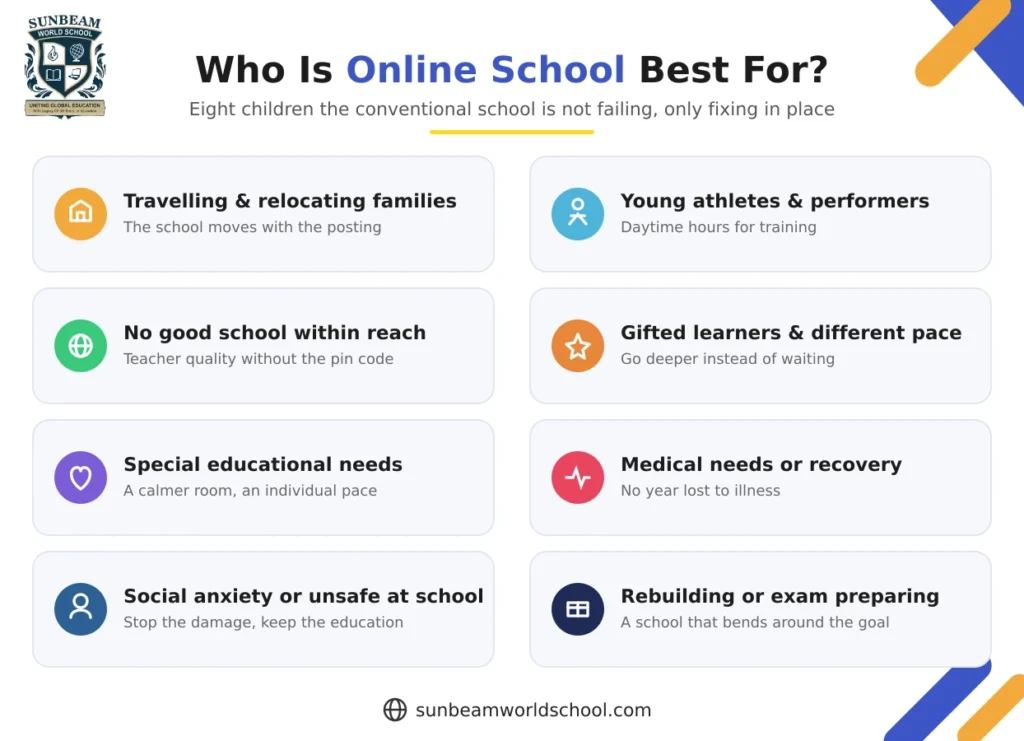
Discover who benefits most from full-time online schooling and how it supports diverse learning needs, flexible schedules, and personalized education.
Online school suits eight kinds of children particularly well. Each one has the same thing in common: the conventional school is not failing them because it is bad, but because it is fixed.
1. Travelling and Relocating Families
Children of travelling and relocating families gain the most, because the school stops being the thing that breaks with every posting. Bank, defence, corporate and government transfers used to mean a new school, a new syllabus and a lost term every few years. An online school moves with the family, and the same teachers and classmates continue from the new city or country.
This holds for families abroad too. A child in Dubai or Singapore can study an Indian curriculum through the CBSE aligned pathway and hold Indian board certification for a return home. We cover this in detail for parents in transferable jobs and for military families.
2. Young Athletes and Performers
Children training seriously in sport, music, dance or theatre need daytime hours that no conventional timetable releases. Grounds are free in the morning, coaches and teachers are available in the afternoon, and a child cannot be in two places at once. Flexible timing turns an impossible choice into a schedule, and recorded classes cover a tournament week. Our guide on online school for student athletes covers how families structure it.
3. Children With No Good School Within Reach
Families in smaller cities and towns face three bad options: relocate, send the child to boarding school, or accept the local ceiling. Online school removes the link between pin code and teacher quality, since the physics teacher is hired from a national pool rather than from whoever lives within commuting distance. Equal learning opportunity is the actual product here, and we wrote about it for geographically disadvantaged children.
4. Gifted Learners and Children Who Need a Different Pace
Gifted learners and children who need one more explanation both lose in a class of forty, and they lose in opposite directions. One is bored into carelessness, the other is quietly left behind.
Every child has their own learning style, and personalised pacing is what a small live batch with an assistant teacher for doubts can actually deliver. A gifted child uses the released hours to go deeper rather than to wait, which is why parents of prodigies find this format before anyone recommends it.
5. Children With Special Educational Needs
Children with ADHD, autism, dyslexia or other learning needs often do better without the sensory load of a classroom of forty. The environment is calmer, the pace is individual, and a lesson can be repeated without a child feeling watched. Our guide to online school for special needs students covers the full picture, with dedicated pieces on ADHD, autism and dyslexia, and the special education programme itself.
6. Children With Medical Needs or Recovering From Illness
A child with medical needs, a long recovery or repeated hospital visits does not need to choose between health and the school year. Classes continue from home or from a hospital bed, recordings cover the days that are lost, and nobody falls a year behind for being ill. We wrote about this for chronically ill children.
7. Children With Social Anxiety or Who Are Unsafe at School
Social anxiety, bullying and school refusal bring more families to us than most people expect, and none of it reflects badly on the child. Removing a child from a place that is hurting them is not running away, it is stopping the damage while the underlying issue is addressed with a professional. Cameras stay on in class, teachers supervise every session, and the anti-bullying policy applies online the way it should have applied offline. Handle this one with a counsellor, not a brochure.
8. Students Rebuilding or Preparing
Students who left school early, and students whose day is dominated by JEE or NEET coaching, both need a school that bends around the goal rather than fights it. NIOS allows flexible subject choice and On-Demand examinations through the year (nios.ac.in), which is why the route works for a returning student and for an aspirant who would otherwise be pushed toward an attendance arrangement that does not hold up. Our post on online school for dropout students covers the first case.
Which Type of Online School Suits Which Child?
The type of online school that suits a child is decided by where the child is going next, not by which school markets hardest. Once the format fits, this is the only question left, and the table below is the whole decision.
|
Where your child is headed |
Pathway that fits |
Who certifies |
What your child holds at the end |
|
Indian universities, JEE, NEET or CUET, or a possible return to a conventional Indian school |
CBSE aligned, NCERT based |
NIOS or BOSSE, under the Ministry of Education |
Class 10 and 12 board certificate, marksheet and migration certificate |
|
Universities in the UK |
Cambridge, IGCSE and A Levels |
Cambridge International, UK |
IGCSE and A Level certificates |
|
Universities in the United States |
American curriculum |
Accredited US pathway, Cognia accreditation |
High school diploma and transcripts |
|
Universities in Australia, without closing Indian options |
WACE with ATAR |
SCSA, Government of Western Australia |
WACE certificate and ATAR, recognised by AIU as Class 12 equivalent since 2023 |
|
Undecided, or the early years |
Activity based design rather than a board decision |
Board chosen later, at Class 9 or 11 |
Short live sessions, kit based work, an adult in the room |
- Indian curriculum focus: For a child aiming at JEE, NEET, CUET or an Indian university, or who may return to a conventional Indian school, the CBSE aligned pathway with board certification through NIOS or BOSSE is the straight line. NCERT textbooks, CBSE pattern assessment, Indian board certificate.
- Global and career focus: For a family whose child will apply to universities abroad, the Cambridge pathway suits the UK and the American curriculum suits the US. These certify through their own authorities and are read natively by universities in those systems.
- The Australian route: WACE is the Western Australian government's school leaving certificate with an ATAR, and the Association of Indian Universities recognised it as equivalent to Class 12 in 2023, so it opens Australian universities without closing Indian ones.
- Activity based and experiential, for the early years: Younger children need short sessions, hands on materials and a learning kit rather than a lecture. This is a design question rather than a board question, and it is what an early years programme should look like.
One caution about how this question usually gets answered. A school that offers one pathway will tell you that pathway is right for every child, because it is the only thing it can sell. The useful conversation starts from your child's destination and works backwards, which is why we teach all four and let the counsellor say no to three of them.
Is Online School a Good Option for Young Children?
Online school works for young children when the design is right, and it fails badly when it is not, which is why this is the most contested question in the format. Search any parent forum and you will find people saying online school is a terrible option for the early years. They are describing a real thing: a five year old parked in front of a six hour timetable learns very little and dislikes school by Grade 2.
The version that works looks nothing like that. Live sessions are short, the screen is a window to a teacher rather than a babysitter, and most of the day is spent off screen with a kit and a workbook, and an adult is in the room. At Sunbeam an adult is needed alongside the child only in pre-primary, and most children in Class 1 and above manage the day independently.
So the honest answer is conditional. If someone is home and the school runs short, activity led sessions for that age, the early years work well, and the child gets a calmer start than a bus at seven in the morning. If neither is true, wait, or choose a conventional school for those years and revisit later. That is a real answer, and no school loses by giving it.
Who Is Online School Not Best For?
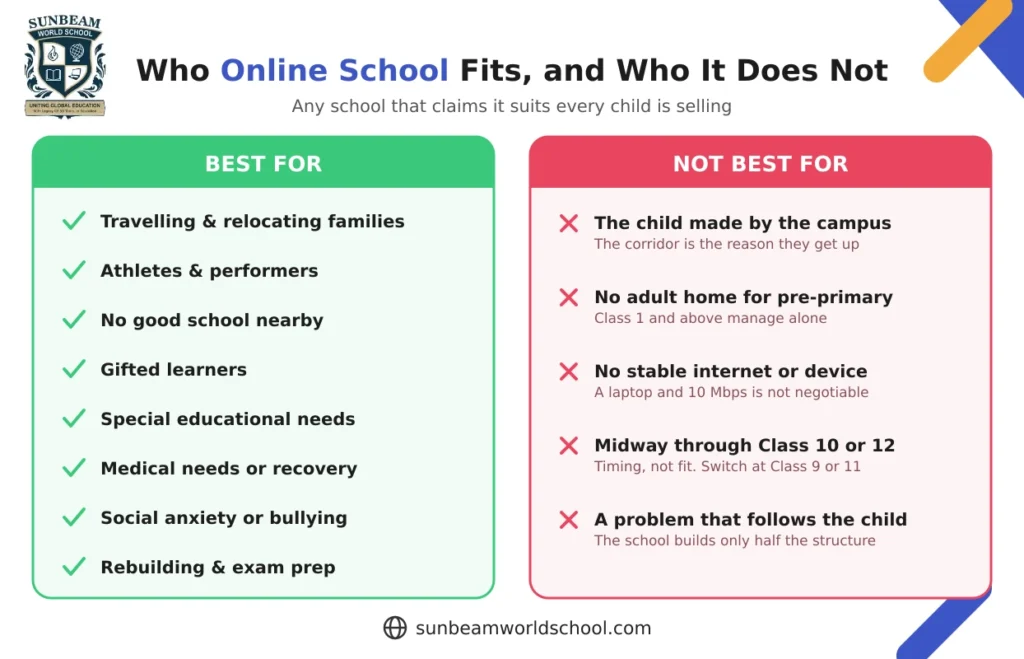
Find out who benefits most from full-time online schooling and when a traditional school may be a better choice.
Online school is not best for four kinds of families, and knowing this before you enrol saves everyone a year.
- The child whose motivation is the campus itself. Some children are made by the corridor, the ground and the noise of two hundred others. Online school gives them the lessons and takes the reason they get up.
- Households where no adult can be nearby for a young child. At Sunbeam an adult is needed alongside the child only in pre-primary, and most children in Class 1 and above manage independently, but pre-primary at home does need someone in the room.
- Families without a stable connection and a device. A laptop and roughly 10 Mbps is the entire requirement, and it is not negotiable.
- A child in the middle of a Class 10 or Class 12 board cycle. This is timing rather than fit: switch at the start of Class 9 or Class 11 instead, which our guide to moving from a regular school to an online school explains.
There is a fifth caution worth naming plainly. Online school is not a way to avoid a problem that will follow the child. A child who will not work without a teacher standing over them still needs structure, and the school can only build half of it. The other half is a routine at home that somebody keeps.
How Do I Know If Online School Is Right for My Child?
Answer five questions honestly and the fit becomes obvious. This is the same conversation our counsellors have on a first call, and it works whichever school you are considering.
- What is the actual problem? Commute, pace, relocation, health, safety, training hours, or no good school nearby. If you cannot name it, the format is not the answer yet.
- Does my child need the building, or tolerate it? The honest answer decides more than any feature list.
- Who is home, and for which grade? Pre-primary needs an adult nearby. Class 1 and above usually do not.
- What replaces the playground? Neighbourhood sport, a club, a hobby class. The commute hours are returned to you for exactly this, and the families who plan it never raise socialisation as a problem later.
- What is the exit? A recognized online school issues a Transfer Certificate, and an NIOS or BOSSE Class 10 certificate opens Class 11 anywhere. Knowing the door opens both ways is what lets you choose on your child's needs rather than on fear.
If four of those five point the same way, the format fits. What remains is choosing the school, which is a separate exercise: board registration, real class hours, batch size and the exit path in writing. Sit in a free demo before you decide anything, and bring the five questions with you.
Where Sunbeam World School Fits
Every school in this category will tell you it is the best one. We would rather list what is checkable and let you hold it against whoever else is on your shortlist.
- Every pathway in the table above, under one school, from Nursery to Grade 12. CBSE aligned with NIOS or BOSSE certification, Cambridge, American and WACE. Most online schools in India offer one or two, which is why their advice about which pathway suits your child tends to match what they sell.
- Accreditation and board registration you can verify yourself. Sunbeam World School is accredited by IAO and Cognia, with board certification through NIOS and BOSSE, listed on the accreditations page. Look the numbers up on the accreditors' own directories rather than taking ours for it.
- Live teaching rather than a video library. Sunbeam is not a video based learning platform: teachers take the live class and assistant teachers run separate doubt sessions, which is what makes a short live block enough.
- Published timings. Grade wise slots with morning, afternoon and evening options are on the school timings page, and Saturdays run as Bagless Learning, off screen by design.
- Support for the children this article names. A dedicated special education programme, cameras on with teacher supervision through every class, and an adult needed alongside the child only in pre-primary.
- Fees in the open. INR 58,320 to INR 1,15,320 a year for 2026-27 depending on grade and curriculum, published on the fee structure page, with board registration and exam fees charged separately by the boards.
None of that makes us right for every child. The section above on who online school is not best for applies to us exactly as it applies to everyone else, and our counsellors will say so on the call. Bring the five questions to a free demo and hold us to them.

Frequently Asked Questions
Who is online school best for?
-Online school is best for children whose lives do not fit a fixed building and timetable: children of families with transferable jobs or postings abroad, young athletes and performers, children with no good school within reach, children who need a faster or slower pace, children with special educational needs, children who are unwell, children who are unhappy or unsafe at school, and students rebuilding after a break or preparing for competitive exams.
Is online school right for my child?
+Who should not choose online school?
+Is online school good for a child who is struggling at school?
+Which type of online school should I choose for my child?
+Is online school a good option for young children?
+How do I select a good online school?
+Is online school the same as offline school?
+
In this article
Share this post:


Press and Blogs
Stay updated with our press releases, educational blogs, and more.
Quick Summary You become a straight A student, and a genuinely good student, by studying...
Quick Summary: The main difference in has vs. have is the subject. Has is used...
Quick Answer A dummy school provides enrolment mainly for board exam purposes without requiring regular daily...