
 Kids Learning
Ascending Order: Definition, Symbol, Examples & Steps
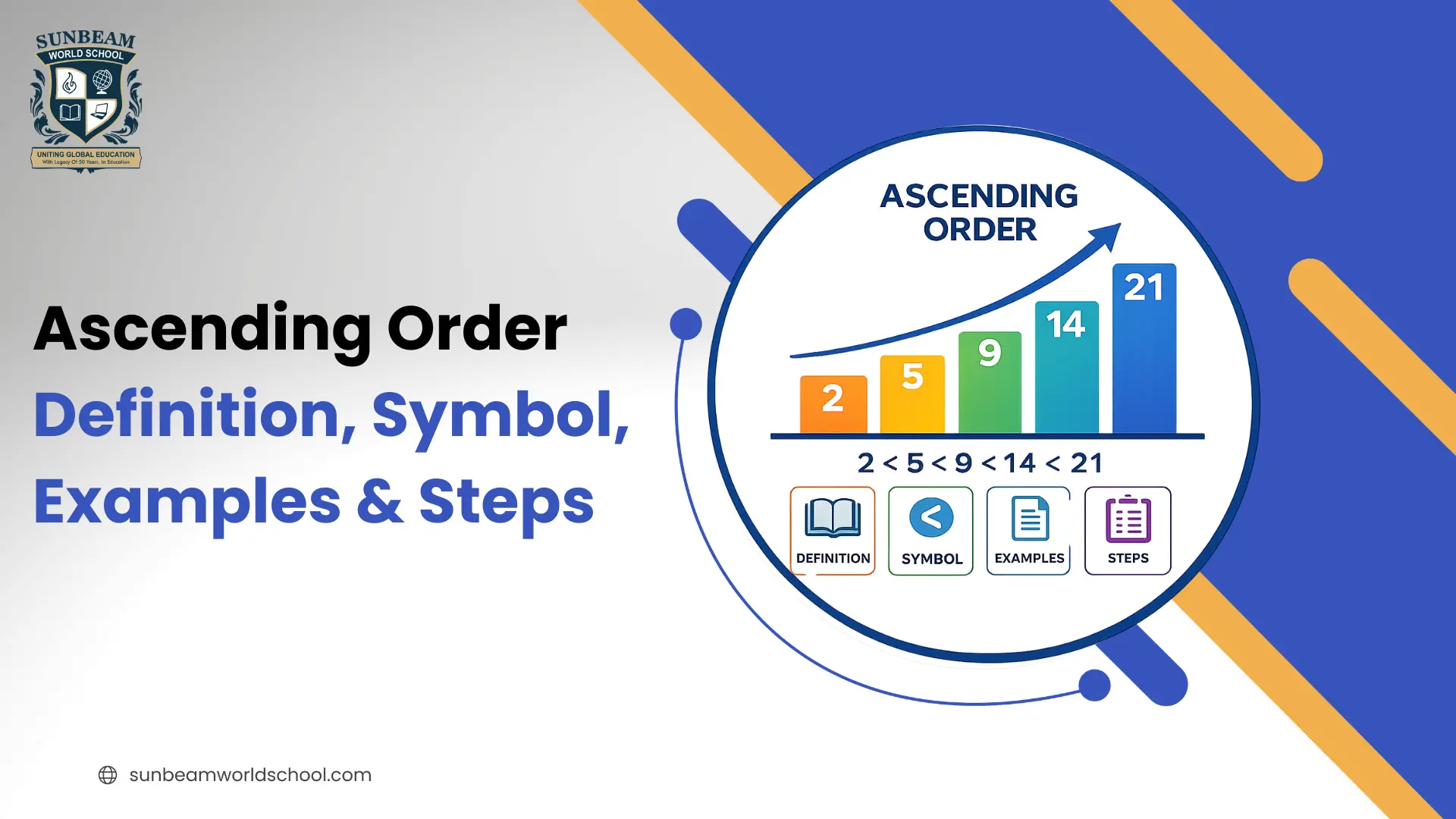
| Quick answer: Ascending order means arranging numbers, letters or objects from the smallest to the largest value. The ascending order symbol is < (less than). For example, 1 < 3 < 5 < 8 is in ascending order because each number is less than the next. |
Ascending order is one of the most important concepts in mathematics and is used to arrange numbers, letters, dates, and other items from the smallest value to the largest. It helps students develop number sense, comparison skills, cognitive development and logical thinking.
Whether you are sorting whole numbers, fractions, decimals, or alphabets, understanding ascending order makes it easier to organize information accurately. In this guide, you'll learn the meaning of ascending order, its symbol, formula, step-by-step method, and practical examples.
What Is Ascending Order?
Ascending order is the way of arranging numbers, letters or items from the smallest value to the largest value. It is also called increasing order, because each value goes "up" as you move from left to right.
If a list of numbers is in ascending order, the first number is the smallest and the last number is the largest. Every number in between is greater than or equal to the one before it.
Example: The numbers 5, 2, 8, 1 written in ascending order become 1, 2, 5, 8. We started with the smallest number (1) and ended with the largest (8).
Ascending Order Meaning in Maths
In maths, ascending order meaning is to place values in a sequence that increases. Whether you are sorting numbers, letters, dates or weights, the rule stays the same — start small and grow bigger.
Numbers: 0, 1, 2, 3, 4, 5 …
Letters: A, B, C, D, E …
Sizes: small, medium, large
Time: 9:00 AM, 10:00 AM, 11:00 AM
This is why ascending order is one of the first ideas children learn while studying number sense — it builds the base for comparison, sorting and later topics like data handling.
Ascending Order Symbol & Formula
The ascending order symbol is <, which means "less than". It is placed between two numbers to show that the number on the left is smaller than the number on the right.
2 < 5 < 8 < 10
Read as: "2 is less than 5, 5 is less than 8, 8 is less than 10."
Ascending Order Formula
For any list of numbers a1, a2, a3 … an written in ascending order:
a1 ≤ a2 ≤ a3 ≤ … ≤ an
The "≤" symbol (less than or equal to) is used because some lists can have repeated numbers.
How to Arrange Numbers in Ascending Order
Follow these four simple steps to arrange any list of numbers in ascending order and learn early maths skills, foundational learning concepts:
- Look at all the numbers in the given list once.
- Find the smallest number and write it first.
- Find the next smallest number from the remaining ones and write it after.
- Keep repeating until every number has been placed in order.
| Worked example: Arrange 12, 5, 9, 1, 7 in ascending order.
Smallest number = 1 Next smallest = 5 Then = 7 Then = 9 Largest = 12 Answer: 1, 5, 7, 9, 12 |
Ascending Order Examples
Here are some common ascending order examples you will see in school maths:
| Given Numbers | Ascending Order |
| 3, 8, 2, 6 | 2, 3, 6, 8 |
| 15, 7, 20, 10 | 7, 10, 15, 20 |
| 50, 30, 70, 10 | 10, 30, 50, 70 |
| 1, 4, 1, 2 | 1, 1, 2, 4 |
| −3, 0, −7, 5 | −7, −3, 0, 5 |
| 100, 99, 101, 98 | 98, 99, 100, 101 |
Tip for negative numbers: The number with the largest digit after the minus sign is actually the smallest. So −7 is smaller than −3, and −3 is smaller than 0.
Ascending Order of Fractions
To arrange fractions in ascending order, all denominators should be the same. Either find a common denominator, or convert each fraction to a decimal and compare.
| Example: Arrange 1/2, 1/4, 3/4, 2/3 in ascending order.
Common denominator = 12 → 1/2 = 6/12, 1/4 = 3/12, 3/4 = 9/12, 2/3 = 8/12 Compare numerators: 3, 6, 8, 9 Ascending order: 1/4, 1/2, 2/3, 3/4 |
Ascending Order of Decimals
For decimals, first compare the whole-number part. If those are the same, compare the digits after the decimal point one by one — from left to right.
| Example: Arrange 0.45, 0.6, 0.405, 0.5 in ascending order.
Write each with three decimal places: 0.450, 0.600, 0.405, 0.500 Compare: 405 < 450 < 500 < 600 Ascending order: 0.405, 0.45, 0.5, 0.6 |
Ascending Order of Dates
Dates in ascending order go from the oldest to the newest. The earliest date is written first and the latest date is written last.
| Example: Arrange in ascending date order: 15 Aug 2024, 26 Jan 2025, 01 Jan 2024, 14 Nov 2024
Ascending date order: 01 Jan 2024 → 15 Aug 2024 → 14 Nov 2024 → 26 Jan 2025 |
This is the same logic used by school diaries, bank statements and exam result lists — older entries come first when sorted in ascending order by date.
Ascending Order of Alphabets
For letters, ascending order is the same as the natural A to Z order. So yes — A to Z is ascending alphabetical order.
Letters: A, B, C, D, E … X, Y, Z
Words: Apple, Ball, Cat, Dog
Names: Aarav, Bhavya, Diya, Karan, Riya
When two words start with the same letter, compare the next letter. For example, in ascending order: Cat, Cow, Crow — all start with "C", so we look at the second letter (a < o < r).
Ascending vs Descending Order
Ascending and descending are opposites. Use this comparison table to see the difference at a glance:
| Point of Difference | Ascending Order | Descending Order |
| Direction | Smallest → Largest | Largest → Smallest |
| Also Called | Increasing Order | Decreasing Order |
| Symbol Used | < (less than) | > (greater than) |
| Numbers Example | 2, 5, 8, 11 | 11, 8, 5, 2 |
| Alphabet Example | A, B, C, D ... Z | Z, Y, X, W ... A |
| Date Example | Oldest date first | Newest date first |
| Short Form | ASC | DESC |
Where We Use Ascending Order in Daily Life
Ascending order isn't just a maths topic — we use it all around us:
- Class register: Roll numbers are usually written in ascending order.
- Library books: Books are arranged by ascending alphabetical order of author names.
- Exam results: Marks can be sorted ascending to find the lowest score.
- Online shopping: "Sort by price: Low to High" is ascending order.
- Calendar: Dates of the month go in ascending order.
- Height line-up: Children standing from shortest to tallest is ascending order.
Ascending Order Practice Questions
Try these on your own — work through each set, then check your answers at the end.
Set 1: Numbers
- Arrange in ascending order: 24, 8, 36, 12, 4
- Arrange in ascending order: 105, 95, 150, 89, 200
- Arrange these negative numbers: −5, −12, 0, −1, 7
- Arrange in ascending order: 1000, 100, 10, 1, 10000
Set 2: Fractions & Decimals
- Arrange in ascending order: 1/3, 1/6, 1/2, 1/5
- Arrange these decimals: 2.5, 2.05, 2.55, 2.005
- Arrange in ascending order: 3/4, 0.6, 1/2, 0.85
Set 3: Dates & Time
- Arrange these dates in ascending order: 12 May 2025, 03 Mar 2025, 19 Jan 2025, 28 Aug 2024
- Arrange these times in ascending order: 4:30 PM, 9:15 AM, 12:45 PM, 7:00 AM
Set 4: Fruit Names (alphabetical)
Pick from your favourite fruits names list and arrange them from A to Z:
- Arrange in ascending alphabetical order: Mango, Apple, Orange, Banana, Cherry
- Arrange in ascending alphabetical order: Watermelon, Grapes, Pineapple, Strawberry, Kiwi
- Arrange in ascending order of letters: Papaya, Pear, Peach, Pomegranate
Set 5: Animal Names (alphabetical)
Practise with names from our animals name list:
- Arrange in ascending alphabetical order: Zebra, Cat, Elephant, Buffalo, Dog
- Arrange in ascending alphabetical order: Horse, Hen, Hippo, Hare
Set 6: Wild Animals (by size, then alphabet)
Use the wild animals name list to attempt these:
- Arrange these wild animals in ascending order of weight: Lion, Elephant, Fox, Tiger, Rabbit (hint: smallest weight first)
- Arrange in ascending alphabetical order: Tiger, Bear, Leopard, Cheetah, Wolf
Set 7: Rhyming Words (alphabetical)
From our rhyming words for kids collection:
- Arrange these rhyming words in ascending alphabetical order: Cat, Bat, Hat, Rat, Mat
- Arrange in ascending alphabetical order: Tree, Bee, Sea, Free, Knee
Set 8: Mixed Word Problems
Five students scored 78, 56, 92, 67, 84 marks. Write the marks in ascending order.
- The heights of four kids are 132 cm, 128 cm, 140 cm, 125 cm. Arrange them in ascending order.
- A shop sells pencils for ₹5, ₹2, ₹10, ₹7. Sort the prices in ascending order.
Show All Answers
Set 1 (Numbers)
- 4, 8, 12, 24, 36
- 89, 95, 105, 150, 200
- −12, −5, −1, 0, 7
- 1, 10, 100, 1000, 10000
Set 2 (Fractions & Decimals)
- 1/6, 1/5, 1/3, 1/2
- 2.005, 2.05, 2.5, 2.55
- 1/2 (0.5), 0.6, 3/4 (0.75), 0.85
Set 3 (Dates & Time)
- 28 Aug 2024, 19 Jan 2025, 03 Mar 2025, 12 May 2025
- 7:00 AM, 9:15 AM, 12:45 PM, 4:30 PM
Set 4 (Fruits)
- Apple, Banana, Cherry, Mango, Orange
- Grapes, Kiwi, Pineapple, Strawberry, Watermelon
- Papaya, Peach, Pear, Pomegranate
Set 5 (Animals)
- Buffalo, Cat, Dog, Elephant, Zebra
- Hare, Hen, Hippo, Horse
Set 6 (Wild Animals)
- Rabbit, Fox, Tiger, Lion, Elephant
- Bear, Cheetah, Leopard, Tiger, Wolf
Set 7 (Rhyming Words)
- Bat, Cat, Hat, Mat, Rat
- Bee, Free, Knee, Sea, Tree
Set 8 (Word Problems)
- 56, 67, 78, 84, 92
- 125 cm, 128 cm, 132 cm, 140 cm
- ₹2, ₹5, ₹7, ₹10
Conclusion
Ascending order is the process of arranging numbers, letters, dates, or objects from the smallest value to the largest. It is a fundamental mathematical skill that helps students compare, sort, and analyze information effectively. By learning the ascending order symbol, formula, and simple arrangement steps, students can confidently solve problems involving whole numbers, fractions, decimals, dates, and alphabets.
Regular practice strengthens logical reasoning and builds a strong foundation for advanced mathematical concepts. At Sunbeam World School, we encourage students to develop essential mathematical skills through interactive learning and practical examples that make concepts like ascending order easy to understand and apply in everyday life.

Frequently Asked Questions
What is ascending order in maths?
-Ascending order is the arrangement of numbers or items from the smallest value to the largest. For example, 2, 5, 7, 9 is in ascending order because every number is greater than the one before it.
What is the symbol of ascending order?
+What is the difference between ascending and descending order?
+How do you write numbers in ascending order?
+Is A to Z ascending or descending order?
+How do you arrange fractions in ascending order?
+How do you arrange dates in ascending order?
+Is there a formula for ascending order?
+What is the opposite of ascending order?
+
In this article
Share this post:


Press and Blogs
Stay updated with our press releases, educational blogs, and more.

Quick Summary The English language contains over 500 words that start with Y, including everyday...

Quick Summary The most common words that start with I include ice, idea, image, important,...

Quick Summary The most common words that start with Z include zoo, zero, zone, zebra,...