
 Online School
Levels of Education: A Complete Guide to Every Stage
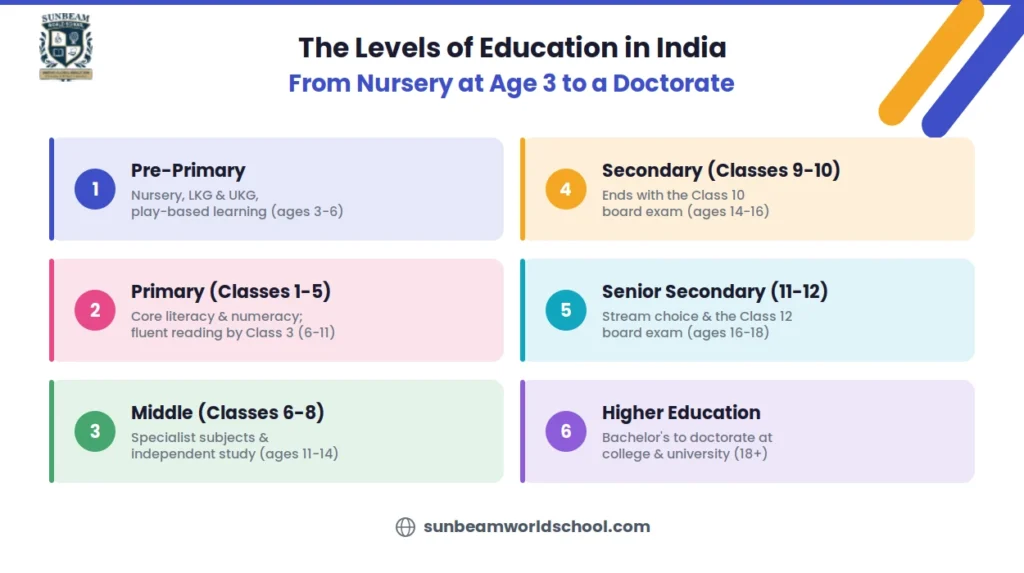
India's education system is commonly divided into five levels of education: pre-primary, primary, secondary, senior secondary, and higher education. However, you may also come across NEP 2020's 5+3+3+4 structure, the three international education levels, or UNESCO's ISCED framework. While the names and number of stages differ, they all describe the same learning journey from early childhood to higher education.
Each framework has a different purpose. The five Indian levels are used by schools and education boards, NEP 2020 groups students by developmental stages, the three international levels are widely used for admissions and visas, and UNESCO's ISCED framework helps compare education systems across countries.
In this guide, you'll learn the different levels of education in India, how they fit into the broader types of education, and how an accredited online school makes it possible to complete every school stage from home.
What Are the Levels of Education?
The Levels of Education in India: From Nursery at Age 3 to a Doctorate
Levels of education are the sequential stages a learner progresses through, from early childhood at age three to doctoral study in adulthood. Each level has a defined age band, a set of classes, and, from secondary school onwards, a qualification that certifies its completion. The table below maps all four frameworks side by side; it is the single most useful reference in this article.
|
Indian level |
NEP 2020 stage |
Classes/ages |
Global 3-stage view |
ISCED |
|
Pre-Primary |
Foundational Stage |
Nursery to UKG (age 3-6) |
Primary (pre-primary) |
ISCED 0 |
|
Primary (Classes 1-5) |
Foundational (1-2) + Preparatory (3-5) |
Ages 6-11 |
Primary |
ISCED 1 |
|
Middle (Classes 6-8) |
Middle Stage |
Ages 11-14 |
Secondary (lower) |
ISCED 2 |
|
Secondary (Classes 9-10) |
Secondary Stage (9-12) |
Ages 14-16 |
Secondary |
ISCED 2-3 |
|
Senior Secondary (Classes 11-12) |
Secondary Stage (9-12) |
Ages 16-18 |
Secondary (upper) |
ISCED 3 |
|
Higher Education |
Not a school stage |
Age 18+ |
Tertiary |
ISCED 5-8 |
Internationally, primary, secondary, and tertiary are the three terms you will meet on admission forms and visa paperwork: primary is elementary school (Classes 1 to 5 or 1 to 6), secondary covers middle and high school combined (Classes 6 to 12), and tertiary is everything at college and university. And when a form asks for your “education level”, it means the highest formal stage you have already completed, not the one you are currently studying.
The School Levels in India, Stage by Stage
Indian schooling runs through five stages between ages 3 and 18. Each stage below carries a different job in a child's development, and each has one milestone that deserves more attention than the rest.
Pre-Primary (Nursery, LKG, UKG: ages 3 to 6)
Pre-primary education is the first level of formal schooling, covering Nursery, LKG, and UKG for children aged 3 to 6. It focuses on play-based learning, early literacy and number sense, motor skills, and social development. Under NEP 2020, pre-primary is formally part of the school system for the first time, grouped with Classes 1 and 2 into a five-year Foundational Stage (ages 3 to 8). At this age, emotional security, playful learning, and a happy child matter far more than worksheet completion.
Primary (Classes 1 to 5: ages 6 to 11)
Primary education covers Classes 1 to 5 and builds the core literacy, numeracy, and general awareness that every later subject assumes. In the US the same stage is called elementary school. Under NEP 2020, Classes 1-2 join the Foundational Stage and Classes 3-5 form the Preparatory Stage. Class 3 is the milestone to watch: successive ASER (Annual Status of Education Report) surveys show that children who leave Class 3 reading fluently do better at every later stage, while those who fall behind rarely catch up, which is exactly why NEP 2020's NIPUN Bharat mission targets Foundational Literacy and Numeracy by the end of Class 3.
Middle School (Classes 6 to 8: ages 11 to 14)
Middle school, also called upper primary, introduces separate specialist subjects, deeper conceptual learning, and independent study. Three things change at once: a single class teacher is replaced by subject teachers, Science and Social Studies split into their component disciplines (Physics, Chemistry, Biology, History, Geography, Civics), and children are expected to manage their own notes, homework, and revision. NEP 2020 formally names this the Middle Stage; some international systems extend it to Class 9 or 10 and call it lower secondary.
Secondary (Classes 9 to 10: ages 14 to 16)
Secondary education is Classes 9 and 10, ending in the first major board examination, the Class 10 CBSE, ICSE, or state-board exam. That certificate matters for two practical reasons: it is the first externally certified qualification on the student's record, and it is what most schools use to decide stream eligibility for Class 11. Under NEP 2020, Classes 9 through 12 form a single four-year Secondary Stage, though the Class 10 board exam remains a distinct milestone.
Senior Secondary (Classes 11 to 12: ages 16 to 18)
Senior secondary education is where students specialize in Science, Commerce, or Humanities and sit the Class 12 board exam, the qualification most Indian and international universities assess. The classic streams are Science (Physics, Chemistry, Mathematics or Biology, plus English), Commerce (Accountancy, Business Studies, Economics, plus Mathematics or Informatics), and Humanities (History, Political Science, Psychology, Sociology, Economics, Languages). NEP 2020 now lets students combine subjects across streams, so Physics with Economics or Political Science with Computer Science are legitimate combinations rather than exceptions.
Higher Education: From Certificate to Doctorate
Higher education has four main levels: undergraduate (bachelor's degree, 3 to 4 years), postgraduate (master's degree, 1 to 2 years), doctoral (MPhil and PhD, 3 to 5+ years), and post-doctoral research. Diplomas and professional certifications sit alongside these tiers at shorter durations. Under NEP 2020, most Indian bachelor's degrees are moving to a flexible four-year model with multiple exit options: certificate after year one, diploma after year two, bachelor's after year three, honours-with-research after year four. Higher education in India is regulated by the University Grants Commission (UGC).
Hierarchy of degrees, from lowest to highest
|
Level |
Typical duration |
Prerequisite |
Example |
|
Certificate |
Weeks to a year |
Class 10 or 12 |
Digital marketing certificate |
|
Diploma |
1 to 3 years |
Class 10 or 12 |
Polytechnic diploma |
|
Associate degree |
2 years |
Class 12 |
US Associate of Arts (uncommon in India) |
|
Bachelor's degree |
3 to 5 years |
Class 12 |
BA, BSc, BCom, BTech, MBBS, LLB |
|
Master's degree |
1 to 2 years |
Bachelor's degree |
MA, MSc, MBA, MTech |
|
MPhil |
1 to 2 years |
Master's degree |
MPhil in Economics |
|
PhD (Doctorate) |
3 to 5+ years |
Master's or MPhil |
PhD in Physics |
|
Post-doctoral research |
Varies |
PhD |
Research fellowship |
Vocational, adult, and open-schooling routes
Vocational education is practical, skill-focused training for a specific trade or profession, and it enters the ladder at multiple points: ITI certificates after Class 8 or 10, polytechnic diplomas after Class 10, advanced diplomas and vocational degrees after Class 12, and professional certifications at any career stage. Most are recognised under the National Skills Qualifications Framework (NSQF), a ten-level ladder placing them alongside academic qualifications, and NEP 2020 mandates vocational exposure from Class 6 with structured internships.
Adult and continuing education covers everything adults take up after leaving formal school, from literacy programmes to part-time degrees. The National Institute of Open Schooling (NIOS) is India's largest open-schooling board and the main route through which adults, homeschoolers, and students who left the formal system earn a recognised Class 10 or 12 certificate, one that carries the same weight as CBSE or state-board certificates for university admission and government jobs.
The Frameworks Behind the Levels: NEP 2020, RTE, and ISCED
NEP 2020 and the 5+3+3+4 structure
NEP 2020 School Structure: Understanding the New 5+3+3+4 Education Framework
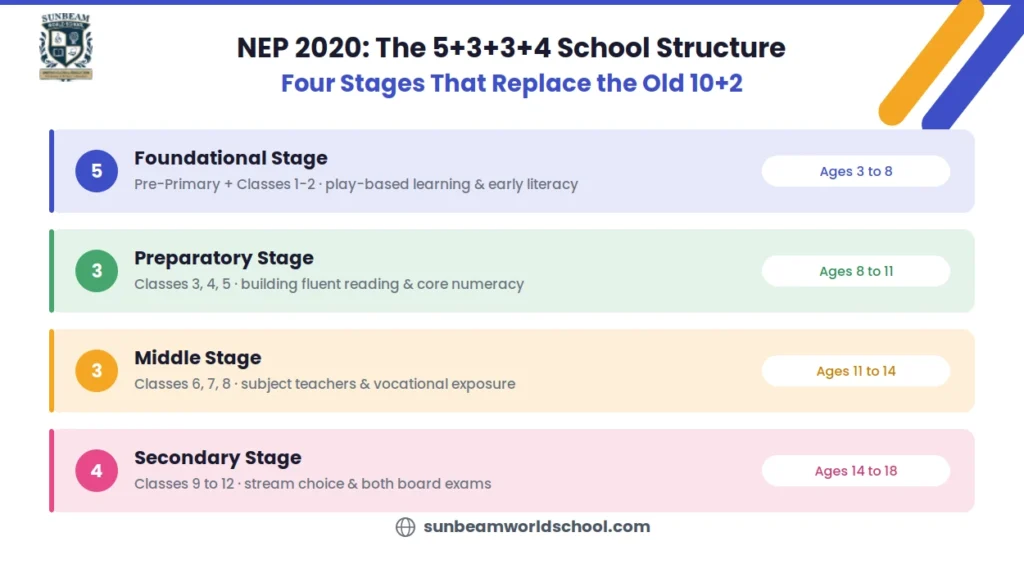
NEP 2020 replaces the older 10+2 school structure with a 5+3+3+4 model, folds early childhood into the school system, mandates vocational education from Class 6, and introduces flexible four-year undergraduate degrees. The shift is from rigid stages and rote learning to a continuous, competency-based system.
|
NEP 2020 stage |
Duration |
Classes covered |
Ages |
|
Foundational Stage |
5 years |
Pre-Primary (3 years) + Classes 1-2 |
3 to 8 |
|
Preparatory Stage |
3 years |
Classes 3, 4, 5 |
8 to 11 |
|
Middle Stage |
3 years |
Classes 6, 7, 8 |
11 to 14 |
|
Secondary Stage |
4 years |
Classes 9, 10, 11, 12 |
14 to 18 |
Its four biggest reforms: the NIPUN Bharat mission for Foundational Literacy and Numeracy by Class 3; choice-based learning across the old streams from Class 11; vocational education from Class 6 with at least ten days of bagless internship a year; and multiple-entry, multiple-exit undergraduate degrees. The full policy is on the Ministry of Education website.
The Right to Education Act
The Right of Children to Free and Compulsory Education Act, 2009, guarantees free and compulsory education for every child aged 6 to 14, covering Classes 1 to 8, and requires private schools to reserve 25 per cent of entry-level seats for children from economically weaker and disadvantaged sections. RTE is the legal boundary of compulsory schooling: pre-primary and the years above Class 8 currently sit outside it, though NEP 2020 recommends extending coverage to ages 3 to 18. Full text on the Department of School Education & Literacy portal. Formal schooling itself now starts earlier: at age 3 with Nursery under NEP 2020, while compulsory schooling begins at age 6 with Class 1.
How Indian classes map to US grades and UK years
Indian classes align with US grades and UK years by age, and all three map onto UNESCO's ISCED framework. A Class 5 student in India is the same age as a Grade 5 student in the US and a Year 6 student in the UK, and all three sit at ISCED level 1.
|
Indian level |
Ages |
US equivalent |
UK equivalent |
ISCED |
|
Pre-Primary (Nursery, LKG, UKG) |
3 to 6 |
Pre-K, Kindergarten |
Reception (age 4-5) |
ISCED 0 |
|
Primary (Classes 1 to 5) |
6 to 11 |
Elementary (Grades 1 to 5) |
Primary (Years 1 to 6) |
ISCED 1 |
|
Middle (Classes 6 to 8) |
11 to 14 |
Middle School (Grades 6 to 8) |
Secondary (Years 7 to 9) |
ISCED 2 |
|
Secondary (Classes 9 to 10) |
14 to 16 |
High School (Grades 9 to 10) |
GCSE (Years 10 to 11) |
ISCED 2-3 |
|
Senior Secondary (Classes 11 to 12) |
16 to 18 |
High School (Grades 11 to 12) |
A-Levels (Years 12 to 13) |
ISCED 3 |
|
Undergraduate |
18+ |
Bachelor's degree |
Bachelor's degree |
ISCED 6 |
|
Postgraduate |
21+ |
Master's degree |
Master's degree |
ISCED 7 |
|
Doctoral |
23+ |
PhD |
PhD |
ISCED 8 |
The full international framework is UNESCO's International Standard Classification of Education (ISCED).
What the Evidence Says About Each Level
Three findings recur across studies of Indian education: a foundational literacy gap in primary school, high dropout at secondary transitions, and an employability gap in higher education. Knowing where each level tends to break down is what turns this ladder from trivia into a decision-making tool.
- The foundational literacy gap. ASER surveys have repeatedly shown that a substantial share of Class 5 children cannot fluently read a Class 2-level text or perform basic arithmetic, and the gap widens through middle and secondary school because every later subject assumes fluent reading. This is why NIPUN Bharat exists, and why Classes 1-3 matter more than any board exam.
- Dropout at transitions. Enrolment at primary level is near-universal, but dropout rises noticeably at the Class 8-9 transition and again after Class 10, particularly among girls in some states. The years around Class 9 are where family support has to become deliberate rather than automatic.
- The employability gap. India Skills Report and AISHE data consistently show a large share of graduates are not considered employable without additional training, the finding behind NEP 2020's push for internships, vocational learning, and flexible degrees, and a reminder to weight practical skills at least as heavily as the degree itself.
So which level is most important? The foundational stage, by evidence. A child who leaves Class 3 reading fluently and enjoying school does better at every later stage; those who fall behind rarely fully catch up. Watch Class 3 as carefully as you watch Class 12.
A Parent's Guide to Every Transition
A child is ready for the next level when they can reliably do the core skills of the current level and can handle the emotional shift of a new environment. Age and class alone are not enough. The markers that matter at each doorway:
- Ready for Class 1: recognizes letters and numbers, sits through a short focused activity, follows a two-step instruction, and separates from parents comfortably.
- Ready for Class 6: reads a full page fluently, completes homework without hand-holding, and shifts between different subjects and teachers.
- Ready for Class 11: has genuine subject preferences, can talk about strengths, and understands that the stream shapes, but does not decide, the next few years.
- Ready for undergraduate study: manages own time and money, studies independently, and has a working sense of what they want from the next few years.
And for the paperwork: each level ends with a specific qualification, nothing external before Class 10; the Class 10 board certificate at secondary; the Class 12 certificate at senior secondary (the one colleges read); then bachelor's, master's, and PhD. On any form, “highest level of education” means the highest of these you have already completed, with ongoing study noted separately. The standard options on most forms, in ascending order, are:
- Below primary or no formal schooling
- Primary (up to Class 5)
- Middle (Classes 6 to 8)
- Secondary (Class 10 pass)
- Senior Secondary / Higher Secondary (Class 12 pass)
- Diploma or vocational qualification
- Bachelor's degree (Graduate)
- Master's degree (Postgraduate)
- MPhil or PhD (Doctorate)
How Sunbeam World School Covers Every Level Online
Sunbeam World School delivers formal education across every school level, from pre-primary through Class 12, entirely online. As an accredited online school, it teaches students on their choice of Indian, British, or American curriculum, with qualified subject teachers in live classes and certificates from recognised boards, so the qualification carries the same weight as a physical school's.
At foundational levels, sessions are short, playful, and interactive, with a parent alongside for the youngest children and a clear focus on the early literacy and numeracy that NEP 2020 places at the center of this stage. From middle school onwards, live subject classes in small batches, structured homework, and continuous assessment mirror the rhythm of a good in-person school, with dedicated preparation for the Class 10 and Class 12 board exams. Senior secondary students receive one-on-one stream counseling matched to their demonstrated strengths, not just to what sounds impressive.
The model is built so that no level is watered down online. Classes stay small enough for teachers to know every child by name and pace, every live lesson is recorded for same-day revision, and an AI-powered learning approach tracks progress so gaps are caught early rather than at exam time. Trained special educators and inclusive one-on-one support keep the same ladder open to children with additional needs, and morning, afternoon, and evening batch timings let families in any time zone keep their child at the right level without disruption.
The easiest way to see any specific level in practice is to book a free demo class for your child's current stage.
Conclusion
The different levels of education frameworks may use different names, but they all describe the same learning journey, from early childhood to higher education. What matters most is completing each stage through a recognized, accredited pathway so the qualifications are accepted by universities and employers.
Today, that pathway can be online as well. An accredited online school follows the same curriculum, boards, and certification standards as traditional schools, allowing students to complete every school level from home.
If you're exploring the right learning path for your child, book a free demo class to experience an online classroom and learn how each stage supports your child's academic growth.

Frequently Asked Questions
How many levels of education are there in India?
-India traditionally recognises five broad levels of education: pre-primary, primary, secondary, senior secondary, and higher education, and middle school (Classes 6 to 8) is sometimes counted as a separate sixth level. Under NEP 2020, the school years are regrouped into four stages using the 5+3+3+4 structure, while internationally the same ladder is condensed into three core stages of primary, secondary, and tertiary education. The number therefore depends on the framework being used, but the underlying progression of classes and ages remains the same.
What are the 4 stages of school under NEP 2020?
+At what age does formal education start in India?
+What does the Right to Education Act cover?
+What are the levels of higher education?
+What is the hierarchy of degrees, from lowest to highest?
+What does “education level” mean on a form?
+What is the difference between elementary and primary school?
+Is Class 12 secondary or senior secondary education?
+What are the 4 levels of education?
+Where does a diploma fit in the levels of education?
+How do Indian classes map to US grades and UK years?
+
In this article
Share this post:


Press and Blogs
Stay updated with our press releases, educational blogs, and more.
Quick Summary Sympathy means feeling sorry for someone from your own point of view. Empathy...

Quick Summary Student success motivational quotes are short, memorable lines that can help students stay...
Quick Summary The area of a square is the total space enclosed within its four...