

 Online School
Can My Child Return to a Regular School After Online School? TC, Marksheets and the Full Process
The question our admissions team hears more than any other is not about fees, timetables or curriculum. It is this: if we choose online school now, will my child ever be able to go back to a regular brick and mortar school later?
Yes. Your child can move from an online school back into a traditional school. Recognized online schools issue the same Transfer Certificate and marksheets that conventional schools admit against, and an NIOS or BOSSE Class 10 certificate opens Class 11 anywhere. The process is documentation, not permission.
That answer deserves more weight than it usually gets, because of what the fear does to the decision underneath it. Parents who believe online school is a one way door end up choosing from fear: they stay in a school that is wrong for the child, or they rule out a format that fits the child's goal, all to protect an option they already had.
The door opens in both directions, whether you want to shift from a regular school to an online school or vice versa. A child can study online for the years it serves them, a posting abroad, a training year in sport or music, a health recovery, a city with no good school nearby, and walk back into a classroom afterwards with documents any school accepts. That means you can choose the format that matches your child's ambition rather than the one that feels safest to reverse.
What decides how smoothly the return goes is not the online format at all. It comes down to three things: whether the school is registered with a recognized board, which class your child is entering, and how early you start the paperwork. This guide covers all three, with the rules that actually apply.
Can You Transfer from an Online School Back to a Regular School?
You can transfer from an online school back to a regular school through exactly the same mechanism any child in India uses when changing schools: documents issued by a recognized institution, verified by the admitting school. There is no separate rulebook for children who studied online, and no board treats the online mode as a disqualification.
The one condition that matters is recognition. A school registered with a recognized board issues documents that other schools accept; a school that cannot name its board registration puts your child's next admission at risk. This is the same test we set out in our guide to whether online school is valid in India, and it is worth applying before you enrol anywhere, not after.
What Documents Does Your Child Need to Rejoin a Traditional School?
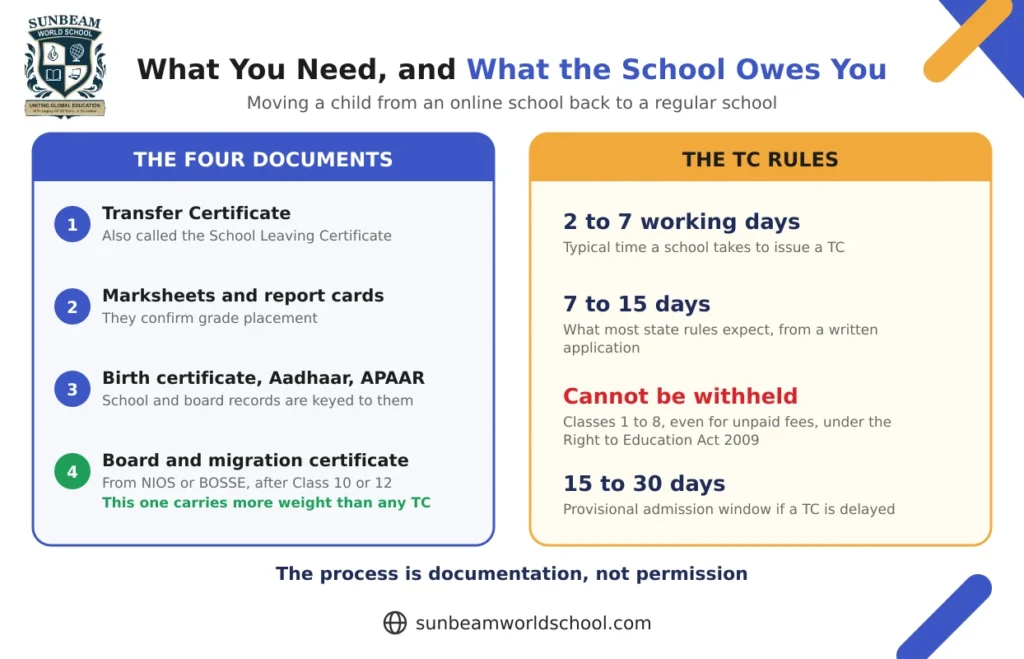
Understand the documents and Transfer Certificate (TC) rules required for a smooth transition from online school to a regular school.
Your child needs four documents to rejoin a traditional school, and a recognized online school issues or facilitates all of them.
- Transfer Certificate, also called the School Leaving Certificate. The two names describe the same document and are used interchangeably across Indian states (India Docs Portal, May 2026). It records the class studied, the leaving date and conduct.
- Marksheets or report cards for the completed grades, showing promotion to the next class.
- Birth certificate, plus Aadhaar and any APAAR ID, which most schools now ask for because state and national education databases are keyed to them.
- For students who finished Class 10 or Class 12: the board certificate and migration certificate issued by NIOS or BOSSE. NIOS students request or download the migration and transfer document through the NIOS Student Portal (nios.ac.in). These are board documents rather than school documents, and they carry more weight than any TC.
At Sunbeam World School, an accredited online school teaching Nursery to Grade 12 across India, the Transfer Certificate and complete marksheets are issued on written request, while the board certificate and migration certificate come from NIOS or BOSSE directly to the student.
Digital records now sit alongside the paper. Apaar IDs and DigiLocker hold school and board records, and boards publish their own TC templates, but admission offices across the country still ask for a signed Transfer Certificate at the counter (EdPayU, 10 April 2026).
What Do the CBSE Admission Bylaws Say About Transfers?
The CBSE admission bylaws say that a student is admitted against a Transfer Certificate from the previous recognized school, and they set the conditions for transfer and migration between schools and boards (CBSE Examination Bylaws, Admission of Students to a School, cbse.gov.in). Three points from that framework decide most real cases.
- Countersignature applies when boards or states differ. A TC from a school under a different board or state system is verified by the appropriate education authority, typically at district level, before the admitting school completes admission (TeacherGyan, August 2024). It is a verification step, not a refusal, and it needs two to four weeks of runway.
- Board year entry is restricted. Direct admission into Class 10 or Class 12 partway through a board cycle is limited to the narrow situations the bylaws set out, with prescribed documentation. This restriction applies to every board change in India, not to online schooling specifically.
- Placement assessment is normal. Schools may test a transferring student to confirm the right class placement. Treat it as routine practice rather than as a judgement on where your child studied.
Which Class Is the Easiest Entry Point for a School Transfer?
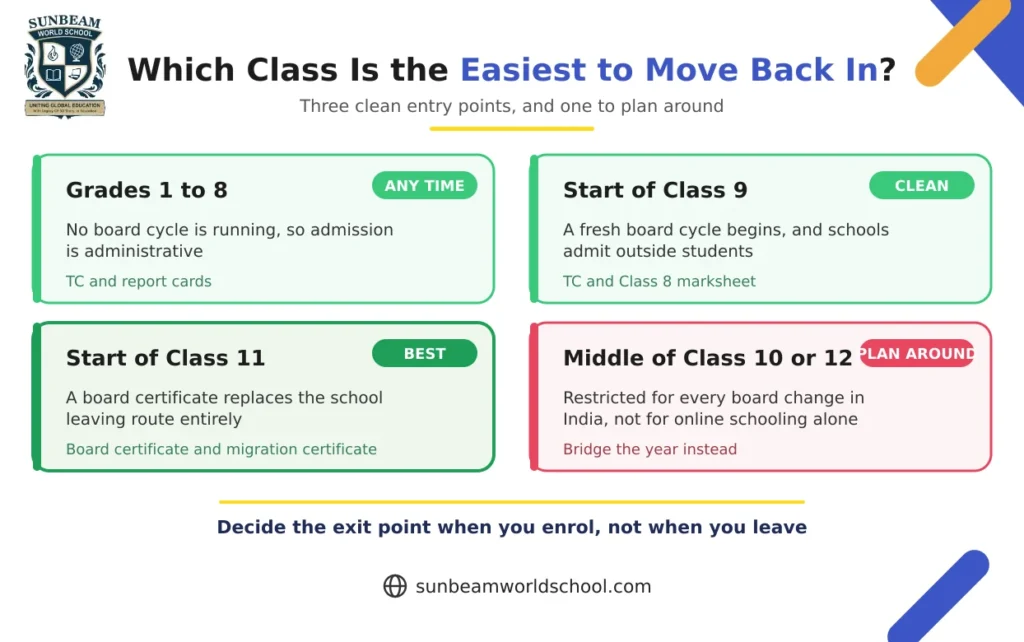
classes that are the easiest to move from online school back to a regular school
The easiest entry points for a school transfer are Class 9, Class 11 and any grade from 1 to 8, because none of them sits inside a running board cycle. The table below is the whole timing decision in one view.
|
Entry point |
Why it works |
Documents that carry it |
|
Grades 1 to 8 |
No board cycle involved, so admission is administrative and a placement test is the most a school will ask |
TC and report cards |
|
Start of Class 9 |
A fresh board cycle begins, and schools admit outside students against a TC |
TC and Class 8 marksheet |
|
Start of Class 11, after Class 10 boards |
The smoothest door of all, because a board certificate replaces the school leaving route entirely |
NIOS or BOSSE Class 10 certificate and migration certificate |
|
Middle of Class 10 or Class 12 |
Restricted for every board change in India, so plan around it rather than into it |
Not advisable; bridge the year instead |
The Class 11 route deserves a note, because it surprises parents. A Class 10 certificate from NIOS or BOSSE is a full board credential, so your child applies to a CBSE, ICSE or state board school for Class 11 holding the same category of document a CBSE student holds, and the countersignature question does not arise at all. Families planning a return often time the whole move around this single fact.
How Long Does a Transfer Certificate Take, and Can a School Refuse It?
A Transfer Certificate usually takes about two to seven working days in practice, and most state rules require schools to issue it within roughly seven to fifteen days of a written application (TeacherGyan, August 2024; EdPayU, 10 April 2026). Apply two to four weeks before you need it, since admission timelines rarely forgive a late document (CitizenNest, 27 May 2026).
On refusal, the law is firmer than most parents realise. Under the Right to Education Act 2009, schools cannot withhold a Transfer Certificate for children in Classes 1 to 8, including for unpaid fees, and refusing one can invite action from the State Commission for Protection of Child Rights (EdPayU, 10 April 2026). For Classes 9 to 12, schools may record pending dues but are still expected to issue the document within a reasonable time.
If a TC is genuinely delayed, admitting schools commonly grant provisional admission with a window of about fifteen to thirty days to produce it (India Docs Portal, May 2026). Two practical habits prevent almost every problem here: check every detail on the TC before you accept it, since a spelling or date error resurfaces years later, and keep scanned copies alongside the original.
At Sunbeam World School, the Transfer Certificate and complete marksheets are issued on written request and our admissions team tells families upfront what the next school will ask for. A school confident in its documentation says this before you enrol, not when you leave.
Will a Regular School Reject My Child for Studying Online?
A regular school will not reject your child for studying online, provided the online school is registered with a recognized board. Schools admit against documents and board records, and the mode of study is not a criterion in the bylaws. What can genuinely block a transfer is different: applying midway through a board year, arriving with documents from an unregistered school, or simply finding no seats left.
For the elementary years the law goes further than reassurance. The Right to Education Act 2009 provides for admission to a class appropriate to the child's age and bars screening procedures at the elementary stage, which covers Grades 1 to 8. A school may assess your child to place them well and to plan support, but that assessment is not a gate it can use to refuse the seat.
Seats are the underrated risk. Sought-after schools in metros run waitlists and fill their sessions early, which has nothing to do with online schooling and everything to do with timing your application to the April session. Families returning from abroad face this most sharply, and our guide to switching schools mid year covers how to plan around it.
How to Move from Online School to a Traditional School: Step by Step
Moving from an online school to a traditional school takes five steps, and starting them three months early removes almost all the friction.
- Ask the admitting school, in writing, which documents it needs from a student coming from a recognized open schooling board, and whether countersignature applies in your state.
- Apply to your online school for the Transfer Certificate and marksheets, with the leaving date stated clearly.
- Complete countersignature if required, using the authority the admitting school names.
- Sit the placement assessment and complete admission through the school's normal process.
- If your child has finished Class 10, skip the TC route: apply for Class 11 with the NIOS or BOSSE certificate and migration certificate instead.
One planning note is worth more than the rest: decide the exit point when you enrol, not when you leave. Families who choose online schooling for a defined period, a posting abroad, a training year, a health recovery, and aim the return at Class 9 or Class 11, describe the move back as paperwork. Families who improvise it in February describe it as a crisis.
What Should You Ask an Online School Before You Enrol?
Ask an online school the exit questions before you enroll, not when you leave. Every difficulty in this article traces back to a decision made at admission time, and the four questions below take one email to answer. A school that answers them plainly has told you how the last day will go.
- Which board will my child be registered with, and what is the registration code? Verify it on the board's own listing (nios.ac.in). Documents from an unregistered school are the one thing that genuinely blocks a transfer.
- Can I see a sample Transfer Certificate? A school that cannot show you the exit document should not be trusted with the entry.
- How many working days does the TC take after a written request?
- If we leave after Class 10, what exactly will my child hold? The right answer names the board certificate and migration certificate, not a school document.
Sunbeam World School publishes its board pathways and accreditations for this reason: the next school will check them, and so should you. Students on our CBSE aligned curriculum certify through NIOS Class 10 and NIOS Class 12, so a child who leaves us at Class 11 leaves holding a recognized board's certificate rather than only ours.

Frequently Asked Questions
Will my child's certificate show that they studied online?
-Your child's certificate will not show that they studied online. The Class 10 and Class 12 certificate is issued by the board that examined them, NIOS or BOSSE, and it records the board, the subjects and the marks. It does not record where the teaching happened or label the mode of study. Schools, universities and employers therefore read it as what it is, a recognized board certificate, and verify it through the board's records and DigiLocker like any other.
Can a regular school legally refuse admission to a child coming from an online school?
+Can my child transfer from one online school to another?
+Can a student transfer from an online school to a regular school in India?
+Do online schools issue a Transfer Certificate?
+How long does it take to get a Transfer Certificate?
+Can a school refuse to give a Transfer Certificate?
+Which class is the best one to switch back to a regular school?
+How do online school credits transfer to public schools?
+
In this article
Share this post:


Press and Blogs
Stay updated with our press releases, educational blogs, and more.
Quick Summary You become a straight A student, and a genuinely good student, by studying...
Quick Summary: The main difference in has vs. have is the subject. Has is used...
Quick Answer A dummy school provides enrolment mainly for board exam purposes without requiring regular daily...