
 Online School
How Much Screen Time Does Online School Really Involve?
Every admissions call starts the same way. Before the fees, before the board, before the timetable, parents ask us one question: how many hours will my child sit in front of a screen, and what is it going to do to them?
Here is our answer. Online school runs about 1.5 to 3 hours of live class a day, depending on the grade. The rest of the learning, assignments, reading, practice and projects, happens off screen. India's own guidelines set that ceiling, and schools that run five or six hours of live class have ignored it.
That number raises the better question, and it is the one we spend most of the call on: whether 1.5 to 3 hours is enough for a child to actually learn. It is, and the reason is worth understanding before you compare a single school. Below we answer that, then the health evidence, the eyes, and what to check before you enrol anywhere.
How Many Hours Is a Child on a Screen in an Online School?
A child in an online school spends about 1.5 to 3 hours a day on a screen, depending on the grade. Classes 1 to 8 should have no more than two live sessions of 30 to 45 minutes. Classes 9 to 12 should have no more than four. Pre-primary is 30 minutes. Those are India's limits, set by the Ministry of Education with NCERT in the PRAGYATA guidelines of 14 July 2020 (education.gov.in).
|
Grade |
Recommended live online teaching |
Roughly |
|
Pre-primary |
Not more than 30 minutes a day |
0.5 hours |
|
Classes 1 to 8 |
Not more than two sessions of 30 to 45 minutes |
Up to 1.5 hours |
|
Classes 9 to 12 |
A maximum of four sessions of 30 to 45 minutes |
Up to 3 hours |
Is 1.5 to 3 Hours Enough for a Child to Learn?
Yes, because a six hour school day was never six hours of teaching. Subtract assembly, attendance, moving between periods, settling forty children down, discipline, distribution of worksheets and the wait while the teacher answers one child at the back, and the instruction left inside a conventional day is a fraction of its length.
A small live batch removes most of that overhead. When a teacher is working with twenty children rather than forty, and an assistant teacher handles doubts separately, the minutes are teaching minutes. This is the entire argument for the shorter block, and it only holds if the school actually teaches live.
The condition matters more than the number. A school that streams recorded lectures and calls it class has not compressed anything, it has simply moved a textbook onto a screen. Ask any student who sat through the pandemic version. The complaint was never the medium. It was staring at a screen for hours to copy notes that could have been a page in a book.
So the question to put to a school is not only how many hours, but what happens inside them. Live teaching with a teacher who knows your child's name is a different product from a video library with attendance.
Is Educational Screen Time Harmful?
Educational screen time is not harmful in itself. It counts toward the daily total that pediatricians cap at no screens below age two, one supervised hour for ages two to five, and under two hours a day for ages five to ten (Indian Academy of Pediatrics, Indian Pediatrics 2022;59:235-244). Any school that tells you class hours do not count is being careless.
Read those numbers correctly. The IAP's concern is what screens displace: sleep, physical activity, meals and family time. It also found that excessive screen use is already common among Indian children, above one to two hours a day, before any online school is involved. The school block is fixed; the recreational hours are where a family actually controls the total.
Guidance elsewhere points the same way, and the comparison is useful if you are reading this from outside India.
|
Country or body |
What it recommends |
Applies to |
|
India: PRAGYATA, 2020 |
Up to two live sessions for Classes 1 to 8, four for Classes 9 to 12 |
Live online class duration |
|
India: IAP, 2022 |
None under 2. One supervised hour for ages 2 to 5. Under two hours for ages 5 to 10 |
Total screen exposure |
|
WHO, 2019 |
Under 5s: no more than one hour of sedentary screen time, less is better |
Children under five |
|
United States: AAP |
No screens under 18 months except video chat. One hour of co-viewed content for ages 2 to 5 |
Recreational media |
|
United Kingdom: RCPCH, 2019 |
No fixed limit. Judge by whether screens displace sleep, activity and family time |
All ages |
|
Canada and Australia |
No more than two hours a day of recreational screen time for ages 5 to 17 |
Recreational screen time |
Will Online School Damage My Child's Eyes?
Online school does not damage a child's eyes when the day is broken up, but digital eye strain is real and has a simple mechanism. Children blink far less while staring at a screen, blinking is what keeps eyes wet, so eyes turn dry and sore and vision blurs. Long focus at close range without breaks tires the focusing muscles, which produces the headaches (AAPOS, updated February 2025).
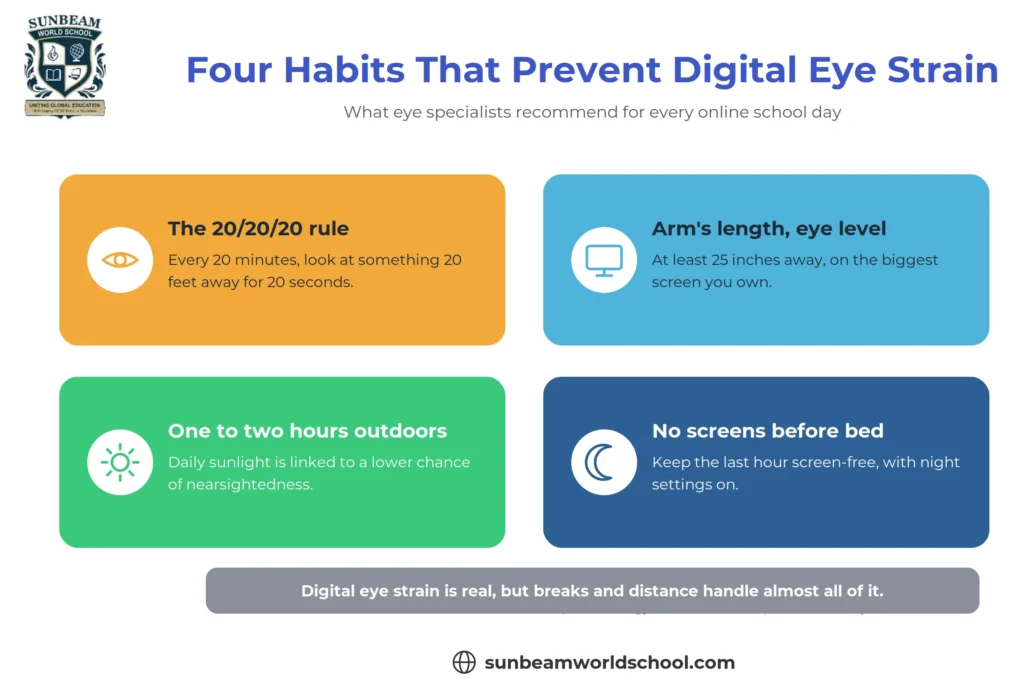
Four expert-recommended habits to reduce digital eye strain and support healthy screen use during online school.
Four habits handle almost all of it, and they cost nothing.
- The 20/20/20 rule: every 20 minutes, look at something about 20 feet away for 20 seconds. AAPOS reports these breaks reduce eye strain and blurry vision.
- Screen at arm's length, at least 25 inches away, at eye level, on the biggest screen you own. A laptop beats a tablet, and both beat a phone.
- One to two hours outdoors daily. AAPOS notes research links sunlight with a lower chance of becoming nearsighted, which makes the hour the missing commute returns the best eye care available.
- No screens in the hour before bed, with night settings on in the evening.
See a pediatric eye doctor if your child has eye pain, headaches, blurry vision, double vision or eye strain after class. These symptoms appear in classroom children too, and an eye test tells you whether something else, such as a need for glasses, is behind them.
What Should Be the Screen Time for a Five-Year-Old?
A five year old should be on a screen for about 30 minutes of live class a day, and under two hours in total once entertainment is counted. PRAGYATA sets 30 minutes at pre-primary; the IAP caps ages five to ten at under two hours a day overall. A school running four hours of live class for Grade 1 sits far outside both, whatever it calls the time. This is where good and bad online schools separate most visibly.
A defensible early years day looks different from a senior one. The live block is short, the screen is a window to a teacher rather than a babysitter, and most of the learning happens off screen with a learning kit, a workbook and an adult within reach. Pediatric guidance asks for early years screen use to be supervised and co-viewed rather than solitary, which is why a parent nearby is a feature of the design rather than a burden of it.
Ask early years hours as a separate question. A school that quotes one number for Nursery to Grade 12 has not thought about five year olds at all.
How Does a Well-Designed Online School Keep Screen Time Down?
A well-designed online school keeps screen time down by teaching live instead of streaming video, keeping sessions short and grade-wise, setting homework off-screen, and building an off-screen day into the week. The IAP guidelines ask schools, not only families, to hold a screen policy, and these are what one looks like in practice.
Sunbeam World School is the worked example below because each of these is checkable on our site, not because the list is unique to us. Hold every school to the same six.
- Live teaching, not a video library. Sunbeam's own answer is blunt: it is not a video-based learning platform. Teachers take the live class and assistant teachers run separate doubt sessions, which is what makes short hours sufficient.
- Grade wise timings rather than one block for everyone. Different grades have classes at different times, with morning, afternoon and evening slots families choose from, published on the school timings page.
- An off screen day inside the week. Saturdays run as Bagless Learning, which is the clearest signal a school can give that it is counting screens rather than filling them.
- Physical materials for the off screen half. A learning kit puts hands on paper and objects for the work that does not need a screen.
- Recordings positioned as revision. Missed a class or want one more explanation? The recording sits on the learning platform for that. A school that expects recordings to be watched daily has quietly doubled the screen day.
- Movement and art inside the timetable. Yoga, dance, theatre, music and craft sessions are the part of a school week that pulls a child off the chair, and they belong on the timetable rather than in the brochure.
One more design choice matters for peace of mind rather than eyes. Cameras stay on in class, so children are supervised by a teacher throughout, and an adult is needed alongside the child only in pre-primary. Most children in Class 1 and above manage the day independently.
What Can Parents Do at Home?
Parents cut the total by setting a separate limit on entertainment screens, keeping meals and bedrooms screen free, and booking the outdoor hour before the evening disappears. The school block is fixed. The rest of the day is where the number is actually decided, and six habits do most of the work.
- Set the recreational limit separately from school. School hours are fixed; entertainment hours, including gaming, are the ones you can shape.
- Keep meals and bedrooms screen free, which protects the two things the guidance cares about most: family time and sleep.
- Put the study device on a table in a shared, well lit room. The setup we recommend takes ten minutes to arrange.
- Book the outdoor hour before the evening disappears, using the time the commute used to take. School clubs and activities fill part of the week and neighbourhood sport fills the rest.
- Treat recordings as revision, not routine, so the day is not watched twice.
- Model it. A house where adults scroll through dinner cannot enforce a screen rule, and children read the gap immediately.
How to Compare Two Online Schools on Screen Time
Compare two schools by asking both for the grade wise timetable in writing and counting the live minutes against PRAGYATA. Five checks settle it, and all five can be done before an admission call ends.
- Ask both for the grade wise timetable in writing. One will send it. That is already an answer.
- Count live minutes, not periods. Six thirty minute periods is three hours, however it is presented.
- Hold the total against PRAGYATA: up to two sessions for Classes 1 to 8, up to four for Classes 9 to 12.
- Ask what share of homework is off screen, and whether recordings are expected viewing or revision.
- Sit in a free demo class and time it yourself, breaks included. The clock does not market.

Frequently Asked Questions
How many hours of screen time does online school involve?
-Online school involves about 1.5 to 3 hours of live class a day depending on the grade, not a full school day. India's PRAGYATA guidelines recommend no more than two sessions of 30 to 45 minutes for Classes 1 to 8, a maximum of four such sessions for Classes 9 to 12, and 30 minutes for pre-primary. Assignments, reading and practice happen off screen, so the live block is the screen time.
Is online school screen time bad for children?
+Will online school damage my child's eyes?
+Does online study count as screen time?
+Is it safe for my child to attend online classes on a mobile phone?
+My child's school runs five or six hours of live online classes. Is that too much?
+Is 1.5 to 3 hours of class enough for a child to learn?
+
In this article
Share this post:


Press and Blogs
Stay updated with our press releases, educational blogs, and more.

Quick Summary You become a straight A student, and a genuinely good student, by studying...

Quick Summary: The main difference in has vs. have is the subject. Has is used...

Quick Answer A dummy school provides enrolment mainly for board exam purposes without requiring regular daily...