
 CBSE
CBSE
Major and Minor Subjects in CBSE Class 12: Complete Subject Guide 2026
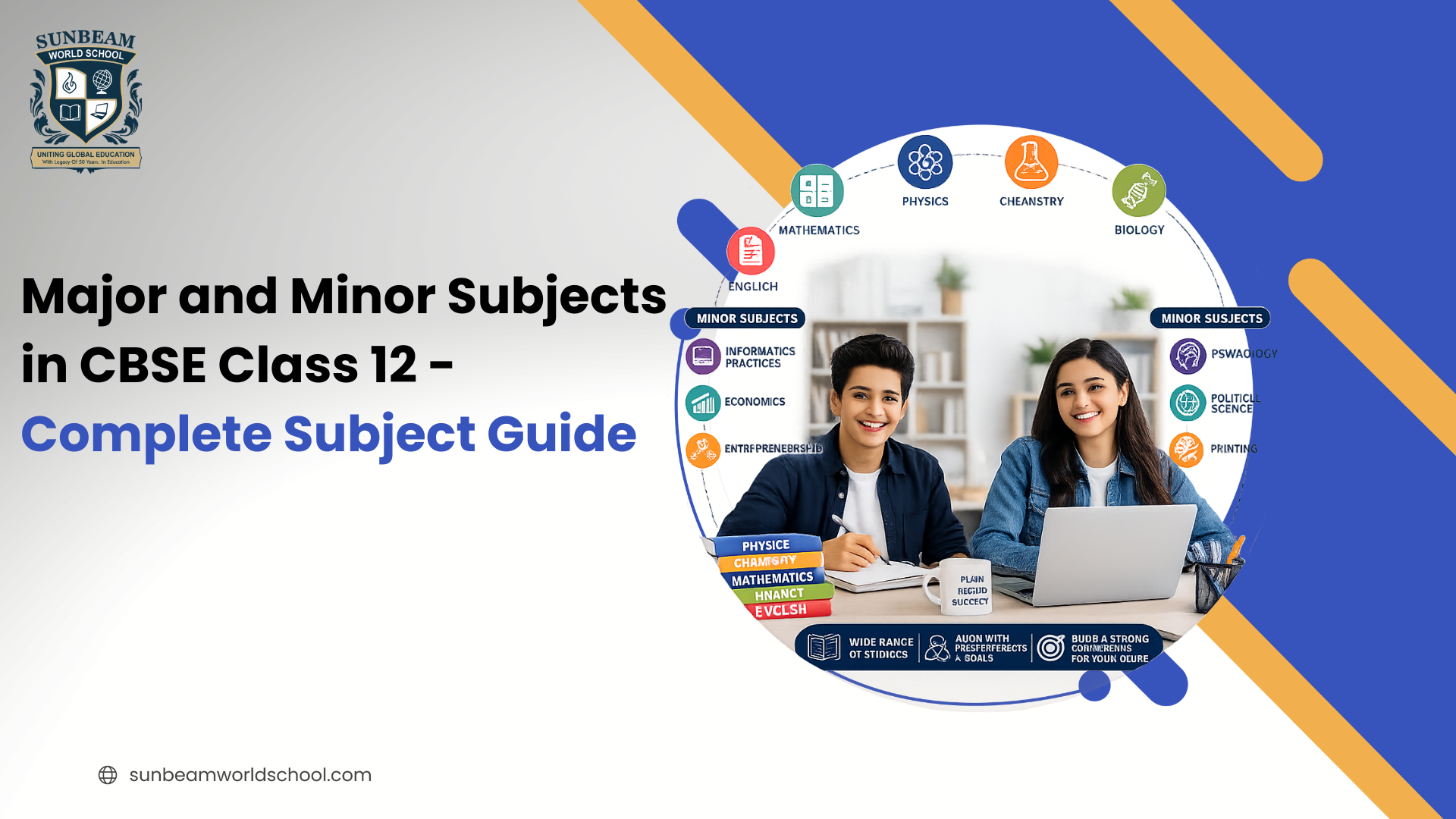
| Major subjects in CBSE Class 12 are the core stream-defining subjects such as Physics, Chemistry, Mathematics, Accountancy, History, or Economics. These subjects are compulsory for a student's chosen stream and play a major role in college admissions, competitive exams, and overall academic eligibility.
Minor subjects are optional or skill-based subjects that students choose alongside their major subjects. Examples include Physical Education, Computer Science, Entrepreneurship, Artificial Intelligence, Music, and Psychology. Minor subjects can improve overall percentage under the Best of 5 rule and help students build additional skills or explore career interests. In CBSE Class 12, students must generally take at least 5 subjects, including compulsory language subjects like English or Hindi. Many students also choose a 6th subject strategically to improve aggregate marks for university admissions. The best subject combination depends on career goals:
Students should choose subjects based on interests, strengths, college eligibility criteria, and long-term career plans rather than peer pressure or perceived difficulty. |
Choosing subjects in CBSE Class 12 can feel confusing, stressful, and honestly, a little intimidating. One moment, you're hearing about PCM, PCB, Commerce with Maths, or Humanities combinations, and the next, everyone seems to have an opinion about what you “should” take.
But here’s the truth: subject selection is not just about marks or trends. It’s about choosing a path that matches your interests, strengths, and future goals.
Your Class 12 subjects can influence college admissions, competitive exam eligibility, career opportunities, and even how enjoyable your next two years of school feel. That’s why understanding the difference between major and minor subjects is so important.
In this guide, we’ll break everything down in a simple and practical way, from CBSE subject rules and stream-wise options to career-focused combinations, the Best of 5 rule, and common mistakes students should avoid. Whether you’re a student or a parent, this guide will help you make informed and confident decisions for Class 12.
| CBSE (Central Board of Secondary Education) is India's largest national school board. Class 12 (Senior Secondary) results determine admissions to India's top colleges and universities, making subject selection directly consequential for your future. |
What Are The Major Subjects In Cbse Class 12?
Major subjects are the core, compulsory academic subjects that define your chosen stream — Science, Commerce, or Arts/Humanities. They are the pillars of your Class 12 curriculum and carry the highest weightage in your marksheet.
Think of major subjects as the subjects you must study to be counted in your stream. Colleges look at these subjects first when evaluating admissions. Your aggregate percentage, stream eligibility, and even scholarship criteria are largely determined by how you perform in your major subjects.
Key Characteristics of Major Subjects
- Compulsory for students of a given stream
- Higher marks weightage in the CBSE marksheet
- Directly linked to college admission requirements
- Include both theory and practical components (especially in Science)
- Form the basis of competitive exams like JEE, NEET, CA Foundation, CUET
| Important
The term "major" isn't an official CBSE label, CBSE uses "core" and "elective", but it is widely understood among students, parents, and educators to refer to the primary stream-defining subjects. We use it here in that accepted sense. |
What Are Minor Subjects in CBSE Class 12?
Minor subjects are elective, optional, or skill-based subjects that students choose in addition to their major subjects. They are not compulsory for stream classification, but they play a surprisingly powerful role in a student's overall academic outcome.
CBSE conducts formal examinations for minor subjects, and the marks are counted in your final result. This matters for two reasons: a strong score in a minor subject can significantly boost your overall percentage, and a poor score cannot drag it down if you've chosen wisely (thanks to the Best of 5 rule).
Why Minor Subjects Actually Matter More Than Students Realize
- They can raise your aggregate percentage under the "Best of 5" rule
- They open supplementary career doors (e.g., Physical Education for sports management)
- Skill-based minor subjects like Artificial Intelligence or Entrepreneurship are increasingly valued by universities
- Language minors improve communication ability and eligibility for language-based programs
- They allow cross-stream exploration — a Science student can study Economics as a minor
Major vs Minor Subjects in CBSE Class 12: Side-by-Side Comparison
Here's a detailed comparison to help you understand exactly how these two categories differ in CBSE 10+2:
| Parameter | Major Subjects | Minor Subjects |
| Definition | Core, stream-defining subjects | Elective or skill-based add-on subjects |
| Compulsory? | Yes — mandatory for students of a particular stream | No — chosen based on student interest |
| Exam Conducted by CBSE? | Yes | Yes |
| Counted in Marksheet? | Yes (all subjects are included) | Yes (all subjects are included) |
| Weightage in Percentage | Higher importance in overall academic profile | Lower importance or considered in Best of 5 |
| Linked to College Admissions? | Directly linked to eligibility for most courses | Indirectly helps improve aggregate or meet criteria |
| Practical Component | Common, especially in Science subjects | Depends on the subject |
| Can Be Used in Best of 5? | Yes | Yes — often helps improve overall percentage |
| Examples | Physics, Accountancy, History | Physical Education, Entrepreneurship, Music |
| Career Impact | Determines stream and course eligibility | Builds additional skills and broadens career options |
Science Stream: Compulsory Major Subjects
- Physics
- Chemistry
- Mathematics or Biology
- English (compulsory)
- Hindi (optional language)
| PCM vs PCB
PCM (Physics, Chemistry, Mathematics) is the route for engineering, technology, and data science careers. PCB (Physics, Chemistry, Biology) is the standard pathway for medical, pharmacy, and life sciences. Some students opt for PCMB — taking all four — for maximum flexibility, though this adds significant workload. |
Science Stream: Optional Minor Subjects
- Computer Science
- Informatics Practices
- Biotechnology
- Engineering Graphics
- Physical Education
- Fine Arts
- Psychology
- Artificial Intelligence
- Yoga
Which Minor Should Science Students Choose?
Computer Science or Informatics Practices is the most strategic minor for PCM students, it directly complements engineering aspirations and is highly valued by both colleges and employers. Physical Education is often chosen as a "high-scoring" minor to boost aggregate percentage. Psychology is an excellent choice for students interested in behavioral sciences or healthcare.
| Pro Tip:
If you're aiming for IIT/NIT, your JEE score matters far more than your Class 12 minor. But if you're targeting CUET-based university admissions, your aggregate percentage matters enormously — so pick a minor you can score high in. |
Major Subjects in CBSE Class 12 Commerce Stream
Commerce is the go-to stream for students interested in business, finance, markets, and entrepreneurship. It leads to careers in CA, MBA, banking, investment, and management. The major subjects build both quantitative and conceptual foundations.
Commerce Stream: Compulsory Major Subjects
- Accountancy
- Business Studies
- Economics
- English (compulsory)
- Hindi (optional language)
- Commerce Stream: Optional Minor Subjects
- Mathematics
- Applied Mathematics
- Entrepreneurship
- Informatics Practices
- Physical Education
- Legal Studies
- Financial Literacy
- Marketing
| Mathematics vs Applied Mathematics for Commerce Students
Mathematics is essential if you plan to pursue CA, actuarial science, economics (Hons), or any quantitative finance degree. It's challenging but opens significantly more doors. Applied Mathematics is a newer, more practical option — better suited for students who need mathematical reasoning but don't plan to pursue pure maths-intensive careers. It's particularly useful for management and social science programs. |
| Note:
Mathematics and Applied Mathematics cannot be taken together — they are mutually exclusive. Decide based on your career plan, not just difficulty level. |
Major Subjects in CBSE Class 12 Arts/Humanities Stream
Arts and Humanities is arguably the most underrated stream in India — despite being the gateway to careers in law, civil services, journalism, psychology, social work, design, and international relations. It offers the widest variety of subject choices and the most room for intellectual exploration.
Arts/Humanities Stream: Major Subject Options
History
- Political Science
- Geography
- Sociology
- Psychology
- Economics
- English (compulsory)
- Hindi
Arts Stream: Optional Minor Subjects
- Fine Arts
- Music (Vocal/Instrumental)
- Dance
- Physical Education
- Home Science
- Philosophy
- Legal Studies
- Fashion Studies
- Mass Media Studies
| Did You Know?
Many top Arts students take Economics as a major — it bridges Humanities and Commerce and is required for Economics (Hons), public policy, and business programs at premier colleges, including Delhi University and JNU. |
Complete List of Minor Subjects Available in CBSE Class 12
CBSE offers a wide spectrum of minor/elective subjects. Availability depends on your school's infrastructure and affiliation, but here's the comprehensive official list:
- Skill-Based & Vocational Subjects
- Artificial Intelligence
- Information Technology
- Web Applications
- Financial Literacy
- Mass Media Studies
- Marketing
- Tourism
- Agriculture
- Healthcare
- Retail
- Entrepreneurship
- Fashion Studies
- Food Production
- Beauty & Wellness
- Creative & Performing Arts
- Fine Arts (Painting)
- Fine Arts (Sculpture)
- Fine Arts (Applied Arts)
- Music – Vocal
- Music – Instrumental (Melodic)
- Music – Instrumental (Percussion)
- Dance (Bharatanatyam / Kathak etc.)
- Theatre Studies
- Physical & Life Skills
- Physical Education
- Yoga
- Sports (NCC/NSS linked)
- Home Science
- Language Subjects
- Sanskrit
- French
- German
- Spanish
- Japanese
- Urdu
- Tamil / Bengali / Punjabi (regional)
| Availability Note:
Not every school offers every minor subject. Before finalising your choice, confirm with your school's academic office which minors are available and being offered in the coming academic session. |
CBSE Subject Selection Rules Every Class 12 Student Must Know
CBSE's subject selection framework has specific rules that govern how many subjects you can take, which are compulsory, and what combinations are allowed. Violating these rules can affect your result, college eligibility, or even board registration. Here's everything clearly explained:
Minimum 5, Maximum 6–7 Subjects
Every Class 12 student must register for a minimum of 5 subjects. Up to 6 or 7 subjects can be taken depending on the school and stream. The typical split is: 2 languages + 3 stream core subjects + 1 optional/minor subject.
Compulsory Language Requirement
At least one of your two language subjects must be either English or Hindi. You may choose both as your language subjects if you wish. No other language can replace English or Hindi as the mandatory component.
Stream Pattern Must Be Followed
Subject selection in Class 12 must align with the stream you enrolled in during Class 11. If you studied PCM in Class 11, you cannot switch to Commerce core subjects in Class 12 without going through a formal stream change process approved by your school.
Mutually Exclusive Subjects
Certain subject pairs cannot be taken together. Biology and Biotechnology cannot be combined in most schools. Mathematics and Applied Mathematics are also mutually exclusive. Always check the official CBSE curriculum document for the current year's restrictions.
6th Subject Is Optional but Strategic
The 6th subject is not compulsory but is highly recommended. If you score higher in your 6th subject than one of your 5 core subjects, it can replace the lowest scorer under the Best of 5 rule — potentially boosting your percentage significantly.
Subject Change Deadline
CBSE typically allows subject changes within a limited window after registration, usually the first few weeks of Class 11 (which affects Class 12 eligibility). After this window, changes become increasingly difficult and require school and board approval.
Internal Assessment Rules
All subjects — major and minor — have an internal assessment component (typically 20–30 marks) assessed by the school, plus a board examination. Students must complete both components to pass. Missing internal assessments can result in failing the subject.
| Watch Out
Some colleges specify that certain subjects must be studied as "main" subjects (not just as electives) to qualify for their courses. For example, many B.Sc. Physics programs require Physics as a core subject, not just mentioned on the marksheet. Always verify admission criteria for your target colleges before finalizing subjects. |
Best Subject Combinations for CBSE Class 12 Based on Career Goals
Choosing subjects strategically based on your career direction is far smarter than following what your friends choose. Here are the most effective subject combinations, matched to common career goals and entrance exams:
| Career Goal | Recommended Combination | Why It Works |
| Engineering (IIT/NIT) | Physics, Chemistry, Mathematics + Computer Science | PCM is mandatory for JEE, while Computer Science strengthens coding and analytical skills. |
| Medicine (NEET) | Physics, Chemistry, Biology + Physical Education or Psychology | PCB is the standard NEET pathway. PE and Psychology are often high-scoring and complement medical studies. |
| CA / Finance | Accountancy, Business Studies, Economics, Mathematics | Mathematics is highly recommended for CA Foundation and careers in finance or analytics. |
| Law (CLAT/NLSIU) | History, Political Science, Sociology + Legal Studies | Legal Studies provides early exposure to legal concepts and entrance exam preparation. |
| Psychology / Counselling | Psychology, Sociology, English + Home Science or Biology | Biology adds a clinical perspective, while Sociology supports understanding human behavior and society. |
| Journalism / Media | English, History, Political Science + Mass Media Studies | Mass Media Studies is directly aligned with journalism and communication careers. |
| Civil Services (UPSC) | History, Geography, Political Science, Sociology | These subjects overlap strongly with UPSC syllabus and optional subjects in Mains. |
| Data Science / AI | Physics, Chemistry, Mathematics + Computer Science or AI | Mathematics and Computer Science form the foundation for AI, coding, and data analytics careers. |
| Design / Architecture | Mathematics, Physics + Fine Arts or Engineering Graphics | Maths is required for architecture entrance exams, while Fine Arts builds creative aptitude. |
CBSE Best of 5 Rule: How It Works and Why It Matters for Class 12
The "Best of 5" rule is one of the most misunderstood yet most impactful aspects of CBSE Class 12 percentage calculation. Here's the clear explanation:
What Is the Best of 5 Rule?
CBSE officially calculates and reports marks for all subjects on the marksheet. However, most colleges and universities use the "Best of 5" formula when calculating your aggregate percentage for admissions, particularly DU, most state universities, and many private colleges.
Under this rule, colleges take your marks from the 5 subjects in which you scored highest, with the condition that one of those five must be English (or the specified language), and the other four should match the course's subject requirements.
How a 6th Subject Can Boost Your Percentage
This is where the strategy lies. Suppose you take 6 subjects. If your 6th subject score is higher than your lowest-scoring subject among the other five, it replaces that lower score in the "Best of 5" calculation — pushing your aggregate up.
| Example:
Say your 5 core subjects give scores of 85, 78, 72, 80, 76. Your aggregate = (85+78+72+80+76)/5 = 78.2%. Now if your 6th subject (e.g. Physical Education) gives you 91, it replaces the 72. New aggregate = (85+78+91+80+76)/5 = 82%. That's a 3.8% gain — potentially the difference between getting into your preferred college or not. |
| Check Each College's Rule
Not every college calculates Best of 5 identically. Some require specific subjects to be included. IITs, for example, require a minimum of 75% aggregate in Physics, Chemistry, and Mathematics specifically. Always verify the individual college's merit criteria before relying on a Best of 5 calculation. |
Career Paths by Stream: What Your CBSE Class 12 Subjects Lead To
Understanding the career landscape beyond your stream helps you choose subjects with long-term purpose, not just short-term familiarity.
Science → PCM
Engineering · Data Science · Architecture · Pilot Training · Research · Defense · Finance
Science → PCB
MBBS · Dentistry · Pharmacy · Nursing · Biotech · Veterinary · Nutrition
Commerce → With Maths
CA · Actuary · Investment Banking · Economics · Business Analytics
Commerce → Without Maths
BBA · Marketing · HR · Retail Management · Public Relations
Arts → Polity/History
UPSC/IAS · Law · Diplomacy · Journalism · Political Consulting
Arts → Creative
Fashion Design · Fine Arts · Film · Advertising · UX/Product Design
Arts → Psychology/Sociology
Counselling · Social Work · HR · Child Development · Research
Arts → Geography
Urban Planning · Environment Science · GIS · Tourism · Government
How to Choose the Right CBSE Class 12 Subjects: A Step-by-Step Framework
Making this decision shouldn't be done impulsively, by copying a friend, or purely based on perceived difficulty. Here's a structured way to approach it:
- Map your interests first. List the subjects you genuinely enjoy studying, not the ones you think look good. Sustained interest is the biggest predictor of Class 12 performance.
- Research your top 3 career options. Look up what subjects are required for the college courses you're most interested in. Work backward from the destination.
- Check college admission criteria. Before picking, verify what DU, Mumbai University, BITS, or your target institution requires as subject prerequisites.
- Assess your current strengths. Choosing a subject you're already reasonably comfortable with means less anxiety and more room for real learning.
- Pick your minor strategically. Choose a minor that either (a) directly supports your career interest or (b) is a subject in which you can score high, to maximize your aggregate under Best of 5.
- Talk to seniors and counselors. Students who completed Class 12 in your intended stream are invaluable sources of lived perspective. Use them.
- Consider the workload honestly. PCMB (all four sciences) is doable but heavy. Choosing 6 subjects when you're already under pressure can backfire. Be realistic.
- Confirm subject availability at your school. Always verify with your school's academic coordinator which subjects are being offered in the current session before finalizing your list.
Common Mistakes Students Make When Choosing CBSE Class 12 Subjects
These mistakes are made every year by thousands of students, and they're almost entirely avoidable with the right awareness.
1. Choosing Based on Peer Pressure
Following your best friend into PCM when you're genuinely more interested in Economics and History is one of the most common and most regrettable decisions. Two years is a long time to study subjects you dislike.
2. Ignoring Career Implications of Subject Choice
Students who skip Mathematics in Commerce and then want to pursue CA or quantitative finance discover the limitation too late. Research the requirements before registration, not after results.
3. Taking PCMB "Just in Case"
The intention is flexibility. The reality is burnout. Taking all four sciences adds an enormous workload without a clear payoff unless you genuinely need both JEE and NEET options — which almost nobody does.
4. Treating Minor Subjects as Unimportant
Students who don't take a minor seriously miss easy marks and a genuine opportunity to learn something new. A well-chosen, well-studied minor can make a real difference to your final percentage.
5. Not Checking the Best of 5 Calculation for Target Colleges
Assuming all colleges calculate aggregates the same way is a costly mistake. Some universities specify which subjects must be included, which can invalidate a high score in an unrelated minor.
6. Changing Stream Without Proper Guidance
Class 12 subjects should ideally continue what was studied in Class 11. Switching streams mid-stream is possible but rarely advisable without dedicated support — the gaps in foundational knowledge can be significant.
Conclusion
Choosing the right major and minor subjects in CBSE Class 12 is more than an academic decision; it’s the foundation for your future learning, career opportunities, and personal growth. The best subject combination is not necessarily the most popular or the most difficult; it’s the one that aligns with your interests, strengths, and long-term goals.
A well-planned subject selection can open doors to top colleges, competitive exams, and rewarding career paths while also making your Class 11 and 12 journey more balanced and enjoyable. Understanding CBSE rules, college eligibility criteria, and the role of minor subjects can help students make smarter, more confident choices.
At Sunbeam World School, students are guided to explore their strengths, interests, and aspirations before choosing subjects. With a future-focused, student-centric approach to learning, we help learners build strong academic foundations and prepare them for real-world success in higher education and beyond.

Frequently Asked Questions
How many subjects are compulsory in CBSE Class 12?
-In class 12, a minimum of 5 subjects is compulsory in CBSE Class 12. Students can optionally take a 6th (or in some cases 7th) subject. The mandatory 5 typically include 2 languages (one of which must be English or Hindi) and 3 core academic subjects aligned with the chosen stream.
Can I change my minor subject after registration?
+Is Physical Education a major or minor subject in CBSE Class 12?
+What is the "Best of 5" rule in CBSE Class 12?
+Is the 6th subject compulsory in CBSE Class 12?
+Can a Science student take Economics as a subject?
+Which is the toughest subject in CBSE Class 12?
+Can Biology and Biotechnology be taken together in CBSE Class 12?
+Does the minor subject appear on the CBSE Class 12 marksheet?
+What is the difference between Informatics Practices and Computer Science in CBSE Class 12?
+
In this article
Share this post:


Press and Blogs
Stay updated with our press releases, educational blogs, and more.

Quick Summary: The main difference in has vs. have is the subject. Has is used...

Quick Summary A metaphor is a way of describing one thing by calling it something...
Quick Answer CBSE On-Screen Marking (OSM) is a digital evaluation system where scanned copies of answer...