
 Exam
Exam
JEE Main 2026: Complete Guide for School Students and Parents
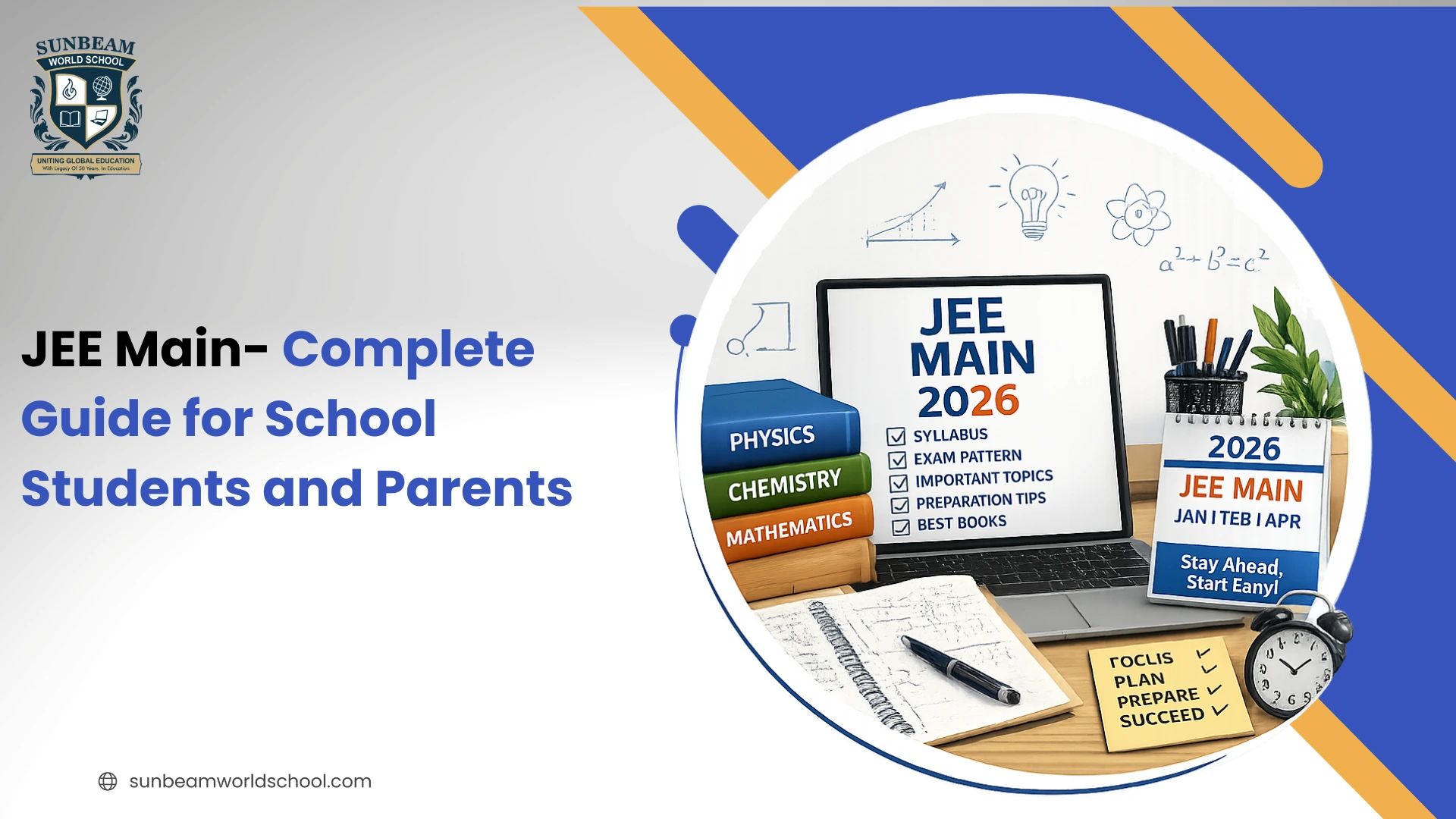
| JEE Main 2026 is India’s national-level engineering entrance exam conducted by the National Testing Agency (NTA) for admission into NITs, IIITs, and other centrally funded institutes, and as a qualifier for JEE Advanced (IITs). It will be held in two sessions (January and April 2026), with the best score considered.
JEE mains Eligibility Criteria: Students must have passed Class 12 in 2024/2025 or be appearing in 2026 with Physics and Mathematics as core subjects. There is no age limit, and candidates can attempt the exam for 3 consecutive years. While no minimum marks are required to appear, at least 75% in Class 12 (65% for SC/ST) is needed for admission into top institutes. The syllabus is based on NCERT Class 11 and 12, and effective preparation requires a long-term strategy from Class 9–12, focusing on concepts, practice, and revision. |
Every year, over 13 lakh students appear for JEE Main, but only a small percentage truly feel prepared when they walk into the exam hall.
Not because they lack intelligence, but because they start too late, follow the wrong strategy, or treat school and JEE preparation as two separate journeys.
If you’re a student wondering when to start, how to manage school with JEE prep, or what actually works, this guide will give you clarity. If you’re a parent trying to understand how to support your child without overwhelming them, this will answer the questions no coaching brochure does.
This is not just another overview of JEE Main 2026. This is a step-by-step school-to-exam roadmap covering eligibility, important dates, syllabus, and a realistic preparation strategy, designed to help students build a strong foundation from Class 9 all the way to exam day.
What Is JEE Main 2026?
JEE Main (Joint Entrance Examination — Main) is India's national-level undergraduate engineering entrance examination, conducted by the National Testing Agency (NTA). It is the primary gateway to:
- NITs (National Institutes of Technology)
- IIITs (Indian Institutes of Information Technology)
- CFTIs (Centrally Funded Technical Institutes)
- Qualifying exam for JEE Advanced → the doorway to IITs
JEE Main 2026 is conducted in two sessions: Session 1 in January and Session 2 in April. Students can appear in both and retain the better percentile score.
JEE Main 2026 Key Dates
| Event | Session 1 | Session 2 |
| Exam Dates | January 21–28, 2026 | April 2–9, 2026 |
| Result Declaration | February 12, 2026 | April 20, 2026 (Expected) |
| Mode | Computer-Based Test (CBT) | Computer-Based Test (CBT) |
Note for parents: JEE Main is not a one-shot exam anymore. Your child gets two attempts each year. The best score counts.
JEE Main Eligibility Criteria
Before preparing, every student must confirm they meet the basic eligibility requirements. Here is what NTA officially specifies for JEE Main 2026:
1. Educational Qualification
Students must have:
- Passed Class 12 (or equivalent) in 2024 or 2025, OR
- Be appearing in Class 12 in 2026
The qualifying exam must include:
- For B.Tech: Physics, Mathematics, and at least one of Chemistry / Biology / Biotechnology / Technical Vocational Subject
- For B.Arch: Physics, Mathematics, and Chemistry
- For B.Plan: Mathematics
2. Age Limit
There is no age limit to appear in JEE Main 2026. Any student who has passed or is appearing in Class 12 can apply, irrespective of their age. However, individual institutes (like NITs) may have their own age requirements.
3. Number of Attempts
Students can attempt JEE Main for a maximum of 3 consecutive years (6 attempts total — 2 per year).
4. Minimum Marks for Admission (Not Just Appearing)
This is a point many students confuse. There is no minimum percentage required to appear in JEE Main. However, for admission into NITs/IIITs/CFTIs, the following criteria apply:
| Category | Minimum Class 12 Percentage Required |
| General / OBC / EWS | 75% aggregate in Class 12 |
| SC / ST | 65% aggregate in Class 12 |
| B.Arch / B.Plan | 50% aggregate |
Important: Scoring well in JEE Main without meeting the 75% board marks threshold means you cannot get admission into NITs even with a good rank. School performance matters directly for JEE admissions.
5. State of Eligibility
Your state of eligibility is determined by the state where your Class 12 board exam is registered. This matters for state quota seats in NITs.
JEE Main 2026 Exam Pattern
Understanding the exam pattern is the first step to smart preparation. Here is the current official pattern:
Paper 1: B.E. / B.Tech (Most Common)
| Feature | Details |
| Mode | Computer-Based Test (CBT) |
| Duration | 3 Hours |
| Total Questions | 90 (attempt 75) |
| Subjects | Physics, Chemistry, Mathematics |
| Questions Per Subject | 30 (20 MCQ + 10 Numerical; attempt 20 MCQ + 5 Numerical) |
| Total Marks | 300 |
| Marking Scheme | +4 (correct), –1 (wrong MCQ), 0 (unanswered / wrong numerical) |
| Medium | English, Hindi + 13 regional languages |
Paper 2A: B.Arch
| Section | Questions | Marks |
| Mathematics | 20 MCQ + 10 Numerical | 100 |
| Aptitude Test | 50 MCQ | 200 |
| Drawing Test (offline) | 2 questions | 100 |
| Total | 77 Questions | 400 Marks |
Paper 2B: B.Planning
| Section | Questions | Marks |
| Mathematics | 20 MCQ + 10 Numerical | 100 |
| Aptitude Test | 50 MCQ | 200 |
| Planning-Based MCQs | 25 MCQs | 100 |
| Total | 105 Questions | 400 Marks |
Understanding the Marking Scheme
The negative marking in JEE Main is a critical factor that separates toppers from average scorers. Every wrong MCQ answer deducts 1 mark. A student who attempts 60 questions accurately will outscore a student who attempts 75 questions carelessly. Accuracy over attempt count is the mindset JEE rewards.
JEE Main 2026 Syllabus at a Glance
The JEE Main 2026 syllabus is based entirely on the NCERT Class 11 and Class 12 curriculum for Physics, Chemistry, and Mathematics. There are no major changes from the 2025 syllabus.
High-Weightage Topics (Focus These First)
Physics:
Modern Physics
Current Electricity & Magnetism
Optics
Laws of Motion & Work-Energy
Rotational Motion
Electromagnetic Induction
Chemistry:
Organic Chemistry (Reactions & Mechanisms)
Coordination Compounds
Chemical Bonding
Thermodynamics & Equilibrium
p-Block & d-Block Elements
Electrochemistry
Mathematics:
Calculus (Differentiation & Integration)
Vectors & 3D Geometry
Matrices & Determinants
Probability
Conic Sections
Sequences & Series
| Key insight: NCERT is non-negotiable for Chemistry — a large portion of questions come directly from NCERT text. For Physics and Mathematics, NCERT builds the foundation but reference books are needed for problem-solving depth. |
JEE Preparation Roadmap: Class 9 to Class 12
This is the section most guides skip. The students who crack JEE Main in their first attempt almost always had a multi-year preparation strategy, not a last-minute rush. Here is what smart preparation looks like at each stage:
Class 9: Building the Foundation (2 Years Before Class 11)
Most students and parents underestimate Class 9. But the concepts introduced here — number systems, basic algebra, mechanics, chemical reactions — are the seeds of JEE topics.
What to do in Class 9
- Master NCERT Science and Mathematics completely. No shortcuts.
- Strengthen mental math and calculation speed — this pays off heavily in JEE's time-pressured environment.
- Start developing a reading habit around concepts, not just procedures. Ask "why does this work?" not just "how do I solve this?"
- Optional but highly valuable: Appear in NTSE, NMMS, or Olympiad competitions. These build analytical thinking that directly helps in JEE.
- Do not join heavy coaching yet. Focus on school performance and conceptual curiosity.
Parent action: Ensure school learning is not becoming rote. Encourage asking questions in class. A strong Class 9 GPA also reduces pressure in Class 10.
Class 10: Strengthening Core Subjects (1 Year Before Class 11)
Class 10 is the last chance to solidify fundamentals before the JEE-relevant syllabus begins in Class 11.
What to do in Class 10:
- Mathematics: Master algebra, trigonometry, coordinate geometry, and statistics, all heavily tested in JEE.
- Science: Go deep in the physics and chemistry sections. Don't rush through them for board marks alone.
- Board exams: A strong Class 10 score opens the door to science stream in Class 11 without pressure, and allows you to choose the right school and stream confidently.
- Start exploring JEE-style problem types. NCERT Exemplar books are excellent for this.
- Appear in NTSE Stage 2 if eligible; cracking it proves JEE-level aptitude.
Parent action: The choice of school for Class 11 and 12 is one of the most consequential academic decisions your family will make. Choose a school that offers strong PCM teaching and an environment that supports JEE preparation, not one that simply offers coaching tie-ups.
Class 11: The Most Critical Year for JEE Preparation
Class 11 is where JEE preparation truly begins. 50% of the JEE Main syllabus comes from Class 11 topics. Most students who struggle in JEE do so because they didn't take Class 11 seriously enough.
What to do in Class 11:
Month-by-month approach:
- April–June (Summer before Class 11): Get NCERT books for Physics, Chemistry, and Mathematics. Read the first two chapters of each. Understand the structure of what's coming.
- July–November: Cover Class 11 syllabus simultaneously with school. Never fall behind school teaching. Use school classes as your primary learning source, not just a checkbox.
- December–March: Revise Class 11 thoroughly. Solve NCERT exercises completely. Begin NCERT Exemplar problems. Start attempting previous year JEE questions from Class 11 topics only.
Study hours (realistic):
- School hours: 6–7 hours (treat every class as JEE preparation)
- Additional self-study: 2–3 hours daily (concept consolidation + problem-solving)
- Weekends: 4–5 hours (revision + mock problems)
Key habits to build in Class 11:
- Maintain a formula and concept notebook — updated weekly.
- Never skip NCERT completely. In Chemistry, it is the exam.
- Attempt JEE Main previous year questions topic-by-topic, not full papers yet.
- Develop error logs — note every mistake and its reason.
Parent action: Resist the urge to measure Class 11 progress only by marks. Understand that Class 11 JEE preparation is about depth of understanding, not speed. A student who truly understands Class 11 Physics will solve Class 12 Physics in half the time.
Class 12: Execution Year: Combine Board Prep with JEE Crunch
Class 12 is about executing what Class 11 built. The pressure peaks here. Students must prepare for board exams (which determine the 75% admission criterion) while simultaneously completing Class 12 JEE topics and reviewing Class 11.
What to do in Class 12:
April–June (Summer before Class 12):
Complete a full self-revision of Class 11 topics. Every chapter. Every formula.
Begin Class 12 chapters: Electrostatics, Chemical Bonding, Integration — start these before school does.
July–November:
Attend every school class with full focus. Class 12 school teaching and JEE teaching overlap significantly.
Begin full-length mock tests once per week from October onwards.
Analyze every mock test. Don't just note the score — understand which topics are losing you marks.
November–December (Pre-Board period):
Balance board prep and JEE. For PCM students, this is manageable because the syllabi overlap at 80%.
Prioritize chapters that appear in both boards and JEE heavily: Electrostatics, Optics, Organic Chemistry, Calculus.
January (JEE Session 1):
Appear in Session 1. Treat it as a real rehearsal. Even if the score is not ideal, the experience is invaluable.
Boards typically follow in February–March. Use this period to peak board performance.
February–March (Boards):
Score 75%+ to ensure NIT admission eligibility. Don't neglect boards while focused on JEE.
April (JEE Session 2):
Armed with Session 1 experience and board preparation, this is the session where most students perform best. JEE is not the end; you can always look for entrance exams that can work for you after class 12.
The Role Your School Plays in JEE Success
Parents often think JEE preparation happens at coaching institutes. The reality is different. The school environment shapes everything: the quality of foundational learning, the study habits formed, the stress management, and the academic discipline that carries students through three years of intense preparation.
What Makes a School JEE-Ready?
- Strong PCM Faculty
School teachers who teach Physics, Chemistry, and Mathematics with conceptual depth — not just board exam focus — give students an enormous head start. When school teaching aligns with JEE thinking, students don't need to "unlearn" anything at coaching.
- NCERT-Anchored but Concept-Driven Teaching
The best JEE preparation starts with NCERT mastery at school. Schools that rush through NCERT for board performance without developing genuine understanding create students who can answer board questions but freeze in front of JEE problems.
- Regular Testing Culture
Schools that conduct regular tests — including multiple-choice, application-based, and numerical problems — develop students who are comfortable with JEE-style questions. Schools that only test for board-style long answers leave students unprepared for CBT-format exams.
- Low Stress, High Performance Environment
JEE preparation is a marathon. Schools that create a high-pressure, rank-obsessed culture often burn students out before Session 1. Schools that build resilience, healthy competition, and self-directed learning produce students who thrive under JEE pressure.
- Support for Time Management
Students managing school, coaching, self-study, and personal life need structured time management support. Schools that provide study halls, library access, counsellors, and flexible academic support help students stay organized without drowning.
- Strong Class 11 and 12 Science Program
This is non-negotiable. The depth and quality of Class 11–12 science teaching directly determines how much additional preparation students need outside school. Schools with excellent PCM programs reduce the dependency on coaching and allow students to use that time for self-directed practice.
How Sunbeam World School Helps Students Prepare for JEE Main
Most schools say they support JEE preparation. Very few build their entire academic environment around making it possible. At Sunbeam World School, the support is not a tagline, it is woven into how we teach, how we test, how we counsel, and how we develop students from Class 9 onwards.
Here is exactly what that looks like in practice.
1. Concept-First Teaching in PCM, From Class 9 Itself
JEE Main is a concept-based exam. It does not reward students who have memorized procedures; it rewards students who understand why those procedures work. That kind of understanding cannot be built in one year at a coaching center. It has to be built over the years, in school, one concept at a time.
At Sunbeam World School, our Physics, Chemistry, and Mathematics faculty are trained to teach the reason behind the rule, not just the rule. A student learning Newton's Laws of Motion in Class 9 at Sunbeam is not just memorizing F = ma. They are understanding force as interaction, visualizing free body diagrams, and building the intuition that will make Class 11 Mechanics feel familiar, not foreign.
This deliberate, concept-first approach across four years means our students enter Class 11 JEE preparation with a foundation that most students are still trying to build.
2. NCERT Mastery as a Non-Negotiable Standard
Across India, the single most common gap between JEE aspirants and JEE qualifiers is NCERT, specifically, whether a student has genuinely mastered it or just "done" it.
At Sunbeam World School, NCERT is not a book students skim before exams. It is the core learning document that teachers teach from, students annotate, and assessments draw from, throughout the academic year. By the time our students reach Class 12, they have covered NCERT Chemistry, Physics, and Mathematics so thoroughly that the "NCERT is enough for boards" advice that other students struggle to implement is already second nature to them.
This directly translates into JEE performance. Chemistry alone draws 20–30% of its questions from NCERT text and examples. Students who have mastered NCERT at school don't need to "revise it for JEE" — they are already there.
3. JEE-Aligned Assessments Throughout the Year
One of the most underappreciated reasons students underperform in JEE Main is unfamiliarity with CBT-format, MCQ-based, numerical-answer-type questions. Most schools test students through board-style long-answer papers. Students arrive at JEE having never practised the actual format they will be tested in.
At Sunbeam World School, our internal assessment calendar includes:
- Regular MCQ-format tests in Physics, Chemistry, and Mathematics — from Class 10 onwards
- Numerical answer-type questions embedded in class assessments and unit tests
- Time-pressured practice sessions that train students to manage the 3-hour JEE format
- Topic-wise JEE Previous Year Question Papers used as supplementary assessment material in Class 11 and 12
By the time a Sunbeam student sits in JEE Session 1, the exam format is not intimidating, it is familiar.
4. Dedicated Science and Mathematics Lab Infrastructure
Understanding conceptual physics requires more than reading about it. It requires seeing it, measuring it, and questioning it. Our well-equipped science laboratories ensure that the practical dimension of Physics and Chemistry, which forms a part of both board exams and JEE Chemistry, is never left to imagination.
Students who have conducted a real electrochemical experiment understand electrochemistry differently from students who have only read about it. This experiential layer deepens conceptual retention and improves long-term recall, exactly what a 3-hour high-stakes exam demands.
5. Expert Faculty with a JEE-Aware Teaching Approach
The quality of the person standing at the front of the classroom is the single biggest variable in school-based JEE preparation. At Sunbeam World School, our senior PCM faculty are:
- Experienced in teaching to both board and JEE standards simultaneously
- Aware of JEE topic weightages and ensure high-priority chapters receive proportionally deeper treatment
- Skilled at identifying students who are struggling conceptually before that struggle becomes a crisis in Class 12
- Accessible for doubt resolution — within and beyond class hours
Students at Sunbeam don't have to wait for a coaching session to clear a doubt. Their school teacher is the first line of academic support.
6. Structured Study Culture and Time Management Support
The JEE journey is three to four years long. Students who succeed are almost always students who developed disciplined, structured study habits early — not students who suddenly became disciplined in Class 12.
Sunbeam World School actively supports this through:
- Academic counselling that helps students build personal study schedules from Class 9 onwards
- Library and supervised self-study infrastructure for after-school preparation
- Guidance on balancing school, coaching, and self-study — a challenge that overwhelms many Class 11 students without structured support
- Parent communication sessions that keep families informed and aligned with what their child needs academically at each stage
We understand that a student's time is finite. Our academic team actively helps students use it intelligently, prioritizing topics, scheduling revision, and building a rhythm that can be sustained across years.
7. Mental Health and Resilience Support
The JEE preparation years — Class 10, 11, and 12 — coincide with some of the most emotionally intense years of a student's life. Academic pressure, peer comparison, family expectations, and exam anxiety are real and significant factors in JEE outcomes.
At Sunbeam World School, we do not treat student wellbeing as separate from academic performance. We treat it as a prerequisite for it. Our school environment is designed to:
- Create healthy, constructive competition — not rank anxiety
- Offer access to counsellors trained in academic stress management
- Normalise asking for help — from teachers, counsellors, and peers
- Celebrate effort and improvement alongside results
Students who feel supported perform better. It is that simple — and that important.
8. A Track Record That Speaks
Sunbeam World School has consistently sent students to premier engineering institutions across India. Our alumni include students who have qualified JEE Main and JEE Advanced to pursue engineering at NITs, IIITs, and IITs — students who built their foundation here, in these classrooms, with these teachers.
This is not accidental. It is the outcome of a school environment where JEE preparation is not an afterthought — it is a considered, deliberate part of how we educate.
Common Mistakes Students Make and How to Avoid Them
After years of observing JEE preparation cycles, these are the mistakes that consistently cost students ranks — sometimes the difference between an NIT and no NIT.
Mistake 1: Starting Too Late
Many students begin serious JEE preparation only in Class 12. By then, Class 11 concepts are shaky, time is compressed, and boards are adding pressure. The students who crack JEE Main in their first attempt almost universally began structured preparation in Class 11 or earlier.
Fix: Start topic-wise JEE practice alongside Class 11 learning. You don't need coaching in Class 9 — you need strong school performance and good study habits.
Mistake 2: Neglecting Class 11 Because "It's Not Board Year"
Class 11 has no major board exam. This psychological pressure-relief leads many students to coast through the year. The result? Half the JEE syllabus is shaky when Class 12 starts.
Fix: Treat Class 11 as seriously as Class 12. The board pressure in Class 12 is real, don't let it also become the first time you seriously engage with Class 11 topics.
Mistake 3: Quantity Over Quality in Problem Practice
Solving 100 problems carelessly builds bad habits. Solving 20 problems with full analysis, error review, and concept revisit builds mastery. Many students feel productive because they "finished" a problem set — but never understood their mistakes.
Fix: Maintain an error log. After every practice session, note which problems went wrong, why, and what the correct concept is. Review this log weekly.
Mistake 4: Ignoring NCERT (Especially in Chemistry)
Students who rely entirely on coaching notes and skip NCERT miss 20–30% of Chemistry questions that come directly from NCERT text, examples, and exercises.
Fix: NCERT Chemistry must be read word for word. Highlighted. Revised three times minimum before the exam.
Mistake 5: Attempting Too Many Questions Without Accuracy
JEE Main rewards accuracy, not attempt count. Students who attempt 75 questions with 50% accuracy score lower than students who attempt 55 questions with 90% accuracy. The –1 penalty for wrong MCQs is a silent rank killer.
Fix: In mock tests, prioritize accuracy. Only attempt questions you are 70%+ confident about. Practice this discipline from the first mock.
Mistake 6: No Mock Test Analysis
Taking mock tests and only looking at the score is one of the most common and damaging habits. The score tells you nothing. The analysis tells you everything: which topics to revisit, where time is being lost, which question types you avoid.
Fix: Spend 90 minutes analyzing every 3-hour mock test. Categorize wrong answers: Was it conceptual, calculation error, or a reading mistake? Each needs a different fix.
Mistake 7: Completely Disconnecting from School
Some students, after joining coaching, begin skipping school classes or treating school as a formality. This backfires in two ways: school performance drops (risking the 75% board threshold) and the foundational teaching in school is lost.
Fix: School is your primary learning environment. Coaching supplements it. Never reverse that priority.
Mistake 8: Underestimating Mental Health
JEE preparation is intense. Students who don't manage stress, sleep enough, and maintain hobbies and relationships frequently hit burnout in Class 12 — right when performance needs to peak.
Fix: Protect sleep (7–8 hours minimum). Keep at least one non-academic activity weekly. Talk to parents, teachers, or counselors when pressure becomes overwhelming. Burnout costs far more rank than a Sunday off ever could.
Best Books for JEE Main 2026 Preparation
Here are the reference books consistently recommended by JEE toppers and educators:
Physics
| Book | Author | Best For |
| NCERT Physics (Part 1 & 2) | NCERT | Foundation — non-negotiable |
| Concepts of Physics | H.C. Verma | Theory + Problems |
| Problems in General Physics | I.E. Irodov | Advanced problem practice |
| DC Pandey Series | DC Pandey | Chapter-wise JEE practice |
Chemistry
| Book | Author | Best For |
| NCERT Chemistry (Part 1 & 2) | NCERT | Everything — especially Inorganic |
| Physical Chemistry | N. Avasthi | Physical Chemistry problems |
| Organic Chemistry | MS Chauhan | Organic reactions & mechanisms |
| Concise Inorganic Chemistry | JD Lee | Inorganic concepts |
Mathematics
| Book | Author | Best For |
| NCERT Mathematics | NCERT | Foundation concepts |
| Problems in Mathematics | V.K. Sinha / Arihant | Chapter-wise practice |
| Trigonometry & Algebra | S.L. Loney | Advanced Maths |
| Previous Year Question Papers | NTA Official | Pattern familiarity |
Conclusion
JEE Main 2026 is not just an exam, it is the culmination of years of learning, habit-building, and disciplined effort that begins long before the registration form is filled.
The students who crack it are rarely the ones who studied the most hours in Class 12. They are the ones who built strong foundations in Class 9 and 10, took Class 11 seriously, developed the habit of understanding over memorizing, and found a school environment that supported their growth rather than just measured it.
At Sunbeam World School, our academic philosophy is built on exactly this belief. We don't prepare students for exams; we prepare students for challenges. JEE Main is one of the most demanding intellectual challenges a school student will face in India. Our curriculum, our faculty, and our culture are designed to make sure that the challenge is one your child is ready for.
If you are a parent evaluating schools for Class 9, 10, 11, or 12 with your child's JEE ambitions in mind, we invite you to explore how Sunbeam World School can be the academic foundation your child deserves.

Frequently Asked Questions
From which class should JEE preparation begin?
-The ideal time to develop JEE-oriented thinking is Class 9, not through coaching, but through strong conceptual learning in school. Formal JEE preparation (topic-wise practice, mock tests) should begin in Class 11. Students who start in Class 12 can still crack JEE Main, but it requires intense focus and often results in rushed board performance.
Is coaching mandatory for JEE?
+How many hours should a student study daily for JEE?
+Can a student appear in JEE Main while in Class 11?
+What is the difference between JEE Main and JEE Advanced?
+Does the school I study in affect JEE preparation?
+What is the expected JEE Main 2026 cutoff for JEE Advanced?
+Is it possible to score 75% in Class 12 boards while also preparing for JEE?
+
In this article
Share this post:


Press and Blogs
Stay updated with our press releases, educational blogs, and more.
Quick Answer CBSE On-Screen Marking (OSM) is a digital evaluation system where scanned copies of answer...

Quick Answer TOC in NIOS means Transfer of Credit. It lets a student carry forward...
CISCE (Council for the Indian School Certificate Examinations) is a private, nationally recognised education board...