 Online Learning
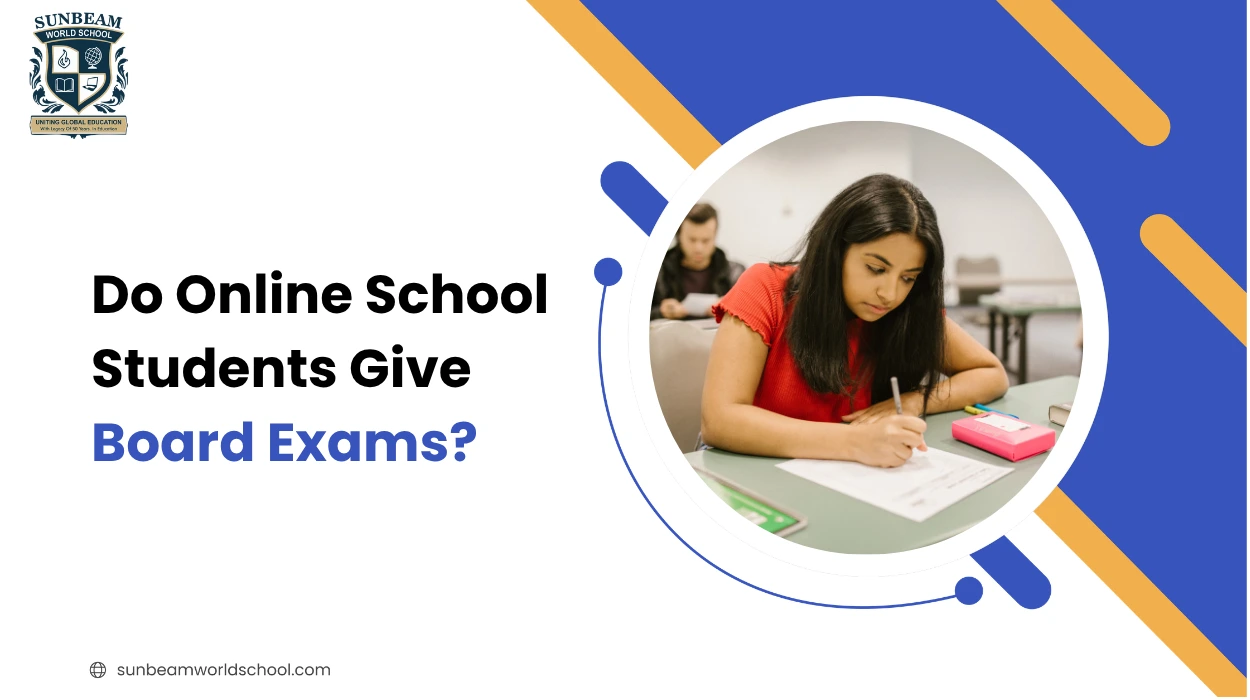
Do Online School Students Give Board Exams?
Yes, online school students do give board exams, but they must physically appear at a designated offline exam center. Central boards like CBSE and ICSE do not conduct board exams remotely, so how and where your child sits the exam depends on the board tied to their curriculum. This is the single most misunderstood part of online schooling, so this guide goes past the one-line answer: it explains exactly how the exam works, the two routes a student can take, which board to choose for which goal, how registration and exam day actually run, and how the certificate holds up for college, entrance exams, and jobs.
How do board exams work for online school students?
To understand why online students sit real board exams, it helps to separate two things that parents often blur together: teaching and examining. They are done by different bodies, and that separation is the whole reason an online qualification is valid.
The school teaches; the board examines and certifies
An online school's job is to teach the syllabus, run assessments, and prepare your child. The board's job is to set the question paper, conduct the exam, evaluate it, and issue the certificate. Because the recognised board, not the school building, is what stands behind the marksheet, a child taught online earns a certificate with the same legal standing as one taught on a campus. This is the core idea explained in what is an online school.
The exam is written offline, at a designated centre
Online school describes how a child learns, not how they are examined. The final Class 10 and Class 12 papers are written with pen and paper, in person, at a physical centre allotted by the board, under the same invigilation as every other candidate. There is no remote or webcam-proctored board exam for CBSE or ICSE, and even open boards conduct their papers at centres. Learning is online; the board exam is offline.
The certificate is identical to a physical school's
Because the same board issues it, the certificate a child earns through an online school is indistinguishable from one earned on a campus. It carries the same board name, the same subjects and grades, and the same recognition for higher study and employment. Nothing on the certificate marks it as online.
What are the two board-exam routes for online students?
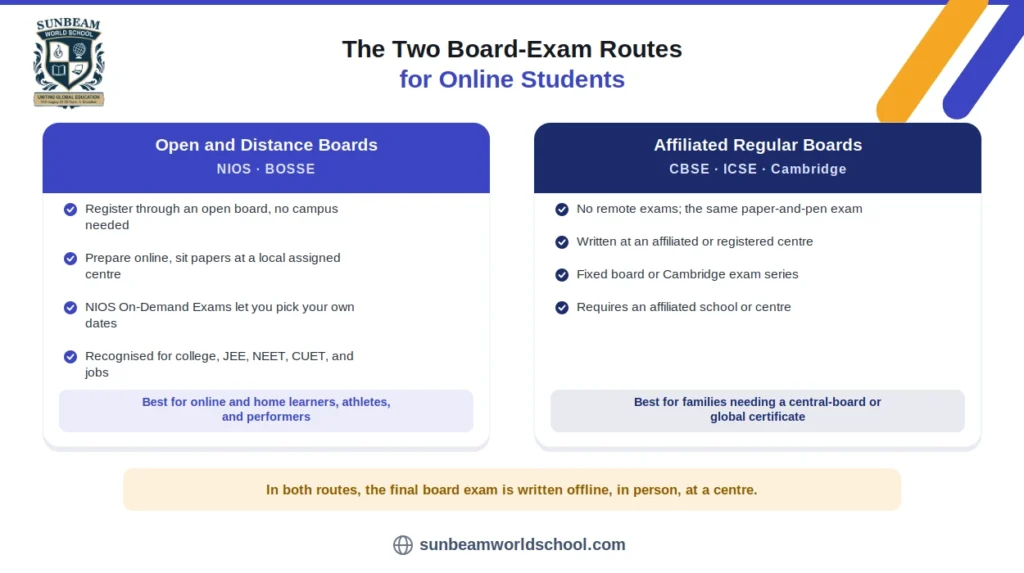
Compare the two board exam pathways available for online school students and understand how each examination route works.
Your child's testing method depends on the board their curriculum follows, and it falls into one of two routes. Knowing which route you are on tells you how registration, exam centres, and flexibility will work.
Route 1: Open and distance boards (NIOS and BOSSE)
This is the most common route for online school students in India. The school registers the child with an open board such as NIOS or BOSSE; the child prepares online and then travels to a local, government-assigned centre to write the papers. The big advantage here is flexibility: NIOS runs On-Demand Examinations, which let a student pick their own exam dates for many subjects rather than waiting for the twice-yearly public exam. This route suits online learners, athletes, performers, and anyone who wants control over their exam calendar. Compare the two open boards in BOSSE vs NIOS, or see the NIOS Class 10 and NIOS Class 12 pathways.
Route 2: Affiliated regular boards (CBSE, ICSE, Cambridge)
Central boards like CBSE and ICSE do not conduct remote exams. A student on these boards sits the exact same paper-and-pen exam at an affiliated centre, either because the online school operates as a fully affiliated digital branch, or because the child is registered through an affiliated school. For the British curriculum, Cambridge exams are written at registered Cambridge centres on the global timetable. This route suits families who specifically need a central-board or international certificate and can work within its fixed, affiliation-based structure.
Which boards do online school students take exams from?
Online students can sit exams from several recognised boards, and the choice matters more than families expect. The right board depends less on the online format than on where your child is headed after Class 12, how much flexibility they need, and whether they are aiming at Indian or overseas universities. Here is what each board's exam actually involves, and who it suits best.
NIOS, for a flexible, widely recognized Indian route
NIOS is India's national open-schooling board, run by the Ministry of Education, and the default choice for most online learners. Students take a minimum of five subjects, including at least one language, and can add more. Two features make it especially flexible: On-Demand Examinations, which let a student sit many papers on a date they choose rather than waiting for the twice-yearly public exam, and Transfer of Credit, which lets a student carry over subjects already passed with another board and reappear only in what is left. Credits can be accumulated over five years, which helps students who want to spread the load. Best for online learners, athletes and performers, and anyone who wants recognition with real control over their exam calendar.
BOSSE, for a modern, skill-oriented open board
BOSSE, the Board of Open Schooling and Skill Education, is a government-recognised open board offering flexible Class 10 and Class 12 certification with a contemporary, skills-focused curriculum. Like NIOS it allows a five-subject structure and open-schooling flexibility, but with a modern subject list that adds skill electives such as coding alongside the core academics. Best for families who want open-board flexibility with a forward-looking syllabus. The two Indian open boards are compared in detail in BOSSE vs NIOS.
Cambridge International, for a global route
Students on the British curriculum sit Cambridge IGCSE at the Grade 10 stage and AS and A Levels at Grades 11 and 12, examined by Cambridge Assessment International Education. Students choose their IGCSE subjects and then specialise into three or four A Levels that universities weigh heavily, sitting exams in the February to March, May to June, or October to November series. Best for families aiming at universities in the UK, Europe, Canada, Singapore, and the Middle East, where Cambridge qualifications are directly recognised.
American diploma via Cognia, for a credit-based route
The American pathway awards a high school diploma based on accumulated credits, a grade point average, and continuous coursework through a Cognia-accredited provider, rather than a single external board exam. Because assessment is spread across the year, there is less pressure on one final paper, and the transcript can be strengthened with AP courses and SAT scores where needed. Best for families targeting universities in the US and Canada, and students who do better with continuous assessment than one high-stakes exam.
CBSE-aligned and WACE options
Many online schools teach a CBSE-aligned Indian curriculum and certify students through NIOS or BOSSE, giving CBSE-pattern learning with an open-board certificate suited to Indian college and entrance-exam goals. Australian families can follow the WACE pathway, which certifies through Western Australia's board and produces an ATAR score used for university admission.
Where and when do online students sit board exams?
Two practical questions decide a family's year: where the exam happens and when. Both are set by the board, and a good online school plans around them so nothing is missed.
Where: a government-allotted centre near home
The board allots an exam centre near the student's home, usually within their own city or a reasonable distance. The school registers the child, the board assigns the centre and issues an admit card, and the child attends in person on the exam date. Because the exam is centre-based, a family can study with an online school based anywhere in the world and still sit the papers locally, which is a major reason learners in smaller towns and abroad choose online school.
When: the Class 10 and Class 12 exam calendars
Timing depends on the board. NIOS holds public exams twice a year, generally in the April to May and October to November windows. Cambridge runs fixed international series, typically February to March, May to June, and October to November. BOSSE and other open boards offer flexible sittings, confirmed at registration. Planning registration a few months ahead keeps you inside every deadline.
On-demand exams: choosing your own dates
A standout advantage of the NIOS route is the On-Demand Examination system. For many subjects, a student can book an exam when they feel ready rather than waiting for a fixed public exam, sitting the paper at a NIOS centre. For athletes, performers, and students balancing other commitments, this control over the calendar is one of online schooling's real benefits.
Can you give board exams without a physical school?
Yes, through the right board, and this is exactly why open boards exist. You can give Class 10 and Class 12 board exams without attending a regular physical school by registering with NIOS or BOSSE, which are designed for open and distance learners and admit students who study from home.
What you generally cannot do is appear for CBSE or ICSE as a pure homeschooler with no school at all, because those boards require registration through an affiliated school. This is the honest nuance many parents miss: homeschooling on its own is not recognised by CBSE or ICSE for board exams, so open boards are the standard, exam-eligible route for online and home learners. If your goal is simply a recognised Class 10 or 12 certificate without a campus, NIOS or BOSSE gets you there cleanly, and the recognition detail is in is online school valid in India.
Is an online school the same as a dummy school?
As open boards let students sit exams without a campus, a grey market of dummy schools has grown up alongside genuine online schools, and boards are cracking down on it. Parents need to know the difference, because it directly affects a child's education.
A dummy school enrols a student only on paper so they become exam-eligible while actually studying somewhere else, usually a coaching institute, with little or no real teaching from the school itself. An accredited online school is the opposite: it delivers full-time, live, timetabled teaching, tracks attendance and assessments, and registers students with a recognised board. The simplest test is this: a real online school teaches your child every day and certifies them through a board, while a dummy school only lends its name for registration. Choosing a genuinely accredited online school keeps your child both well taught and safely on the right side of board rules.
How do online students register for board exams?
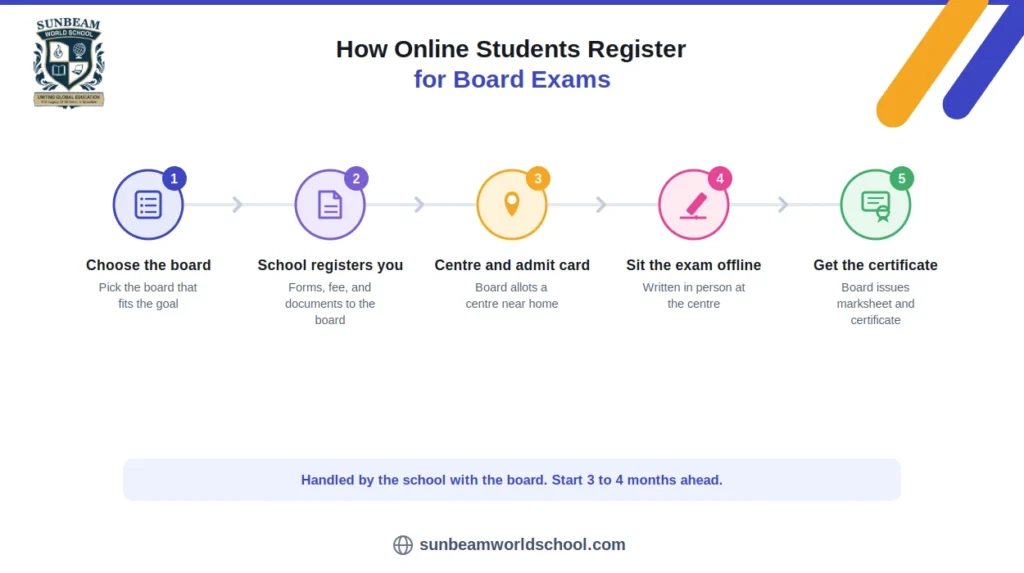
A step-by-step guide showing how online school students register for board exams and receive their certificates.
Registration is handled by the school with the board, not left to parents to navigate alone, but it helps to understand the sequence and the timeline so you can plan the year with confidence. The process usually begins several months before the exam session.
- Step 1: Choose the board and pathway. The school first helps you confirm the board that fits your child's goal, since this decides the syllabus, subjects, and exam calendar. Getting this right at the start prevents changes later.
- Step 2: The school registers the student. Within the board's admission window, the school submits the child's details, pays the registration fee, and uploads the documents required, typically previous marksheets, an ID or age proof, and photographs. For NIOS, this is also where Transfer of Credit is applied if the child is carrying over passed subjects.
- Step 3: The board confirms and issues an enrolment number. The child becomes an official candidate of the board, with a unique enrolment or registration number used for every step that follows.
- Step 4: The board allots a centre and releases the admit card. Once the exam fee for the chosen session is paid, the board assigns a centre near the student and releases an admit card or hall ticket, usually a few weeks before the exam, which the family downloads and prints.
- Step 5: The student sits the exam. The child attends the allotted centre in person on the scheduled dates, writes the papers, and completes any practical or project components.
- Step 6: The board issues the result and certificate. The board evaluates the papers and issues the marksheet and certificate directly, exactly as for a physical-school candidate. The wider admission flow is in online school enrolment step by step.
When to start. Begin at least three to four months before the exam session to meet the board's registration and fee deadlines comfortably. For NIOS On-Demand Examinations, you can register once and then book individual papers as your child is ready.
What to keep ready. Previous marksheets, a government ID or age proof such as Aadhaar or a birth certificate, passport-size photographs, and, for a mid-year switch, the Transfer Certificate from the current school.
How do practical exams and internal assessments work?
Practical exams, projects, and internal assessments are part of the board's scheme, and online students complete them rather than skipping them. Depending on the board and subject, practicals may be sat at the exam centre, conducted under supervision, or submitted as project coursework. Online schools prepare students for this with a home-delivered learning kit for hands-on science, virtual and simulated 3D labs, and guided project work, so a child is ready for whatever component the board requires. The practical side is genuinely covered, not treated as an afterthought.
Are online school board certificates valid?
Because the certificate comes from a recognised board, it carries the same validity as a physical school's. It helps to see exactly where that validity applies.
For Indian universities and entrance exams
NIOS and BOSSE Class 10 and 12 certificates are accepted by Indian universities and for national entrance exams including JEE, NEET, and CUET, on the same footing as CBSE and State boards. A child on the open-board route is fully eligible for the same colleges and competitive exams as a physical-school peer.
For government jobs and recruitment
Open-board certificates are accepted for government-job recruitment and public examinations that require a Class 10 or 12 qualification. Because NIOS is a national board under the Ministry of Education, its certificate is treated as a mainstream qualification, not a lesser one.
For international universities
Cambridge, American, and WACE certificates are recognised directly by universities in their home systems, and are evaluated by the Association of Indian Universities as equivalent to Class 12 for admission to Indian colleges. The equivalence process is explained in the AIU equivalence certificate guide, and the full validity walkthrough is in is online school valid in India.
How do you choose the right board for board exams?
Since online students can sit several boards, the decision should follow your child's goal after Class 12, not the online format. A simple way to choose:
- Aiming for Indian colleges, JEE, NEET, or CUET: NIOS or BOSSE, or a CBSE-aligned pathway certified through an open board. All are widely recognised for Indian higher education and entrance exams.
- Aiming for universities abroad: Cambridge (IGCSE and A Level) for the UK and much of the world, or the American diploma via Cognia for the US and Canada.
- Wanting maximum flexibility over exam dates: NIOS, for its On-Demand Examinations and twice-yearly public exams.
- Wanting a modern, skills-oriented open board: BOSSE, as a contemporary alternative to NIOS.
A good online school will help you match the board to the plan, and many, including Sunbeam World School, let a child change pathway if their goals evolve.
How does Sunbeam World School prepare students for board exams?
Sunbeam World School is built so that board exams are a supported, well-rehearsed step rather than a source of stress. As a global online school with recognised accreditations including Cambridge, Cognia, NIOS, and BOSSE, it handles the administrative moving parts and prepares students academically, so families are never left to figure out the board on their own.
The right board, chosen with a counsellor
Before anything else, an academic counsellor helps you choose the board that fits your child's plan after Class 12, and the school can change pathway later if goals evolve. Getting this decision right at the start shapes the whole exam journey, from syllabus to certificate.
Board registration and exam-centre support
The school registers each student with the chosen board inside its window, applies Transfer of Credit where relevant, tracks fee and form deadlines, and guides families through centre allotment and downloading the admit card. Parents are walked through every step instead of decoding board portals alone.
Syllabus-aligned teaching and structured revision
Live teacher-led classes and recorded lessons are mapped to each board's exact syllabus and paper pattern, and the final months move into structured revision with previous-year papers, so preparation matches the real exam. The model is on the learning approach page and the boards on the affiliations and accreditation page.
Mock exams in the real board format
Students rehearse with full mock exams set and timed like the actual board paper, then receive detailed feedback on where to focus, so exam day feels familiar rather than daunting.
One-on-one doubt clearing and exam-season mentoring
Any student can book one-on-one teacher hours to clear doubts, and board-year students get closer mentoring through the exam season to stay on track and manage stress and time.
Guidance through results and next steps
Support does not stop at the exam. The school helps families read the marksheet, apply for re-evaluation if needed, and move on to college admissions or the AIU equivalence process for international boards. The easiest way to see how it works is to book a free demo class or start an application.
The bottom line
Online school students absolutely give board exams. They learn online, then sit the same Class 10 and Class 12 papers as everyone else, in person at a designated offline centre, and receive the same board-issued certificate. How and where depends on the board, and the rest of the decision is about matching that board to your child's plan.
Get board exams become a well-supported, well-rehearsed step rather than a leap into the unknown. The exam is real, the recognition is real, and a good online school handles the registration and preparation with you. If you want to see how that works in practice, you can book a free demo class or start an application.

Frequently Asked Questions
Does CBSE allow online school?
-No, CBSE does not fully allow online k-12 schooling. CBSE affiliation is granted to physical schools that meet its infrastructure norms, and CBSE does not conduct remote board exams. Most online schools therefore teach a CBSE-aligned syllabus and certify students through an open board such as NIOS or BOSSE, or operate through an affiliated centre. Your child studies online and sits the board exam in person.
Can I give Class 11 and 12 exams without going to school?
+Is homeschooling recognised by CBSE or ICSE for board exams?
+Do online school students give the same board exam as regular students?
+
In this article
Share this post:


Press and Blogs
Stay updated with our press releases, educational blogs, and more.
Quick Summary Student success motivational quotes are short, memorable lines that can help students stay...
Quick Summary The area of a square is the total space enclosed within its four...
Quick Summary The English language contains over 500 words that start with Y, including everyday...