
 Curriculum
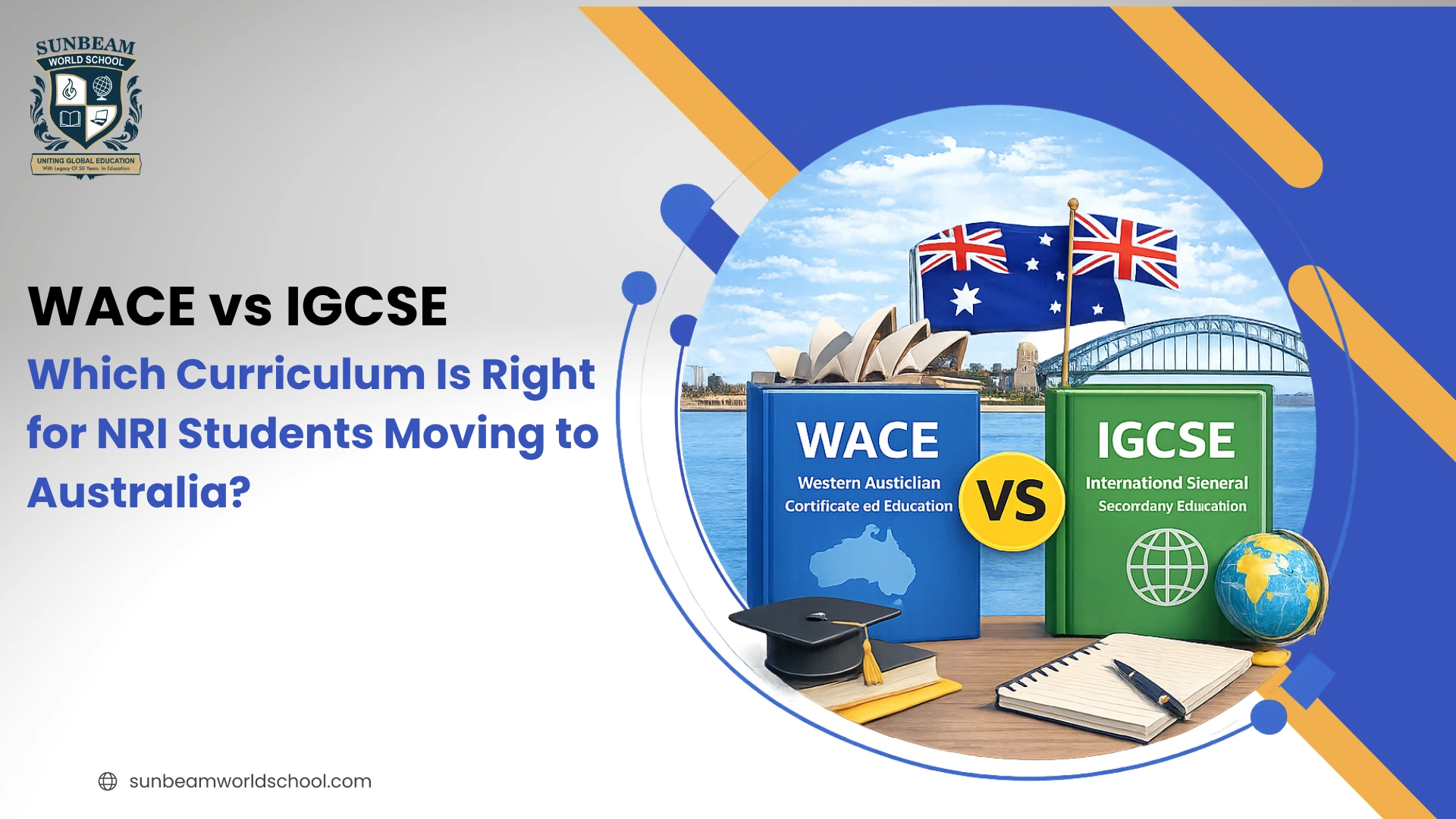
WACE vs IGCSE: Which Curriculum Is Right for NRI Students Moving to Australia?
| For NRI families moving to Australia, choosing between WACE and IGCSE depends on long-term plans and university goals. WACE (ATAR pathway) is best suited for students planning to stay in Australia, as it provides a direct, cost-effective route to Australian universities and supports smoother social integration. In contrast, the IGCSE pathway (followed by IB or A Levels) offers greater global flexibility and is ideal for families who may relocate again or are considering universities in countries like the UK, India, or the US. A practical hybrid approach is to complete IGCSE and then transition to WACE ATAR in Year 11, allowing students to benefit from both international curriculum continuity and access to Australian higher education. |
You’ve booked the tickets, sorted the visas, and maybe even shortlisted a few suburbs in Australia. But just when things start to feel under control, a much bigger question shows up:
“Which curriculum should my child follow: WACE or IGCSE?”
If you’re an NRI parent moving from India, this decision can feel overwhelming. One path is familiar — structured, global, and predictable. The other is new — locally aligned, slightly complex, but deeply integrated into the Australian system.
And here’s the tricky part:
This isn’t just a school decision. It’s a university decision. A career decision. Sometimes, even a country's decision.
Do you prioritize global flexibility in case you move again? Or do you optimize for the smoothest, most direct route into Australian universities?
Most families find themselves stuck between these two worlds, unsure which trade-offs actually matter.
That’s exactly what this guide is here to solve.
| One thing to clarify upfront
Strictly speaking, IGCSE covers secondary school (equivalent to Grades 9–10 in India, or Years 9–10 in Australia), while WACE covers senior secondary (Years 11–12). This guide compares them as curriculum pathways — the broader choice between the Cambridge International track (IGCSE → A Levels or IB) and the Australian mainstream track (Australian Curriculum → WACE). We'll make this clear throughout. |
The real question NRI families are asking
Before diving into the curricula themselves, it helps to name the actual anxiety that most parents bring to this decision. It isn't really "WACE or IGCSE." It's one of three deeper questions:
- "We might not stay in Australia permanently — will WACE lock us in?"
- "My child has done IGCSE in India. Is switching to WACE going to set them back?"
- "Which qualification gives my child the best shot at a good university — in Australia, in India, or internationally?"
These are the right questions. Everything else in this guide is answering them. But the short answer to all three: IGCSE/Cambridge track is more portable internationally but requires finding the right school in Australia; WACE is the best path if you're planning to stay and your child will apply to Australian universities. Neither is categorically superior — context is everything.
| "The question isn't which curriculum is better. It's which curriculum is better for your child, in your specific situation, with your specific plans." |
Understanding WACE: what it is and how it works
WACE stands for the Western Australian Certificate of Education. It is the credential awarded to students who successfully complete senior secondary education (Years 11 and 12) in Western Australia. It is governed by the School Curriculum and Standards Authority (SCSA), a statutory body under the Government of Western Australia.
But here's the thing that often surprises NRI parents: WACE isn't just a qualification. It's a comprehensive two-year programme that covers what students study, how they are assessed, and how their performance is converted into an ATAR (Australian Tertiary Admission Rank) — the number that Australian universities use for admissions decisions.
| WACE is more than just Western Australia
Although WACE is the Western Australian credential, each Australian state has its equivalent: NSW has the HSC, Victoria has the VCE, Queensland has the QCE, and so on. This guide focuses on WACE because it is the most structured and relevant framework for understanding how the Australian mainstream system works — and because WACE International is now available in several countries including India. The core WACE structure and the ATAR logic apply broadly across Australian state credentials. |
The WACE pathway structure
Students in Western Australia enter senior secondary school at Year 10 (age 15–16) and work toward WACE across Years 10, 11, and 12. The WACE programme offers three main course types:
ATAR courses– academically rigorous courses assessed by external examinations, designed for students heading to university. These directly contribute to an ATAR score.
General courses — designed for students aiming toward vocational training or the workforce. Assessed through internally set work tasks (no high-stakes external exams).
VET (Vocational Education and Training) courses — practical industry qualifications that can count toward WACE alongside academic courses.
For NRI families with university-bound children, the ATAR pathway is almost always the relevant one. Students on the ATAR pathway typically study a minimum of 4–5 ATAR courses in Year 12, sit external examinations, and receive an ATAR that ranks them against all other Year 12 students in Western Australia.
How the ATAR is calculated
This is the piece that is most unfamiliar to Indian families — and the piece that matters most for understanding WACE.
Your child's ATAR is not simply a percentage of marks. It is a percentile rank — a number between 0 and 99.95 that tells universities where your child sits relative to all Year 12 students in Western Australia. An ATAR of 90 means your child performed better than 90% of all students in their year group. An ATAR of 99 means they performed better than 99% — placing them in the top 1%.
The ATAR calculation involves three steps:
Course scores are calculated from a 50/50 combination of school-based assessment and the final external ATAR examination for each subject.
Scaling is applied to account for the relative difficulty of different subjects. A student who scored 80 in Physics (a harder, more competitive subject) may receive a higher scaled score than one who scored 80 in a less competitive subject.
The student's top four scaled scores are added to form the Tertiary Entrance Aggregate (TEA), which is then converted to an ATAR percentile.
Why scaling matters for NRI students choosing WACE subjectsSubject scaling in WACE means that choosing rigorous ATAR subjects — particularly Mathematics Methods, Chemistry, Physics, and English Literature — can significantly boost an ATAR compared to choosing easier subjects. This is counterintuitive but well-documented. Students who take harder subjects are typically more competitive academically, and the SCSA's scaling reflects this. When choosing ATAR subjects, NRI students should prioritise subjects that align with their strengths and scale well. |
ATAR scores and what they unlock
| ATAR Range | University Access | Example Courses |
| 95–99.95 | Elite courses at top Australian universities | Medicine (UWA), Law (Murdoch), Engineering (UWA) |
| 85–94 | Competitive courses at Group of Eight universities | Commerce, Nursing, Computer Science, Architecture |
| 75–84 | Strong range of bachelor programmes | Business, Education, Science, Arts at leading universities |
| 60–74 | Good selection of undergraduate degrees | Many programmes across ECU, Murdoch, Curtin |
| 50–59 | Some programmes with conditional entry | Foundation or bridging pathways widely available |
| Below 50 | Direct entry very limited; pathway programmes available | TAFE, Certificate, Diploma programmes as stepping stones |
WACE requirements — what students must complete
To be awarded a WACE, students must meet four requirements:
Breadth and depth of study — a minimum of 20 units including at least 10 Year 12 units, with at least one unit from List A (humanities) and one from List B (STEM)
Achievement standard — Grade C or better in at least 14 units across Years 10–12
Literacy and numeracy standard — demonstrated through either NAPLAN Band 8 achievement or the Online Literacy and Numeracy Assessment (OLNA)
Compulsory Year 12 English — at least two units of English at Year 12 level
The OLNA — important for NRI students arriving from overseasStudents who have not completed Australian NAPLAN tests (because they were studying in India) must sit the OLNA — an online literacy and numeracy assessment — at the start of Year 10 or Year 11. This is not a barrier; it is simply an administrative requirement. Schools are well used to helping new international students navigate this, and NRI students who have done IGCSE or CBSE typically pass it comfortably. |
Understanding Cambridge IGCSE: what it is and how it works in Australia
Cambridge IGCSE (International General Certificate of Secondary Education) is a globally recognised secondary qualification for students aged 14–16, designed and administered by Cambridge Assessment International Education (CAIE). Most NRI families relocating from India are already familiar with IGCSE — it's the curriculum many premium international schools in India follow from Grades 9 to 10.
In Australia, there are 19 schools offering Cambridge IGCSE — predominantly private international schools located in major cities including Perth, Sydney, Melbourne, and Brisbane. These schools typically serve the internationally mobile population: expat families, diplomats, and families who want to maintain curriculum continuity while living in Australia.
How IGCSE fits into the Australian education landscape
Here is where the picture gets important for NRI families: IGCSE in Australia is a secondary qualification, not a senior secondary qualification. It covers the equivalent of Years 9–10 (ages 14–16). After completing IGCSE, students at international schools in Australia typically progress to either:
Cambridge A Levels — the direct Cambridge progression, covering two more years of subject-specific study
IB Diploma Programme — the International Baccalaureate, which many international schools offer alongside IGCSE as the senior secondary pathway
Australian state credentials (WACE, VCE, HSC) — some students transfer to the mainstream Australian system after IGCSE for their senior secondary years
This means that if your child attends an IGCSE school in Australia, the school will almost certainly offer a senior secondary pathway — usually IB Diploma or A Levels. You are not choosing IGCSE instead of WACE; you are choosing the international track (IGCSE + IB/A Levels) instead of the Australian mainstream track (Australian Curriculum + WACE).
How IGCSE is graded
Cambridge IGCSE uses a letter grade scale from A* to G, with U indicating ungraded:
| Grade | Performance Description | Australian University View |
| A* | Outstanding — top of cohort performance | Excellent — accepted by all Australian universities for Year 11 entry or as supporting evidence |
| A | Excellent — strong command of subject | Strong — widely recognised, supports ATAR pathway transition |
| B | Good — above average performance | Good — sufficient for most Year 11 programme entry |
| C | Satisfactory — meets the minimum standard | Minimum pass — widely accepted as a secondary qualification |
| E/F/G | Below standard / minimum pass | Limited recognition for progression to senior secondary |
IGCSE and Australian university entry
Here is the nuance that many guides miss: IGCSE alone does not get a student into an Australian university. Australian universities require a completed senior secondary qualification — typically a state credential like WACE with an ATAR, or an IB Diploma with a score. A student who finishes IGCSE without going on to complete either WACE or IB Diploma (or A Levels) will not have a direct pathway to Australian university entry.
However, IGCSE is fully recognised as a valid Years 9–10 credential in Australia. Students with strong IGCSE results can enter WACE ATAR courses in Year 11 at any Australian school. The transition from IGCSE to WACE ATAR is well-established and many international school students do exactly this.
WACE vs IGCSE: the complete side-by-side comparison
Let's put everything side by side. This table covers every dimension that matters to an NRI family making a school choice in Australia.
| Factor | WACE (ATAR Pathway) | Cambridge IGCSE |
| Track Type | Australian mainstream | International track |
| What it covers | Senior secondary — Years 11 & 12 (age 16–18); leads to ATAR for university entry | Lower secondary — equivalent to Years 9–10 (age 14–16); foundation before senior secondary |
| Administered by | School Curriculum and Standards Authority (SCSA), Government of Western Australia | Cambridge Assessment International Education (CAIE), University of Cambridge |
| Age of students | 16–18 (Years 11–12) | 14–16 (Years 9–10) |
| Number of subjects | Minimum 4 ATAR courses; 5 recommended + breadth requirements (List A & B) | Typically 7–10 subjects across 5 groups; built-in breadth |
| Assessment model | 50% school-based (moderated) + 50% external ATAR exams | Mainly external exams; some coursework/practicals |
| Grading | Course scores → scaled → ATAR percentile (0–99.95) | Letter grades A*–G; C is minimum pass; boundaries set post-exam |
| University entry (Australia) | Direct — ATAR used by all Australian universities | Not direct — requires A Levels, IB, or WACE after IGCSE |
| University entry (global) | Accepted internationally; ATAR conversion tables available | IGCSE alone not sufficient; pathway to A Levels/IB required |
| Global portability | Moderate — strong in Australia & UK; less familiar elsewhere | High — recognised in 160+ countries including India |
| Recognised in India | Yes — recognised by AIU; less familiar than CBSE/IGCSE | Yes — recognised as equivalent to Class 10 |
| School availability in Australia | Widely available — government & most private schools | Limited — ~19 schools, mainly private international |
| School fees | Govt: free/low; Private: AUD 10,000–30,000/year | International schools: AUD 25,000–50,000/year |
| Teaching approach | Inquir |
WACE (ATAR Pathway)
Strengths of WACE for NRI Students
- Gives a direct pathway to all Australian universities through the ATAR system
- Available at all government and most private schools — offering wider choice than IGCSE schools
- Government schools provide free or low-cost education for PR holders and citizens
- Enables full social integration with Australian peers — important for long-term settlement
- The 50/50 split between school assessment and exams rewards consistent effort
- A strong ATAR is recognised for university entry in the UK, Canada, and globally
- Subject scaling benefits students choosing rigorous subjects like Maths Methods and Physics
- WACE International is available in India, offering continuity for some NRI students
Weaknesses of WACE for NRI Students
- Less portable compared to IGCSE or IB if the family relocates internationally
- ATAR and subject scaling system can be complex and difficult to understand initially
- Students from CBSE or IGCSE may need time to adjust to a different assessment style
- OLNA requirement adds an extra step for students without Australian NAPLAN
- Less focused on external exams, which may require extra preparation for global applications
- Less recognised than IGCSE or IB among some top Indian institutions
Cambridge IGCSE (international school track)
Strengths of IGCSE for NRI students
- Curriculum continuity for students already doing IGCSE in India — familiar structure and teaching style
- Globally portable — recognised in 160+ countries including India, UK, USA, Canada, Singapore
- Fully recognised by Indian AIU as Class 10 equivalent — important if the family returns
- International school environment typically supports newcomers more deliberately
- Clear progression to A Levels or IB Diploma, both of which carry strong global university recognition
- The analytical, exam-based style is familiar to students from Indian educational backgrounds
- Better preparation for applying to UK and global universities where IGCSE + A Level results are the primary credential
Weaknesses of IGCSE for NRI students
- IGCSE alone does not qualify a student for Australian university entry — must be followed by IB or WACE
- International schools are expensive — typically AUD 25,000–50,000 per year
- Only 19 schools offering IGCSE in Australia — geographic choice is limited
- Risk of limited social integration with Australian peers; international school environments can be insular
- If ultimately targeting Australian universities, the ATAR pathway through a mainstream school may be more efficient
- Students who move to a WACE pathway after IGCSE need to adapt to a very different assessment model
Which qualification gets my child into which universities?
This is the question at the centre of most family conversations. Here is the honest answer for each scenario.
Applying to Australian universities
Australian universities primarily use the ATAR for domestic undergraduate admissions. A student who completes WACE and earns an ATAR has a clear, direct pathway to any Australian university based on their score.
A student who completed Cambridge IGCSE followed by IB Diploma can also apply to Australian universities — the IB total points (out of 45) are converted to an equivalent ATAR using a nationally standardised conversion table. An IB score of 30 typically converts to an ATAR of around 83; a score of 38 converts to roughly 97. Most Australian universities have clear IB-to-ATAR conversion tables published on their admissions pages.
A student with only IGCSE (no senior secondary qualification) cannot apply directly to an Australian university. They would need to complete WACE, IB, or A Levels first, or enrol in a foundation programme.
Applying to Indian universities (if the family returns)
Cambridge IGCSE is recognised by the Association of Indian Universities (AIU) as equivalent to Class 10 board results. Cambridge A Levels and IB Diploma are both recognised for Class 12 equivalence. The international school track gives students returning to India clear equivalence.
WACE is also recognised by the AIU, but it is less familiar to most Indian university admissions offices and Indian parents. A student with a WACE certificate applying to an Indian university may face more questions about equivalence than one with IGCSE or IB credentials. This is a real practical consideration for families who see India as a possible return destination.
Applying to UK universities
Both pathways work well for UK universities. Cambridge IGCSE followed by A Levels is the classic British pathway and is fully understood by all UK admissions tutors. WACE/ATAR is also accepted — most UK universities publish ATAR equivalence tables (a WACE ATAR of 90 typically meets a standard AAB A Level requirement, for example). Students on the Cambridge international track with A Levels have, if anything, a slight familiarity advantage at UK universities.
Applying to US universities
US universities use a holistic admissions process — they do not simply look at a single score. Both WACE and IGCSE (+ A Levels or IB) are recognised. Students with Cambridge A Levels may receive advanced placement credit at some US universities. WACE ATAR students typically need to present strong SAT or ACT scores alongside their results since US admissions offices are less familiar with converting ATARs. Both tracks lead to competitive US applications — the difference is preparation strategy, not qualification recognition.
| Cambridge, Oxford, and Ivy League specifically
All three recognise strong WACE ATARs from international students — Cambridge University, Oxford, and Ivy League institutions have all accepted WACE graduates. Cambridge and Oxford's typical ATAR benchmark is around 97.5–99+ for the most competitive courses. For the international track, A*AA or A*A*A at A Levels is the standard. Both paths lead to the same destination if the grades are there. |
The transition experience: what NRI students actually face
Numbers and qualification comparisons only tell part of the story. What actually matters to a 14 or 15-year-old moving to Australia is what school feels like — how hard the adjustment is, whether they feel behind, and how long it takes to feel settled.
Moving at primary school age (up to Year 6)
This is the easiest transition. Young children adapt to new environments quickly, pick up language and cultural cues naturally, and the academic gap between curricula is minimal at primary level. For families moving with primary school-aged children, the curriculum question is secondary to finding a school with a supportive community, a good pastoral care structure, and manageable travel distance.
Moving at lower secondary age (Years 7–10, age 12–15)
This is where curriculum continuity starts to matter more. A student from a CBSE or IGCSE background arriving at an Australian government school in Year 8 or Year 9 will find the teaching style noticeably different — more relaxed, more discussion-based, with less emphasis on rote learning and structured exam preparation. Many Indian students initially find the Australian classroom pace slower than what they are used to.
Subject content gaps vary. Mathematics and Sciences in the Indian system are typically taught at a higher level at equivalent year groups — an Indian student in Year 9 Mathematics will often find Australian Year 9 Maths straightforward. English comprehension and essay-writing skills may require more adjustment, particularly if the student is transitioning from a school where English was a strong but secondary focus.
For families with children in this age group, the IGCSE school option offers more curriculum familiarity and often a more structured support system for new arrivals. Mainstream Australian schools are welcoming but less specifically set up for the international student transition experience.
Moving at senior secondary age (Years 11–12, age 16–18)
This is the most complex transition — and the one where curriculum choice matters most. A student arriving in Year 11 with strong IGCSE results from India can enter WACE ATAR courses, but they will be joining a cohort that has spent the previous year studying the Year 11 units of the same courses. The content gap is manageable but real, and the assessment style — 50% continuous school-based assessment — is very different from the end-of-course examination model most Indian students are accustomed to.
Students arriving at this stage who are set on Australian university entry should seriously consider mainstream WACE schools with strong international student support. Students who are applying to UK, Indian, or global universities — or whose families may relocate again — are better served by the international school track (IGCSE + IB or A Levels) where available.
The Year 12 arrival problemFamilies arriving in Australia when their child is already in Year 12 face a genuinely difficult situation. Starting WACE ATAR courses mid-Year 12 is nearly impossible — the continuous assessment component is part of the grade from the beginning of the year. For a family arriving mid-Year 12, the most practical options are: (1) deferring by one year and starting a full Year 11–12 cycle; (2) completing the remaining term abroad or online; or (3) exploring foundation or bridging year options at Australian universities. Plan ahead if at all possible. |
How subjects compare between WACE and Cambridge IGCSE
One question parents often ask is: "How similar are the subjects?" The content overlap is substantial in Science and Mathematics — the conceptual foundations are international. The differences appear most in teaching approach, assessment format, and subject structure
| Subject Area | WACE ATAR (Year 12) | Cambridge IGCSE | Transition Difficulty |
| Mathematics | Mathematics Methods (calculus-based, highly scaled); Specialist Mathematics; Mathematics Applications | Mathematics (0580); Additional Mathematics (0606) | Low — Strong overlap; IGCSE students typically find WACE Maths accessible |
| Sciences | Physics, Chemistry, Biology, Human Biology (separate courses, each with external exam) | Physics (0625), Chemistry (0620), Biology (0610) | Low–Medium — Content familiar; assessment approach differs (50/50 vs exam-focused) |
| English | English; Literature; EALD | English Language (0500/0990); English Literature (0475) | Medium — Australian text focus; essay style differs from Cambridge analytical approach |
| Humanities | Modern History; Geography; Politics and Law; Economics | History (0470); Geography (0460); Economics (0455); Global Perspectives (0457) | Medium — Australian context; partial content overlap |
| Technology | Computer Science; Engineering Studies; Design and Technology | Computer Science (0478); ICT (0417) | Low — Good content alignment; practical structure differs |
| Languages | Indonesian, French, Japanese, Italian, Chinese, Hindi, Modern Greek, others | Hindi (0549), French (0520), Spanish (0530), Arabic (0508), etc. | Low — Broad equivalence; Hindi speakers often perform well in WACE Hindi ATAR |
| Hindi as a WACE ATAR subject — a hidden advantage for NRI students
Many NRI families don't realise that Hindi is a fully available and well-scaled ATAR course in Western Australia. Native or near-native Hindi speakers who take Hindi ATAR typically achieve very high course scores, and the subject scales reasonably in the ATAR calculation. For NRI students who are fluent Hindi speakers, this can meaningfully improve an ATAR. Check with the specific school to confirm availability. |
Types of schools in Australia: what NRI families need to know
Understanding the Australian school landscape helps parents make a realistic choice — not just an academic one.
Government (state) schools
Government schools are free for Australian citizens and permanent residents. For temporary visa holders, annual school fees apply — typically AUD 3,000–8,000 per year depending on the state. These schools follow the national curriculum and offer WACE ATAR pathways in Years 11–12. Academic quality varies by school and suburb. In Western Australia, the state school system has strong reputations in academic suburbs like Subiaco, Nedlands, and North Perth. Government schools offer the most natural integration into Australian society and are where the majority of Australian children study.
Private (independent) schools
Private schools charge fees ranging from AUD 10,000 to AUD 35,000 per year. They typically offer both WACE and, in some cases, IB Diploma. Many of Perth's and Sydney's most academic private schools have strong ATAR track records — schools like Christ Church Grammar, Hale School, PLC, and MLC Perth consistently achieve high median ATARs. Private schools often have smaller class sizes, better resources, and more structured international student support.
International schools (Cambridge/IB pathway)
Australia has 19 schools offering Cambridge IGCSE — these are almost all private international schools. Fees are typically AUD 25,000–50,000 per year and sometimes higher. These schools serve primarily the internationally mobile population and often also offer IB Diploma or Cambridge A Levels as the senior secondary pathway. Notable examples include the International School of Western Australia (Perth), British International School (Sydney), and Carey Baptist Grammar School (Melbourne, which offers both VCE and IB).
Catholic schools
Catholic schools occupy the middle ground — fees are typically lower than independent private schools but higher than government schools (AUD 5,000–15,000/year). They follow the national curriculum and offer WACE ATAR pathways. Some Catholic schools in major cities have strong academic reputations and international student communities.
The decision framework: which path is right for your family?
Here is a practical way to think through the decision. Work through each scenario and see which fits your family's situation.
You're settling in Australia permanently or long-term (5+ years)
Lean toward WACE. If Australia is where your child will grow up and apply to university, the mainstream Australian path (WACE ATAR) is the most direct, cost-effective, and socially integrative route. Your child will graduate alongside Australian peers with the same credential Australian universities know best.
Your stay in Australia is uncertain or temporary (1–4 years)
Lean toward IGCSE / international school. Curriculum continuity matters when there's a real chance of another move. If your family's situation is uncertain, the Cambridge track gives you the most flexibility, and online schooling can bridge gaps during transitions. Cambridge IGCSE + A Levels or IB Diploma will transfer to India, UK, Singapore, or anywhere else without the disruption of switching curriculum frameworks again.
Your child plans to apply to UK or global universities
Lean toward IGCSE + A Levels. Cambridge A Levels are the direct pathway to UK universities and carry strong recognition at US and global institutions. WACE ATAR is accepted in the UK but less familiar. For a student targeting LSE, Imperial, or Oxbridge, A Levels are the natural choice.
Your child wants to study at an Australian university
WACE ATAR is the most direct path. Australian universities know and use the ATAR. IB Diploma also works well — conversion tables exist. But for the most straightforward admissions pathway, completing WACE and earning a strong ATAR is the clearest route into Australian undergraduate programmes.
Your child is currently in IGCSE in India and you're moving mid-secondary
Complete IGCSE, then transition to WACE ATAR in Year 11. Don't abandon a qualification mid-course. If your child is in Year 9 or Year 10 IGCSE, finish it — the credential has real value. Then enter WACE ATAR courses in Year 11, where strong IGCSE results are an excellent foundation.
There's a real chance your family returns to India
IGCSE + IB is more practical. Both Cambridge IGCSE and IB Diploma are recognised by the AIU and widely understood at Indian institutions. WACE is also technically recognised but is less familiar in India. If India remains a realistic scenario, the international school track reduces re-entry friction significantly.
School fees are a significant constraint
WACE in government or Catholic schools is far more affordable. International schools offering IGCSE cost AUD 25,000–50,000 per year. A government WACE school costs little to nothing for PR holders. If budget matters, the mainstream Australian path is the financially sensible option without sacrificing academic quality.
Your child is a strong, self-directed learner who adapts easily
Either path works well. Academically capable and adaptable students do well in both systems. The WACE ATAR rewards consistency and strategic subject choice; IGCSE + A Levels rewards depth and exam technique. If your child ticks both boxes, choose based on family plans rather than academic fit.
Practical tips for NRI families making the transition
Research schools before arriving, not after
Australian school catchment zones mean you may need to live in a specific area to access your preferred government school. If a particular school is important, secure housing in the catchment area first. Private and international schools have their own admissions processes — start early.
Don't repeat an entire year unnecessarily
Some schools will suggest your child repeat a year when arriving mid-year. This is sometimes appropriate but not always necessary. Push back and ask for a subject-by-subject assessment of where your child actually is. Many Indian students are academically ahead, particularly in Maths and Sciences.
Understand the 50/50 assessment model before Year 11
WACE ATAR courses start awarding continuous school-based assessment marks from the first week of Year 11. Students who don't understand this often underweight the importance of early assessment tasks. Brief your child before they start: every piece of assessed work from day one counts.
Take the OLNA seriously but don't stress about it
NRI students sit the OLNA at the start of Year 10 or 11 since they haven't done Australian NAPLAN. It covers literacy and numeracy at approximately Year 9 level. Students from strong IGCSE or CBSE backgrounds typically pass it comfortably. Spend a week doing practice papers online to remove any uncertainty.
Choose ATAR subjects strategically — not just by interest
Subject scaling in WACE means that some subjects boost ATARs more than others. Mathematics Methods, Chemistry, Physics, and English Literature scale well. Ask a school counsellor for the TISC scaling data for each subject you're considering. Choosing a harder subject that scales well is almost always the right call for academically strong students.
Hindi ATAR can be a significant ATAR booster for NRI students
If your child is a fluent Hindi speaker, Hindi ATAR is among the most strategically valuable choices available to them in WACE. Native-level fluency in a heritage language translates to very high course scores, and the subject contributes meaningfully to the ATAR. This is one of the most underused advantages NRI students have.
Ask international schools about post-IGCSE pathways explicitly
If you're considering an IGCSE international school, confirm exactly what the school offers after Year 10. Do they offer IB Diploma? Cambridge A Levels? Or will your child need to transfer to a WACE school for Years 11–12? Knowing this in advance prevents a mid-secondary school change you weren't expecting.
Visit schools in person — online impressions can be misleading
An Australian school's website and a suburb's reputation only tell you so much. School culture — how supported new students feel, how the pastoral care team operates, how diverse the student body is — only becomes clear on a campus visit. Book two or three school visits before your child's first day if at all possible.
Account for the Australian school year calendar
The Australian school year runs from late January to mid-December — opposite to the northern hemisphere. Families arriving from India mid-year will be joining Australian students mid-academic year. Schools typically recommend a catchment or lateral entry into the current year, but discuss with individual schools about whether starting the following year (for a full year of the relevant grade) is more beneficial academically.
Quick Decision Tree: WACE or IGCSE?
1. Is your family planning to stay in Australia for more than 4 years?
If yes or most likely, the WACE (ATAR pathway) is the better choice. It offers direct entry to Australian universities, is more affordable (especially in government schools), and helps your child integrate socially and academically.
If no or uncertain, choose IGCSE at an international school, followed by IB or A Levels. This ensures global portability and smooth curriculum continuity if you relocate again.
2. If staying in Australia: Is your child entering Year 9 or 10 (already doing IGCSE in India)?
If yes, the best approach is to complete IGCSE (in Australia or online) and then transition to WACE ATAR in Year 11. This gives your child both an international qualification and access to Australian university pathways.
If no (arriving earlier), enrol directly in an Australian school following the national curriculum leading to WACE ATAR. This allows for the smoothest transition without switching systems later.
Final takeaway: Choose WACE for long-term settlement, IGCSE for flexibility, and a hybrid pathway if transitioning mid-way.
Common myths NRI parents believe about Australian schooling
Over the years, a set of myths about Australian education have circulated among Indian expat communities — online and in WhatsApp groups. Let's clear them up.
Myth 1: "Australian schools are too easy compared to India"
Partially true — but incomplete. At primary and junior secondary level, Australian schools do operate at a more measured pace than competitive Indian schools. Indian students often do find themselves academically ahead, particularly in Mathematics. However, the top WACE ATAR courses — particularly Mathematics Specialist, Physics, Chemistry, and English Literature — are genuinely rigorous. Students who coast through Years 7–10 because it feels easy are often surprised by the step up in ATAR courses in Years 11–12.
Myth 2: "You need an IB school to get into a good university overseas"
False. WACE/ATAR is accepted by UK universities (with equivalence tables), US universities (alongside SAT/ACT), and universities across Asia and the rest of the world. Multiple Australian students with WACE ATARs gain admission to Oxford, Cambridge, and Ivy League institutions every year. The qualification is not the barrier. Grades, results, and co-curricular profile are what matter — not whether you did IB or WACE.
Myth 3: "Cambridge IGCSE prepares students better for life"
Depends entirely on what "better for life" means. IGCSE's analytical, exam-based framework produces strong critical thinkers who perform well under exam pressure. WACE's continuous assessment model produces students who manage ongoing workload, collaborate effectively, and develop consistent study habits. Both produce excellent students. The framing of one as globally superior to the other is not supported by evidence.
Myth 4: "Private schools in Australia are always better than government schools"
Also false. Some of Australia's best academic results come from selective government schools (like Perth Modern School, which is consistently among the top performing schools in WA). Catchment-area government schools in affluent suburbs regularly outperform mid-range private schools. School fee does not equal school quality in the Australian context.
Myth 5: "My child will fall behind if they switch from IGCSE to WACE"
Students transitioning from strong IGCSE backgrounds to WACE ATAR courses typically adapt well within one or two terms. The main adjustment is assessment style (continuous school-based work vs terminal exams) and the specific Australian context in Humanities subjects. In Science and Mathematics, IGCSE students often start ahead. The adjustment period is real but rarely prolonged for well-prepared students.
The bottom line: making this decision with confidence
Moving to a new country is one of the most demanding experiences a family can navigate. And somewhere in the middle of visa paperwork, shipping containers, and house hunting, you also have to figure out where your child goes to school and what curriculum they'll be studying for the next two to six years.
Here is the honest summary of everything in this guide:
- WACE is the right path if Australia is your long-term or permanent home, if your child will apply to Australian universities, and if you want the most affordable, socially integrative school experience.
- IGCSE + IB or A Levels is the right path if your stay is uncertain, if your child may relocate internationally again, or if you want maximum flexibility across global university systems including India and the UK.
- The hybrid path — completing IGCSE then transitioning to WACE ATAR in Year 11 — works well for families arriving with children in Years 9–10 who want both curriculum continuity and Australian university access.
- Neither curriculum is categorically superior. Both produce excellent university outcomes. The right choice is the one that fits your family's plans, your child's learning style, your budget, and your geographic reality.
Above all: make the decision based on information, not anxiety. Talk to your child's current school about where they are academically. Visit two or three prospective schools in Australia. Ask them directly how they support new Indian students and what typical transition timelines look like. The schools have done this many times before — the uncertainty you feel is normal, and it won't last.
Sunbeam World School: Supporting NRI Families at Every StageAt Sunbeam World School, we understand the journey NRI families navigate — because we work with hundreds of students who have moved across countries, switched curricula, and built their academic journeys across multiple systems. Whether a family is preparing to move to Australia, has returned from abroad, or is weighing the IGCSE and international curriculum pathways, our Cambridge-authorised academic team has the experience to help parents make decisions with real information rather than secondhand advice. Our Cambridge IGCSE and A Level programme is designed with exactly this kind of global mobility in mind — students who graduate from our programme carry credentials that are recognised in Australia, the UK, the USA, India, and 160+ countries. If your child is currently in IGCSE with you in India and Australia is on the horizon, the qualification they are building right now is the right foundation for either path they take in Australia. Global curriculum alignmentCambridge IGCSE programme designed for students with international futures — WACE, IB, or A Level transitions all supported. NRI-informed counsellingAcademic counsellors with direct experience of IGCSE-to-WACE and IGCSE-to-IB transitions advise students and families. Cambridge-authorised qualityOur teachers are Cambridge-trained. Our students' credentials are externally validated and recognised worldwide. University pathway planningFrom Year 9 onward, we help students build subject combinations and profiles that open doors — in Australia, India, the UK, and globally. Speak with our academic counselling team → |
Conclusion
At the end of the day, choosing between WACE and IGCSE isn’t about picking the “better” curriculum because neither is universally better. It’s about choosing the path that aligns with your family’s reality.
If Australia is your long-term destination and your child is likely to apply to Australian universities, WACE with the ATAR pathway is the most practical, cost-effective, and seamless option.
If your future is uncertain, if another country move is possible, or if global university options (UK, India, US) are a priority, then the IGCSE + IB or A Levels track gives you unmatched flexibility and portability.
And for many NRI families, the smartest route isn’t choosing one over the other, it’s combining both strategically.
Complete IGCSE → transition to WACE ATAR → keep both doors open.
This is exactly where schools like Sunbeam World School play an important role, helping students build a strong Cambridge foundation while keeping future pathways open across Australia and globally.
Remember, your child’s success will depend far more on how well they adapt, engage, and perform, not just which curriculum they follow.

Frequently Asked Questions
Is IGCSE recognised in Australia for university entry?
-IGCSE is recognised as a valid secondary qualification in Australia — equivalent to Years 9–10. However, IGCSE alone is not sufficient for direct entry to Australian universities. Students must complete a senior secondary qualification such as WACE (with ATAR), IB Diploma, or A Levels after IGCSE. Strong IGCSE results are an excellent foundation for entering WACE ATAR courses in Year 11.
Can my child switch from IGCSE to WACE mid-secondary school?
+What ATAR score does my child need for a good university in Australia?
+How does WACE compare to CBSE in difficulty?
+Which curriculum is better if we might move again after Australia?
+Is WACE recognised in India if we return?
+How expensive are international IGCSE schools in Australia compared to WACE schools?
+My child is strong in Hindi — is there any advantage to choosing WACE?
+
In this article
Share this post:


Press and Blogs
Stay updated with our press releases, educational blogs, and more.

The CBSE new curriculum 2026-27 introduces significant reforms aligned with NEP 2020, moving away from...
What after IGCSE? After completing IGCSE, students usually move to A Levels (2 years) to...

Indian vs American Education System The Indian education system (CBSE) and the American education system...