
 Academic Excellence
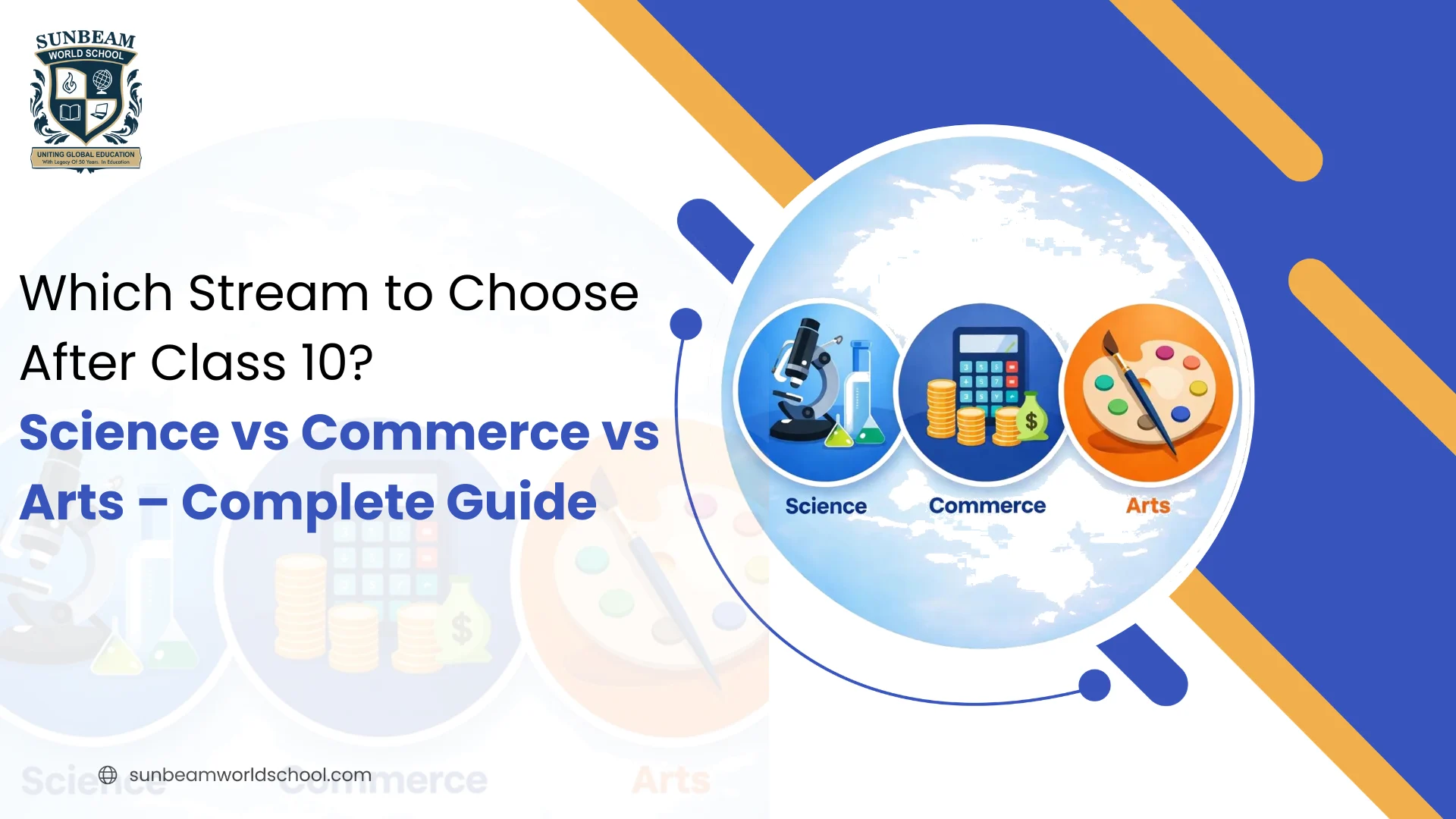
Which Stream to Choose After Class 10? Science vs Commerce vs Arts – Complete Guide
Which Stream to Choose After Class 10 in IndiaChoosing the right stream after Class 10 depends on your interests, strengths, and career goals — not just marks or societal pressure. The three main options in India are Science, Commerce, and Arts, and each offers strong career opportunities. ● Science is best for students interested in engineering, medicine, technology, or research, with subjects like Physics, Chemistry, and Maths/Biology. ● Commerce suits students interested in business, finance, economics, and management, leading to careers like CA, MBA, or banking. ● Arts/Humanities is ideal for students interested in subjects like history, psychology, law, media, and civil services, with growing demand in creative and analytical fields. There is no single “best” stream after Class 10; the right choice depends on your aptitude and long-term goals. Students should evaluate their interests, learning style, and career direction before deciding. A structured self-assessment, career research, and guidance from schools and parents can help make an informed decision. Importantly, stream selection is flexible, and students can change paths later through different courses and career options. |
Every year, millions of students in India face the same question: which stream should I choose after Class 10? With options like Science, Commerce, and Arts, it’s easy to feel confused and pressured to make the “right” decision.
If you’re comparing Science vs Commerce after 10th or wondering whether Arts could be the right fit, you’re not alone. Almost every student goes through this phase of uncertainty.
For many, this choice feels like it will define their entire future. But in reality, choosing a stream is just the beginning of your journey — not the final destination.
This guide gives you everything you need to make an informed decision for choosing the best stream for Class 11 India!
Who Should Read This Guide?This guide is for Class 10 students preparing for their board results, parents who want to support their child without imposing a choice, school counsellors looking for a comprehensive reference, and anyone feeling overwhelmed by the Science vs Commerce vs Arts debate. |
Why Stream Selection After Class 10 Matters More Than You Think
The stream you select in Class 11 determines far more than just the subjects you study for two years. It shapes:
- The undergraduate courses you are eligible to apply for
- The entrance exams you will prepare for (JEE, NEET, CA, CLAT, NDA, CUET, and more)
- Your academic confidence and daily motivation throughout Classes 11 and 12
- The professional network and peer environment you grow in
- Your foundational knowledge base for the next decade of your career
The good news? Every single stream offers high-paying, prestigious, and fulfilling career paths. The idea that only Science leads to 'good jobs' is outdated, and the data support this.
What truly matters is the fit between your natural strengths, your genuine interests, and the demands of the stream. A student who loves Literature and grudgingly studies Physics will almost always perform worse than a student who is passionate about Physics, and the same is true in reverse.
Choosing a Stream After Class 10: Science vs Commerce vs Arts
Understanding the difference between Science, Commerce, and Arts after Class 10 is essential before making your decision. Each stream offers unique subjects, learning styles, and career opportunities. Let’s begin!
Science Stream After Class 10
| Science Stream
Core Subjects: Physics • Chemistry • Mathematics (PCM) • Biology (PCB) • Computer Science (optional) Best Suited For: Analytical thinkers • Problem-solvers • Students who enjoy experimentation • Those with strong math/logic aptitude • Aspiring engineers or doctors Career Paths: Engineering (IIT/NIT/BITS) • Medicine & Surgery (MBBS) • Data Science & AI • Biotechnology • Architecture • Environmental Science • Defence (via NDA) • Research & Academia |
Science is often described as the 'prestige stream' — and while that perception is changing, there is truth in the fact that it opens a very wide set of doors. The core subjects (Physics, Chemistry, Mathematics, or Biology) are demanding and require consistent effort throughout the year.
The PCM combination (Physics, Chemistry, Maths) leads most directly to engineering, technology, and data fields. The PCB combination (Physics, Chemistry, Biology) is the pathway for medicine, pharmacy, and life sciences. Many schools also allow PCM + Biology, which keeps all options open but significantly increases workload.
Key Entrance Exams: JEE Main & Advanced (engineering), NEET-UG (medicine), BITSAT (Birla institutes), NDA (defence), and state-level engineering/medical entrance tests.
The Science Stream Reality CheckScience suits students who genuinely enjoy the subject matter, not just those who score well. Marks in Class 10 Science do not always predict success in Class 11, because the difficulty level increases significantly. Honest self-reflection on your actual interest in physics principles, chemical reactions, and mathematical proofs is essential before choosing this path. |
Commerce Stream After Class 10
| Commerce Stream
Core Subjects: Accountancy • Business Studies • Economics • Mathematics (optional but recommended) • Entrepreneurship (in some schools) Best Suited For: Practical, application-oriented thinkers • Students interested in money, markets, and business • Future entrepreneurs • Those comfortable with numbers but not pure sciences • Students interested in law or management Career Paths: Chartered Accountancy (CA) • Company Secretary (CS) • Cost & Management Accounting (CMA) • BBA / MBA (Management) • Economics & Finance • Banking & Insurance • Law (after Commerce) • Digital Marketing & Analytics |
Commerce is the stream that reflects how the world of business actually works. It bridges the gap between theory and real-world application — you will study how companies manage finances, how economies function, and how markets behave.
One common misconception is that Commerce is only for students from 'business families.' This is simply not true. Some of India's most successful first-generation entrepreneurs, bankers, and finance professionals come from Commerce backgrounds with no prior family exposure to business.
Key Entrance Exams & Professional Routes: CUET for BBA/B.Com programs, CA Foundation (ICAI), CMA Foundation (ICMAI), CS Foundation (ICSI), CLAT for Law, and CAT/XAT for MBA programs after graduation.
The Commerce Stream Reality CheckStudents often underestimate Commerce and are then surprised by its depth. Accountancy requires precision and discipline. Economics demands analytical and logical thinking. If you are considering CA — arguably the most pursued professional qualification from Commerce — be prepared for a multi-year commitment with a historically low pass rate at advanced levels. It is achievable, but it requires serious dedication |
Arts / Humanities Stream After Class 10
| Arts & Humanities Stream
Core Subjects: History • Political Science • Geography • Psychology • Sociology • Economics • Philosophy • Literature & Languages" Best Suited For: Creative thinkers and writers • Students passionate about society, culture, and ideas • Empathetic communicators • Those interested in governance, law, or social change • Students with strong verbal and critical thinking skills Career Paths: Civil Services (IAS/IPS/IFS) • Law (LLB/LLM) • Journalism & Mass Communication • Psychology & Counselling • Design & Fine Arts • Social Work & NGO Sector • Teaching & Education • International Relations • Content & Digital Media |
Arts or Humanities, as it is increasingly called, is arguably the most misunderstood stream in Indian education. It has been unfairly stigmatised for decades, but the narrative is shifting rapidly and for very good reasons.
In 2026, some of the most in-demand skills globally — critical thinking, communication, empathy, cultural understanding, creative problem-solving — are precisely what the Humanities develop. Content creation, UX research, policy analysis, behavioural psychology, and social impact roles are growing faster than ever.
Key Entrance Exams: CLAT (Law), UPSC Civil Services Exam (arguably the most prestigious exam in India, highly accessible from Arts), NID/NIFT (Design), IIMC entrance (Journalism), and CUET for BA programs at central universities.
| The Arts Stream Reality Check
The Arts stream does not guarantee easier marks — it requires deep reading, articulate writing, and the ability to form and defend arguments. Subjects like Political Science and History demand a thorough understanding, not just memorisation. If you are choosing Arts only to 'escape' Science or Commerce, you may find yourself struggling for different reasons. Choose it because the subjects genuinely excite you. |
Science vs Commerce vs Arts: Which Stream is Best After Class 10?
Choosing between Science, Commerce, and Arts after Class 10 can feel confusing, especially when each stream offers different career paths and opportunities.
This comparison will help you understand the key differences in difficulty level, career scope, flexibility, and future growth, so you can decide which stream best matches your interests and goals.
| Factor | Science | Commerce | Arts / Humanities |
| Difficulty Level | High | Moderate | Moderate |
| Math Requirement | High (PCM) | Medium | Optional |
| Creativity Scope | Moderate | Moderate | Very High |
| Job Market Demand | Very High | High | Growing |
| Entrance Exams | JEE / NEET | CA / CMA / CUET | CLAT / NDA / CUET |
| Avg. Course Duration | 4–5 years | 3–5 years | 3–5 years |
| Scope Abroad | Excellent | Good | Good |
| Flexibility to Switch | Moderate | High | High |
How to Choose the Right Stream After Class 10
Before you listen to anyone else, your parents, your teachers, your friends, do this exercise honestly and privately. Your answers matter more than anyone else's opinions.
Step 1: Audit Your Class 10 Subjects
Look at your marks and, more importantly, look at your energy. Which subjects did you look forward to studying? Which ones felt like a chore? Which chapters made you feel curious enough to read beyond the textbook?
You might suit Science if:
- Physics numericals excite rather than exhaust you
- You enjoy Chemistry lab experiments
- Maths feels logical and satisfying, not random
- You find yourself asking 'how does this work?'
You might suit Commerce if:
- Current events in markets and economy interest you
- You enjoy organising, planning, and analysing data
- Business concepts feel intuitive and interesting
- You liked Maths but not Physics or Chemistry
You might suit Arts if:
- Reading, writing, and discussion energise you
- History, current affairs, or society fascinate you
- You think in stories, arguments, and ideas
- You are interested in the 'why' behind human behaviour
| Warning signs of a wrong choice:
● Choosing a stream mainly because friends chose it ● Picking Science 'just in case' without genuine interest ● Letting Class 10 marks alone make the decision ● Choosing based on parental pressure without discussion |
Step 2: Think About Your Learning Style
Streams do not just differ in content — they differ in how learning happens. Understanding your natural learning style can be as revealing as looking at your marks.
- If you learn best through structured problems with clear right answers → Science or Maths-heavy Commerce
- If you learn best through discussion, debate, and reading multiple perspectives → Arts/Humanities
- If you learn best through case studies, real-world examples, and practical scenarios → Commerce
- If you learn best through experiments, data, and hands-on work → Science
- If you learn well across all styles → You have true flexibility and should focus on interest over style
Step 3: Explore Career Directions (Without Committing to One)
At 15, you do not need to know your exact career. You need a rough direction. Ask yourself:
- Do I see myself working more with people, with systems, or with ideas?
- Am I drawn to creating, analysing, or helping people?
- Does the idea of a structured professional career (doctor, engineer, CA) appeal to me, or do I want something more unconventional?
- Am I willing to commit to competitive entrance exams, or do I prefer direct college admission routes?
Your answers to these questions will start to point clearly towards one stream over the others.
Step 4: Talk to People Already in Those Fields
Before finalising anything, speak to at least two or three people who are actually working in careers you are considering. Not just studying, working. Ask them what their day looks like. Ask what skills they use most. Ask what they wish they had known at your age.
Most professionals are happy to share their experiences, and even a 20-minute conversation can give you more clarity than hours of online research.
Your Stream Selection Checklist● I have identified which Class 10 subjects I genuinely enjoyed studying ● I have assessed whether my interest is driven by passion or by marks alone ● I have researched at least 3 career options from each stream I am considering ● I have spoken with my school counsellor or a career guidance professional ● I have discussed my thinking with my parents in an open, two-way conversation ● I have considered the entrance exam requirements for my target careers ● I am choosing based on my own interest — not peer pressure or family expectation ● I understand I can still pivot after Class 12 if my goals evolve |
Top Career Paths From Each Stream in 2026
Here is a more detailed look at where each stream leads — including some exciting emerging careers that did not exist a decade ago.
High-Demand Careers from Science
- Engineering: Artificial Intelligence & Machine Learning Engineer
- Data: Data Scientist and Data Analyst
- Medicine: Medical Doctor (MBBS, MD, MS)
- Engineering: Aerospace and Aeronautical Engineer
- Tech: Cybersecurity Specialist
- Science: Climate Scientist and Environmental Researcher
- Biotech: Biomedical Engineer and Genetic Researcher
- Engineering: Robotics Engineer
High-Demand Careers from Commerce
- Finance: Chartered Accountant (CA) — among India's most respected qualifications
- Finance: Investment Banker and Financial Analyst
- Business: Entrepreneur and Business Strategist
- Marketing: Digital Marketing Manager and Growth Hacker
- Operations: Supply Chain and Logistics Manager
- Law: Corporate Lawyer (after BA LLB or BBA LLB)
- Finance: Actuary — a growing, highly specialised and well-paid field
- Economics: Economist and Policy Analyst
High-Demand Careers from Arts / Humanities
- Civil Services: IAS / IPS / IFS Civil Servant (UPSC — open to all streams)
- Media: Journalist, Documentary Filmmaker, and Podcast Creator
- Tech/Design: UX Researcher and Human-Centred Designer
- Psychology: Clinical Psychologist and Mental Health Counsellor
- Policy: Public Policy Analyst and NGO Leader
- Law: Lawyer (LLB and LLM)
- International: Foreign Service Officer and Diplomat
- Digital: Content Strategist and Social Media Director
How Parents Can Help Choose the Right Stream After Class 10
If you are a parent reading this, your role in this decision is perhaps the most important and the most delicate. Your child needs your support, your resources, and your presence. What they do not need is to carry the weight of your unfulfilled ambitions or your fears about status and security. These are real feelings, but they should not determine your child's academic path.
What Research Consistently Tells UsStudents who choose streams aligned with their interests, even if those streams are seen as 'less prestigious', consistently outperform students who choose high-status streams under family pressure. Academic confidence, mental health, and long-term career satisfaction are all significantly higher when the choice is authentically the student's own. |
What Good Parental Support Looks Like
- Listening to your child's interests before sharing your opinions
- Asking questions like 'What excites you most about that subject?' rather than 'What will you do with that?'
- Researching career outcomes in streams other than the one you would have chosen
- Connecting your child with professionals from different fields — not just the ones you know
- Reassuring your child that every stream has a path to dignity, security, and success
- Supporting the decision even if it differs from what you imagined
The parent who says 'I trust your judgment and I will support you' will see their child thrive far more than the parent who says 'You have to take Science because that is where the opportunities are.'
Can You Change Your Stream Later?
The short answer is yes, but it is important to understand what that means in practice.
1. Switching After Class 10 (Before Class 11 Begins)
This is the easiest window. If your school has not yet locked in your subject combination, you can change it relatively easily. Most schools allow subject changes in the first few weeks of Class 11, though policies vary. Act quickly and consult your school administration.
2. Switching After Class 12 (At the Graduation Level)
This is more common than most students realise. Arts students can pursue engineering degrees via lateral entry in some institutions. Science students regularly pursue management, law, or economics degrees. Commerce students enter journalism, design, and psychology programs.
CUET (Common University Entrance Test) has made cross-stream movement more accessible at the undergraduate level. Many premier universities now evaluate aptitude alongside stream-specific marks.
3. Switching Mid-Career
This happens constantly, and increasingly so. Many professionals change fields entirely in their 20s and 30s. The key skills you develop in any stream (analytical thinking, communication, discipline, research) are transferable. A Science background brings rigour to policy analysis. A Commerce background brings financial literacy to journalism. An Arts background brings storytelling to corporate strategy.
7 Common Myths About Choosing a Stream After Class 10
Many students are influenced by outdated beliefs and half-truths about Science, Commerce, and Arts. Let’s clear those myths and look at what really matters before you decide.
| The Myth | The Reality |
| Science is the only stream with good jobs | Commerce and Arts also lead to well-paying, high-status careers |
| Arts is for students who could not get into Science | Passionate Arts students often outperform disengaged Science students |
| High marks in Class 10 mean you should take Science | Interest and aptitude matter more than marks |
| Commerce only suits students from business families | Commerce is open to students from all backgrounds |
| You can't change streams later | Stream changes and career pivots are possible |
| Only Science students go abroad | Arts and Commerce students also study and work abroad |
| Stream selection determines your entire future | Skills, effort, and adaptability matter more than your stream |
Why School Choice Matters for Stream Selection
Choosing the right stream after Class 10 is important, but the school you choose plays an equally crucial role in shaping your success. Here’s how the right school can make a real difference:
1. Quality of Teaching
Strong faculty can simplify complex concepts and build a solid foundation. This is especially important for demanding streams like Science and subjects like Accountancy in Commerce.
2. Career Guidance & Counselling
A good school provides career counselling sessions, helping students understand different career paths, entrance exams, and future opportunities before and after choosing a stream.
3. Subject Availability & Flexibility
Not all schools offer every subject combination. The right school ensures you have access to the subjects you need and flexibility to explore your interests.
4. Learning Environment
An encouraging and pressure-free environment boosts confidence and performance. Arts students, for example, benefit from open discussions, while Science students need focused academic support.
5. Exposure & Practical Learning
Workshops, labs, industry exposure, and real-world learning opportunities help students connect theory with practice, making learning more engaging and meaningful.
6. Exam Preparation Support
From board exams to competitive exams like JEE, NEET, CUET, or CLAT, schools with structured preparation systems give students a clear advantage.
7. Personalised Attention
Every student learns differently. Schools that offer mentorship and individual support help students stay on track and improve consistently.
At Sunbeam World School, students benefit from a balanced approach that combines academic excellence, career guidance, and a supportive environment. This ensures that every student not only chooses the right stream but also thrives in it.
Time To Make Your Decision
If you have read this guide thoroughly, you now have more clarity than most students do when they make this decision. Here is a simple three-part framework to make your final choice:
- Ask yourself which stream's subjects would energise you on a difficult Monday morning, not which stream looks best on paper.
- Identify at least one career path in your target stream that genuinely excites you, and research what it takes to get there.
- Share your thinking with a trusted adult — a teacher, counsellor, or family member, who will listen before advising.
Whatever stream you choose, commit to it fully for at least the first semester, then reassess. Give yourself time to adjust, ask for help when subjects are hard, and remember that every successful professional you admire once stood exactly where you are standing now.
Conclusion
Choosing the right stream after Class 10 is an important decision, but it does not define your entire future. Science, Commerce, and Arts each offer strong career opportunities, and what truly matters is choosing a path that aligns with your interests, strengths, and long-term goals.
At Sunbeam World School, students receive personalised guidance, career exposure, and a supportive environment to make confident decisions. With the right mentorship, whether in a school or online learning setup, this choice becomes clearer and less stressful. We are currently open for admissions, welcoming students to begin their journey with the right support.
Remember, your stream is just the beginning; your dedication, curiosity, and skills will shape your future far beyond Class 11 and Class 12.
FAQs
1. Which stream is best after Class 10?
There is no single best stream, there is only the best-fit stream for each individual student. Science, Commerce, and Arts each offer excellent careers. The right choice depends entirely on your interests, strengths, and long-term goals.
2. Can I take both Science and Commerce subjects?
Most CBSE and state board schools allow certain subject combinations across streams, for example, Economics from Commerce alongside Science subjects. However, this increases the workload significantly. Check with your specific school for the combinations they permit.
3. What if I am unsure about my career goal? Which stream should I pick?
If you are genuinely undecided, lean towards the stream where you have shown the most consistent interest and energy, not just marks. Science keeps technical doors open but closes some humanities doors. Commerce keeps business options open. Arts/Humanities is the most versatile at the graduate level for non-technical fields. When in doubt, speaking with a qualified career counsellor is worth the investment.
4. Is Commerce without Mathematics a good option?
Commerce without Mathematics is possible, and many students choose this path. However, it may restrict access to certain courses like B.Com (Hons) in some colleges, Economics programs, and other quantitative fields. If Mathematics is not a barrier for you, keeping it as a subject in Commerce is generally advisable.
5. How important are Class 10 marks for stream selection?
Most schools require minimum marks in relevant subjects for certain streams, typically 60% or above in Science for the Science stream. However, Class 10 marks do not predict success in Class 11. Interest, consistency, and willingness to work hard matter far more over the next two years.
6. What is the scope of Arts in 2026?
The scope of Arts and Humanities has expanded dramatically. Civil services, law, design, psychology, journalism, digital media, public policy, and international relations are all highly competitive and well-compensated fields. Arts graduates are increasingly being hired by technology companies for roles in UX research, content strategy, and communications.

In this article
Share this post:


Press and Blogs
Stay updated with our press releases, educational blogs, and more.
Is NCERT enough for JEE Main 2026? NCERT is essential but not sufficient on...
A Levels and AS Levels are globally recognized UK qualifications taken after GCSE or IGCSE...
Best Courses After 12th in India Choosing the right course after Class 12 depends on...