
 Curriculum
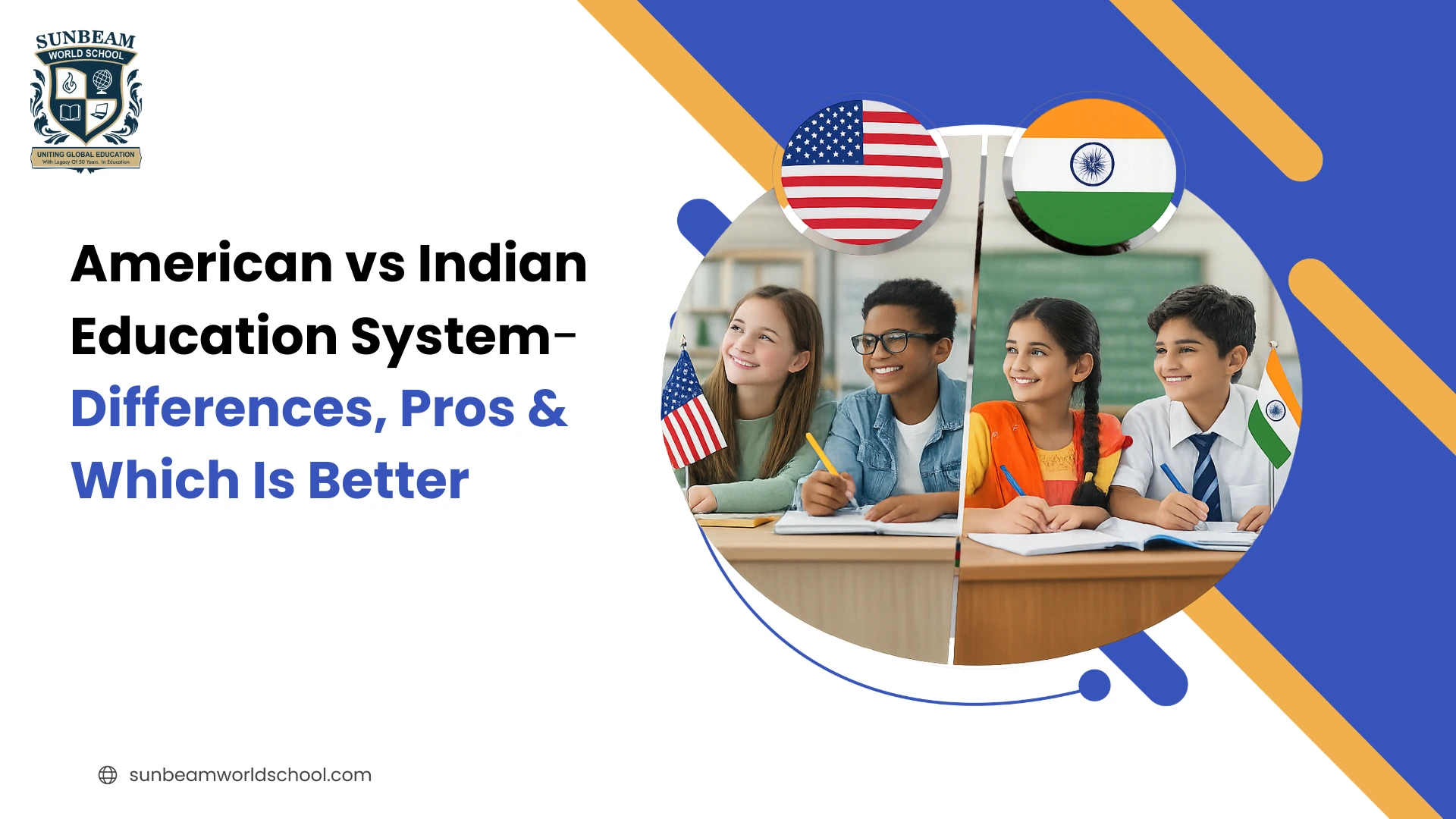
American vs Indian Education System: Differences, Pros & Which Is Better
Indian vs American Education SystemThe Indian education system (CBSE) and the American education system differ in structure, teaching style, flexibility, and assessment. India follows a structured, exam-focused approach that builds strong foundational knowledge, especially in math and science. In contrast, the US system emphasizes flexibility, critical thinking, and holistic development through continuous assessment and extracurricular activities. In India, success is largely marks-driven, with board exams and competitive tests like JEE and NEET playing a crucial role. In the US, admissions are profile-based, considering GPA, extracurriculars, essays, and leadership. While Indian education is more affordable and academically rigorous, the American system offers greater subject choice, creativity, and global exposure. |
What if your child’s future depended not just on how much they study, but how they are taught to think?
The Indian system, based on CBSE, is structured and exam-focused. The American system is flexible and centered on holistic growth. The right fit depends on your child's strengths, interests, and goals that’s the real difference between the Indian education system (CBSE) and the American education system.
One builds discipline, depth, and the ability to master complex subjects under pressure. The other nurtures creativity, confidence, and the courage to question, explore, and innovate.
So the real question isn’t which system is better, it’s this: Which system will bring out the best in your child?
In this guide, we break down the real differences, hidden trade-offs, costs, and outcomes, so you can make a decision that isn’t just informed, but future-ready.
How the Indian And American Education Systems are Structured
Before comparing philosophies or outcomes, you need to understand the nuts and bolts of how each system is laid out from pre-school through high school graduation.
India's Education Structure
India's schooling system follows a 10+2 model — 10 years of general education followed by 2 years of specialised senior secondary schooling. Students are governed primarily by three national boards: CBSE (Central Board of Secondary Education), ICSE (Indian Certificate of Secondary Education), and various state boards. The CBSE alone has over 27,000 affiliated schools across India and abroad.
The journey looks like this: Nursery/KG (3–5 years old), Primary School (Classes 1–5), Upper Primary (Classes 6–8), Secondary (Classes 9–10, leading to the Class 10 Board Exam), and Senior Secondary (Classes 11–12, culminating in the Class 12 Board Exam). Those two final board exams are gateways — they determine college admissions, career trajectories, and in many families, social standing. Students looking for a flexible alternative can explore CBSE-aligned online secondary education that follows the same rigorous curriculum with greater scheduling flexibility.
America's Education Structure
The US follows a K-12 model — Kindergarten through 12th grade. Unlike India's centralised boards, the American system is heavily decentralised. Education is largely a state and district responsibility, with no single national curriculum. This creates enormous variation: a school in rural Mississippi and one in Silicon Valley may have dramatically different resources, expectations, and curricula.
The structure runs: Elementary School (K–5 or K–6, ages 5–11), Middle School (Grades 6–8), and High School (Grades 9–12). High school graduation doesn't rely on a single high-stakes exam. Instead, students build a transcript of grades, standardised test scores (SAT/ACT), extracurriculars, and personal essays for college applications. Families seeking US curriculum-aligned online programs can access this model from anywhere in the world, without relocation.
| Aspect | 🇮🇳 India (CBSE/ICSE) | 🇺🇸 United States |
| Model | 10+2 | K–12 |
| Governing Body | CBSE, ICSE, State Boards | State & Local School Districts |
| Centralization | High (national boards) | Low (state-level control) |
| Primary School | Classes 1–5 | Kindergarten–Grade 5 |
| Middle School | Classes 6–8 | Grades 6–8 |
| High School | Classes 9–12 | Grades 9–12 |
| Key Exit Exams | Class 10 & Class 12 Boards | SAT / ACT (optional at many colleges) |
| School Year / Holidays | ~190 school days/year | ~180 school days/year |
Teaching Philosophy: The Real Difference
If you ask most educators what separates these two systems, the answer almost always comes down to one word: purpose. What is school for?
India's Education Structure: Knowledge as Foundation
Indian education — particularly under CBSE — is built on the idea that students need a deep, reliable foundation of facts, formulas, and theoretical knowledge before they can apply or innovate. The classroom is teacher-centred. Lectures, note-taking, and repetition are the primary modes of instruction. Academic excellence is treated as a moral virtue, not just a practical one.
America's Education Structure: Learning as Exploration
American education is rooted in constructivism — the idea that students learn best by constructing knowledge through experience and inquiry. Classrooms are more student-centred. Teachers ask questions rather than give answers. Discussion, debate, projects, and collaborative problem-solving are central. The aim is to develop a lifelong learner, not just a repository of information.
Indian vs US Education SystemNeither philosophy is wrong. In fact, both are responding to real problems: the Indian system is trying to ensure no child gets left behind on core knowledge in a resource-constrained environment. The American system is trying to prepare students for a world where information is freely available, and the premium is on knowing what to do with it. We cannot forget that India's "rote learning" reputation is real but overstated. Elite schools in Bangalore, Mumbai, and Delhi, particularly those with international curricula, are deeply project-based and inquiry-driven. Similarly, not all American schools are bastions of critical thinking; many underfunded public schools in the US drill standardised test prep as relentlessly as any Indian coaching institute. |
Curriculum Design & Subject Flexibility
What children actually study and how much choice they have in the matter differ dramatically between the CBSE vs IGCSE vs American curriculum..
India: Deep, Structured, Demanding
The CBSE syllabus is renowned for its academic rigour, particularly in Mathematics and Science. By Class 10, Indian students are covering topics in algebra, calculus foundations, and chemistry that American high schoolers typically encounter in Grade 11 or 12. This depth gives Indian graduates a strong quantitative edge, and it's one reason Indian professionals dominate fields like engineering, medicine, and finance globally.
The trade-off is flexibility. Until Class 11, students have minimal choice in what they study — the curriculum is standardised and mandatory. In Classes 11–12, they choose between streams: Science, Commerce, or Humanities. But this choice, once made, is relatively binding. A Science student switching to Commerce faces serious obstacles.
USA: Broad, Flexible, Interdisciplinary
American high school students can take courses ranging from AP Calculus to Film Studies to Entrepreneurship — sometimes in the same semester. Students earn credits toward graduation, and electives make up a significant portion of their schedule. This interdisciplinary approach means students graduate with a broader (if sometimes shallower) academic portfolio.
Advanced Placement (AP) courses let motivated students take college-level classes during high school — and if they score well on the AP exam, they can earn college credit, saving time and tuition money.
| Curriculum Factor | India (CBSE) | USA |
| Core Subjects Depth | Very High (especially Math & Science) | Moderate — varies by school |
| Elective Flexibility | Low until Class 11 | High from Grade 9 onwards |
| Stream/Track Choice | Fixed after Class 10 (Science/Commerce/Arts) | Fluid — students can change courses yearly |
| Advanced / Accelerated Learning | Competitive exams (JEE, NEET) | AP, IB, Dual Enrollment programs |
| Vocational / Practical Learning | Limited in mainstream schools | Widely available (CTE programs) |
| National Standardisation | High (NCERT textbooks) | Low (varies by state & district) |
| Language Requirement | Hindi + English + third language | English; foreign language often optional |
The Math FactorIndian and American students learn math differently—and it shows in their strengths.
What does this mean in real life?
|
Examinations & Assessment: Two Worlds Apart
Nothing reveals the philosophical difference between these systems more clearly than how they assess students.
India: High-Stakes, High-Pressure
The Indian system is exam-centric. Class 10 and Class 12 board examinations are centralised, standardised, and carry enormous weight. A student's future college options — and in many families, their sense of self-worth — is tied to these marks. The exams test detailed subject knowledge, often with a significant memory component. One bad exam day can undo years of preparation. For students navigating this system, a complete study guide for CBSE board exams can make a significant difference in how confidently they approach these high-stakes assessments.
Beyond boards, competitive entrance exams like JEE (for IITs) and NEET (for medical colleges) are among the most difficult exams in the world. JEE Advanced 2024 had an acceptance rate of under 0.3% — stricter than Harvard. This creates an entire parallel coaching industry worth over ₹58,000 crore annually.
USA: Continuous, Multi-Dimensional
American assessment is spread over the entire school year. Grades factor in homework, quizzes, tests, projects, class participation, and presentations. This continuous assessment model reduces the impact of any single bad day but introduces its own pressure: students must perform consistently across every class, every week.
For college admissions, the SAT and ACT matter, but they're just one piece of a holistic application that includes GPA, extracurriculars, recommendation letters, and personal essays. Over 1,800 US colleges have gone "test-optional" post-pandemic, further reducing reliance on standardised testing.
| Aspect | India — Exam Reality | USA — Exam Reality |
| Primary Evaluation Metric | Class 12 Board Scores | GPA + Standardized Tests (SAT/ACT) |
| Typical Competitive Benchmark | 95%+ in Class 12 | GPA 3.8+ and SAT 1400+ |
| Preparation Approach | 2+ years of intensive coaching (JEE/NEET) | Balanced focus on academics + extracurriculars |
| Role of Entrance Exams | Extremely high (JEE, NEET decide top college entry) | Important but not decisive (many colleges test-optional) |
| Holistic Factors | Limited role | Major role (essays, leadership, research, personality) |
| Admission Reality | Marks-driven system | Profile-driven system |
| Key Insight | High scores are essential for top colleges | Strong profile matters as much as academic scores |
The Hidden Cost of Both SystemsBoth education systems build valuable skills, but at a cost.
But there’s a catch: |
The Teacher's Role: Authority vs. Facilitator
The relationship between teacher and student might be the most culturally loaded difference between the two systems.
In India, teachers hold a position of deep cultural authority — the guru-shishya tradition runs through Indian pedagogy even in its modern secular form. Students are expected to receive knowledge respectfully, not challenge it. Questioning a teacher in class is often seen as disruptive rather than intellectually healthy. This creates an environment of discipline and respect, but can suppress the kind of critical inquiry that drives innovation.
In American classrooms, teachers function more as facilitators of learning. Students are encouraged — sometimes required — to defend their views, debate their peers, and challenge assumptions including the teacher's. This can feel chaotic by Indian standards, but it develops articulateness, confidence in public speaking, and the ability to handle disagreement productively.
Importantly, neither dynamic is "natural" — both are deeply cultural. Indian students who arrive at American universities often describe the first semester as disorienting: suddenly, they're expected to have opinions and share them loudly. American students in rigorous Indian coaching environments often struggle with the intensity of memorisation and the lack of creative latitude.
Indian Teacher Model- Strengths
- A clear authority structure aids classroom management
- Deep subject matter expertise expected
- Strong mentor-student relationships (especially coaching)
- Systematic knowledge transfer is efficient
- Cultural respect for the teacher motivates effort
Indian Teacher Model- Weakness
- Can suppress questioning and intellectual risk-taking
- Overloaded classrooms (40–60 students) limit personalisation
- Teacher-centred; student voice is secondary
- Low salaries in government schools affect quality
- Limited professional development / updating methods
American Teacher Model- Strengths
- Fosters independence, critical thinking, self-expression
- More student-centred and responsive
- Differentiated instruction for varied learning styles
- Regular professional development is standard
- Encourages curiosity and question-asking
American Teacher Model- Weakness
- Enormous quality variance between school districts
- Low social status of teachers vs. India's guru tradition
- Teacher burnout and turnover are significant issues
- Students can lack rigour without teacher authority
- Underfunded schools face severe resource constraints
Student Well-being, Stress & Extracurriculars
This is where both systems face their most serious criticisms — for very different reasons.
The Indian Pressure Cooker
The mental health toll of India's competitive academic environment is well-documented and deeply concerning. Students preparing for JEE or NEET often study 12–16 hours a day for 2+ years. Kota, the coaching hub city in Rajasthan, has become synonymous with both academic excellence and a tragic rate of student suicides. The pressure doesn't originate only from schools — it comes from families, communities, and the very real scarcity of good college seats relative to the number of aspirants. Learning how to deal with exam stress and setbacks is a skill that is just as important as the subjects themselves in the Indian academic context.
Extracurricular activities — sports, arts, music, social activities — are often treated as distractions in India's exam-focused culture. This is changing at elite private schools, but in the mainstream, a student spending three hours on football is often viewed by family as squandering precious study time.
The American Paradox
American students face their own mental health crisis, though the causes differ. Social media, campus violence concerns, increasing economic inequality, and a culture of performative achievement (college application anxiety in affluent suburban schools can rival anything in India) all contribute. A 2023 CDC survey found that nearly 30% of US high school students experienced poor mental health, the highest level in decades.
The US system genuinely values extracurriculars — they are built into college applications, school culture, and scheduling. Students who play sport, lead clubs, volunteer, and maintain a strong GPA are the archetype of a successful American student. This is healthy in theory, but in practice, it creates a different kind of pressure: the pressure to be exceptional in everything simultaneously.
| In India, success often depends on acing exams. In the US, success means strong grades plus extracurriculars, achievements, and a compelling personal story. |
Real Costs: What Education Actually Costs Families
Cost is one of the most practically important factors — and one of the most honestly discussed.
Cost of Education in India
India's public school system is free and universal by law — but the quality of government schools varies wildly. The vast majority of India's urban middle class opts for private schools, which range from ₹30,000/year for a modest CBSE school to ₹8–15 lakh/year for elite international schools in metro cities.
Add coaching classes for boards and entrance exams (₹1–5 lakh/year in cities, much more in intensive residential programmes), and the total cost of a K-12 + college-prep education for a competitive student can reach ₹20–50 lakh over 12 years — without higher education.
Cost of Education in the USA
Public K-12 schooling in the US is free for residents, funded by local property taxes, which is why wealthy neighbourhoods have dramatically better-funded schools. Private K-12 schooling ranges from $15,000 to $60,000+ per year for elite prep schools.
The real cost shock comes at the university level: tuition at a private US university runs $55,000–$85,000 per year (not including room, board, and other costs). State universities are cheaper for in-state residents ($10,000–$30,000/year tuition), but total costs, including living, can reach $30,000–$50,000/year.
| Education Stage | India (Approx.) | USA (Approx.) |
| Public K–12 | Free (government schools) | Free (public schools) |
| Private K–12 (Mid-range) | ₹50K–₹2L/year | $15K–$35K/year |
| Elite Private K–12 | ₹5L–₹15L/year | $40K–$65K/year |
| Coaching / Tutoring | ₹50K–₹5L/year | $2K–$15K/year |
| Public University (per year) | ₹30K–₹2L | $10K–$30K (in-state) |
| Top Private University | ₹2L–₹12L/year (IITs/IIMs) | $55K–$85K/year |
| Student Loan Culture | Growing but less prevalent | Deeply entrenched ($1.7T total debt) |
| The Bottom Line on Cost
India's K-12 education is dramatically more affordable than America's — even at the elite private level. Where India loses its advantage is at the university level: a seat at IIT costs almost nothing compared to MIT, but there are only ~16,000 IIT seats for 1.3 million JEE applicants. The American system is expensive but far more accessible at the undergraduate level, and financial aid makes elite universities genuinely reachable for talented low-income students. |
Career Outcomes & Global Recognition
Ultimately, any education system must be judged partly by what it produces — and here both systems have compelling stories.
What Indian Education Produces
India's education system has produced some of the world's most successful engineers, doctors, scientists, and business leaders. A 2023 study found that Indian-origin CEOs lead more Fortune 500 companies than any other immigrant group, Google's Sundar Pichai, Microsoft's Satya Nadella, Adobe's Shantanu Narayen, and IBM's Arvind Krishna all came through the Indian education system. The rigour of Indian mathematics and science education creates world-class technical talent.
Domestically, India's higher education system has expanded massively, with 1,000+ universities and 40,000+ colleges. IITs and IIMs carry genuine global prestige, and their graduates command salaries competitive with top Western university graduates.
What American Education Produces
American universities, particularly the Ivy League, MIT, Stanford, and state flagship universities, dominate global rankings. The US higher education system has produced more Nobel laureates than any other country by a wide margin. The emphasis on research, interdisciplinary thinking, and innovation culture means American graduates are disproportionately represented in founding startups, leading creative industries, and driving scientific breakthroughs.
The flexibility of the American system also means graduates are comfortable pivoting careers, working across industries, and adapting to change — skills increasingly valuable in an economy disrupted by automation and AI.
The Emerging Hybrid AdvantageThe most successful students today combine the best of both systems.
Together, these create a powerful advantage. This is why many second-generation Indian-Americans—who grow up with both influences—often excel as entrepreneurs, engineers, and leaders.This blend of deep knowledge and strong soft skills is what personalized learning as a future standard aims to deliver — tailoring the academic experience to each student's strengths rather than forcing a one-size-fits-all model. |
How to Choose the Right Education System For Your Child
Choosing the right education system depends on your child’s strengths, career goals, learning style, and budget. Here’s how to decide what fits best.
| Choose Indian Education If… | Choose American Education If… |
| Your child has strong aptitude in math and science | Your child’s strengths are creative, artistic, or entrepreneurial |
| You are aiming for careers like engineering, medicine, or finance | You value holistic development alongside academics |
| Cost is a major factor (more affordable option) | You can manage the cost or access financial aid |
| You value deep foundational knowledge over breadth | You prefer flexibility and exploration in learning |
| Your child performs well under structure and clear expectations | Your child struggles with high-pressure exam environments |
| You plan for IIT/IIM or studying abroad after graduation | You want your child to study and work in the US |
| You prefer a focused, academically rigorous path | You want a college experience that values the whole profile |
Is the Indian or American Education System Better?
Neither system is better overall. Each one suits a different kind of student. The Indian system is a better fit if your child thrives on structure, depth, and exam-based achievement. The American system is a better fit if your child needs flexibility, creative freedom, and a broader definition of success.
The question "which is better" only makes sense once you ask: better for whom, for what purpose, and with what resources?
There is no universally superior system. The Indian system produces excellent outcomes for students with strong academic ability who are entering technical fields. It builds the discipline, foundational knowledge, and tolerance for difficulty that lead to world-class engineers and doctors.
The American system produces better outcomes for students whose talents are creative, entrepreneurial, or interdisciplinary. It gives them space to discover and develop those talents, instead of filtering them out through narrow exam performance.
| Choose Indian Education If… | Choose American Education If… |
|---|---|
| Your child has strong aptitude in math and science | Your child's strengths are creative, artistic, or entrepreneurial |
| You are aiming for careers like engineering, medicine, or finance | You value holistic development alongside academics |
| Cost is a major factor (more affordable option) | You can manage the cost or access financial aid |
| You value deep foundational knowledge over breadth | You prefer flexibility and exploration in learning |
| Your child performs well under structure and clear expectations | Your child struggles with high-pressure exam environments |
| You plan for IIT/IIM or studying abroad after graduation | You want your child to study and work in the US |
| You prefer a focused, academically rigorous path | You want a college experience that values the whole profile |
Conclusion: Indian vs American Education System
Both the American education system and the CBSE-based Indian education system have produced exceptional thinkers, leaders, and innovators. The CBSE system builds strong academic foundations, discipline, and deep subject knowledge, while the American system encourages creativity, flexibility, and self-expression.
At institutions like Sunbeam World School, educators are increasingly blending these strengths to offer a more balanced, future-ready learning experience. Sunbeam holds internationally accredited online programs spanning Indian, American, British, and Australian curricula — making it one of the few schools where families can choose the model that best fits their child without switching institutions.
Ultimately, there is no single “better” system. The right choice depends on a child’s strengths, goals, and learning style. A system that combines rigour with creativity and structure with exploration is best suited for success in today’s global world. Explore Sunbeam World School's programs and find the curriculum track that is the right fit for your child.
FAQs
1. Which is better: Indian or American education system?
There is no universally better system. The Indian education system excels in academic rigor and foundational knowledge, while the American system focuses on flexibility, creativity, and holistic development. The right choice depends on a student’s goals, strengths, and learning preferences.
2. Why is the American education system considered more flexible?
The American education system allows students to choose electives, explore multiple subjects, and change academic paths easily. This flexibility encourages creativity, interdisciplinary learning, and personal growth, unlike India’s more structured and stream-based approach.
3. Is the Indian education system too stressful for students?
The Indian system can be highly competitive and exam-focused, leading to significant academic pressure. While it builds discipline and resilience, it can also impact mental health, especially for students preparing for competitive exams like JEE and NEET.
4. Do American schools focus less on academics?
American schools do not focus less on academics; instead, they balance academics with extracurricular activities, projects, and skill development. The system emphasizes application of knowledge, critical thinking, and overall personality development rather than only exam performance.
5. Why do Indian students perform better in mathematics?
Indian students often outperform in mathematics due to a strong focus on practice, repetition, and conceptual depth. The structured curriculum builds solid computational skills, though it may offer fewer opportunities for creative problem-solving compared to the American system.
6. Is studying in the USA more expensive than in India?
Yes, studying in the USA is significantly more expensive, especially at the university level. However, scholarships, financial aid, and diverse college options can offset costs, whereas India offers more affordable education but limited seats in top institutions.
7. What are the main differences between the CBSE and the US curriculum?
CBSE focuses on a standardized, theory-heavy curriculum with limited flexibility, while the US curriculum offers diverse subjects, electives, and continuous assessment. The American system promotes exploration, whereas CBSE emphasizes depth and academic discipline.
8. Which education system is better for studying abroad?
The American system aligns more closely with global universities due to its flexible curriculum and holistic evaluation. However, Indian students from CBSE or ICSE also succeed abroad if they complement academics with extracurricular activities and strong application profiles.
9. Do extracurricular activities matter more in the US than in India?
Yes, extracurricular activities play a major role in the US education system and college admissions. In India, academics remain the primary focus, though the importance of extracurriculars is gradually increasing in top schools and universities.
10. Can Indian students succeed in the American education system?
Yes, Indian students often adapt well and succeed in the American system. Their strong academic foundation gives them an advantage, and with time, they develop skills like communication, critical thinking, and participation in extracurricular activities.
11. Is CBSE recognised in the USA?
Yes, the CBSE qualification is widely recognised by American universities. Students with strong Class 12 CBSE scores (especially 85%+) and good SAT/ACT scores can apply and are regularly admitted to competitive US universities. Some universities may ask for SAT Subject Tests or AP scores for additional academic evidence.

In this article
Share this post:


Press and Blogs
Stay updated with our press releases, educational blogs, and more.
For NRI families moving to Australia, choosing between WACE and IGCSE depends on long-term plans...

The CBSE new curriculum 2026-27 introduces significant reforms aligned with NEP 2020, moving away from...

What after IGCSE? After completing IGCSE, students usually move to A Levels (2 years) to...