
 Online School
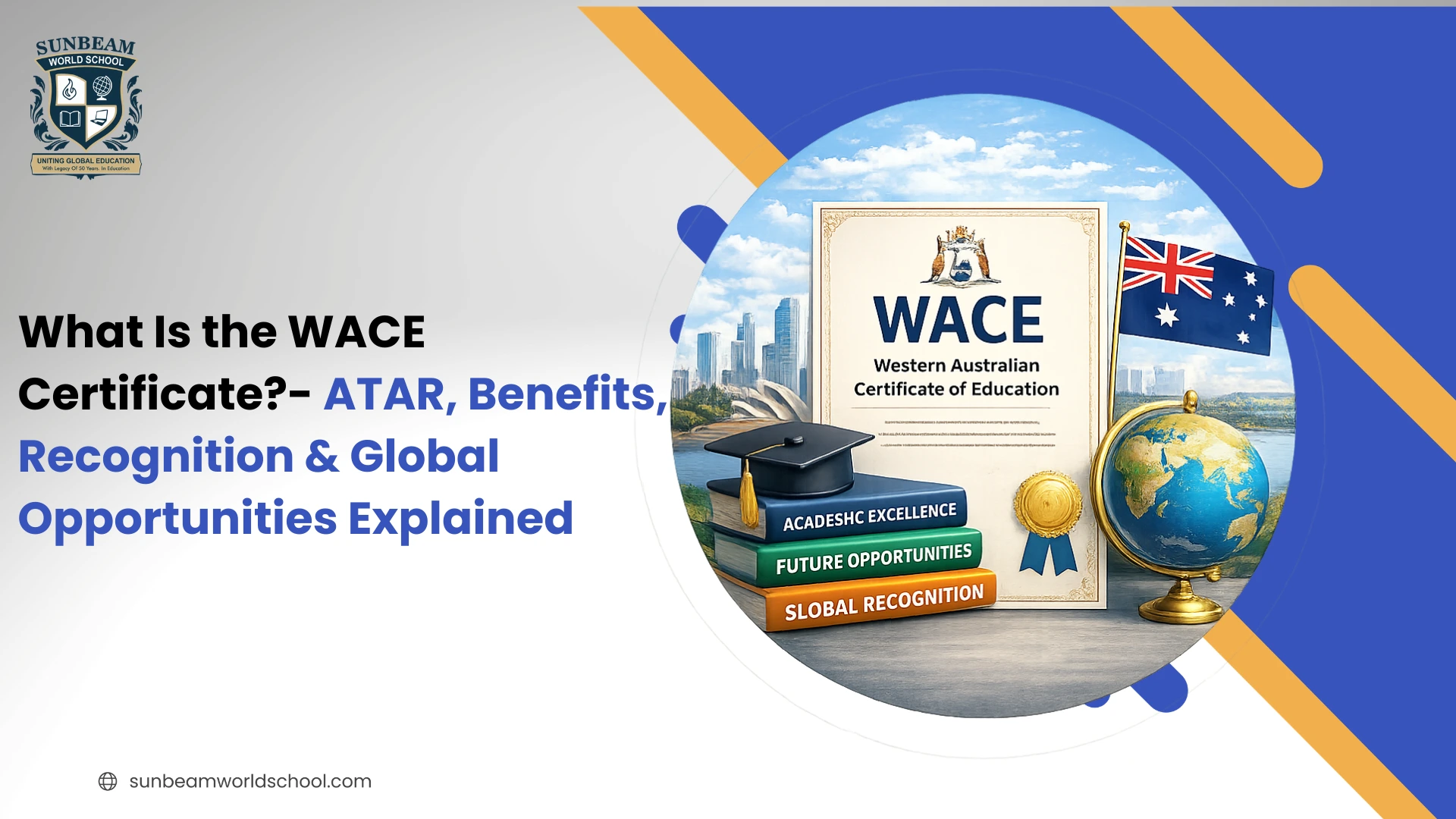
What Is the WACE Certificate? ATAR, Benefits, Recognition & Global Opportunities Explained
| The Western Australian Certificate of Education (WACE) is an internationally recognized senior secondary qualification issued by the Government of Western Australia. Now officially accepted in India by the Association of Indian Universities (2023), it offers students global university access with local equivalence.
Unlike traditional boards like CBSE, WACE provides flexible learning through three pathways: ATAR (university-focused), General, and Vocational (VET), allowing students to customize their academic journey. It's globally accepted Australian Tertiary Admission Rank (ATAR) gives students a standardized score used by top universities worldwide. WACE aligns strongly with India’s National Education Policy 2020, emphasizing skill-based, flexible, and holistic learning. With acceptance across Australia, the UK, the US, Canada, and India, it bridges global education opportunities with national recognition. |
Planning to send your child abroad for higher education?
Then the school board you choose today can shape their entire future. Because not every curriculum is built for global university admissions.
While CBSE, IB, and Cambridge are familiar options, the WACE (Western Australian Certificate of Education) is emerging as a smarter, more flexible pathway. With its globally recognized ATAR score, personalized subject choices, and direct access to international universities, it is designed for students who want to study and succeed globally.
So what makes WACE different, and could it be the better choice for your child?
Let’s break it down.
What Is the WACE Certificate?
WACE stands for the Western Australian Certificate of Education. It is the official senior secondary qualification awarded by the School Curriculum and Standards Authority (SCSA), a statutory body that operates directly under the Government of Western Australia. This is not a private organization or a non-profit foundation; it is a government institution with over a century of heritage, established in 1913.
Students earn the WACE upon completing Years 11 and 12 (equivalent to Classes 11 and 12 in India). To receive the certificate, they must meet requirements across three standards: breadth and depth of study, academic achievement, and literacy and numeracy competency. As of 2020, there are 106 courses available for students to study, a number that far exceeds most other international boards.
The key difference from other boards and WACE is that it is a government-issued certification. Every certificate carries a unique student identification number from SCSA, and all credentials are issued under the authority of the Government of Western Australia. There is no intermediary, no franchise model.
Along with the WACE certificate, every student also receives a Western Australian Statement of Student Achievement (WASSA) — a formal record of every course, qualification, and program they completed during senior secondary schooling. This document travels with students wherever they go and is recognized by universities and employers globally.
Understanding the ATAR: Your Global University Key
One of the most distinctive features of WACE is the ATAR: the Australian Tertiary Admission Rank. Think of it as a universally understood academic score, a percentile rank between 0.00 and 99.95 that tells universities exactly where a student stands relative to all school-leaving students in Western Australia.
An ATAR of 90.00, for example, means the student has performed at an equal or higher level than 90% of all school-leaving-aged people in the state. It is calculated by the Tertiary Institutions Service Centre (TISC) in Western Australia, based on a student's best results across their Year 12 ATAR-pathway subjects.
What makes the ATAR especially powerful is its portability. Unlike board percentages that can be interpreted differently by different institutions, the ATAR is a standardized, recognized metric used by top universities across Australia, the UK, the US, Canada, Europe, and Asia to evaluate applicants directly from school.
| WACE students in India who complete the ATAR pathway receive a globally transferable score that opens doors to the Group of Eight Australian universities, the UK Russell Group, Ivy League institutions, and top universities in Canada, Europe, and Singapore, as well as full Class 12 equivalence for Indian university admissions. |
Three Pathways: Every Student Finds Their Fit
One of WACE's most talked-about features is that it does not force every student into the same academic mould. Students in Years 11 and 12 choose from three distinct learning pathways, typically selecting five to six subjects across a combination of these tracks:
Pathway 1
ATAR
University-bound students. Externally examined. Generates the ATAR score for direct university entry. At least 4 ATAR courses required.
Pathway 2
General
Broadens skills and knowledge. Ideal for students who want depth in specific areas without ATAR examinations. At least 5 Year 12 General courses required.
Pathway 3
VET
Vocational Education and Training. Leads to recognized qualifications for practical, skills-based careers. Can be combined with ATAR or General courses.
This flexibility means a student passionate about filmmaking, coding, business, medicine, or hospitality can craft a senior secondary experience that genuinely reflects their interests and goals, not a rigid stream assigned by stream selection.
Importantly, WACE also allows the integration of regional Indian languages, Indian History, and Social Sciences within its curriculum structure. This is a deliberate design choice to ensure global learning stays rooted in the local context, a rare combination in international education.
WACE in India: Official Recognition and What It Means for You
The entry of WACE into India is not a pilot experiment or a soft launch. It is backed by a formal series of recognitions that make it a fully legitimate pathway for Indian students.
In 2023, the Association of Indian Universities (AIU) officially granted WACE foreign board equivalence, treating it as equivalent to Indian Class 10 and Class 12 qualifications. This means a student who completes WACE in India can apply to Indian universities with the same standing as a CBSE or ICSE student.
WACE also aligns strongly with India's National Education Policy (NEP) 2020. When SCSA mapped its curriculum against NEP 2020 priorities, the overlap was significant; both frameworks emphasize holistic development, competency-based learning, flexibility in subject selection, and the integration of vocational education. India's NEP 2020 called for exactly the kind of system WACE has been delivering for decades.
| Historic milestone: WACE is the first international government-backed school board to receive official recognition in India in over 25 years. The last time a foreign board entered the Indian education system at this scale was more than two decades ago. It follows Australia's expanding academic footprint in India, which also includes the establishment of Deakin University and the University of Wollongong campuses on Indian soil. |
Over the next three years, WACE aims to partner with 100 schools across India. Sunbeam World School is among the pioneering institutions already delivering this curriculum, giving our students a significant head start.
WACE vs CBSE vs IB vs Cambridge: An Honest Comparison
No comparison guide can substitute for understanding what matters most for your child's specific goals. But here is a clear, factual breakdown across the dimensions that families ask about most WACE vs CBSE vs IB vs Cambridge:
| Feature | WACE | CBSE | IB (IBDP) | Cambridge (A-Level) |
| Governing Body | Govt. of Western Australia | Govt. of India | Private non-profit (IBO) | University of Cambridge |
| India Recognition | AIU (2023) | National Board | AIU | AIU |
| Global University Entry Score | ATAR (universally accepted) | % score (India-focused) | IB Points | A-Level Grades |
| NEP 2020 Alignment | Strong alignment | Partial | Partial | Partial |
| Subject Flexibility | 106 courses, 3 pathways | Stream-based, limited | 6 subject groups, some flexibility | High flexibility |
| Regional Language / Indian Content | Officially integrated | Built-in | Limited | Limited |
| JEE / NEET Alignment | Separate prep needed | Direct alignment | Separate prep needed | Separate prep needed |
| Relative Cost | Moderate (vs IB) | Most affordable | High | Moderate–High |
| Australian University Pathway | Direct ATAR entry | Additional steps needed | Possible with bridging | Possible with bridging |
The honest summary: if your child's goal is a strong performance in a competitive Indian exam (JEE/NEET), CBSE remains the most direct route. But if the goal is global university readiness, a skills-driven education, and keeping international options wide open, WACE offers advantages that no other board in India currently combines in one package.
Why Should Students in India Choose the WACE Curriculum?
Confused between CBSE, IB, or Cambridge? WACE offers global recognition, flexible learning, and ATAR-based university access, all while keeping Indian options open.
1. Direct Pathway to Top Global Universities
WACE offers the globally recognized ATAR score, used by universities in Australia, the UK, the US, Canada, and Asia. Unlike percentage-based systems, ATAR provides a standardized ranking, making admissions clearer and more transparent. This gives students a strong advantage when applying to competitive international universities without complex grade conversions.
2. Recognized in India (No Compromise on Local Options)
WACE is officially recognized by the Association of Indian Universities, making it equivalent to Class 12 in India. This ensures students can apply to Indian universities and keep domestic career options open, while still benefiting from a globally aligned curriculum and international opportunities.
3. Flexible Subject Choices (No Rigid Streams)
WACE removes the traditional Science, Commerce, and Arts divide by offering flexible subject combinations. Students can choose from ATAR, General, and VET pathways based on their interests and goals. This allows them to build a personalized academic journey instead of following a fixed, one-size-fits-all structure.
4. Designed for Study Abroad Aspirations
WACE is built for students planning to study abroad. It focuses on skills like research, academic writing, and independent learning, which are essential for global universities. This ensures students are not just eligible for international admissions but also prepared to succeed in competitive academic environments worldwide.
5. Strong Alignment with Future Skills
Aligned with the National Education Policy 2020, WACE emphasizes critical thinking, practical knowledge, and real-world application. Instead of rote memorization, students learn how to analyze, solve problems, and apply concepts, making them better prepared for modern careers and evolving industry demands.
6. Balanced Alternative to IB and Cambridge
WACE offers global recognition similar to IB and Cambridge but with a more structured and balanced approach. It is often more accessible and flexible, while still maintaining strong academic standards. This makes it a practical option for families seeking international education without the intensity or cost associated with other global boards.
7. Encourages Career-Focused Learning Early
Through its VET and flexible pathways, WACE allows students to explore career interests during school itself. They can combine academic subjects with skill-based learning, helping them gain clarity about future careers. This early exposure supports better decision-making before entering university or professional pathways.
8. Reduces Academic Pressure
WACE follows a balanced assessment system with continuous evaluation rather than relying on one final exam. This reduces stress and encourages consistent learning. Students can focus on understanding concepts over time, leading to better academic performance, improved confidence, and a healthier learning experience overall.
Where Can WACE Take Your Child?
WACE graduates are accepted by leading universities across virtually every major English-speaking and international destination. Here is a snapshot of the universities where WACE students compete directly with their ATAR:
| Region | Top Universities & Institutions |
| Australia | University of Melbourne, ANU (Canberra), University of Sydney, University of Queensland, Monash University, Curtin, UWA, ECU |
| United Kingdom | Oxford & Cambridge, Imperial College London, UCL, King’s College London, Russell Group universities |
| United States | Ivy League institutions, MIT, Caltech, top liberal arts colleges |
| Canada & Asia | UBC, University of Toronto, McGill University, NUS, NTU (Singapore), top Hong Kong & Japanese universities |
| India | All AIU-member universities, private & deemed universities, full Class 12 equivalence |
Additionally, WACE students in India gain access to a Western Australian Government Bursary of AUD 20,000 on a merit basis — a tangible financial benefit that no other international board in India currently offers.
WACE at Sunbeam World School: What Makes This Different
Sunbeam World School is an AI-powered online school serving over 100,000 students across 30+ countries, from Nursery to Grade 12. Our offering of WACE is not simply about adding another board to a list, it is about giving our students one of the most future-ready educational qualifications in the world, delivered in a learning environment already built for the global era.
Here is what WACE students at Sunbeam World School benefit from:
Internationally certified teachers — all WACE teachers complete over 150 hours of annual training led by SCSA-certified trainers
Year-round academic support — dedicated online portal, fortnightly live Q&A sessions with the SCSA team, and ongoing curriculum guidance
Flexible learning batches — three batch timings designed for students across different time zones
Australian connection opportunities — student exchange programmes, university visits, and graduation celebrations in Western Australia
Dual recognition — AIU-equivalent for Indian universities, ATAR for global institutions
Online delivery — accessible to students in any city in India or abroad, with no geographic restriction
Conclusion
The WACE certificate is more than a new option; it represents a shift toward global, flexible, and future-ready education.
With its ATAR-based evaluation, multiple learning pathways, and international recognition, WACE gives students the freedom to learn beyond rigid systems while keeping both Indian and global opportunities open.
This is where Sunbeam World School makes a real difference. By combining WACE with AI-powered personalized learning, global exposure, and continuous academic support, the school creates an environment built for modern learners.
As education evolves, the focus is no longer just on choosing a board, but choosing the right future. And WACE at Sunbeam World School offers exactly that.

Frequently Asked Questions
What is the WACE certificate?
-The Western Australian Certificate of Education (WACE) is the official senior secondary qualification issued by the School Curriculum and Standards Authority (SCSA), a statutory body of the Government of Western Australia. It is awarded after completing Years 11 and 12 and is internationally recognised by top universities across Australia, the UK, US, Canada, and now India — following AIU equivalence in 2023.
Is WACE recognized by Indian universities?
+What is the ATAR, and how is it different from a board percentage?
+How is WACE different from IB or Cambridge?
+Can WACE students appear for JEE or NEET?
+How long has WACE been active internationally?
+
In this article
Share this post:


Press and Blogs
Stay updated with our press releases, educational blogs, and more.

Quick Summary An algebra equation is a maths statement that sets two expressions equal using...
Quick Summary The area of rectangle equals its length multiplied by its width (A =...
Quick Summary Sympathy means feeling sorry for someone from your own point of view. Empathy...