
 Curriculum
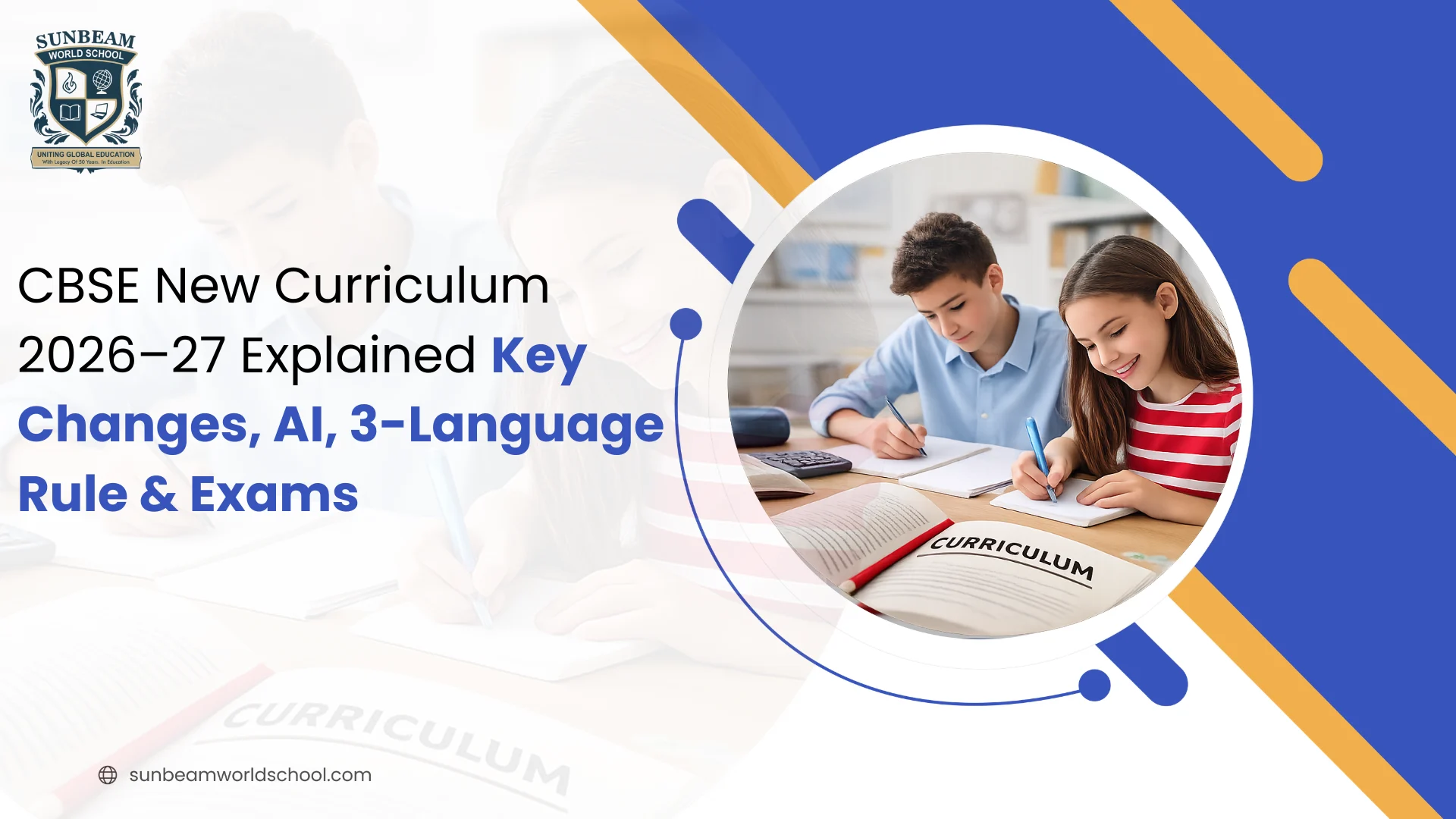
CBSE New Curriculum 2026–27 Explained: Key Changes, AI, 3-Language Rule & Exams For Classes 6-12
| Starting in the 2026–27 academic session, CBSE is rolling out major reforms aligned with NEP 2020, shifting focus from rote memorization to competency-based learning and real-world application. Key changes include the introduction of Computational Thinking and AI from Class 3, a mandatory three-language formula with at least two Indian languages (R3 from Class 6), and compulsory vocational education in Classes 9–10. Students will also have the option to take an advanced-level Maths and Science paper from Class 9 without affecting their aggregate. For senior classes, rigid stream boundaries are being removed to allow greater subject flexibility. Board exam reforms begin from 2028, with around 50% competency-based questions and the introduction of two exam sessions, while AI becomes a board-examined subject by 2029 and the full three-language policy is implemented by 2031. |
If you’re a parent of a school-going child, a CBSE teacher, or a student stepping into Class 9 this year, the past two weeks have probably left you overwhelmed with half-explained news headlines. Two Indian languages are compulsory. AI is now a subject. Maths has two levels now?
From a compulsory third language in Class 6 to AI coding sessions for Class 3 students, CBSE’s 2026-27 overhaul is the most significant curriculum shift in a decade. Here’s every change, with real timelines and zero jargon.
Let’s start with a clear snapshot of everything that changed.
| Parameter | Details |
| Released on | 1–2 April 2026 |
| Classes Covered | 3 to 12 |
| Framework | NCF-2023 + NEP 2020 |
| Board Exam Impact | From 2028 onwards |
| First AI Board Exam | 2029 |
| Full 3-Language Rollout | 2031 |
Key Changes in CBSE Education System 2026–27: Who Is Affected & How
Understand the latest CBSE 2026–27 reforms, key curriculum changes, and how they impact students, parents, teachers, and schools across India.
Classes 3–5
Thinking Skills Enter the Classroom
- Computational Thinking (CT) is now woven into Maths and other subjects — not a separate course
- Learning happens through puzzles, games, and pattern-recognition activities
- No board exam impact — assessed internally by school
- Maths and subject teachers will handle this — no specialist CT teacher needed yet
Classes 6–8
Third Language + Foundational AI Begins
- A third language (R3) is now compulsory from Class 6 — at least 2 of the 3 must be Indian languages
- English can still be one of the three languages — it is NOT removed
- Students in Class 6 this year will be the first batch to sit board exams under the full 3-language scheme in 2031
- Foundational AI concepts introduced alongside CT — through projects and cross-subject work
- No board exam impact for this band yet; all assessments are internal
Class 9
The Biggest Changes Are Here
- Entirely new Scheme of Studies under NCF-2023 — first batch to experience it
- Optional Advanced Maths & Science paper (25 marks, 1 hour) — no risk to aggregate, noted separately
- Art Education is now compulsory (textbooks + internal assessment)
- Physical Education & Wellbeing is now compulsory
- Vocational Education is now compulsory — board exam for it begins 2027-28
- New interdisciplinary subject: “Individuals in Society” — internally assessed
- Revised R1 & R2 language textbooks rolled out this year
- First board exam under this new scheme: Class 10 in 2028
Class 10
Advanced Track + AI Modules
- CT and AI are now compulsory modules (AI board exam from 2029)
- Advanced Maths/Science paper available for those who opted in at Class 9
- Two-language board requirement begins from 2028 exams
- “Environmental Education” to be added as interdisciplinary subject in a subsequent year
- Current Class 10 students (2026 boards) are NOT yet affected — old framework still applies
Classes 11–12
Exam Pattern & Subject Flexibility
- ~50% of board exam questions will now be competency-based (case studies, application, source-based)
- Greater flexibility in choosing subject combinations across streams
- Revised R1/R2 language textbooks introduced this year
- AI available as an elective specialisation (machine learning, real-world applications)
- Interdisciplinary learning actively encouraged across Science, Arts, and Commerce
What Every Family Should Know
|
Why Is CBSE Overhauling the Curriculum Now?
India’s National Education Policy (NEP 2020) was passed six years ago and promised a root-to-branch transformation of school education. The National Curriculum Framework for School Education (NCF-2023) — the implementation blueprint for NEP- was published two years later. But what about the actual curriculum changes in classrooms? Those are only arriving now, starting academic year 2026-27.
The core argument behind both NEP and NCF is this: Indian school education has, for decades, over-rewarded memorization and under-invested in reasoning, creativity, and real-world skill-building. The new curriculum is CBSE’s most concrete attempt to fix that — not through minor tweaks, but through a structural redesign.
| Official Position CBSE Chairman Rahul Singh, speaking at the April 2 webinar, clarified that the framework is evolving and will be refined based on feedback. The rollout is deliberately phased; not all changes hit classrooms on Day 1 of the 2026-27 session. |
The revised curriculum for Classes 9 and 10 was published on April 2, 2026. Classes 11 and 12 received theirs a day earlier, on April 1. The AI curriculum for Classes 3–8 was launched separately on April 1 by Union Education Minister Dharmendra Pradhan.
CBSE Class-Wise Changes: What Applies to You
Before diving into each reform, here’s the master reference table. Bookmark this.
| Classes | Key New Elements (2026–27) | Assessment Mode | Board Exam Year |
| Class 3–5 | Computational Thinking (CT) integrated via puzzles and maths activities | Internal / Ongoing | N/A |
| Class 6–8 | Foundational AI concepts + CT; Third language (R3) compulsory from Class 6 | Internal / School-based | N/A |
| Class 9 | New Scheme of Studies (NCF-2023); Two-level Maths & Science option; Vocational, Art, PE — all compulsory; Interdisciplinary subject “Individuals in Society” | Mixed: Internal + Standard Board | First Board: 2028 |
| Class 10 | Advanced Maths/Science 25-mark optional paper; Environmental Education added later; CT/AI compulsory modules | Mixed: Internal + Board | Board: 2028 onwards |
| Class 11–12 | Greater subject flexibility; Competency-based exam questions (~50%); Revised R1/R2 language textbooks | Board Examination | Ongoing |
The Three-Language Rule, Decoded
This is the reform that generated the most headlines and the most confusion. Let’s set the record straight.
Under the NCF-2023 framework, CBSE is moving to a structured three-language system with levels labelled R1, R2, and R3. The foundational rule: at least two of the three languages must be Indian.
What changes from 2026-27?
From this academic session, a third language becomes compulsory starting Class 6. CBSE has introduced R3-level textbooks for Class 6. The cohort that starts Class 6 with these textbooks will reach Class 10 in 2030-31 — and that will be when the first board exam under this three-language structure is held (2031).
For students already in Class 9 this year: revised R1 and R2 language textbooks are being rolled out. Their first board examination under this structure will be held in 2028.
| Language Level | What It Is | Must Be Indian? | When Compulsory |
| R1 (First Language) | Primary language of instruction / home language | Yes (typically) | Already in place |
| R2 (Second Language) | Second language study (e.g., Hindi or regional language) | Yes | Already in place |
| R3 (Third Language) | Additional language — can be English, a classical language, or a foreign language | Only if 2 Indian languages are not already covered in R1 + R2 | Mandatory from Class 6 (2026–27) |
What about English?
English is not removed. What changes is its treatment: if a student is already studying two Indian languages at R1 and R2 levels, English can be studied as the R3 language (or as a foreign language). CBSE’s total language offering now stands at 44 languages, with newly added options including Santhali, Maithili, Dogri, and Konkani at the secondary level.
The exemption clause
Students returning from foreign schools can be exempted from R3 if the third language they studied abroad is not available in their domestic school. This is a practical accommodation for the large diaspora student population.
Reality Check for ParentsThe three-language mandate will not hit Class 10 board exams until 2028, and full implementation only arrives in 2031. If your child is currently in Class 9 or above, the language reform affects textbook content, not exam structure yet. |
AI & Computational Thinking: From Class 3, But Not the Way You Think
On April 1, Education Minister Dharmendra Pradhan launched a dedicated CT and AI curriculum for Classes 3 to 8 — the largest structured integration of AI education into a school system globally by scale. The initiative is themed “AI for Education, AI in Education.”
What students at each stage will actually learn
| Grade Band | Focus | Teaching Method | Who Teaches It |
| Classes 3–5 | Computational Thinking as a thinking skill — pattern recognition, sequencing, problem decomposition | Puzzles, games, math activities, worksheets | Maths / Subject teachers (integrated) |
| Classes 6–8 | Foundational AI concepts + deeper CT — how AI works, basic logic, ethical use of technology | Interactive projects, group tasks, cross-subject integration | Multi-discipline teacher collaboration |
| Classes 9–10 | Compulsory CT and AI modules; formal assessment begins | Structured modules, textbooks, NCERT content | Computer Science teachers |
| Classes 11–12 | AI as an elective specialisation (machine learning, real-world applications) | Subject-level courses | CS teachers |
The curriculum explicitly promotes interdisciplinary AI learning — linking AI concepts with mathematics, science, and even the humanities. Support material and teacher handbooks will be available on the DIKSHA platform.
| What This Looks Like in Practice For a Class 6 student, this doesn’t mean opening a laptop and writing Python. It means solving structured puzzles that teach pattern recognition, discussing why a music app recommends certain songs, and thinking through logical decision trees — the building blocks of AI thinking. |
The board exam timeline for AI
CT and AI will be integrated (and internally assessed) for Classes 3–8 starting now. Structured modules for Classes 9–12 will be rolled out from 2027-28. AI becomes a compulsorily board-examined subject starting 2029, when today’s Class 6 students reach Class 10.
Two-Level Maths & Science for Class 9: The Advanced Option
This is one of the most practically significant changes for Class 9 students in 2026-27. CBSE is introducing an optional advanced-level paper in both Mathematics and Science, without removing the standard paper every student takes.
Here’s how it works:
| Paper Type | Marks | Duration | Who Takes It | Counted in Aggregate? |
| Standard Paper | 80 marks | 3 hours | All students | Yes |
| Advanced Paper | 25 marks | 1 hour | Optional — students seeking higher proficiency | No (noted separately on mark sheet if ≥50%) |
The advanced paper focuses on higher-order thinking and conceptual understanding — the kind of reasoning that JEE and NEET preparation demands. Critically, the advanced marks are not added to your overall aggregate, so there is no risk in attempting it. Students who score 50% or above get a separate notation on their Class 10 mark sheet — a signal to colleges and competitive exam coaches.
Students can choose to take advanced Maths, advanced Science, both, or neither. NCERT is preparing additional learning material and higher-order questions for these tracks.
The first board exam under this two-level system — for Class 10 students — will be held in 2028.
| Who Should Consider the Advanced Track? Students aiming for JEE, NEET, or CUET will benefit from the additional rigour and the mark-sheet notation. It is not mandatory — students already under academic pressure should weigh this carefully before opting in. |
The Four New Mandatory Subject Areas in Classes 9 & 10
Perhaps the most structural shift: CBSE is making four subject areas compulsory for all students in Classes 9 and 10, where they were previously absent, optional, or under-resourced.
| Mandatory Subject | Status in 2026–27 | Assessment Mode | Board Exam |
| Art Education | Compulsory; textbooks being rolled out | Internal / School-based | Internal assessment only (for now) |
| Physical Education & Wellbeing | Compulsory; textbooks being rolled out | Internal / School-based | Internal assessment only |
| Vocational Education | Compulsory | Internal + Board exam (hybrid) | Vocational board exams from 2027–28 |
| Interdisciplinary Studies | “Individuals in Society” introduced in Class 9; “Environmental Education” follows in Class 10 (phased rollout) | To be defined (phased) | To be introduced |
CBSE Chairman Rahul Singh was explicit about the intent: these subjects should be meaningful, not just mark-distribution exercises. The board will publish assessment rubrics to ensure consistent standards across schools, while keeping evaluation practical.
What vocational education covers
Vocational subjects offer students early exposure to practical career-related skills. Options include fields linked to technology, trades, healthcare, design, and more — aligned with NSQF (National Skills Qualification Framework) levels. This is not a replacement for academic subjects; it runs alongside them as a compulsory element of the study scheme.
How Exams and Assessments Will Change
The shift in assessment philosophy is arguably more important than any individual subject change. The old model rewarded memorized information, while the new system focuses on application. CBSE is also introducing a two-board exam system, allowing students to improve scores through a second attempt. The old model rewarded volume of memorised information. The new model is explicitly designed to test how well students can use what they’ve learned.
| Assessment Feature | Old Approach | New Approach (2026–27) |
| Question Type Split | Mostly direct recall and definition questions | ~50% competency-based (case study, source-based, application) |
| Vocational Subjects | Optional; sometimes treated as easy marks | Compulsory; hybrid internal + board assessment from 2027–28 |
| Art, PE, Interdisciplinary | Often absent or ignored | Compulsory; assessed internally with CBSE-defined rubrics |
| Advanced Maths/Science | Not available | Optional 25-mark, 1-hour paper; noted separately on mark sheet |
| CT & AI | Not applicable | Integrated assessment (Classes 3–8); board exam from 2029 |
| Language Exams | Focus on literature and grammar | Communication-skill emphasis; two languages compulsory in board exams from 2028 |
Social Science assessments remain largely unchanged in pattern despite revised textbooks. The four new compulsory areas (Art, PE, Vocational, Interdisciplinary) are all assessed through internal school examinations — not CBSE board exams, at least initially.
CBSE Curriculum Reform Timeline 2026–2031
Explore the complete CBSE reform timeline from 2026 to 2031, including key milestones, curriculum changes, and board exam implementation phases.
April 2026 — Now
Curriculum released; Class 9 new scheme begins
New Scheme of Studies for Class 9 kicks in. R3 textbooks in Class 6. AI curriculum for Classes 3–8 launched. Four compulsory subject areas activated for Classes 9–10 with internal assessment.
2027–28
Vocational education board exams begin
Vocational subjects transition from pure internal assessment to a hybrid model with a compulsory board examination component. CT/AI structured modules rolled out for Classes 9–12.
2028
First board exams under the new Class 9 scheme (Class 10 boards)
Today’s Class 9 students appear in Class 10 boards. Two-language board requirement begins. Advanced Maths/Science appears on mark sheets for qualifying students.
2029
AI becomes a board-examined subject
Computational Thinking and AI formally enters the board examination framework for Classes 9–10, shifting from internal to assessed status.
2030–31
Full three-language formula reaches Class 10 boards
The cohort that started R3 in Class 6 in 2026–27 reaches Class 10. First board exams under the complete three-language scheme. R3 textbooks reach Class 10.
CBSE Education System Before vs After 2026
Here’s what the shift actually means for a student’s day-to-day school experience.
| Old System (Pre-2026) | New System (2026–27 Onwards) |
| Rote memorisation rewarded in exams | Competency-based questions (~50% of board paper) |
| No structured AI or coding curriculum | AI and CT compulsory from Class 3 |
| English as default “second language” | Two Indian languages required (R1 + R2) |
| Vocational subjects optional and marginalised | Vocational education compulsory + board-examined |
| Art and PE with no formal assessment | Art and PE compulsory with CBSE rubrics |
| Single-level Maths and Science for all | Optional advanced track in Maths & Science |
| Interdisciplinary subjects absent | Interdisciplinary subjects (“Individuals in Society” etc.) |
| Direct recall dominated question papers | Case-based, source-based, analytical questions |
What Should You Do Right Now?
Depending on which class your child is in, here are the most important immediate actions.
- If your child is entering Class 6: Confirm which third language (R3) your school is offering and whether it qualifies under CBSE’s new guidelines.
- If your child is entering Class 9: Download the new Scheme of Studies PDF from cbseacademic.nic.in and review the four new mandatory subject areas.
- If your child is in Class 9 already: Decide on the Advanced Maths/Science track by the first month. It’s optional but early commitment helps preparation.
- For all parents: Attend the special PTM your school is required to hold. Bring specific questions about the new mandatory subjects.
- For teachers: Access the DIKSHA platform for CT/AI teacher handbooks before you begin the AI curriculum integration.
- For Class 11–12 students: Expect ~50% of your board paper to be competency-based. Practice case-study and analytical questions now.
- If your child is worried about failing or has already received a compartment result, understand the CBSE compartment exam process, eligibility, and preparation strategy before taking the next step.
CBSE New Education Policy 2026: Is It Beneficial for Students?
Yes, but only if schools are ready to deliver it. The CBSE 2026-27 reform is in the right direction. It moves away from rote recall, builds real skills, and gives students room to stretch without being penalized. The phased rollout is sensible, and the separation of the advanced paper from the main aggregate is a genuinely student-friendly design.
The honest caveat: Compared to international boards like IGCSE and the American curriculum, CBSE is now moving closer to a skill-based, flexible learning model. The curriculum is only as good as its implementation. AI education that becomes just another memorization exercise defeats the purpose. Vocational learning without proper lab infrastructure is a box-ticking exercise. The reform needs schools and parents who take it seriously.
At Sunbeam World School, we don’t wait for change to arrive; we prepare for it. Our faculty have been trained on the NCF-2023 framework, our classrooms are equipped for skill-based and AI-integrated learning, and our students entering Class 9 this year are stepping into the new scheme with full academic support.
Have questions about how the new curriculum applies to your child? Our academic counsellors are here to help.
FAQs
1. Is English being removed as a subject?
No, English remains firmly in the curriculum. What changes is that if a student already studies two Indian languages, English can be placed at the R3 level (third language). Schools that offer English as R1 or R2 — which is most English-medium schools — can continue as before. English is not going anywhere.
2. Will my child’s Class 10 board exams in 2026 change due to this?
No. The first CBSE Class 10 board exams under the new scheme will be held in 2028 (for students who entered Class 9 in 2026-27). Students already in Class 10 this year are not affected by the new scheme. Their board exams proceed under the previous framework.
3. Is the AI subject going to replace Computer Science?
No, AI and Computational Thinking in Classes 3–8 are integrated into the existing curriculum — not a separate standalone “subject”. For Classes 9–10, CT/AI is a compulsory module (not a replacement for Computer Science as an elective). In Classes 11–12, AI remains an elective specialisation.
4. If my child attempts the Advanced Maths paper and scores below 50%, does it hurt their aggregate?
No. The advanced paper marks are explicitly not included in the overall aggregate. A score below 50% simply means no additional notation on the mark sheet. There is no downside to attempting it beyond the time and preparation involved.
5. How will vocational education work in practice if schools don’t have infrastructure?
This is a legitimate concern CBSE is addressing. Schools are permitted to collaborate with external vocational partners and NSQF-registered institutions. CBSE is also developing Composite Skill Labs — multi-functional spaces designed to deliver vocational education from Class 9 onwards. Implementation quality will vary significantly between schools initially.
6. What if my child’s school hasn’t been told about any of these changes?
CBSE issued a formal circular to all affiliated schools directing them to download the curriculum, sensitise teachers, and hold parent meetings. If your school hasn’t communicated this, you can proactively download the curriculum PDFs from cbseacademic.nic.in and bring specific questions to your next PTM.
7. Are these changes applicable to CBSE schools abroad?
Yes, CBSE’s curriculum applies to all affiliated schools globally. However, the three-language framework includes an exemption: students returning from foreign schools may be exempt from R3 if the language they studied abroad is unavailable in domestic schools.
In this article
- IGCSE vs A Levels: What After Grade 10? Complete Global Guide for Students
- American vs Indian Education System: Differences, Pros & Which Is Better
- What Is the Cambridge Curriculum? A Complete Guide to Cambridge IGCSE & Online Cambridge Education
- What Is Curriculum in Education? A Guide for Parents, Educators, and Schools
- Why the American Curriculum is a Top Choice for Students Worldwide
- Sunbeam World School’s Curriculum for Second Grader
Share this post:


Press and Blogs
Stay updated with our press releases, educational blogs, and more.
What after IGCSE? After completing IGCSE, students usually move to A Levels (2 years) to...
Indian vs American Education System The Indian education system (CBSE) and the American education system...
The Cambridge Curriculum, also known as the Cambridge International Curriculum, is a globally recognized education...