
 Academic Excellence
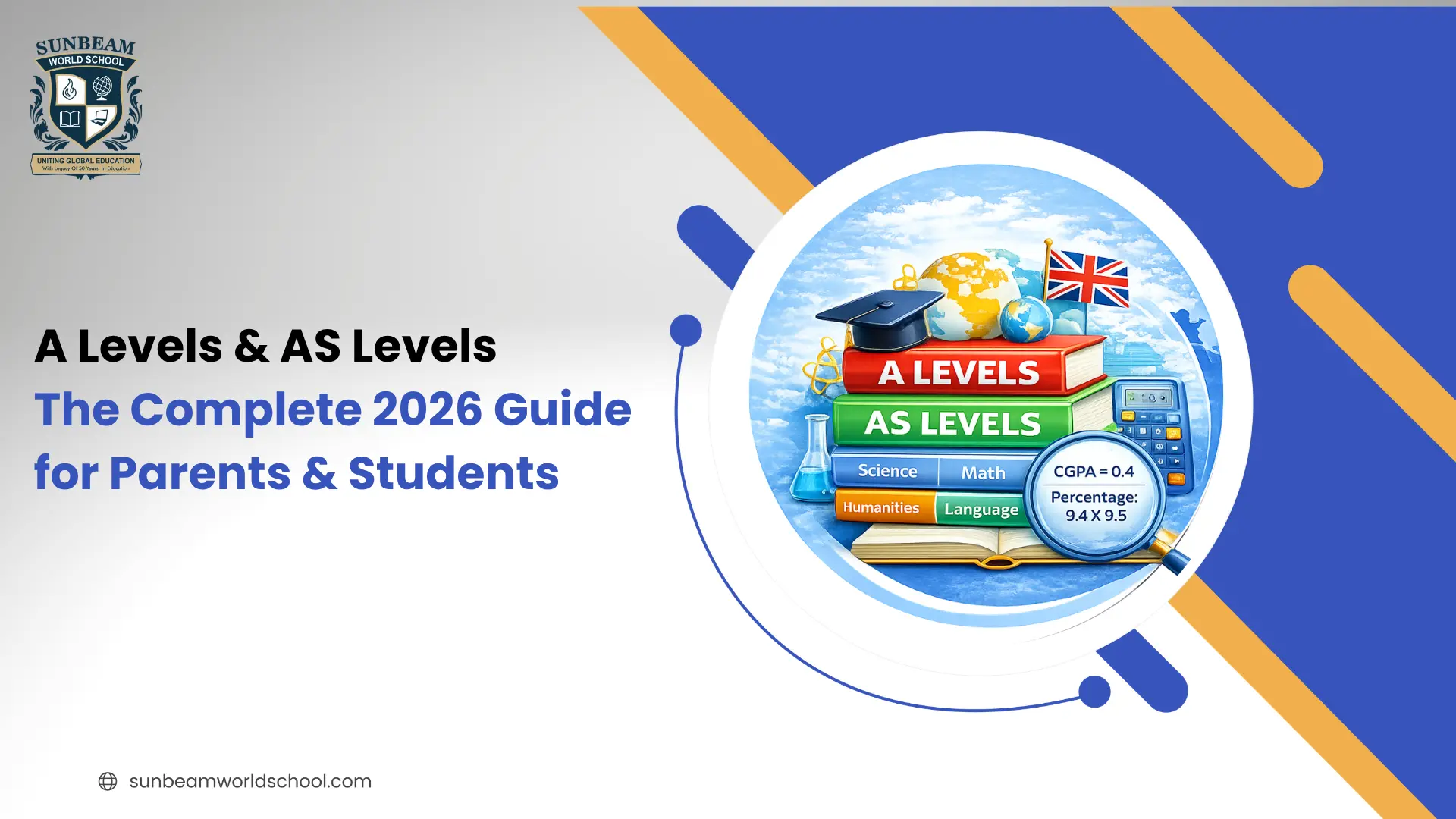
A Levels & AS Levels: The Complete 2026 Guide for Parents & Students
| A Levels and AS Levels are globally recognized UK qualifications taken after GCSE or IGCSE and are essential for university admissions. The AS Level (Advanced Subsidiary) is a one-year course in Year 12, covering the first half of the syllabus and graded from A to E. The A Level (Advanced Level) is the full two-year qualification (Year 12 and 13), graded from A* to E, and is the main requirement for university entry worldwide.
The key difference between AS Level and A Level is depth, duration, and importance. AS Level provides foundational knowledge and acts as a checkpoint, while A Level builds advanced subject expertise and is what universities primarily assess. A-level grades are also converted into UCAS tariff points, which universities use to set admission criteria. To succeed, students should choose three A Level subjects aligned with career goals. If unsure, selecting facilitating subjects like Maths, Science, or English helps keep future options open. |
Choosing what your child studies after IGCSE or GCSE can feel overwhelming and for good reason. The next two years play a major role in shaping university options and future career paths.
If you’ve come across terms like A Levels, AS Levels, UCAS points, or facilitating subjects and found them confusing, you’re not alone. Many parents feel unsure at this stage, especially when the decisions seem so important.
Don’t worry, this guide is designed to simplify everything. We’ll walk you through how A Levels and AS Levels work, how they differ, how universities evaluate them, and how to choose the right subjects, so you and your child can move forward with confidence.
| Before you read on: Written for parents, not just educators
Most A-Level guides are written for students or school counselors. This one is designed for parents who want to understand the system clearly enough to have an informed conversation with their child about the next two years of education — and to feel confident in whatever decision they make together. |
What are A Levels and where do they fit?
Let's start from the beginning, because before understanding the difference between AS Level and A Level, it helps to understand what this entire stage of education is for and how it connects to what came before and what comes after.
The journey from IGCSE to university
Most students who arrive at A Levels have spent the previous two years studying Cambridge IGCSE — typically 7 to 10 subjects, covering a broad range of disciplines. IGCSE is about breadth: learning to engage with many different types of knowledge.
A Levels are the deliberate opposite. They are about depth. A student who studied 9 subjects at IGCSE now chooses just 3 (occasionally 4) to study in genuine depth over two years. This is the transition from "learning about the world broadly" to "developing real expertise in a focused area." Universities at the end of this journey want to see that a student can sustain that depth — that they can engage with a subject rigorously and independently over time.
| Stage | Age | Qualification | Details |
| Stage 1 | 14–16 | Cambridge IGCSE | 7–10 subjects · broad foundation |
| Stage 2 | 16–17 (Year 12) | AS Level | 3–4 subjects · Year 1 |
| Stage 3 | 17–18 (Year 13) | A Level (A2) | 3 subjects · Year 2 |
| Stage 4 | 18+ | University | 3–4 year degree |
Why do A Levels matter so much?
In the UK and in the Cambridge International system, A Level results are the primary basis for university entry. When a university in the UK, India, the United States, or Australia looks at an application from a Cambridge International student, the A Level results are the first academic evidence they evaluate. Strong A Level grades open the most competitive university courses. Weak A Level grades narrow options significantly. This is why the two years between IGCSE and university feel, and are consequential.
| To make A level more easy for understanding:
Think of IGCSE as the foundation and A Levels as the walls. Universities look at the walls, but they couldn't exist without the foundation underneath. |
What is AS Level?
AS Level stands for Advanced Subsidiary Level. It is a one-year qualification that covers the first half of the A Level program. Most students begin their post-IGCSE studies with AS Level subjects in Year 12 (age 16–17).
Here is the single most important thing to understand about AS Level: it has two completely different roles, and which role it plays depends on what the student does next.
Role 1: AS Level as a stepping stone to A Level
In the Cambridge International system, a student typically takes 3 or 4 AS Level subjects in Year 12. At the end of Year 12, they sit AS Level examinations. The results serve two purposes: they are a standalone qualification (the student has an AS Level certificate for each subject they pass), and they are a record of Year 1 performance that informs Year 2 subject decisions.
If the student goes on to complete the A2 components in Year 13, the AS marks can be "carried forward" and combined with the A2 marks to form the final A Level grade. This is called the carry-forward route.
Role 2: AS Level as a standalone qualification
Some students take AS Level in a subject they are interested in but do not intend to pursue to full A Level. For example, a science-focused student might take AS Level History because they enjoy it, without planning to complete A Level History. The AS Level certificate they earn has genuine value on its own — it demonstrates academic breadth and earns UCAS tariff points.
What does AS Level actually cover?
AS Level covers the first half of the A Level syllabus — approximately half the content and skills of the full two-year course. The assessment focuses on foundational understanding of the subject. In most cases, an AS Level examination involves 1 or 2 papers per subject, typically 1.5 to 2 hours each.
| Think of AS Level as Year 12 of a two-year course. Your child takes it whether they're planning to stop at Year 12 or continue to Year 13. It earns a qualification in its own right. It gives your child and you a real academic checkpoint before committing to the full A Level in each subject. It is genuinely useful, not just a stepping stone. |
What is A Level?
A Level stands for Advanced Level. It is the full two-year qualification — the complete post-16 academic program — and it is what universities are primarily looking at when they assess applications.
A student who completes A Level has spent two years studying a subject to considerable depth. The A Level examination tests not just what they know, but their ability to analyze, evaluate, construct arguments, solve problems, and apply knowledge in unfamiliar contexts. These are university-level intellectual skills, and that is precisely the point.
How is the full A Level structured?
The full A Level is divided into two parts:
AS Level components (Year 12) — foundational content, establishing core knowledge and skills in the subject
A2 components (Year 13) — advanced content, requiring deeper analysis and independent thinking
The final A Level grade reflects performance across both years, with the A2 components typically carrying significant weight. In the Cambridge system, the final grade is determined by combining the marks across all papers (AS + A2) in the overall grade calculation.
The A* grade, what it means and why it matters
The A* (A-star) is the highest grade available at A Level. It does not exist at AS Level. It is awarded to students who not only achieve a high overall score across the full A Level but also demonstrate particularly strong performance in the A2 component specifically. The A* grade was introduced to help top universities, including Oxford, Cambridge, and Imperial, differentiate between the strongest candidates in the most competitive application pools.
Why the A* matters for your childIf your child is targeting highly competitive courses at top universities — Medicine, Law at Oxford/Cambridge, Engineering at Imperial — A* grades in relevant subjects are often either required or expected. For other strong universities, AAA or AAB is typically sufficient. Discuss the realistic target grade with your child's school based on their IGCSE performance and intended direction. |
AS Level vs A Level: The Complete Side-by-Side Comparison
This is the section most parents are looking for. Below is a comprehensive comparison of every meaningful difference between AS Level and A Level — from duration and grades to university recognition and what each qualification is used for.
| Feature | AS Level (Year 12) | Full A Level (Year 12 + 13) |
| What it is | The first year of the A Level programme, taken as a qualification in its own right | The complete two-year advanced qualification — what universities primarily assess |
| Duration | 1 year (Year 12) | 2 years (Year 12 + 13) |
| Grades awarded | A, B, C, D, E — maximum grade is A | A*, A, B, C, D, E — A* is available only here |
| UCAS points | A=20 · B=16 · C=12 · D=10 · E=6 | A*=56 · A=48 · B=40 · C=32 · D=24 · E=16 |
| Standalone qualification? | Yes — own certificate | Yes — primary qualification |
| University entry basis? | Rarely — provides predicted grade evidence, not primary basis | Yes — the primary basis for all UK and most international university offers |
| Syllabus depth | Foundational — half the A Level content | Complete — full depth, including advanced analysis and extended problem-solving |
| Number of exam papers | Typically 1–2 papers per subject | Typically 2–3 papers per subject across both years |
| Carries forward to A Level? | Yes — AS marks contribute to final A Level grade within 13 months | N/A — A Level is the final destination |
| Can stop here? | Yes — and earn a valid qualification | Yes — the natural endpoint for post-16 academic study |
| Assessment includes A*? | No — A is highest | Yes — A* is highest |
| Recognised in India? | Yes — AIU recognised | Yes — AIU recognised as equivalent to Class 12 |
| Best suited for | A subject of interest not being pursued to full A Level; academic breadth; Year 12 checkpoint | Core subjects for university entry; demonstrating academic depth in chosen field |
AS Level is Year 12. A Level is Years 12 + 13. Your child will almost certainly take AS Levels; they are part of the two-year A Level journey. The question is whether they continue each AS Level subject to the full A Level, or stop some at AS Level. Full A Level results are what universities ask for. AS Level results demonstrate breadth and serve as checkpoints.
AS Level and A Level Grading System Explained: Grades, Marks & How It Works
One of the first things that confuses parents coming from CBSE or ICSE backgrounds is that A Levels don't use percentages. There are no marks out of 100 on your child's final certificate. Instead, the qualification uses a letter grade system. Here is everything you need to know about it.
A Level grade scale
| Grade | What it means | UCAS Points | What this unlocks |
| A* | Outstanding — top of cohort. Strong performance across full A Level with particularly high A2 scores | 56 | Oxford, Cambridge, Imperial, LSE for competitive courses; required by some Russell Group courses |
| A | Excellent — strong command of the full A Level content and skills | 48 | All top universities — meets or exceeds most standard offer requirements |
| B | Good — above average. Solid understanding with some gaps in advanced areas | 40 | Strong universities — meets most ABB and BBB offers widely |
| C | Satisfactory — competent understanding of core content | 32 | Broad range of universities — minimum pass for most standard offers |
| D | Limited — partial understanding with significant gaps | 24 | Some universities accept DDD offers; limits choices significantly |
| E | Minimum pass — basic engagement with the subject | 16 | Accepted by few universities for standard degree entry |
| U | Ungraded — did not meet minimum standard | 0 | Not recognised as a qualification — no UCAS points |
AS Level grade scale
| Grade | What it means | UCAS Points | Note |
| A | Excellent — highest grade at AS Level | 20 | A* is not available at AS Level |
| B | Good — above average for Year 12 | 16 | Strong predictor of A grade at A Level with continued effort |
| C | Satisfactory — competent Year 12 performance | 12 | Minimum typically needed to continue subject to A Level confidently |
| D | Below average — suggests subject may need reconsideration | 10 | Consider discussing with school whether to continue to A Level |
| E | Minimum pass | 6 | Continuing to full A Level from here requires significant additional work |
How Are Grade Boundaries Set
Grade boundaries are the minimum raw marks a student needs to achieve each grade. Critically, these are not fixed percentages. After each examination session, Cambridge sets the boundaries based on the difficulty of that specific paper and how the full cohort performed. This process is called statistical pegging.
In practice, this means: if a paper was unusually difficult in a given year, the number of raw marks needed for an A will be lower. The grade standard remains consistent year to year, even as paper difficulty fluctuates. A grade A in 2026 represents exactly the same academic standard as a grade A in 2019 — Cambridge ensures this through its boundary-setting process.
| What parents should take from this
Don't compare raw marks between years. Your child's grade — A*, A, B, C — is the meaningful number. Raw marks only tell you where your child's performance sat relative to that specific paper's difficulty, not relative to an absolute standard. Focus on the grade letter, not the percentage behind it. |
Understanding UCAS Tariff Points
If you've seen university course entry requirements expressed as a number, like "120 UCAS points," this section explains what that means and how to calculate your child's likely UCAS points total.
What are UCAS points?
UCAS (Universities and Colleges Admissions Service) tariff points are a numerical system that converts A Level (and AS Level) grades into a common currency for university admissions. It allows universities to express entry requirements in a single number, and students to compare their predicted grades against those requirements.
Calculating a UCAS points total
Each A Level grade converts to a set number of points. A student's total is the sum of their 3 (or more) A Level grades:
| A Level Grade | Points | AS Level Grade | Points | Example Total (3 A Levels) |
| A* | 56 | A | 20 | A*A*A = 56 + 56 + 48 = 160 pts |
| A | 48 | B | 16 | AAA = 48 + 48 + 48 = 144 pts |
| B | 40 | C | 12 | AAB = 48 + 48 + 40 = 136 pts |
| C | 32 | D | 10 | ABB = 48 + 40 + 40 = 128 pts |
| D | 24 | E | 6 | BBB = 40 + 40 + 40 = 120 pts |
| E | 16 | — | — | BBC = 40 + 40 + 32 = 112 pts |
What points do different universities require?
| University Tier | Typical Grades Required | UCAS Points | Notes |
| Oxford & Cambridge | A*AA – A*A*A | 152–160 pts | Specific subject requirements always apply |
| Imperial, UCL, LSE | AAA – A*AA | 144–152 pts | Subject requirements common |
| Russell Group (mid) | ABB – AAB | 128–136 pts | Varies greatly by course |
| Good universities | BBB – ABB | 120–128 pts | Wide range of strong courses |
| Broader access | CCC and above | 96+ pts | Many valid professional pathways |
| Indian universities (AIU) | Varies by institution | — | Cambridge A Level recognised as Class 12 equivalent |
| Important:
Points Are Necessary But Not Sufficient Meeting a university's UCAS points threshold is the starting point, not the finish line. Many courses at selective universities also require specific subjects (Medicine needs Chemistry; Engineering needs Maths and Physics) and consider personal statements, references, and entrance assessments. Always check both points and subject requirements for every course your child is targeting. |
How many subjects should your child take?
This is one of the questions parents ask most often — and one where well-meaning advice sometimes leads to the wrong decision. Here is the honest picture.
The standard: 3 A Levels
The vast majority of students take 3 A Level subjects. This is not a minimum — it is genuinely the standard that universities expect and base their offers on. UK universities, including Oxford and Cambridge, set entry offers based on 3 A Levels taken together in Year 13. There is no widespread benefit to taking a fourth A Level; in fact, spreading effort across 4 demanding subjects while trying to achieve top grades in each is a common reason students underperform.
The AS Level approach in Year 12
Many students take 4 subjects at AS Level in Year 12, then decide at the end of Year 12 — informed by their results, their progress, and their developing interests — which 3 to continue to full A Level in Year 13. This built-in checkpoint is one of the most valuable features of the Cambridge International structure. It gives students (and parents) a real decision point with real evidence, rather than requiring all choices to be locked in at age 16.
A practical approach for Year 12 subject selection
|
A Level subjects: the complete list by category
Cambridge International A Levels offer over 55 subjects across six broad categories. Understanding the categories helps parents and students see the full landscape of choices before narrowing down.
Mathematics
Mathematics (9709)
Further Mathematics (9231)
Statistics (component)
Sciences
Physics (9702)
Chemistry (9701)
Biology (9700)
Psychology (9990)
Marine Science (9693)
Environmental Management
Humanities & Social Sciences
History (9489)
Geography (9696)
Sociology (9699)
Global Perspectives (9239)
Law (9084)
Philosophy (9774)
Business & Economics
Economics (9708)
Business (9609)
Accounting (9706)
Management of Business
Travel & Tourism (9395)
Languages
English Language (9093)
English Literature (9695)
French (9716)
Spanish (9719)
Hindi (9687)
Arabic (9680)
German (9717)
Technology & Creative
Computer Science (9618)
Information Technology (9626)
Art & Design (9479)
Design & Technology (9705)
Media Studies (9607)
Music (9483)
| Not all schools offer all subjects
Individual schools are authorised to offer specific subjects. Before your child decides on a combination, confirm which subjects are available at their school and whether their preferred combination has any scheduling conflicts in the exam timetable. |
How To Choose A Level Subject
This is where many parents feel uncertain, as the impact of subject choices can be significant. The best approach is to use a clear, practical framework to avoid regret.
Start with the end goal — university.
A common mistake is choosing A Level subjects based only on IGCSE preferences. Enjoyment matters, but only if the subject supports future degree options.
Begin by asking: “What does my child want to study at university?” Even a broad idea helps guide decisions. If unsure, choose facilitating subjects to keep options open.
Identify 3–5 possible university courses
Your child doesn't need a definitive answer — they need a direction. Look up the entry requirements for a few courses they might be interested in. Note which A Level subjects each requires or recommends. This tells you which subjects are non-negotiable and which are flexible.
Prioritise facilitating subjects
Facilitating subjects are those that keep the widest range of university degree options open. They include: Mathematics, Further Mathematics, Physics, Chemistry, Biology, English Literature, History, Geography, and Languages. If your child is unsure of their direction, a combination including 2 facilitating subjects provides maximum flexibility without closing doors prematurely.
Be honest about academic strengths
Ask your child's IGCSE teachers — not just the student — where their genuine academic strengths lie. Choosing subjects because they "sound impressive" while the student is significantly weaker in them is a common path to disappointing A Level results. A grade A in three subjects a student is strong in is always better than a grade C in a subject they struggled with.
Ensure the combination tells a coherent story
University admissions tutors notice when subject combinations are incoherent. Three creative arts subjects alongside a desire to study Engineering reads as a mismatch. History, Economics, and English for a student interested in Law reads as well-reasoned. The combination should make sense — even if it wasn't consciously planned to.
Include at least one subject the student genuinely loves
Two years is a long time. A student who has no subject they're genuinely interested in will find sustained motivation harder to maintain. Whether it's Computer Science, Geography, or Art — one subject driven by genuine interest produces the best engagement and often surprises parents with the results.
Recommended A Level combinations by career path
To make subject selection concrete, here are subject combinations that consistently work well for the most common degree and career directions — with the reasoning behind each choice.
Medicine, Dentistry & Veterinary
Chemistry + Biology + Mathematics (or Physics). Chemistry is non-negotiable for all three fields. Biology is required by most medical schools. Mathematics strengthens analytical and statistical credentials.
Engineering (all disciplines)
Mathematics + Physics + Further Mathematics (or Chemistry). Both Maths and Physics are typically required. Further Maths signals strong quantitative ability for the most competitive engineering courses.
Computer Science / AI / Data Science
Mathematics + Further Mathematics + Physics (or Computer Science). Cambridge specifically recommends Further Maths for Computer Science applicants. Computing skills should be demonstrated through projects, not just the A Level label.
Economics / Finance / Business
Mathematics + Economics + History (or Geography). Mathematics is essential for rigorous economics programmes. Avoid pairing Economics with Business Studies — it looks repetitive to admissions tutors.
Law
English Literature + History + Economics (or Philosophy). Law schools want evidence of analytical writing and structured argument. English and History are the strongest foundations. Standalone Law A Level is not required.
Politics / PPE / International Relations
History + Economics + English (or Politics). The classic PPE pathway. History and Economics together is the most respected combination for Oxford PPE and similar programmes.
Biomedical / Life Sciences
Biology + Chemistry + Mathematics. The core trio for any biological science. Adding Psychology or Geography strengthens applications to interdisciplinary biomedical programmes.
Architecture / Creative Design
Mathematics + Art & Design + Physics (or Geography). Architecture programmes want both visual creativity and mathematical / scientific thinking. Art alone is not sufficient for top architecture schools.
How AS Level and A Level are assessed
Understanding the assessment structure helps parents support their children more effectively — knowing what types of work matter, when they matter, and how they contribute to final grades.
Written examinations
For the vast majority of A Level and AS Level subjects, the primary form of assessment is written examinations. AS Level exams are typically taken at the end of Year 12 (May/June). Full A Level exams are taken at the end of Year 13. Papers are set and marked by Cambridge examiners — not by the school — which means grades are externally validated and consistent globally.
Non-examined assessment (coursework / NEA)
Several subjects include a coursework component, typically called Non-Examined Assessment (NEA). Subjects with significant NEA components include English Language, English Literature, Art & Design, Media Studies, Computer Science (programming project), and Design & Technology. These components are marked by teachers and moderated by Cambridge. They typically contribute 20–30% of the final grade.
Practical assessments (science subjects)
Science A Levels — Biology, Chemistry, and Physics — require completion of a practical component. This involves conducting experiments in school laboratories, recording observations, and demonstrating hands-on scientific method. The practical endorsement appears on the final certificate and is expected by university admissions tutors. Most universities specifically state that they expect students to have completed and passed the practical assessment.
Oral assessments (language subjects)
Language A Levels include a spoken language component, conducted in school and moderated externally. This tests the student's ability to communicate orally in the language — listening comprehension and spoken response — which written exams alone cannot assess.
When are exams held?Cambridge International runs two main exam series each year. The May/June series is the primary series — when most students in India and internationally sit their exams. The October/November series is available for resits and for certain subjects. Results for the May/June series are typically released in August. |
The carry-forward rule:In Cambridge International A Levels, a student can take AS Level papers in May/June of Year 12 and carry those marks forward to combine with A2 papers in May/June of Year 13 — as long as both sittings are within 13 months of each other. This is the "carry-forward route." Alternatively, some students sit all papers (both AS and A2) in a single May/June session at the end of Year 13 — the "linear route." Both are valid; the right choice depends on the student and the school's academic structure. |
How To Prepare For A Level And As Level Exams
Students who achieve A* and A grades at A Level are not always the most naturally talented students in their year group. They are usually the students who built good academic habits from the beginning of Year 12 — not the ones who crammed hardest in the final weeks. Here is the strategy that works.
Read and understand the full syllabus
Cambridge publishes the complete syllabus for every A Level and AS Level subject. It lists every topic, skill, and command word that will be examined. Students who study from the syllabus never have gaps. Download it on day one of Year 12.
Start past papers in Year 12
The most effective revision tool Cambridge provides is its archive of past papers, freely available online. Students who start practising with past papers in Year 12 arrive at AS Level exams already familiar with question styles, timing, and mark scheme expectations.
Learn Cambridge's command words
"State," "describe," "explain," "analyse," "evaluate," "assess," "compare" — each word tells the examiner what type of response to award marks for. Students who misread command words lose marks in every exam. Memorise the definitions and apply them precisely.
Analyze mark schemes, not just answers
After attempting any past paper question, study the mark scheme in detail. It shows exactly what Cambridge rewards — specific phrases, specific ideas, specific structures. Self-marking against mark schemes is the fastest way to improve at A Level.
Build an 8-week revision plan
Begin structured revision at least 8 weeks before the first exam. Use spaced repetition — returning to material at increasing intervals rather than in one long session. Research consistently shows spaced practice produces better long-term retention than massed cramming.
Get teacher feedback on extended answers
Essays, analysis questions, and extended responses are where the most A Level marks are won and lost. Ask teachers to mark practice work against mark schemes. Qualitative feedback on argument structure and analytical depth is irreplaceable preparation.
Start coursework early and iterate
NEA and coursework components are worth 20–30% of final grades. Start them at the beginning of the course, not in the final term. Ask for teacher feedback and revise based on it. Unlike exams, coursework is entirely within a student's control — treat it accordingly.
Read beyond the syllabus
For History, English, Economics, Law, and Philosophy, the students who achieve A* write with genuine intellectual depth — perspectives and evidence that go beyond the set texts. Wide reading of academic articles, quality journalism, and relevant books makes this possible and is visible in exam responses.
What Do University Admissions Tutors Look For?
University entry requirements are published as grade conditions — "we require AAB" — but what admissions tutors are actually doing is more nuanced than matching grades to a requirement. Understanding this helps parents and students make better choices and build stronger applications.
Grades are the floor, not the ceiling
When a university publishes a requirement of AAB, it means they will generally not make offers to applicants predicted below AAB. It does not mean every student with AAB is admitted. For competitive courses at selective universities, grades are necessary but not sufficient. Personal statements, teacher references, and sometimes entrance assessments (ESAT for Cambridge Engineering, UCAT for Medicine) all contribute.
Subject requirements are as important as grade requirements
This is the point that trips up the most families. A student with A*A*A but without Chemistry cannot study Medicine, regardless of their grades. Engineering departments require Mathematics and Physics — no exceptions. Law programmes at Oxford and Cambridge expect analytical subjects. Always read the subject requirements alongside the grade requirements for every course being considered.
AS Level results in university applications
Most UK universities do not make offers based on AS Level results — they make offers based on predicted A Level grades, informed by AS Level performance. However, AS Level results serve several important functions in the application process:
- They provide teachers with the evidence to write confident, accurate predicted grades in references
- Strong AS Level results can strengthen a personal statement narrative and provide talking points at interviews
- Some international universities (particularly in the United States) actively consider AS Level results alongside A Level predicted grades
- For students applying to Indian universities, AS Level certificates are directly recognised by the AIU
Cambridge and Oxford specifically
Both Oxford and Cambridge make offers typically in the range of A*AA to A*A*A. They accept Cambridge International A Levels from CAIE, Oxford AQA, and Pearson Edexcel.
Most applicants study 3 to 4 A Levels, with offers based on 3. For STEM courses, Cambridge University specifically notes that strong applicants usually take Further Mathematics. Both universities also require entrance assessments — ESAT, UCAT, or similar — depending on the course, which students should begin preparing for in Year 12.
A Levels vs IB Diploma vs BTEC: Which is right for your child?
Many parents ask whether A Levels are the right choice, or whether the IB Diploma or a vocational qualification might serve their child better. Here is an honest comparison.
| Factor | A Levels | IB Diploma | BTEC Level 3 |
| Duration | 2 years | 2 years | 1–2 years |
| Subjects studied | 3 (+ AS Level) | 6 subjects (3 HL, 3 SL) | 1–3 vocational areas |
| Focus | Deep expertise in 3 subjects | Broad education across 6 subjects | Vocational skills for specific careers |
| Assessment | Mainly written exams + some coursework | Exams + extended essay + TOK + CAS | Mainly coursework / portfolio |
| UK university recognition | Universal | Very strong | Subject to course — less universal |
| International recognition | Excellent (160+ countries) | Excellent (global) | Limited internationally |
| Right for students who… | Know their direction and want depth | Want to keep options broad, internationally oriented | Have specific vocational career goals |
| Workload type | Concentrated — few subjects, high depth | Heavy and broad — most demanding overall | Consistent — portfolio-based throughout |
| Built-in checkpoint (Year 12)? | Yes — AS Level acts as checkpoint | No — committed to full 2-year programme | No — continuous assessment |
For families who are uncertain: A Levels are the right default for students who have a general sense of direction and want the qualification most widely recognised for university entry worldwide. The IB Diploma suits students who genuinely want intellectual breadth and international exposure. BTEC is best for students with a specific vocational goal where practical, portfolio-based assessment suits their learning style.
A Levels & AS Levels at Sunbeam World SchoolAt Sunbeam World School, our Cambridge International A Level program is built around a simple belief: the best academic outcomes come from the right combination of rigorous teaching, individual support, and genuine care for each student's direction. We are a Cambridge-authorized center, which means our teachers are trained by CAIE, our facilities meet Cambridge standards, and our students receive externally validated qualifications recognized worldwide. Here is what that looks like in practice for A Level and AS Level students at Sunbeam: Individual academic counsellingEvery student receives one-on-one subject counselling before choosing their A Level and AS Level subjects — we review IGCSE results, interests, and university targets together. Cambridge-trained teachersOur faculty attend regular Cambridge professional development programmes. They understand what examiners reward — and they teach to that standard, not just to the textbook. Past paper culture from day oneWe introduce past paper practice and mark scheme analysis from the very beginning of Year 12 — not as a last-minute revision tool, but as a core learning method throughout the two years. Fully equipped labsScience A Level practical work is part of the grade. Our Physics, Chemistry, and Biology laboratories are equipped to the full Cambridge practical curriculum standard. University application supportOur university counselling begins in Year 12 — covering subject selection, UCAS applications, personal statement writing, and preparation for admissions interviews and tests. Parent communicationWe believe parents are partners in their child's education. Regular progress reports, parent counselling sessions, and open communication keep families fully informed throughout the A Level journey. |
What Every Parent Should Take Away From This Guide
|
Conclusion
A Levels and AS Levels are more than just qualifications — they are the bridge between school and university, shaping the academic and career opportunities available to your child. With the right subject choices, consistent effort, and a clear understanding of how the system works, students can keep doors open to top universities worldwide.
At Sunbeam World School, this journey is guided with care and expertise. From personalized subject counseling to Cambridge-trained faculty and dedicated university application support, we ensure that every student is equipped not just to succeed academically but to make confident, well-informed decisions about their future.
If you’re navigating A Levels and AS Levels as a parent, remember: the goal isn’t just choosing subjects, it’s choosing the right path forward.

Frequently Asked Questions
What is the difference between AS Level and A Level?
-AS Level (Advanced Subsidiary) is a one-year qualification covering Year 12 content, graded A to E maximum. A Level is the complete two-year qualification graded A* to E. Most university offers are based on full A Level grades. AS Level provides a checkpoint at the end of Year 12, earns its own certificate, and can contribute marks toward the final A Level. The key difference: AS Level is Year 1, A Level is Year 1 + Year 2 together.
Can my child take AS Level and then decide whether to do full A Level?
+Is AS Level sufficient for university entry?
+How many A Levels should my child take?
+My child doesn't know what they want to study at university. How do we choose subjects?
+What does the A* grade require?
+Are Cambridge A Levels and AS Levels recognised in India?
+What happens if my child is unhappy with their AS Level or A Level results?
+What is the right age to start A Levels?
+
In this article
Share this post:


Press and Blogs
Stay updated with our press releases, educational blogs, and more.
Is NCERT enough for JEE Main 2026? NCERT is essential but not sufficient on...

Best Courses After 12th in India Choosing the right course after Class 12 depends on...

Which Stream to Choose After Class 10 in India Choosing the right stream after Class...