

 Academic Excellence
What are the Passing Marks out of 80 in CBSE?
What Are the Passing Marks Out of 80 in CBSE?
As per the current CBSE examination scheme, students must score 33% marks to pass a subject.
Passing Marks Formula
- 33% of 80 = 26.4
- CBSE rounds this off to 27 marks
Passing marks out of 80 = 27
Are you also thinking about what are the passing marks out of 80 in CBSE exams in 2025-2026?
In this guide, we researched the official CBSE website to list the passing marks for both CBSE Class 10 and Class 12, and also brought handy other CBSE guidelines, criteria, and rules to make things easy for you. And as a bonus, we bring you a few crucial exam tips to pass with flying colors in board exams.
Let’s get started!
What Are the Passing Marks Out of 80?
According to CBSE, the passing marks out of 80 are 26.4, which is 33% of the total marks (if the exam is of 80 marks). So, you need to score at least 33% in every subject to pass.
Here is a table that clearly defines the passing marks for subjects with practicals in classes 9-12.
| Class | Total Marks (Theory) | Passing Marks (Theory) | Internal Assessement | Passing Marks (Internal Assessment) | Overall Passing Criteria |
| Class 9 | 80 | 26 | 20 | 7/20 | Must score 33% overall (theory + internal) |
| Class 10 | 80 | 26 | 20 | 7/20 | Must score 33% overall and pass the internal separately. |
| Class 11 | 80 | 26 | 20 | 7/20 | Must score 33% in both theory and practical |
| Class 12 | 80 (for Science subjects 70) | 26/80 (23/70) | 20 (30) | 7/20 (10/30) | Must score 33% in theory + 33% in practical separately + overall 33%. |
In India, the Central Board of Secondary Education (CBSE) is one of the most prestigious education boards. If you are going to appear for the class 10 or 12 board exam, then you need at least 26.4 marks out of 80 to pass the CBSE board exams. Learn more about why CBSE might be the right choice for your child.
Passing Marks Out of 80 for CBSE Class 10
For CBSE Class 10, the passing criteria is:
| Component | Maximum Marks | Passing Marks |
| Theory Exam | 80 | 27 |
| Internal Assessment | 20 | 7 |
| Total | 100 | 33 |
Passing Marks Out of 80 for CBSE Class 12
For CBSE Class 12, the rule remains the same:
| Component | Maximum Marks | Passing Marks |
| Theory Exam | 80 | 27 |
| Practical / Internal | 20 | 7 |
| Total | 100 | 33 |
Even after extensive exam preparation, it is natural to feel nervous about meeting the minimum requirements. When you understand the minimum marks to pass, you can plan your studies more effectively.
So, Is 25.9 Marks Out Of 80 A Fail?
Yes, 25.9 marks out of 80 is most likely a fail, as the minimum passing score in CBSE is 33% which rounds to 26 marks out of 80. Your score of 25.9 is below this 26-mark threshold, meaning you did not meet the minimum requirement to pass, even if you scored 20 out of 20 in the practical exam.
One must pass the theory separately to pass the subject. CBSE may award grace marks (1–5 marks) in rare cases if a student narrowly misses passing, but this is not guaranteed.
Understanding How Passing Marks Are CalculatedExample 1: PASS
✔ Passed (cleared both theory and internal) Example 2: FAIL
❌ Failed (did not score minimum 27 in theory) |
What Is The CBSE Passing Criteria For Class 10 & 12?
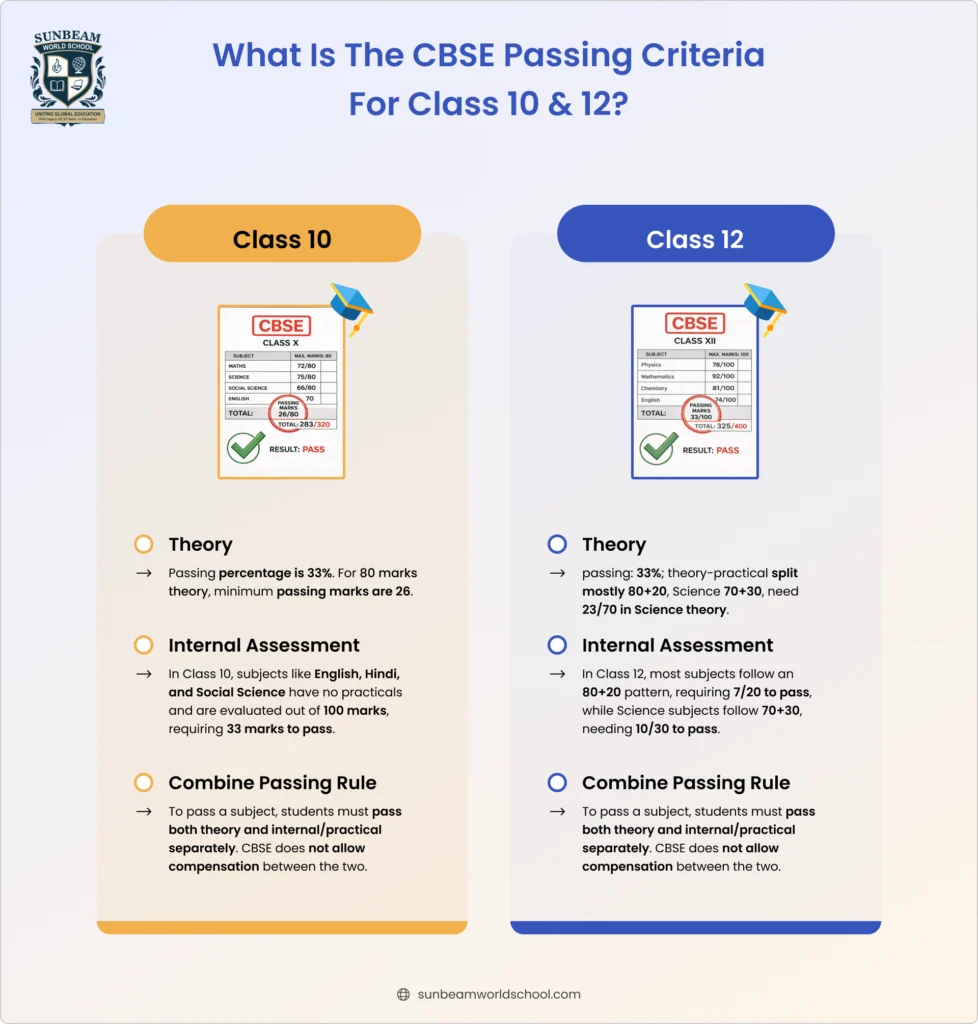
Understand the CBSE passing rules for Class 10 and 12 to plan exam preparation effectively.
CBSE says you need 33% to pass, and the CBSE pattern follows 80 marks for theory and 20 marks for internal assessment. Students must meet the minimum passing marks in both assessments separately.
1. Theory
For class 10, the minimum passing percentage for every subject is 33%. Thus, the theory portion carries 80 total marks, then the passing marks would be:
33% of 80= 26.4, which is rounded up to 26 marks.
For class 12, most subjects follow the same 80 theory and 20 practical rules, but for Science subjects such as Physics, Chemistry, and Biology, the pattern changes to 70 marks for theory and 30 marks for practicals. Therefore, students must score at least 23 out of 70 in the theory section to pass.
2. Internal Assessment
The Internal Assessment is worth 20 marks, so to pass it, students must score 7 marks. 33% of 20= 6.6, which is rounded up to 7 marks. Though internal assessment is not for all subjects.
In class 10, English, Hindi, and Social Science do not have practical exams, so they are marked out of 100. Students must score at least 33% (33 marks out of 100) to be considered passed.
In Class 12, internal assessment marks vary by subject. Most subjects follow an 80+20 pattern, requiring at least 7/20 to pass. Science subjects like Physics, Chemistry, and Biology follow a 70+30 pattern, with 10/30 as the passing mark.
3. Combine Passing Rule
To pass a subject, students must qualify in both theory and internal assessment/practical components separately. CBSE does not allow marks from the practical/internal to compensate for failing theory, or vice versa.
What Happens If You Fail the 80-Mark Theory Exam?
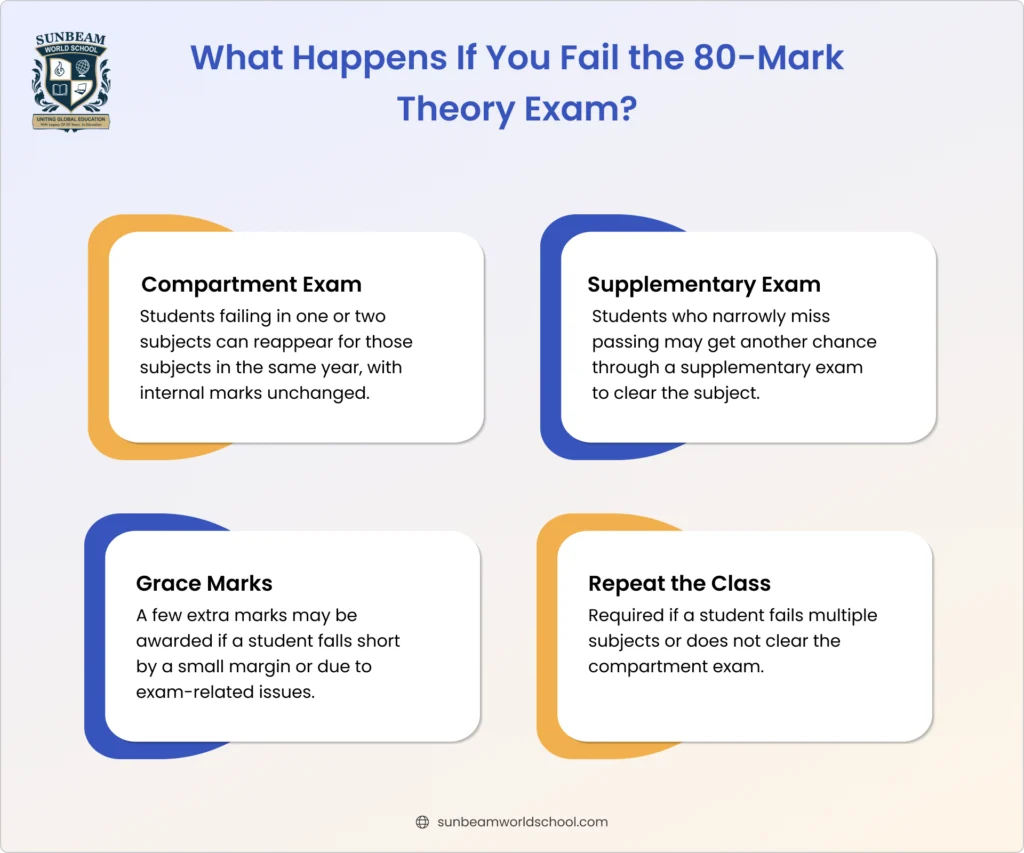
CBSE provides multiple options for students who do not clear the 80-mark theory exam.
In case a student fails the theory exam (usually of 80 marks), then CBSE provides alternative options like:
1. Compartment Exam
When a student fails one or two subjects, they may reappear for those subjects in the same academic year. Only the failed subjects need to be retaken, while the internal assessment marks remain unchanged. This provides a second chance to clear the subject without losing the academic year.
2. Supplementary Exam
In some schools or boards, CBSE may offer a supplementary exam for students who narrowly miss passing. The supplementary exam is usually conducted after the main board results and gives another opportunity to meet passing criteria. Marks obtained in this exam are added to the previous total for final results.
3. Grace Marks
Grace marks are the extra marks awarded by CBSE to the students who fall short by only a small margin. In this case, students are given grace marks just to meet the passing criteria and not to improve their overall score. Here are the following situations when grace marks are given:
-If a student falls short by 1-5 marks, then CBSE will award those marks in theory, practical, or both to reach the passing criteria.
-If a question in the exam was incorrect, out of syllabus, or had printing issues, CBSE may give grace marks to all the affected students.
-The third situation arises in rare cases, when many students struggle due to a tough paper, CBSE may award grace marks across the board
4. Repeat the Class
If a student fails in multiple subjects or the compartment exam, repeating the class may be necessary. This ensures that students can gain a stronger foundation before moving to the next grade.
Schools and teachers usually guide students about this option and provide strategies for improvement.
CBSE Passing Rules for 2025–2026
To succeed in CBSE board assessments, students must meet specific criteria in both written exams and internal components. The 2025–2026 passing rules emphasize balanced preparation, making it essential for students to perform consistently across all evaluation areas rather than relying on overall scores alone.
1. Minimum Passing Percentage — 33%
Across all board-exam subjects, a student must secure at least 33% to be considered as having passed. This percentage applies subject-wise (not just overall).
-For example, in a subject with 100 total marks, a student must score 33 marks to pass.
2. Separate Passing Status for Theory & Internal Assessments
CBSE’s assessment structure usually includes:
-Theory exam (usually out of 80 marks)
-Internal assessment / practical / project (out of 20 marks)
For Class 12 (and in some cases Class 11):
Students must pass both components separately:
-Minimum 33% in theory
-Minimum 33% in practical/internal
-Additionally, the aggregate (total) must be at least 33% in that subject
This means even if total marks are above 33%, if either component is below 33%, the student will not pass that subject.
For Class 10:
CBSE’s official Q&A indicates that passing is judged on the combined total (theory + internal) for Class 10. However, many schools still ensure adequate performance in both components as part of internal policy. CBSE
3. Practical/Internal Rules
-Practical marks may include practical exams, projects, viva voce, and assignments.
-Schools conduct these, but the minimum of 33% must be achieved by the student in that component too (where applicable).
This prevents situations where a student fails theory but compensates with high internal marks (or vice versa).
4. Grace Marks / Moderation
CBSE may award grace marks only in limited borderline cases, such as helping a student just clear the passing criteria where there is a genuine shortfall by a mark or two.
However, this is not a guaranteed rule every year. It is applied at CBSE’s discretion and depends on overall board moderation policies.
Why This Matters for Students
Many students assume that high internal marks can compensate for low theory scores-but CBSE rules don’t work that way.
-Students must plan preparation not just for theory papers, but also for internal assessments and practicals.
-You cannot rely on total marks alone if one component falls short (especially in Class 12).
-Teachers and schools typically guide students early to meet both thresholds.
7 Best Tips for Students to Score Better in 80-Mark Exams
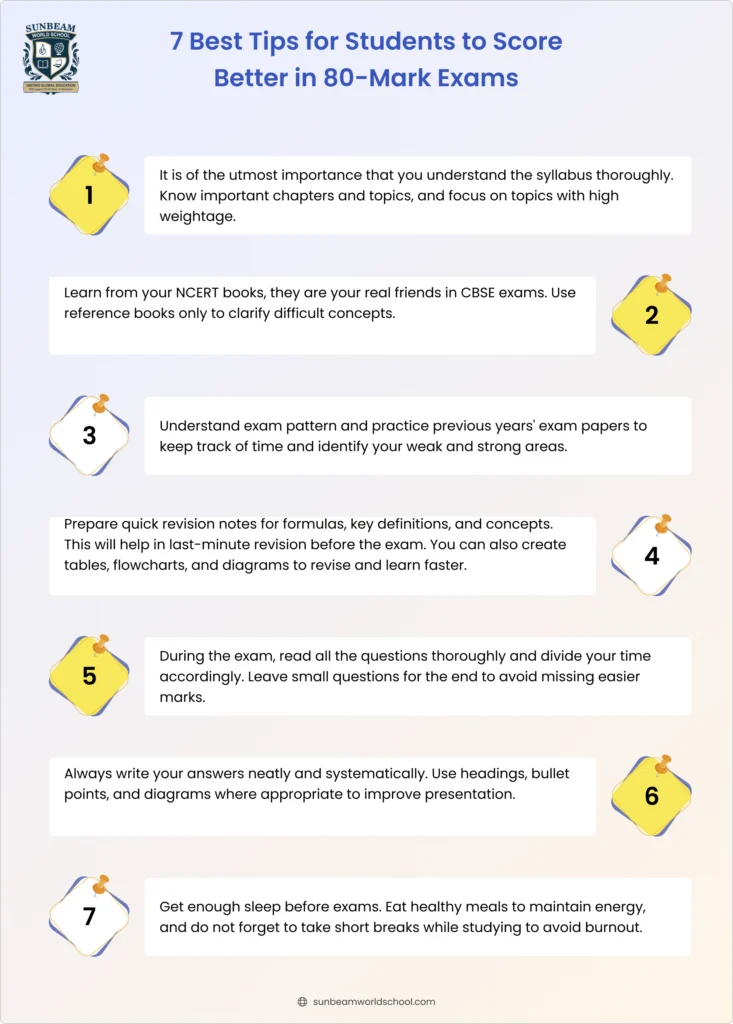
Smart preparation and good exam habits can help students score higher in 80-mark exams.
Scoring well in 80-mark exams can be overwhelming and challenging for some students. Here we bring you the right strategies and tips that can improve performance and help you pass exams with confidence:
Tip 1: It is of the utmost importance that you understand the syllabus thoroughly. Know important chapters and topics, and focus on topics with high weightage.
Tip 2: Learn from your NCERT books, they are your real friends in CBSE exams. Use reference books only to clarify difficult concepts.
Tip 3: Understand exam pattern and practice previous years’ exam papers to keep track of time and identify your weak and strong areas.
Tip 4: Prepare quick revision notes for formulas, key definitions, and concepts. This will help in last-minute revision before the exam. You can also create tables, flowcharts, and diagrams to revise and learn faster.
Tip 5: During the exam, read all the questions thoroughly and divide your time accordingly. Leave small questions for the end to avoid missing easier marks.
Tip 6: Always write your answers neatly and systematically. Use headings, bullet points, and diagrams where appropriate to improve presentation.
Tip 7: Get enough sleep before exams. Eat healthy meals to maintain energy, and do not forget to take short breaks while studying to avoid burnout.
Final Thoughts
Though it is challenging, it is not impossible to score good or higher marks in CBSE 10th and 12th examinations. Now that you know passing marks out of 80, you can aim not only to just pass but to score good marks.
The idea is to plan and prepare effectively for both theory and practical exams. Start by consistently practicing previous year papers, sample papers, creating structured study routines, and improving time management and concentration to boost your performance.
With dedication and consistent effort, learners can confidently aim for higher scores and achieve their desired results in board examinations.
At SunBeam World School, we take utmost care of each student so that they can excel in their studies without any difficulty.
Keep Learning!
FAQs
1. What are the passing marks out of 80 in CBSE?
CBSE requires a minimum of 33% in theory exams. For an exam out of 80 marks, 33% = 26.4, usually rounded up to 26 marks. Students must also pass the internal/practical assessment separately if applicable.
2. Is 27 passing marks out of 80?
Yes, 27 is the passing mark out of 80. Since the minimum passing mark is 26, 27/80 is above the threshold and considered a pass in theory.
3. Is 25 a pass or fail out of 80 in CBSE?
25 marks is below the minimum passing mark of 26. Therefore, 25/80 is a fail in theory, even if internal marks are sufficient. Sometimes, CBSE may award grace marks (1–5 marks) in rare cases if a student narrowly misses passing, but this is not guaranteed.
4. Does CBSE provide grace marks?
Yes, CBSE may award grace marks in special situations, if a student falls short by 1–5 marks to meet the passing criteria. Suppose there is a mistake in the question paper or printing issues, but if many students struggle due to an unusually tough paper, grace marks are awarded.
5. Do Class 10 and Class 12 have the same passing marks?
Yes, the minimum passing percentage is 33% for theory and practical/internal for both Class 10 and 12. However, the total marks distribution may differ (e.g., 70+30 for science in Class 12), so the absolute passing marks change.
6. Does the passing mark requirement differ between Class 10 and Class 12?
The core requirement remains the same: 33% in theory and, if applicable, 33% in practical/internal.What changes is the distribution (some Class 12 subjects might have a theory+practical split like 70 + 30 instead of 80 + 20).
In this article



Share this post:


Press and Blogs
Stay updated with our press releases, educational blogs, and more.

Which Stream to Choose After Class 10 in India Choosing the right stream after Class...

You just saw your result. Maybe your heart sank. Maybe you’re reading this while your...

What to do after Class 10 is what many students and parents wonder about. The...