
 Curriculum
What Is Curriculum in Education? A Guide for Parents, Educators, and Schools
| Curriculum is the backbone of education, shaping what students learn, how they learn, and how knowledge is applied in real life. A good curriculum includes subjects, skills, activities, and values, helping students think critically, learn creatively, embrace personalized learning, and develop holistically, preparing them for higher education, careers, and responsible global citizenship. |
Education is not just about textbooks, exams, or classrooms—it’s about what students learn, how they learn, and why that learning matters, at the center of this process lies the curriculum. In fact, research shows that schools with well‑structured curricula report up to 30% higher student achievement and engagement compared to those without defined frameworks.
Whether you are a parent choosing the right school, an educator designing lessons, or an institution shaping future‑ready learners, understanding curriculum is essential. From traditional subject‑based models to modern, skill‑driven and digital approaches, curriculum determines the quality, relevance, and impact of education.
This guide offers a complete, easy‑to‑understand explanation of curriculum in education – equipping you with practical insights and real‑world relevance.
What Is Curriculum in Education?
Curriculum is the structured and purposeful framework that shapes what learners study, how they learn, and how their progress is assessed, guiding education in schools, colleges, and all learning institutions to ensure meaningful, skill-oriented, and future-ready outcomes.
A strong curriculum ensures that learning is intentional, structured, and meaningful, rather than random or purely exam-driven, providing students with a coherent and purposeful educational experience.
How the Meaning of Curriculum Has Evolved
Historically, curriculum was viewed narrowly. It was mostly about:
-Prescribed subjects
-Fixed textbooks
-Rigid schedules
-Standardized exams
This model worked for industrial‑age education, where uniformity was valued over individuality. However, modern education demands something different. Today, curriculum is understood as a dynamic learning ecosystem that includes:
-Academic knowledge
-Life skills and soft skills
-Digital literacy
–Emotional and social development
-Ethical and global awareness
This shift reflects the reality that education is not just about passing exams, but about preparing learners for a complex, interconnected world. Let’s understand the difference between the traditional curriculum and modern curriculum.
| Aspect | Traditional Curriculum | Modern Curriculum |
| Focus | Emphasizes memorization, rote learning, and subject mastery. | Emphasizes skills, critical thinking, creativity, and real-world application. |
| Teaching Approach | Teacher-centered, lecture-based, and structured. | Learner-centered, interactive, and flexible. |
| Assessment | Primarily exams and tests measuring factual knowledge. | Continuous, formative, performance-based, and competency-focused assessments. |
| Content | Fixed textbooks and prescribed subjects. | Adaptive, interdisciplinary, and incorporates life skills and digital literacy. |
| Learning Pace | Uniform pacing for all students. | Personalized learning pathways based on individual pace and interests. |
| Skills Development | Focuses on academic knowledge only. | Focuses on holistic development including social, emotional, and practical skills. |
| Technology Integration | Minimal or traditional use of resources. | Digital tools, blended learning, and technology-driven methods are integral. |
| Global Perspective | Often local or national context. | Includes global awareness, cultural relevance, and citizenship education. |
| Flexibility | Rigid structure, difficult to adapt. | Flexible and adaptable to learner needs and societal changes. |
Why Curriculum Is Important in Education
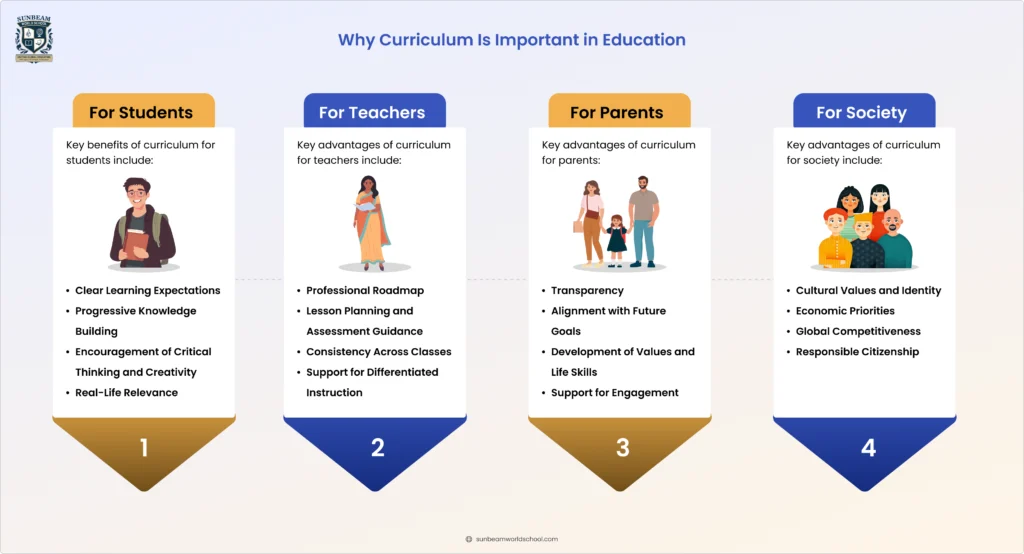
A well-designed curriculum benefits students, guides teachers, informs parents, and strengthens society.
Curriculum is the backbone of any education system. It does more than just outline subjects or chapters—it shapes learning experiences, develops skills, and prepares students for life. A thoughtfully designed curriculum impacts students, teachers, parents, and society in profound ways.
1. For Students
A well-designed curriculum provides students with clarity, structure, and meaningful learning opportunities. It ensures they progress in a logical, skill-oriented way, building knowledge step by step rather than in isolation.
Key benefits of curriculum for students include:
-Clear Learning Expectations: Students understand what they are expected to learn and achieve, reducing confusion and anxiety.
-Progressive Knowledge Building: Concepts are introduced in a sequence that reinforces prior learning, ensuring mastery before moving to advanced topics.
-Encouragement of Critical Thinking and Creativity: Beyond rote learning, students are guided to analyze, evaluate, and create solutions, fostering independent thought.
-Real-Life Relevance: Curriculum connects classroom lessons to practical applications, helping students see how learning matters in everyday life and future careers.
-Holistic Skill Development: A strong curriculum includes life skills, digital literacy, social-emotional learning, and values, not just academic knowledge.
2. For Teachers
For educators, the curriculum serves as a roadmap and framework that guides teaching while allowing creativity in delivery.
Key advantages of curriculum for teachers include:
-Professional Roadmap: Curriculum provides a clear framework of learning goals and outcomes, helping teachers plan and organize instruction effectively.
-Lesson Planning and Assessment Guidance: It informs the selection of teaching methods, resources, and assessment tools, making lessons purposeful.
-Consistency Across Classes: Ensures all students receive a uniform standard of education, while still leaving room for teacher innovation.
-Support for Differentiated Instruction: Teachers can adapt lessons to meet the needs of diverse learners, ensuring inclusivity and engagement.
-Enhanced Student Outcomes: A structured curriculum helps teachers identify gaps, track progress, and improve overall student achievement.
3. For Parents
Parents rely on curriculum to understand what their child is learning and how education supports future success.
Key advantages of curriculum for parents:
-Transparency: Provides insight into subjects, skills, and knowledge being taught.
-Alignment with Future Goals: Helps parents see whether learning prepares students for higher education, careers, or real-world problem solving.
-Development of Values and Life Skills: Parents can assess how the curriculum nurtures ethics, empathy, leadership, and social skills.
-Support for Engagement: Knowing the curriculum enables parents to reinforce learning at home and support their child’s interests and strengths.
4. For Society
Curriculum shapes not only individual learners but also the future citizens of a nation, reflecting cultural, economic, and social priorities.
Key advantages of curriculum for society include:
-Cultural Values and Identity: Curriculum transmits the heritage, traditions, and ethical values of a community or nation.
-Economic Priorities: Prepares students with skills needed for the workforce, entrepreneurship, and innovation.
-Global Competitiveness: Incorporates international standards, digital literacy, and global perspectives to prepare students for a connected world.
-Responsible Citizenship: Education fosters civic awareness, social responsibility, and empathy, contributing to a healthy, just, and inclusive society.
-Shaping Future Generations: A well-rounded curriculum ensures students grow into capable, informed, and ethical adults, driving societal progress.
Core Components of an Effective Curriculum
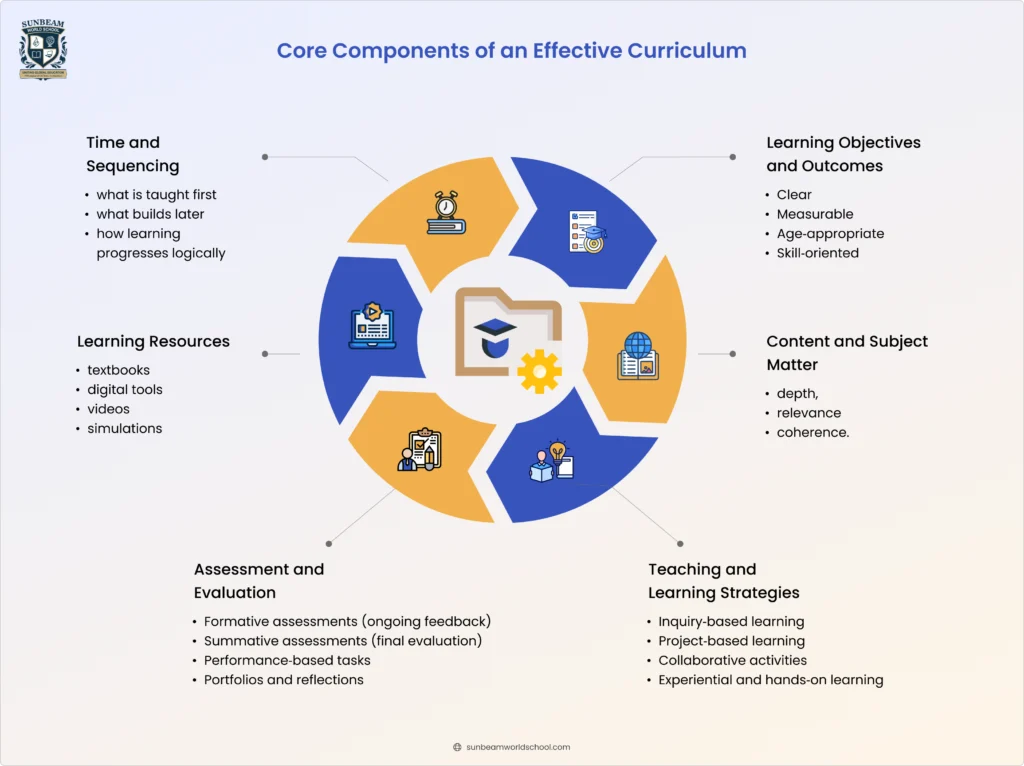
An effective curriculum is built on clear goals, strong content, smart teaching strategies, and meaningful assessment.
An effective curriculum is not accidental. It is built from carefully aligned components. Here are the components that makes a curriculum effective:
1. Learning Objectives and Outcomes
These define what learners should know or be able to do after completing a unit or program. Strong objectives are:
-Clear
-Measurable
-Age‑appropriate
-Skill‑oriented
2. Content and Subject Matter
This includes facts, concepts, principles, and skills. Quality curriculum focuses not on overload, but on depth, relevance, and coherence.
3. Teaching and Learning Strategies
Curriculum outlines how learning will take place, such as:
-Inquiry‑based learning
-Project‑based learning
-Collaborative activities
-Experiential and hands‑on learning
4. Assessment and Evaluation
Assessment is not just about exams. A balanced curriculum includes:
-Formative assessments (ongoing feedback)
-Summative assessments (final evaluation)
-Performance‑based tasks
-Portfolios and reflections
5. Learning Resources
These include textbooks, digital tools, videos, simulations, labs, and community resources that support learning.
6. Time and Sequencing
Curriculum also defines pacing: what is taught first, what builds later, and how learning progresses logically.
Understanding The Types of Curriculum
Understanding the different types of curriculum is essential for parents, educators, and school leaders because each type serves a different purpose and learning philosophy.
No single curriculum type is universally perfect; the effectiveness depends on learners’ needs, age, learning environment, and long-term goals. Let’s understand various types of curriculum:
1. Formal Curriculum
The formal curriculum is the officially approved and documented curriculum that schools are required to follow. It is carefully structured and aligned with educational standards set by national boards, governments, or international organizations.
Key characteristics:
-Clearly defined learning objectives
-Prescribed subjects and content
-Structured timetable and academic calendar
-Standardized assessment methods
2. Informal Curriculum
The informal curriculum refers to learning that occurs outside structured classroom instruction. It is not officially planned but plays a powerful role in student development.
Key characteristics:
-Unstructured and spontaneous
-Occurs through social interaction
-Reinforces life skills and values
3. Hidden Curriculum
The hidden curriculum consists of unspoken lessons students learn through school culture, routines, and expectations.
Key characteristics:
-Not written in curriculum documents
-Embedded in daily school life
-Influences attitudes and behavior
4. Subject-Centered Curriculum
A subject-centered curriculum organizes learning around traditional academic disciplines taught separately.
Key characteristics:
-Focus on subject mastery
-Teacher-led instruction
-Content-heavy approach
5. Learner-Centered Curriculum
The learner-centered curriculum places students at the heart of the learning process. It adapts content, pace, and methods based on learner needs and interests.
Key characteristics:
-Flexible pacing
-Personalized learning paths
-Active student participation
6. Teacher-Centered Curriculum
In a teacher-centered curriculum, the teacher controls what is taught, how it is taught, and how learning is assessed.
Key characteristics:
-Lecture-based instruction
-Limited student autonomy
-Emphasis on discipline and structure
7. Integrated Curriculum
An integrated curriculum connects multiple subjects around common themes or real-world problems.
Key characteristics:
-Interdisciplinary learning
-Emphasis on application
-Concept-based instruction
8. Spiral Curriculum
The spiral curriculum revisits key concepts repeatedly over time, each time at a deeper and more complex level.
Key characteristics:
-Progressive complexity
-Reinforcement of prior learning
-Long-term retention
9. Competency-Based Curriculum
In a competency-based curriculum, progress is based on mastery rather than time spent in class.
Key characteristics:
-Skill and outcome focused
-Flexible timelines
-Individual progress tracking
10. Activity-Based Curriculum
An activity-based curriculum emphasizes learning through active participation rather than passive listening or rote memorization. It is built on the idea that students learn best when they do, experience, and reflect.
Key characteristics
-Hands-on, experiential learning
-Learning through experiments, role-play, simulations, and games
-High student engagement and interaction
-Emphasis on exploration, discovery, and problem-solving
11. Montessori Curriculum
The Montessori curriculum is a child-centered educational approach developed by Dr. Maria Montessori. It focuses on independence, self-discipline, and learning through exploration within a carefully prepared environment.
Key characteristics
-Prepared learning environment with structured, age-appropriate materials
-Self-paced and self-directed learning
-Mixed-age classrooms to encourage peer learning
-Minimal direct instruction from teachers
-Strong focus on independence, responsibility, and concentration
| Curriculum Type | Definition | Key Features | Best Suited For |
| Formal Curriculum | The officially approved and documented learning plan that schools are required to follow as part of an education system. | Structured syllabus, prescribed subjects, standardized assessments, fixed timetable | Accredited schools, exam-oriented education systems |
| Informal Curriculum | Learning that occurs naturally outside formal classroom instruction through daily interactions and experiences. | Unstructured learning, social interaction, value-based skill development | Social, emotional, and life-skill development |
| Hidden Curriculum | The unwritten lessons, values, and behavioral expectations students learn through school culture and routines. | Implicit rules, discipline norms, behavioral modeling | Character building and attitude formation |
| Subject-Centered Curriculum | A curriculum organized around individual academic subjects taught separately. | Content-heavy approach, subject mastery focus, teacher-led instruction | Traditional academic education and competitive exams |
| Learner-Centered Curriculum | A curriculum designed around students’ needs, interests, abilities, and learning pace. | Personalized learning, active participation, flexible pacing | Inclusive classrooms and diverse learners |
| Teacher-Centered Curriculum | A curriculum where teachers control instruction, content delivery, and assessments. | Lecture-based teaching, structured lessons, limited student autonomy | Early education and large classroom settings |
| Integrated Curriculum | A curriculum that connects multiple subjects through common themes or real-world problems. | Interdisciplinary learning, application-based teaching | Holistic and project-based learning environments |
| Spiral Curriculum | A curriculum where key concepts are revisited multiple times with increasing depth and complexity. | Progressive learning, concept reinforcement, long-term retention | Subjects requiring deep conceptual understanding |
| Competency-Based Curriculum | A curriculum where students progress based on skill mastery rather than time spent in class. | Outcome-focused learning, flexible timelines, mastery-based assessment | Skill-based, vocational, and self-paced education |
| Activity-Based Curriculum | A curriculum that emphasizes learning through active engagement and practical activities rather than passive listening. | Hands-on tasks, experiments, role-play, simulations, interactive and experiential learning | Early childhood, primary education, skill-oriented subjects, learners who thrive with experiential methods |
| Montessori Curriculum | A child-centered educational approach that promotes independence, self-directed learning, and holistic development in a prepared environment. | Self-paced learning, mixed-age classrooms, hands-on materials, focus on independence and practical life skills | Early childhood and elementary education, learners who thrive in autonomous and exploratory environments |
Difference Between Curriculum And Syllabus
While often used interchangeably, curriculum and syllabus serve different purposes in education. Understanding the distinction helps parents, teachers, and students know what to expect from learning programs and how education is structured from the big picture down to each subject.
| Aspect | Curriculum | Syllabus |
| Definition | The complete educational plan outlining what, how, and why students learn, including teaching methods, learning objectives, content, and assessments. | A detailed outline of topics, chapters, and content to be covered in a particular subject or course. |
| Scope | Broad and holistic; covers philosophy, objectives, teaching methods, assessments, and learning experiences. | Narrow and specific; limited to content/topics of a single subject. |
| Purpose | To guide overall learning, skill development, and holistic growth. | To guide subject-specific content delivery and exam preparation. |
| Flexibility | Can adapt to different teaching styles, learner needs, and educational goals. | More rigid; usually fixed for a subject or course. |
| Focus | Emphasizes learning outcomes, skills, and values in addition to knowledge. | Emphasizes coverage of topics for exams or assessments. |
| Timeframe | Long-term; spans an academic year or entire program. | Short-term; specific to a course, semester, or unit. |
| Example | CBSE Curriculum for Class 10, IB Diploma Program, Montessori Program | Chapter-wise syllabus for Mathematics Class 10, English Literature Course Syllabus |
| Who Prepares It | Education boards, school authorities, curriculum specialists | Subject teachers, examination boards |
| Evaluation | Includes multiple forms of assessment: formative, summative, performance-based | Mostly exam-oriented, topic-specific assessment |
How A Curriculum Is Designed?
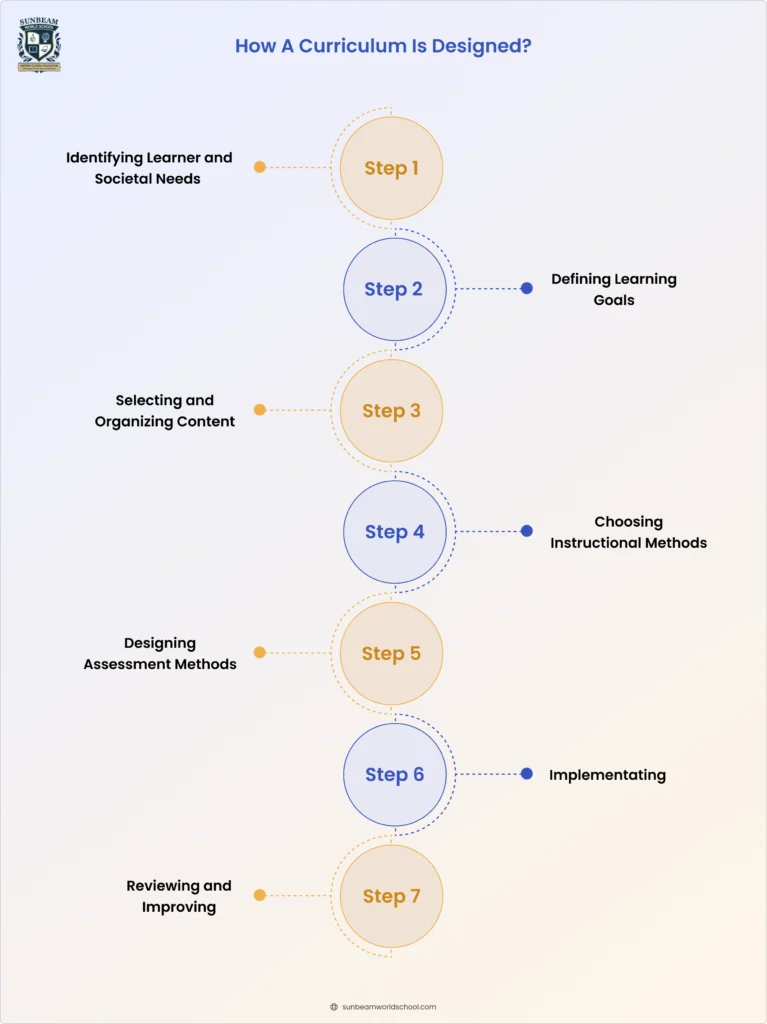
Steps showing how a curriculum is designed in education
Designing a curriculum is a careful, evidence-based process that ensures students gain the right skills, knowledge, and values. Studies show that schools with a clearly defined curriculum framework report up to 30% higher student achievement compared to schools without structured planning, highlighting the importance of thoughtful curriculum design.
Step 1: Identifying Learner and Societal Needs
Understand students’ abilities, interests, and future requirements, while considering societal, cultural, and economic contexts. This ensures the curriculum is practical and relevant.
Step 2: Defining Learning Goals
Set clear learning objectives for knowledge, skills, and values. Goals guide content, teaching methods, and assessments.
Step 3: Selecting and Organizing Content
Choose relevant material and arrange it logically from simple to complex. Integrate subjects where possible and include enrichment activities.
Step 4: Choosing Instructional Methods
Decide how content will be taught. Use methods like lectures, projects, experiments, or digital tools, tailored to learner needs.
Step 5: Designing Assessment Methods
Plan how learning will be evaluated. Include formative (ongoing) and summative (final) assessments, ensuring alignment with learning goals.
Step 6: Implementating
Deliver the curriculum in classrooms or online. Ensure teachers are prepared, resources are available, and students are actively engaged.
Step 7: Reviewing and Improving
Regularly gather feedback and update the curriculum to keep it relevant, effective, and aligned with emerging trends and learner needs.
Modern Trends in Curriculum Designing
Education is evolving rapidly, and modern curriculum design reflects changes in skills, technology, and global perspectives.
-Skill-Based Learning: Focuses on developing communication, collaboration, creativity, and critical thinking, preparing students for real-world challenges and careers.
-Digital and Blended Curriculum: Combines online tools with traditional teaching methods, offering flexibility, accessibility, and interactive learning experiences.
-Personalized Learning Pathways: Adapts curriculum to individual learner pace, interests, and abilities, ensuring higher engagement and mastery of concepts.
-Global and Cultural Relevance: Integrates diverse perspectives, cultural awareness, and global citizenship education to create informed and empathetic learners.
-Social and Emotional Learning (SEL): Helps students build empathy, resilience, self-awareness, and emotional regulation for personal and social growth.
Challenges in Curriculum Implementation
Implementing a curriculum is often more complex than designing it, as schools face practical, resource-based, and instructional challenges that affect learning outcomes.
1. Diverse Learner Needs
Meeting the varying abilities, learning styles, and backgrounds of students can be difficult, making it challenging to ensure all learners achieve the intended outcomes without gaps or frustration. Schools need adaptive strategies to address differences effectively.
2. Teacher Training Gaps
Teachers may lack adequate professional development or guidance to effectively deliver new curricula, limiting teaching quality and reducing alignment with learning goals. Continuous training and support are crucial for successful curriculum implementation.
3. Resource Limitations
Insufficient textbooks, digital tools, lab equipment, or classroom materials can hinder practical implementation and prevent students from engaging fully with curriculum activities. Adequate funding and resource planning are essential for a smooth rollout.
4. Overemphasis on Exams
Focusing primarily on test scores may restrict creative, skill-based, or experiential learning, reducing the curriculum’s effectiveness in developing holistic knowledge and competencies. Balanced evaluation methods help foster critical thinking and real-world skills.
5. Resistance to Change
Educators, administrators, or parents may resist curriculum updates due to comfort with traditional methods, slowing adoption of modern, innovative approaches. Effective communication and showcasing benefits can reduce resistance and encourage acceptance.
6. Inadequate Assessment Alignment
Assessments that don’t match learning objectives can misrepresent student progress and fail to reinforce critical skills and understanding. Aligning evaluation with goals ensures meaningful feedback and supports continuous improvement.
Real‑World Examples of Curriculum Models in Practice
Curriculum theories come alive in real classrooms. Schools adopt models that best fit their teaching philosophy, student needs, and educational goals. Here’s how different curriculum models work in practice:
1. Traditional Schools – Subject-Centered Curriculum
Focuses on teaching each subject separately, emphasizing exams and academic mastery.
Examples: CBSE, ICSE, Common Core schools.
Key Features:
-Teacher-led instruction
-Content-heavy syllabus
-Structured learning progression
Outcomes:
-Strong subject knowledge
-Clear academic structure
-Limited interdisciplinary connections
2. Alternative Schools – Learner-Centered & Activity-Based Curriculum
Prioritizes student interests, choice, and hands-on learning through projects and activities.
Examples: Montessori schools, Reggio Emilia-inspired programs, project-based learning schools.
Key Features:
-Self-directed and inquiry-based learning
-Active, experiential activities
-Flexible pacing based on learner needs
Outcomes:
-Develops independence, critical thinking, and problem-solving skills
-Higher student engagement and motivation
3. International Schools – Integrated & Competency-Based Curriculum
Combines interdisciplinary learning with skill mastery, aligning with global standards.
Examples: IB (International Baccalaureate), Cambridge IGCSE programs.
Key Features:
-Holistic and interdisciplinary approach
-Emphasis on real-world competencies
-Global perspectives incorporated in learning
Outcomes:
-Internationally recognized qualifications
-Strong critical thinking and adaptability
-Preparation for higher education and global opportunities
4. Online Schools – Personalized & Digital Curriculum
Uses technology to offer self-paced, flexible learning pathways with interactive content.
Examples: Sunbeam World School demonstrates how an online curriculum can combine global standards with individualized learning experiences.
Key Features:
-Digital tools and platforms for learning
-Personalized instruction and adaptive learning paths
-Blend of live and asynchronous teaching
Outcomes:
-Self-paced learning
-Access to global resources
-Interactive and engaging experiences
5. Vocational & Skill-Oriented Schools – Competency-Based Curriculum
Focuses on skill mastery and practical outcomes rather than time spent in class.
Examples: Technical institutes, coding bootcamps, culinary schools.
Key Features:
-Hands-on, performance-based assessments
-Outcome-focused learning paths
-Flexible timelines for mastery
Outcomes:
-Proficiency in specific skills
-Career-ready graduates
-Strong alignment with industry needs
How Parents Can Evaluate a School’s Curriculum
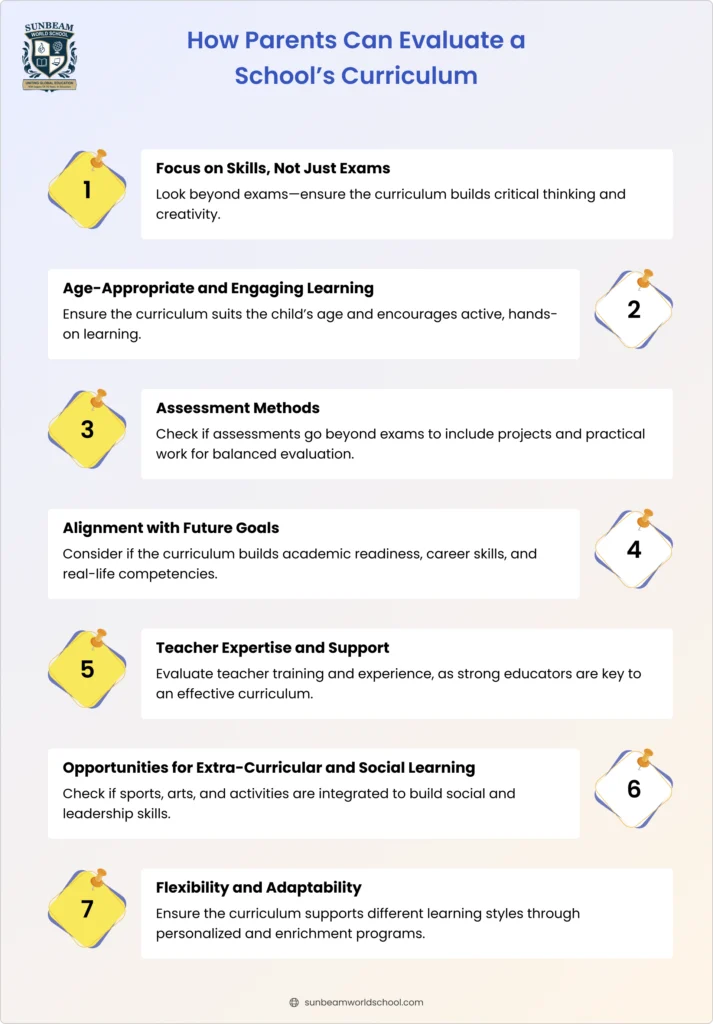
A practical checklist to help parents choose a school with a strong, future-ready curriculum.
Choosing the right school is not just about facilities or reputation—it’s about the quality and relevance of the curriculum. Parents play a key role in understanding how a school prepares students for the future. Here’s a practical guide to evaluating a school’s curriculum:
1. Focus on Skills, Not Just Exams
-Check whether the curriculum emphasizes critical thinking, creativity, and problem-solving alongside academic grades.
-Schools that focus solely on exams may neglect holistic skill development.
2. Age-Appropriate and Engaging Learning
-Evaluate whether the curriculum is designed for the child’s age and developmental stage.
-Look for interactive, hands-on activities that make learning engaging rather than passive.
3. Assessment Methods
-Ask about how students are evaluated: Are there only written exams, or are projects, portfolios, and practical assessments included?
-Balanced assessment methods give a better picture of learning and skills.
4. Alignment with Future Goals
-Consider whether the curriculum prepares students for higher education, career readiness, and life skills.
-International or competency-based programs may offer broader opportunities and flexibility.
5. Teacher Expertise and Support
-A curriculum is only as effective as the teachers delivering it.
-Ask about teacher training, professional development, and their experience in implementing the curriculum.
6. Opportunities for Extra-Curricular and Social Learning
-Check if the school integrates sports, arts, clubs, and social projects as part of the informal or integrated curriculum.
-These experiences enhance social, emotional, and leadership skills.
7. Flexibility and Adaptability
-The best curricula adapt to different learning styles and student needs.
-Ask how the school supports personalized learning, remediation, or enrichment programs.
Common Curriculum Mistakes Schools Should Avoid
Designing and implementing a curriculum is challenging. Avoiding these common mistakes can ensure learning is effective, engaging, and future-ready.
Mistake 1: Overloading Content
Including too many topics or excessive information can overwhelm students, reduce the depth of learning, and hinder long-term retention. Focus on quality over quantity.
Mistake 2: Ignoring Learner Diversity
A one-size-fits-all approach fails to address different learning styles, abilities, and interests, leaving some students behind. Personalized or differentiated learning is essential.
Mistake 3: Lack of Clear Learning Objectives
Without well-defined goals, teaching can become random or inconsistent, making it difficult to measure progress and ensure meaningful outcomes.
Mistake 4: Overemphasis on Exams
Focusing solely on grades can limit creativity, critical thinking, and practical skill development, turning learning into rote memorization rather than understanding.
Mistake 5: Poor Teacher Training
Even a well-designed curriculum fails without adequately trained teachers. Regular professional development is critical for effective delivery.
Mistake 6: Neglecting Life Skills and Values
Academic knowledge alone is not enough. Schools often overlook emotional, social, and ethical development, which are vital for holistic growth.
Mistake 7: Lack of Regular Review and Updates
Curricula that remain static become outdated. Failing to review and revise content, methods, and assessments can make learning irrelevant for today’s world.
Mistake 8: Insufficient Integration of Technology
Modern education requires digital literacy and tech-enabled learning. Ignoring technology limits student engagement and preparedness for the digital world.
Mistake 9: Weak Assessment Alignment
Assessments not aligned with learning objectives can misrepresent student understanding and fail to reinforce the intended skills or knowledge.
Mistake 10: Ignoring Parental Involvement
Parents play a critical role in reinforcing learning. Lack of communication about curriculum goals and progress can hinder student support at home.
Curriculum Available at Sunbeam World School
Sunbeam World School offers a range of internationally recognised curriculum tracks to meet diverse learning goals and global education standards:
- American Curriculum
This curriculum is based on U.S. educational frameworks, like the Common Core State Standards and Next Generation Science Standards, emphasising creativity, problem-solving, and real-world readiness. It prepares students for admission to universities in the U.S., Canada, the UK, and other systems. - British (Cambridge) Curriculum
The British curriculum provides a globally structured academic pathway, focused on analytical thinking, conceptual clarity, and international standards, commonly structured around IGCSE and A-Level frameworks. - Indian Curriculum (CBSE-Aligned & NIOS)
Sunbeam offers programs aligned with the Central Board of Secondary Education (CBSE) plus options like the National Institute of Open Schooling (NIOS), including its Open Basic Education (OBE) programme, which supports flexible, inclusive learning paths. - Multi-Board Homeschooling Programs
For homeschooling families and international learners, Sunbeam supports multiple board pathways such as CBSE, NIOS, and Cambridge, enabling students to choose curricula that match their academic goals and geographic mobility. - Skill-Enhanced Learning Integration
Across all curriculum tracks, Sunbeam incorporates co-curricular and skill development elements—such as coding, robotics, foreign languages, creativity workshops, and life skills—to ensure a holistic education that goes beyond academics.
How Sunbeam World School’s Curriculum Shapes Real Classroom Learning
At Sunbeam World School, the curriculum goes beyond textbooks to shape how students engage, apply knowledge, and grow academically and personally. With American, British (Cambridge), and Indian (CBSE/NIOS) pathways, lessons are flexible yet aligned with clear learning outcomes.
Classrooms—live online or blended—feature interactive lessons, discussions, projects, and real-world problem-solving, moving students beyond rote learning. Continuous assessment through assignments, presentations, quizzes, and skill-based activities ensures progress tracking and personalized feedback.
By fostering a learner-centered culture, the curriculum develops critical thinking, collaboration, communication, and digital skills, making learning meaningful and future-ready.
BONUS BOX:Understanding the philosophies behind a curriculum helps parents and educators see why it’s designed a certain way, not just what it includes. 1. Behaviorist Curriculum TheoryFocuses on observable outcomes. Learning is broken into small steps, reinforced through repetition and testing. -Best for: Foundational skills, early literacy/numeracy, exam preparation. -Limitations: Can overlook creativity, critical thinking, and deeper understanding of concepts. 2. Constructivist Curriculum TheoryLearners actively construct knowledge through experiences and reflection. -Best for: Project-based, inquiry-driven, and experiential learning classrooms. -Limitations: Can be time-consuming, harder to standardize, and may challenge teachers used to traditional methods. 3. Humanistic Curriculum TheoryCenters on the whole learner — emotional, social, and intellectual growth. -Best for: Learner-centered schools, personalized learning, alternative education models. -Limitations: May lack focus on standardized outcomes and measurable academic achievement. 4. Social Reconstructionist CurriculumUses education as a tool for social change, addressing real-world issues. -Best for: Global curricula, citizenship education, interdisciplinary programs. -Limitations: Can be politically or socially sensitive; may challenge traditional content coverage and assessment structures. These theories show that curriculum is not just about content—it’s shaped by a vision of learning and the kind of students schools aim to develop, helping parents and educators evaluate schools more insightfully. |
Conclusion
Curriculum is the backbone of an effective education; it shapes what students learn, how they learn, and how well they are prepared for the future. A well-designed curriculum goes beyond textbooks, integrating skills, values, real-world application, and continuous assessment to create meaningful learning experiences.
Sunbeam World School demonstrates how a thoughtfully structured curriculum can translate into impactful classroom learning. We at Sunbeam World School, ensure learners receive education that is relevant, engaging, and future-ready. Through interactive teaching methods, continuous evaluation, and a learner-centered approach, the curriculum at Sunbeam World School supports both academic success and holistic student development.
Give your child the advantage of a future-focused education. Enroll at Sunbeam World School and begin a journey of confident, joyful learning.
Happy Schooling!
FAQs
1. What is Curriculum?
Curriculum is the structured framework that defines what students learn, how learning is delivered, and how progress is assessed, including subjects, skills, values, teaching methods, and learning experiences across an educational program.
2. What is the curriculum in schools?
The school curriculum outlines subjects, learning objectives, teaching approaches, activities, and assessments that guide students’ academic and skill development throughout different grade levels in a structured and progressive manner.
3. What is the purpose of the curriculum?
The purpose of a curriculum is to provide clear learning direction, ensure consistent education standards, develop academic knowledge and life skills, and prepare students for higher education, careers, and responsible citizenship.
4. How often should a curriculum be updated?
A curriculum should ideally be reviewed every three to five years to stay aligned with changing learner needs, technological advancements, workforce demands, and educational research while maintaining academic relevance and effectiveness.
5. How does Curriculum differ in online schools?
Online school curricula emphasize digital learning tools, flexible pacing, interactive content, and personalized instruction, allowing students to learn remotely while meeting academic standards and developing self-management and digital literacy skills.
6. Is Curriculum the same as a syllabus?
No, curriculum is broader and includes learning goals, teaching methods, assessments, and values, while a syllabus is a subject-specific outline listing topics and content to be covered during a course or academic term.
7. Why is curriculum important in education?
Curriculum is important because it ensures structured learning, skill development, academic consistency, and meaningful outcomes, helping students, teachers, and parents align education with real-world and future goals.
8. What is a learning experience in the curriculum?
A learning experience includes all activities through which students gain knowledge or skills, such as lessons, projects, discussions, experiments, assessments, and real-world applications that support curriculum objectives.
9. What is the National Curriculum Framework?
The National Curriculum Framework is a guiding document that outlines educational goals, teaching principles, and learning outcomes, helping schools design age-appropriate, skill-based, and culturally relevant curricula aligned with national priorities.
In this article
Share this post:


Press and Blogs
Stay updated with our press releases, educational blogs, and more.
Starting in the 2026–27 academic session, CBSE is rolling out major reforms aligned with NEP...
What after IGCSE? After completing IGCSE, students usually move to A Levels (2 years) to...
Indian vs American Education System The Indian education system (CBSE) and the American education system...