
 Digital Learning
STEM vs STEAM Education – Differences, Benefits, and Which Is Better for Students
In today’s rapidly evolving, technology-driven world, STEM and STEAM education must go beyond textbooks to prepare students for real-life challenges and future careers. The discussion around STEM vs STEAM has become a crucial conversation for parents, teachers, and schools striving to equip students with future-ready skills.
While STEM education focuses on Science, Technology, Engineering, and Mathematics to build strong analytical and technical abilities, STEAM education expands this framework by integrating the Arts—encouraging creativity, design thinking, and human-centered problem-solving.
In this guide, we explore STEM vs STEAM education in detail – covering definitions, benefits, curriculum differences, career opportunities, and future trends – so you can confidently decide which is better: STEM or STEAM, and how each approach can support your child’s success.
What Is STEM Education?
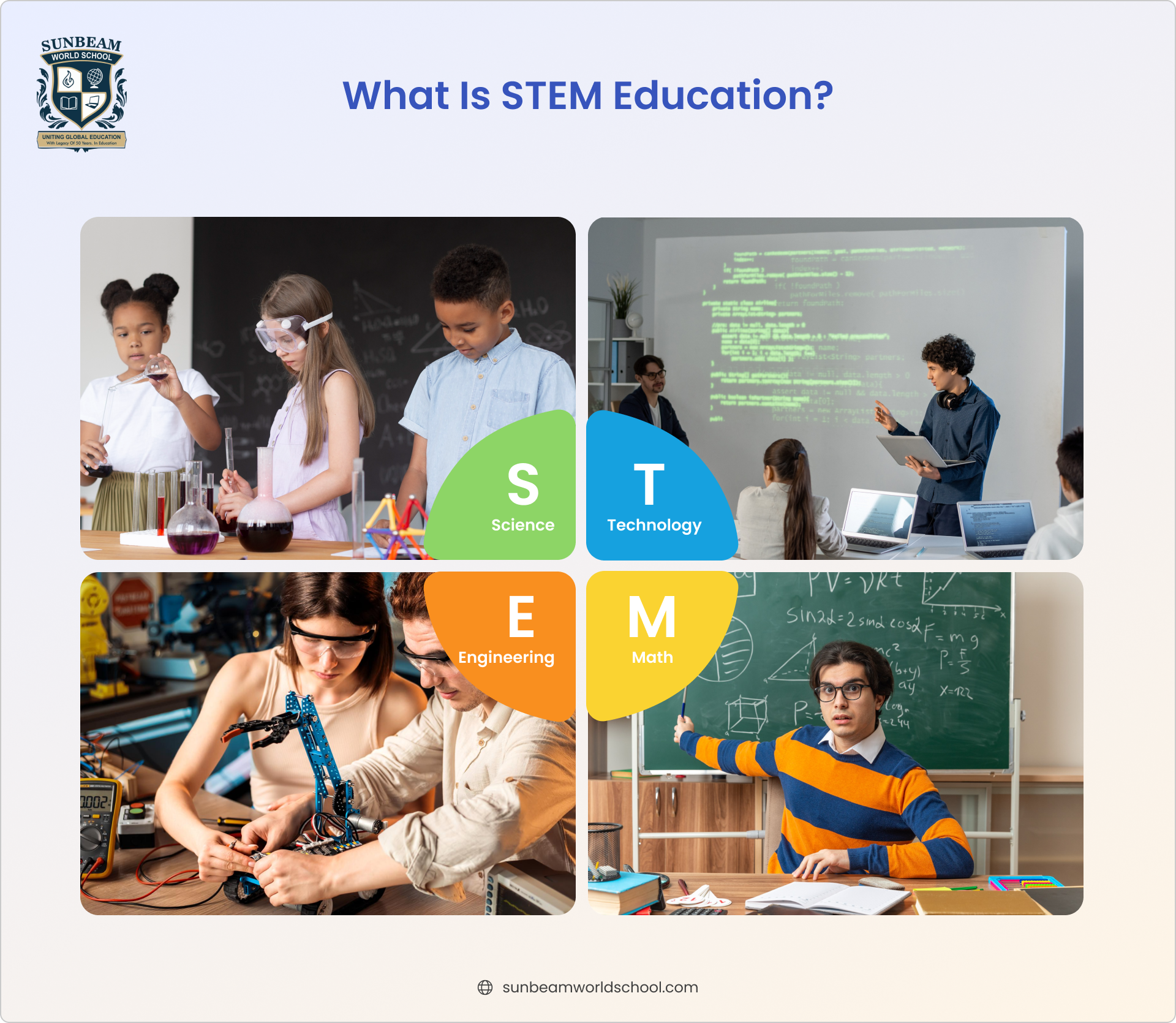
STEM education is an interdisciplinary learning approach that integrates Science, Technology, Engineering, and Mathematics into a unified framework focused on real-world application. Rather than teaching each subject in isolation, STEM encourages students to connect concepts across disciplines to analyze problems, think critically, and develop innovative solutions.
Key Features of STEM Education:
- Emphasizes hands-on learning, experimentation, inquiry, and logical reasoning
- Helps students understand not just what concepts are, but how and why they apply in real-life situations
- Reflects real-world professional practices by combining data, technology, scientific principles, and mathematical reasoning
- Strengthens problem-solving, analytical thinking, and creativity
- Prepares learners for future-ready careers in rapidly evolving technological and scientific fields
- Makes learning more relevant, engaging, and purpose-driven, aligned with the demands of the 21st-century workforce
Benefits of STEM Education
STEM education builds the skills students need to analyze, create, and innovate—laying a strong foundation for academic success and future career opportunities.
1. Develops Strong Problem-Solving Skills
STEM education teaches students how to identify problems, analyze variables, test solutions, and refine outcomes. This structured problem-solving approach helps learners tackle complex challenges logically and systematically, both in academics and real life.
2. Encourages Critical and Logical Thinking
Through experimentation, data analysis, and scientific reasoning, students learn to think critically rather than accept information at face value. STEM trains the mind to question assumptions, evaluate evidence, and make informed decisions.
3. Promotes Hands-On and Active Learning
STEM learning emphasizes experiments, projects, coding activities, and design challenges. This experiential approach improves understanding, boosts engagement, and increases long-term retention of concepts.
4. Builds Technology and Digital Literacy
Students gain exposure to coding, robotics, software tools, and digital systems, preparing them to confidently use and adapt to technology in both academic and professional environments.
5. Prepares Students for Future Careers
Many of the fastest-growing jobs—such as data science, engineering, artificial intelligence, biotechnology, and cybersecurity require STEM skills. Early exposure helps students explore interests and build career-relevant competencies.
6. Encourages Innovation and Creativity Within Structure
STEM education fosters innovation by challenging students to design, test, and improve solutions. While grounded in logic and data, STEM encourages creative thinking to find efficient and effective outcomes.
7. Strengthens Collaboration and Teamwork Skills
Group projects and experiments teach students how to communicate ideas, share responsibilities, and work toward common goals, which is one of the essential skills in modern workplaces.
8. Improves Academic Performance Across Subjects
STEM education is not restricted to any particular subject. STEM education strengthens math and science proficiency while also enhancing reasoning skills that support learning in other subjects, including language and social sciences.
9. Builds Confidence and Resilience
STEM projects are like real-life projects that often involve trial and error. Learning to handle failure, refining ideas, and trying again to build confidence, perseverance, and a growth mindset.
10. Connects Learning to Real-World Applications
STEM helps students see the relevance of education by linking classroom concepts to real-world problems such as renewable energy, medical innovation, infrastructure development, and technological advancement.
What Is STEAM Education?
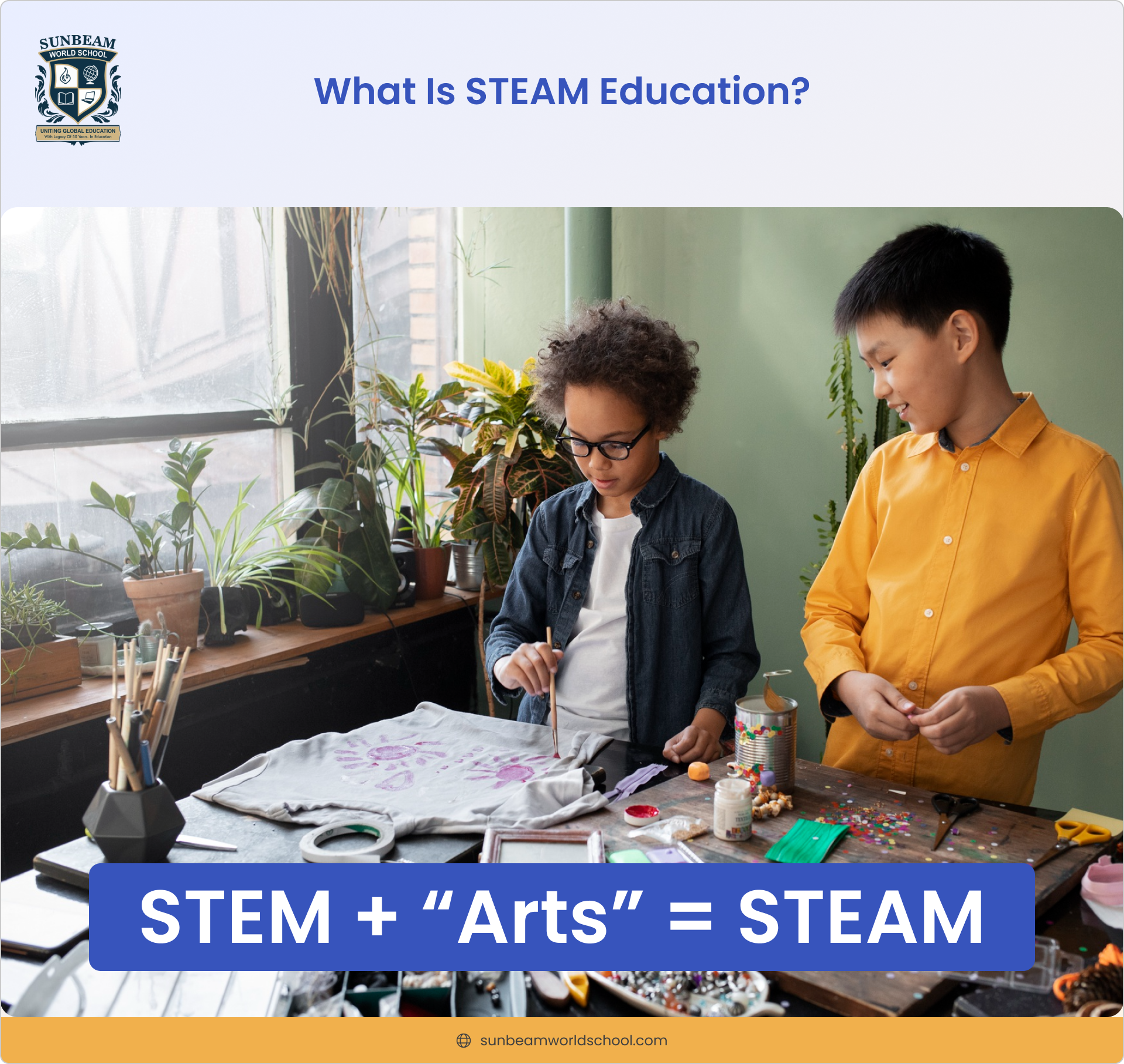
STEAM education is an expanded and more holistic learning framework that integrates Science, Technology, Engineering, Arts, and Mathematics into a unified, interdisciplinary approach. It builds upon the foundation of STEM by intentionally including the Arts—such as visual arts, design, music, language, creativity, and humanities—to enhance how students understand, apply, and communicate technical knowledge.
Key Features of STEAM Education:
- Recognizes that real-world innovation requires more than technical skills—it also needs creativity, imagination, empathy, and communication
- Blends analytical thinking with creative expression to support well-rounded problem-solving
- Encourages students to approach challenges from multiple perspectives
- Supports inclusive learning by catering to diverse learning styles and strengths
- Promotes human-centered and design-thinking approaches to problem-solving
- Helps students communicate ideas effectively through visuals, storytelling, and design
Benefits of STEAM Education
Discover how integrating Arts with Science, Technology, Engineering, and Math nurtures creativity, critical thinking, and real-world problem-solving skills in students.
1. Enhances Creativity
By integrating the arts, STEAM encourages students to think beyond formulas and predefined answers. Creative exploration helps learners generate original ideas, design innovative solutions, and approach problems with imagination—skills essential for modern innovation.
2. Improves Communication
STEAM teaches students how to present complex ideas clearly using visuals, storytelling, design, and multimedia. This ability to communicate technical concepts effectively is critical in careers such as engineering, design, marketing, and product development.
3. Encourages Inclusive Learning
STEAM supports different learning styles by combining logic with creativity. Students who may struggle with purely technical subjects often excel when given opportunities to express understanding through art, design, or storytelling.
4. Develops Human-Centered Problem Solving
Research on classroom STEAM programs using robotic kits shows measurable gains in young learners’ computational thinking and problem‑solving abilities after project participation. With STEAM, Students learn to design solutions that are not only functional but also meaningful, usable, and impactful for people.
5. Builds Collaboration and Social Skills
STEAM projects often involve teamwork across disciplines. Students learn how to collaborate, respect diverse perspectives, and work collectively toward shared goals.
6. Strengthens Critical Thinking
Field surveys of educators indicate that implementing STEAM methodologies has improvedcritical thinking scores by approximately 25 units and increased hands‑on learning skills across schools. By combining logic with creativity, STEAM helps students become adaptable thinkers who can analyze problems, shift perspectives, and adjust solutions when conditions change.
7. Prepares Students for Emerging Careers
Many modern careers—such as UX/UI design, game development, architecture, digital media, product innovation, and educational technology—require both technical and creative skills. STEAM prepares students for these blended roles.
8. Increases Engagement and Motivation
STEAM learning is often more engaging because it connects academic concepts to real-life applications, personal interests, and creative exploration, keeping students curious and motivated.
9. Encourages Lifelong Learning and Curiosity
STEAM fosters a mindset of exploration and continuous improvement. Students learn that learning is not limited to right or wrong answers but is an evolving process of discovery.
10. Reflects the Reality of Real-World Problem Solving
Real-world challenges—such as climate change, healthcare design, urban planning, and digital transformation—require both technical expertise and creative insight. STEAM mirrors this reality better than isolated subject learning
What is The Difference between STEM and STEAM
STEM and STEAM are interdisciplinary learning approaches preparing students for future careers. STEM focuses on Science, Technology, Engineering, and Mathematics to build analytical and technical skills. STEAM adds the Arts, fostering creativity, communication, and design thinking.
Both emphasize hands-on learning, critical thinking, and real-world problem-solving. This guide explores their differences, benefits, and career opportunities, helping parents and educators choose the right approach for diverse learners.
Discover the key differences between STEM and STEAM, from technical skills to creativity, and how each prepares students for future careers.
| Aspect | STEM | STEAM |
| Full Form | Science, Technology, Engineering, Mathematics | Science, Technology, Engineering, Arts, Mathematics |
| Core Focus | Technical and analytical skills | Technical skills + creativity |
| Learning Style | Structured and logic-driven | Flexible and exploratory |
| Role of Creativity | Limited and solution-oriented | Central and expressive |
| Problem-Solving | Linear and systematic | Design-thinking and adaptive |
| Skill Development | Critical thinking, logic, accuracy | Creativity, communication, empathy |
| Student Engagement | Best for analytical learners | More inclusive for diverse learners |
| Real-World Approach | Functionality-focused | Human-centered and innovative |
| Career Orientation | Engineering, science, technology roles | Design, innovation, hybrid careers |
| Communication Skills | Secondary focus | Strong emphasis |
Key Similarities Between STEM and STEAM
Learn how STEM and STEAM are related, key similarities between STEM and STEAM, explained clearly and simply:
1. Strong Focus on Core Disciplines
Both STEM and STEAM are built on Science, Technology, Engineering, and Mathematics. They emphasize logical thinking, data analysis, and scientific reasoning as essential skills for students.
2. Problem-Solving–Centered Learning
STEM and STEAM encourage students to identify real-world problems and develop practical solutions. Learners apply concepts rather than memorizing facts, strengthening analytical and critical thinking.
3. Hands-On, Experiential Approach
Both approaches promote project-based and inquiry-driven learning, allowing students to experiment, design, test, and improve their ideas through hands-on activities.
4. Interdisciplinary Education
STEM and STEAM integrate multiple subjects instead of teaching them in isolation. This helps students understand how different disciplines work together in real-life applications.
5. Future-Ready Skill Development
Both frameworks prepare students for modern careers and emerging industries, building skills such as innovation, collaboration, adaptability, and digital literacy.
6. Emphasis on Innovation and Creativity
While STEAM explicitly includes the Arts, both models encourage innovation, creative problem-solving, and original thinking in designing solutions.
7. Collaboration and Teamwork
Students in both STEM and STEAM environments often work in teams, enhancing communication, leadership, and collaboration skills.
8. Technology Integration
Both STEM and STEAM rely heavily on technology tools, digital platforms, coding, and simulations to enhance learning and prepare students for a tech-driven world.
How Have STEM and STEAM Evolved?
STEM and STEAM education have evolved to meet the growing demands of technology, industry, and society, preparing students for a world that requires both technical expertise and creative problem-solving.
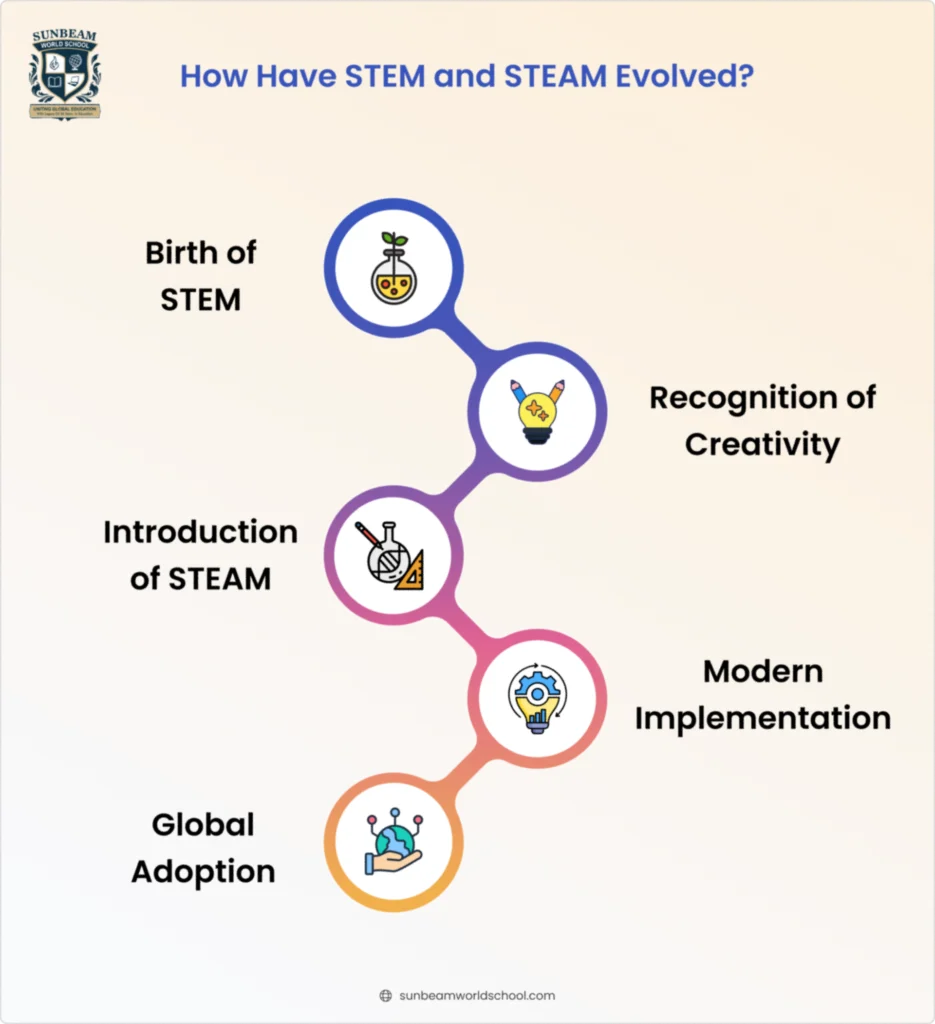
Birth of STEM
STEM education formally emerged in the early 2000s as a response by the National Science Foundationto the growing need for a workforce skilled in science, technology, engineering, and mathematics. Early initiatives included coding clubs, robotics workshops, and hands-on experiments, emphasizing practical application over rote learning.
Recognition of Creativity
By the mid-2010s, educators recognized that technical skills alone weren’t enough. Creativity, communication, and design thinking became essential to foster innovation and deep understanding.
Introduction of STEAM
STEAM added the Arts to STEM, integrating visual arts, music, design, and storytelling. This approach promotes holistic thinking and human-centered solutions while maintaining technical rigor.
Modern Implementation
Today, STEM and STEAM use project-based learning, design thinking, and technology tools like VR, AI, and robotics. Curricula blend disciplines and emphasize soft skills such as collaboration, adaptability, and communication.
Global Adoption
STEM and STEAM are now worldwide, preparing students for emerging industries by combining analytical rigor with creativity for real-world problem-solving.
Why the Arts Improve STEM Learning
The integration of the Arts into STEM education enhances how students understand, apply, and retain technical knowledge. Real-world innovation rarely depends on technical expertise alone—successful problem-solving also requires creativity, communication, and human-centered thinking, which the Arts naturally develop.
1. Improves Creative and Flexible Thinking
The Arts encourage students to explore multiple solutions instead of following a single, linear path. When applied to STEM subjects, this flexibility helps learners design innovative solutions, adapt to changing constraints, and think beyond formulas and fixed outcomes.
2. Strengthens Design Thinking and Innovation
Art-based learning introduces design principles such as ideation, prototyping, testing, and iteration. These skills directly support engineering and scientific processes, enabling students to build solutions that are not only functional but also user-friendly and impactful.
3. Enhances Conceptual Understanding and Retention
Visual arts, storytelling, and creative expression help students visualize abstract STEM concepts such as data patterns, systems, and processes. This multi-sensory learning approach improves comprehension and long-term retention compared to text-only instruction.
4. Improves Communication of Complex Ideas
STEM professionals must explain complex ideas clearly to diverse audiences. The Arts develop presentation, storytelling, and visual communication skills, allowing students to convey technical information effectively through diagrams, models, and narratives.
5. Increases Student Engagement and Motivation
Creative activities make STEM learning more engaging and relatable. When students can express ideas through design, music, or visual projects, they develop stronger emotional connections to learning, increasing participation and curiosity.
6. Supports Inclusive and Diverse Learning Styles
Not all students learn best through equations and code. The Arts provide alternative ways to demonstrate understanding, helping students with different strengths excel in STEM subjects and reducing learning barriers.
7. Reflects How Innovation Works in the Real World
Modern industries—such as product design, architecture, game development, healthcare technology, and UX/UI—blend technical expertise with creativity. Integrating the Arts mirrors real-world workflows, preparing students for interdisciplinary careers.
In essence, the Arts do not replace STEM rigor—they enhance it. By combining analytical thinking with creativity and communication, students develop deeper understanding, stronger problem-solving skills, and the ability to innovate in real-world contexts.
What Is the Future of STEM and STEAM Education in Schools?
The future of STEM and STEAM education is interdisciplinary, technology-driven, and creativity-focused. As the world evolves, students need both technical skills and creative problem-solving abilities to thrive in innovation-driven careers.
Emerging technologies like AI, VR/AR, robotics, and gamified learning will transform classrooms, making education interactive, adaptive, and globally accessible. STEAM will emphasize creativity, design thinking, and collaboration, while STEM continues to build analytical and technical expertise.
Early exposure, lifelong learning, and soft skills development will prepare students for future-ready careers in AI, sustainable design, biotech, UX/UI, and other hybrid fields. With a focus on adaptability, innovation, and global collaboration, STEM and STEAM education equips learners to solve complex real-world challenges confidently.
Which Is Better– STEM or STEAM?
There is no one-size-fits-all answer—STEM and STEAM serve different purposes, and the better choice depends on your child’s interests, learning style, and career goals.
- STEM focuses on technical and analytical skills, ideal for students who enjoy logic, coding, engineering, or science. It builds a strong foundation for careers in technology, engineering, data, and scientific research.
- STEAM adds Arts to STEM, integrating creativity, design thinking, and communication. It is best for students who thrive on innovation, interdisciplinary problem-solving, and creative expression. STEAM prepares learners for hybrid careers like UX/UI design, product innovation, sustainable design, and entrepreneurship.
The balanced approach: Many educators suggest blending both—STEM provides the foundation, while STEAM expands creativity and adaptability, better preparing students for the real-world challenges of the 21st century.
Career Opportunities in STEM and STEAM
STEM and STEAM education open doors to diverse, high-demand, and future-ready careers. While STEM focuses on technical expertise, STEAM integrates creativity and design thinking, preparing students for interdisciplinary roles that combine innovation with problem-solving.
1. STEM Career Opportunities
STEM graduates are in high demand across industries such as technology, engineering, healthcare, and data science.
STEM careers emphasize critical thinking, technical problem-solving, and innovation, often offering high-paying and globally transferable opportunities.
Popular career paths for STEM include:
- Engineering: Civil, Mechanical, Electrical, Aerospace, Robotics
- Computer Science & IT: Software Developer, AI/ML Engineer, Cybersecurity Analyst, Data Scientist
- Science & Research: Biotechnologist, Chemist, Environmental Scientist, Physicist
- Mathematics & Analytics: Statistician, Actuary, Quantitative Analyst, Operations Research Analyst
- Healthcare & Medicine: Biomedical Engineer, Geneticist, Research Scientist
2. STEAM Career Opportunities
STEAM combines STEM knowledge with creativity, arts, and design thinking, enabling students to pursue careers where innovation and human-centered design are key.
STEAM careers encourage collaboration, creativity, and applied innovation, often bridging technical skills with artistic expression to solve complex, real-world problems.
Examples of STEAM include:
- Design & User Experience: UX/UI Designer, Industrial Designer, Product Designer
- Creative Technology: Game Designer, Animation Artist, AR/VR Developer, Multimedia Specialist
- Innovation & Entrepreneurship: Startup Founder, Product Innovator, Creative Technologist
- Interdisciplinary Research: Environmental Design, Sustainable Architecture, Smart City Planner
- Education & Communication: STEAM Educator, Science Communicator, Educational Content Designer
How Parents Should Choose Between STEM and STEAM
Parents should choose between STEM and STEAM based on their child’s interests and learning style. If a child enjoys logic, numbers, coding, and problem-solving, STEM may be the better fit.
If a child shows creativity, imagination, and enjoys design or storytelling, STEAM can be more engaging. STEAM also offers greater career flexibility by combining technical and creative skills, while emotional engagement increases when learning aligns with a child’s natural strengths.
How Sunbeam World School Nurtures STEM and STEAM Skills in Kids
Sunbeam World School integrates STEM and STEAM learning into its online curriculum, helping students develop critical thinking, creativity, and problem-solving skills.
Through interactive live classes, technology-enabled tools, hands-on projects, and creative exploration, students apply concepts from science, technology, engineering, mathematics, and the arts to real-world scenarios.
This balanced STEM-STEAM approach prepares learners for future-ready careers, encourages innovation, and nurtures both analytical and creative abilities in a global online learning environment.
STEM and STEAM Projects At Sunbeam World School
Discover how STEM and STEAM projects at Sunbeam World School empower students to apply science, technology, engineering, arts, and math concepts in real-world scenarios.
These hands-on activities lead to measurable outcomes, including enhanced problem-solving, creativity, collaboration, and tangible results achieved by real students.
- Robotics and Coding Projects
Students build and program robots using kits like VEX IQ or block-based programming platforms. These activities strengthen engineering, math, and coding skills while encouraging teamwork and practical problem-solving. - Urban Planning Simulations
Using GIS software and design thinking, students analyze community needs and propose inclusive solutions. This combines data analysis, creativity, and empathy, helping learners understand real-world societal challenges. - Maze Navigation with Educational Robots
Students design mazes and program robots like Sphero to navigate them. This enhances logical thinking, sequencing, and problem-solving skills, making learning interactive and fun. - Environmental Storytelling Projects
Learners create video campaigns or multimedia presentations to explore environmental issues. This blends science knowledge with communication, digital literacy, and creativity, giving students a platform to express ideas and solutions.
These classroom projects do more than teach concepts—they build confidence, collaboration skills, and practical abilities, preparing students for the real-world demands of STEM and STEAM careers.
Interactive STEM And STEAM Tools Used At Sunbeam World SchoolAt Sunbeam World School, STEM and STEAM learning is enhanced through interactive tools and digital platforms, making lessons engaging, hands-on, and results-driven.
|
Conclusion
The STEM vs STEAM education debate isn’t about choosing one over the other—it’s about finding the right balance for different learning styles and career goals. Today’s students need both analytical thinking and creative problem-solving to succeed in a rapidly changing world.
At Sunbeam World School, STEM and STEAM learning come together through interactive online classes and hands-on projects, helping students build critical thinking, innovation, and real-world skills. Whether aspiring to be engineers, scientists, designers, or entrepreneurs, students are prepared to thrive in the future.
FAQs
1. What is the difference between STEM and STEAM learning?
The main difference between STEM and STEAM learning is the inclusion of the Arts. STEM focuses on Science, Technology, Engineering, and Mathematics to build analytical and technical skills, while STEAM adds the Arts to encourage creativity, design thinking, communication, and human-centered problem-solving.
2. Which is correct, STEM or STEAM?
Both STEM and STEAM are correct. STEM emphasizes technical and scientific skills, while STEAM expands this approach by integrating creativity and the arts. The right choice depends on a student’s learning style, interests, and career goals.
3. What is STEAM education?
STEAM education is an interdisciplinary learning approach that combines Science, Technology, Engineering, Arts, and Mathematics. It blends logical thinking with creativity, helping students develop innovative, adaptable, and real-world problem-solving skills.
4. What does STEAM mean instead of STEM?
STEAM means Science, Technology, Engineering, Arts, and Mathematics. The addition of the Arts encourages creativity, design, communication, and empathy—skills that complement technical knowledge and reflect how real-world problems are solved.
5. Why is STEM now called STEAM?
STEM is not replaced by STEAM, but expanded into STEAM. Educators recognized that creativity, communication, and design thinking are essential alongside technical skills, leading to the inclusion of the Arts to support innovation and deeper learning.
6. What are the disadvantages of STEAM education?
Some challenges of STEAM education include the need for well-trained teachers, more resources, and careful curriculum planning. Without proper balance, creative activities may overshadow technical rigor. However, when implemented effectively, STEAM offers strong academic and real-world benefits.
7. Why are STEM and STEAM lumped together?
STEM and STEAM are often discussed together because they share the same core subjects—Science, Technology, Engineering, and Mathematics. STEAM builds on STEM by adding creativity, making both approaches complementary rather than competing educational models.
8. Which is better: STEM or STEAM for kids?
There’s no one-size-fits-all answer. STEM suits students who enjoy analytical, technical, and logical problem-solving. STEAM is ideal for those who thrive on creativity, interdisciplinary thinking, and innovation. Often, a balanced approach combining both is most effective.
9. What are the benefits of STEM education?
STEM education strengthens problem-solving, analytical thinking, hands-on learning, technology skills, and prepares students for future careers in science, technology, engineering, and mathematics fields.
10. What are the benefits of STEAM education?
STEAM enhances creativity, critical thinking, collaboration, communication, and real-world problem-solving skills, preparing students for innovation-driven careers that require both technical and creative expertise.
11. Can STEM and STEAM be combined in schools?
Yes, schools like Sunbeam World implement a hybrid approach, teaching STEM subjects while integrating creative projects from STEAM. This approach develops both analytical and creative skills, making learning more engaging and holistic.
12. What careers can you pursue with STEM or STEAM education?
STEM careers include engineering, computer science, biotechnology, and data analysis. STEAM careers expand into UX/UI design, game development, product innovation, creative technology, and interdisciplinary roles blending creativity with technical expertise.
13. Is STEAM education suitable for all students?
Yes, STEAM supports diverse learning styles, combining technical and creative activities. Students who struggle with purely technical subjects often excel when given opportunities to express understanding through arts and design.
14. How are STEM and STEAM education implemented in schools?
Sunbeam World School uses project-based learning, coding, robotics, creative assignments, and collaborative activities to integrate STEM and STEAM. Students work on real-world challenges, applying both technical and creative skills to solve problems.
In this article



Share this post:


Press and Blogs
Stay updated with our press releases, educational blogs, and more.

What to do after Class 10 is what many students and parents wonder about. The...

One can study effectively using research-backed study tips and smart techniques rather than long, passive...

Failing an exam doesn’t define a student’s potential. Use these practical strategies to bounce back...