
 Academic Excellence
How To Stop Bullying In Schools
| Bullying in schools is a widespread issue that adversely affects student well‑being, academic success, and social development, requiring evidence‑based prevention and intervention approaches. School Bullying can be effectively reduced through evidence‑based, multi-level strategies that combine clear anti-bullying policies, social-emotional learning, staff training, proactive supervision, and community engagement. Research shows that structured school-wide programs lead to measurable decreases in bullying behaviors and improve student well-being. |
Whether you are a student facing bullying, a parent worried about your child being bullied, a teacher managing classroom dynamics, or a school administrator shaping policies, understanding bullying and how to stop it is essential.
Bullying- whether physical, verbal, relational, or cyber – can have long-lasting effects on a student’s emotional, social, and academic well-being. Implementing effective bullying prevention strategies ensures student safety, promotes well-being, and fosters a supportive learning environment.
In this guide, we share actionable steps, school-wide and classroom strategies, and practical tools to help children, educators, and parents prevent bullying and build a culture of empathy, respect, and inclusion.
What Is Bullying?
Bullying is unwanted, aggressive behavior that is intentional, repeated over time, and involves a power imbalance between the perpetrator and the victim. It can occur in many forms, each of which can have lasting effects on a victim’s emotional, social, and academic development.
Bullying can happen anywhere—at school, online, in neighborhoods, or even within families. Its effects are not only immediate but can also have long-term consequences, including anxiety, depression, and decreased academic performance. Recognizing bullying early is crucial for prevention and intervention.
Both peers and adults play a key role in identifying, reporting, and addressing bullying incidents effectively. Educating children about empathy, respect, and conflict resolution can significantly reduce the occurrence of bullying in schools and communities.
Understanding The Types of Bullying With Examples
Explore the different forms of bullying to help students, parents, and educators identify, prevent, and address harmful behaviors effectively.
| Type of Bullying | Definition | Examples |
| Physical Bullying | Harming someone’s body or belongings | Hitting, kicking, tripping, stealing or destroying property |
| Verbal Bullying | Using words to hurt, intimidate, or humiliate | Name-calling, teasing, threats, inappropriate jokes |
| Relational (Social) Bullying | Damaging someone’s social relationships or reputation | Spreading rumors, excluding peers, public humiliation |
| Cyberbullying | Bullying through digital platforms and online channels | Threatening messages, posting embarrassing photos, harmful social media content |
Key Characteristics of Bullying
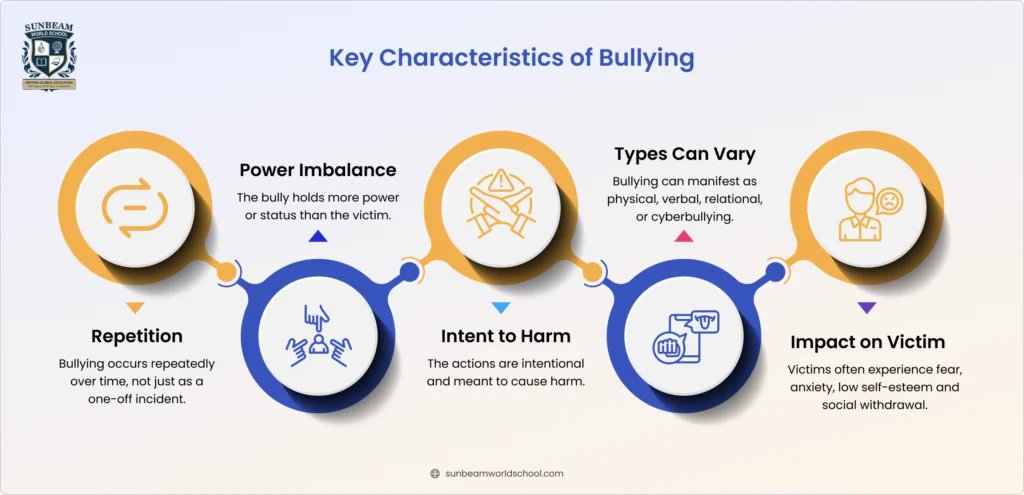
Bullying is not just occasional misbehavior—it has distinct features that differentiate it from normal conflicts. Understanding these characteristics helps educators, parents, and students identify bullying early and implement effective prevention strategies.
Let’s understand!
-Repetition – Bullying occurs repeatedly over time, not just as a one-off incident.
-Power Imbalance – There is a clear difference in power, strength, or social status between the bully and the victim.
-Intent to Harm – The actions are deliberate, aimed at causing physical, emotional, or psychological distress.
-Types Can Vary – Bullying can manifest as physical, verbal, relational, or cyberbullying.
-Impact on Victim – Victims often experience fear, anxiety, low self-esteem, and social withdrawal.
Strategies to Eliminate Bullying in Schools

Preventing bullying requires a comprehensive, school-wide approach that addresses the environment, policies, staff preparedness, and student behavior. Implementing structured strategies ensures a safer, more supportive learning environment for all students.
1. Build a Safe & Supportive School Climate
Creating a positive school culture is the foundation of bullying prevention. Students should feel respected, included, and valued in every space.
Key Actions:
-Establish core school values such as empathy, respect, and inclusion.
-Promote peer support programs and encourage community responsibility.
-Integrate Social and Emotional Learning (SEL) programs to enhance empathy, conflict resolution, and communication skills.
2. Implement Clear Policies & Rules
Schools must have well-documented anti-bullying policies that are easy to understand and consistently enforced.
Key Actions:
-Clearly define what constitutes bullying.
-Outline consequences for inappropriate behavior.
-Explain reporting procedures and investigation steps.
-Ensure policies are communicated to students, staff, and parents.
3. Train Staff & Educators
Every school employee, not just teachers, should be trained to recognize and respond to bullying effectively.
Key Actions:
-Teach staff how to intervene safely in bullying situations.
-Train staff to support victims and guide them toward resources.
-Ensure consistent enforcement of school policies across all staff members.
4. Monitor Bullying Hot Spots
Bullying often occurs in unsupervised areas such as hallways, stairwells, cafeterias, playgrounds, and online platforms. Proactive monitoring is essential.
Key Actions:
-Identify and supervise high-risk areas within the school.
-Train teachers and staff to recognize early signs of bullying.
-Encourage student reporting and peer vigilance in common spaces.
Classroom Strategies to Prevent Bullying
Preventing bullying starts at the classroom level, where teachers can directly influence student behavior, promote empathy, and create a positive learning environment. Implementing proactive strategies in daily classroom routines helps reduce conflicts and fosters inclusion.
1. Promote Open Communication
Encourage students to express their feelings and discuss issues openly.
Key Actions:
-Hold regular class meetings to talk about respect, kindness, and conflict resolution.
-Create a safe space for students to report concerns without fear of retaliation.
-Encourage peer support and active listening among students.
2. Integrate Social and Emotional Learning (SEL)
SEL programs teach empathy, self-awareness, and interpersonal skills, which reduce bullying behaviors.
Key Actions:
-Conduct activities that teach conflict resolution and emotional regulation.
-Use role-playing exercises to help students understand the impact of bullying.
-Reinforce teamwork and collaboration through group projects.
3. Establish Clear Classroom Rules
Consistent rules help students understand acceptable behavior and consequences for bullying.
Key Actions:
-Display classroom rules that emphasize respect, inclusion, and responsibility.
-Review and discuss rules regularly with students.
-Apply consequences consistently for any violations.
4. Encourage Positive Peer Interactions
Fostering a culture of friendship and respect among students reduces opportunities for bullying.
Key Actions:
-Pair students strategically for collaborative tasks to build friendships.
-Recognize and reward acts of kindness and cooperation.
-Encourage older or more confident students to mentor peers.
5. Monitor and Intervene Early
Teachers should remain vigilant to identify signs of bullying early and act promptly.
Key Actions:
-Observe interactions during group work, recess, and transitions.
-Intervene immediately in situations of conflict or harassment.
-Provide support to both victims and bystanders to prevent escalation.
10 Effective Tips To Reduce Bullying in Schools
Bullying is a serious issue that can negatively impact a student’s emotional, social, and academic development. Schools that implement structured, proactive strategies can prevent bullying and foster a safe and inclusive learning environment for student well-being.
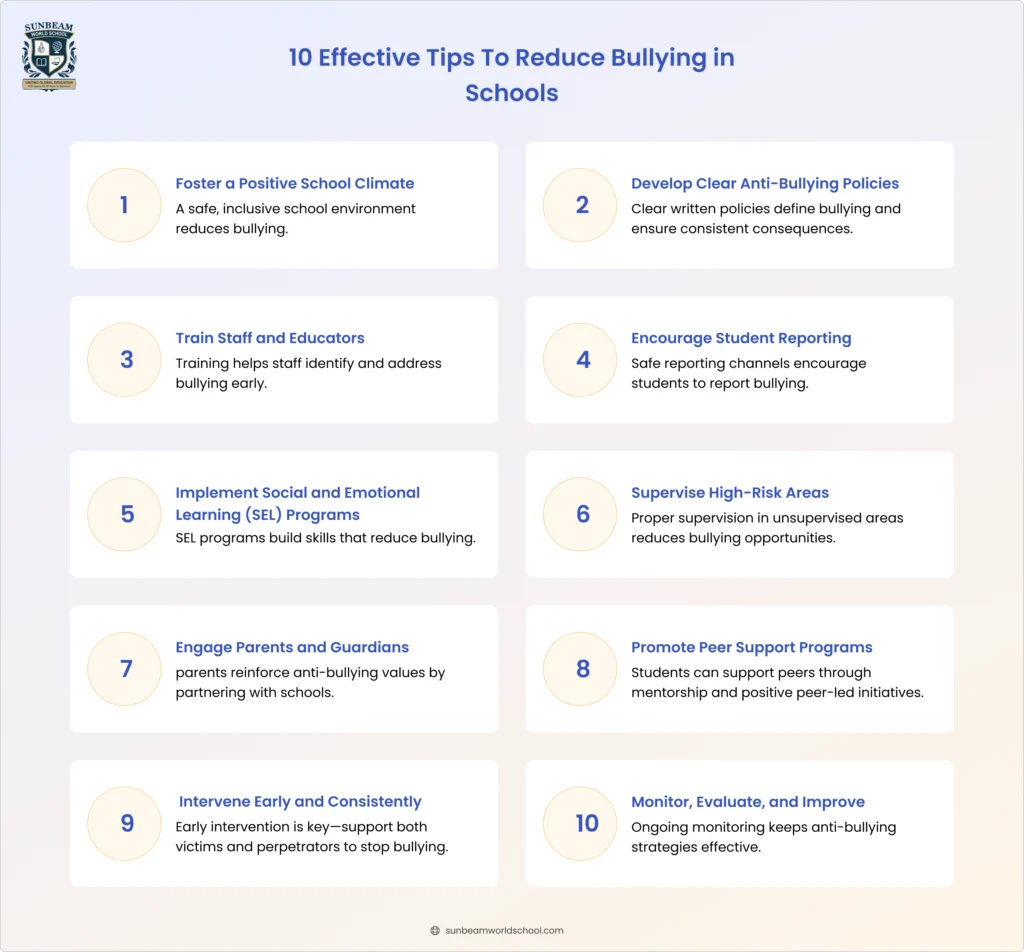
Below are 10 effective bullying prevention strategies that educators, parents, and administrators can adopt to reduce bullying in schools.
1. Foster a Positive School Climate
Creating a safe and supportive school environment is the foundation of bullying prevention. When students feel respected and included, bullying behavior decreases.
Action Steps:
-Promote empathy, kindness, and respect through school campaigns.
-Celebrate positive behaviors with recognition programs.
-Encourage collaborative activities to build peer relationships.
Example: Schools can have a “Kindness Week” where students engage in activities that promote inclusivity and empathy.
2. Develop Clear Anti-Bullying Policies
Written policies help students, staff, and parents understand what constitutes bullying and the consequences of such behavior. Clear rules ensure consistent enforcement.
Action Steps:
-Define bullying, including physical, verbal, relational, and cyberbullying.
-Outline step-by-step reporting procedures.
-Include consequences for perpetrators.
-Communicate policies to all school stakeholders.
Tip: Post policies visibly in classrooms, hallways, and on the school website for easy access.
3. Train Staff and Educators
Teachers and school staff play a crucial role in preventing and addressing bullying. Training ensures that staff can identify bullying early and respond appropriately.
Action Steps:
-Conduct professional development sessions on bullying recognition and intervention.
-Teach staff safe ways to intervene and support victims.
-Encourage consistent enforcement of school policies.
Example: Workshops can include role-playing exercises to practice intervention strategies.
4. Encourage Student Reporting
Students often witness bullying but may hesitate to report it. Establishing safe reporting channels empowers students to act without fear.
Action Steps:
-Set up anonymous reporting forms or digital platforms.
-Provide guidance on when and how to report bullying.
-Reinforce a culture of openness where students feel supported.
Tip: Recognize and thank students who report bullying to encourage proactive participation.
5. Implement Social and Emotional Learning (SEL) Programs
SEL programs help students develop essential skills like empathy, emotional regulation, and conflict resolution, which reduce the likelihood of bullying.
Action Steps:
-Integrate SEL lessons into the curriculum.
-Conduct group activities to practice cooperation and communication.
-Use real-life scenarios to teach problem-solving and empathy.
Example: Students can participate in peer mediation sessions to resolve conflicts constructively.
6. Supervise High-Risk Areas
Bullying often occurs in unsupervised spaces such as playgrounds, hallways, stairwells, and cafeterias. Proper supervision reduces opportunities for negative behavior.
Action Steps:
-Identify bullying “hotspots” through observations and incident reports.
-Increase adult presence in these areas during peak times.
-Monitor online platforms and school-managed digital spaces for cyberbullying.
Tip: Rotate staff supervision schedules to ensure consistency.
7. Engage Parents and Guardians
Parents play a critical role in reinforcing anti-bullying behaviors at home and in partnership with schools.
Action Steps:
-Organize parent workshops on bullying awareness and prevention.
-Share school policies and resources with families.
-Encourage open communication between children and parents about bullying experiences.
Example: Schools can host “Parent-Teacher Anti-Bullying Nights” to educate families and create a unified approach.
8. Promote Peer Support Programs
Students can support each other in a positive way through mentorship and peer-led initiatives.
Action Steps:
-Implement buddy systems where older students mentor younger ones.
-Create anti-bullying programs like student-led anti-bullying clubs.
-Encourage peer mediation for conflict resolution.
Tip: Empower students to lead campaigns like “Stop Bullying, Start Friendship.”
9. Intervene Early and Consistently
Prompt intervention is critical to stopping bullying before it escalates. Both victims and perpetrators should receive appropriate support.
Action Steps:
-Address incidents immediately using a consistent process.
-Provide counseling to victims to restore confidence and emotional well-being.
-Work with perpetrators to understand their behavior and prevent recurrence.
Example: Implement a “check-in system” for students involved in bullying to monitor progress.
10. Monitor, Evaluate, and Improve
Continuous monitoring ensures that anti-bullying strategies remain effective and relevant.
Action Steps:
-Conduct surveys and gather feedback from students and staff.
-Track bullying incidents and analyze trends over time.
-Adjust policies, training, and programs based on insights.
Tip: Use digital dashboards or school management software to track and report bullying data efficiently.
Tools & Resources for Bullying Prevention
Effectively preventing and reducing bullying in schools requires the right combination of policies, programs, and tools. These resources help educators, administrators, and parents detect, monitor, and address bullying incidents efficiently while fostering a safe learning environment.
1. StopBullying.gov
A comprehensive U.S. government resource providing guidance for schools, parents, and students.
-Features: Prevention strategies, research-based tips, reporting mechanisms, and online safety guidelines.
-Benefits: Offers evidence-backed strategies for creating safer school environments and raising awareness about different types of bullying.
2. Crisis Prevention Institute (CPI)
Focuses on staff training for conflict de-escalation and safe intervention in bullying situations.
-Features: Online and in-person training, certification courses, and real-life scenario simulations.
-Benefits: Equips teachers and staff with practical skills to manage aggression safely while supporting victims.
3. School Safety & Monitoring Software
Digital platforms designed to track, report, and analyze bullying incidents.
-Examples: Hero K12, Gaggle Safety Management, and SafetyCenter.
-Benefits: Helps schools document incidents, monitor trends, and generate reports for administrators and parents.
4. Online Safety Tools for Cyberbullying
Tools that monitor digital communication to prevent online harassment.
-Examples: Bark, Net Nanny, Qustodio.
-Features: Real-time alerts for cyberbullying, inappropriate content detection, and parental control dashboards.
-Benefits: Allows schools and parents to detect online bullying early and take immediate action.
5. Visual Analytics & Engagement Tools
Heatmaps, engagement tracking, and analytics software help understand student behavior patterns.
-Examples: Hotjar, Crazy Egg.
-Benefits: Identify virtual “hotspots” where bullying may occur, monitor student interaction on online learning platforms, and improve interventions.
6. Counseling & Support Platforms
Provide professional support for students affected by bullying.
-Examples: BetterHelp, Talkspace (for school partnerships), and local mental health hotlines.
-Benefits: Offers confidential support, coping strategies, and emotional guidance for students, helping them recover and build resilience.
| Pro Tip: Combining preventive tools, staff training, and support resources ensures a holistic approach to bullying prevention. Schools that actively implement these tools not only reduce bullying incidents but also foster a positive and safe learning environment. |
Measuring the Impact of Anti-Bullying Programs

Implementing anti-bullying initiatives is only effective if schools regularly measure their impact. Monitoring and evaluation help educators understand what works, identify gaps, and make data-driven decisions to improve student safety and wellbeing.
1. Track Bullying Incidents
-Record the number and type of bullying reports before and after implementing programs.
-Compare trends over time to evaluate effectiveness.
2. Student Surveys & Feedback
-Conduct anonymous surveys to gauge students’ sense of safety, awareness of policies, and perceptions of school climate.
-Include questions about both in-person and online bullying experiences.
3. Teacher and Staff Observations
-Collect feedback from teachers, counselors, and support staff about behavioral changes and bullying hotspots.
-Assess how effectively staff implement prevention strategies.
4. Academic & Social Outcomes
-Monitor absenteeism, participation, and engagement levels, as bullying often impacts academic performance and social interactions.
-Improved academic and social metrics can indicate successful anti-bullying interventions.
5. Use Data Analytics Tools
-Platforms like Hero K12, Gaggle, or Google Forms/Sheets can help track incidents and visualize trends.
-Analytics make it easier to spot patterns, measure response times, and monitor program effectiveness across grades and classrooms.
| Pro Tip: Combine qualitative feedback (student and teacher perceptions) with quantitative data (incident reports, engagement metrics) to get a full picture of your anti-bullying program’s success. Regular evaluation ensures continuous improvement and a safer school environment. |
Effective Online Safety Measures To Prevent Cyberbullying
Cyberbullying involves using digital platforms—social media, messaging apps, emails, or online games—to harass, threaten, or humiliate others. Preventing it requires proactive strategies to protect students’ emotional and digital well-being.
- Educate students about responsible online behavior and digital citizenship.
- Encourage strong, unique passwords and privacy settings on all accounts.
- Teach students how to recognize, report, and block cyberbullying.
- Promote open communication between students, teachers, and parents regarding online interactions.
- Monitor school-managed platforms and provide guidance on safe internet usage.
- Encourage empathy, kindness, and respectful online communication.
Role of Community Engagement to Prevent Bullying
Preventing bullying goes beyond the classroom—engaging the wider community helps create a consistent culture of respect and safety. Collaboration between schools, parents, local organizations, and students strengthens prevention efforts.
- Involve parents in workshops and awareness programs on bullying and online safety.
- Partner with local organizations, NGOs, and law enforcement to support anti-bullying campaigns.
- Organize community events that promote empathy, inclusion, and teamwork.
- Encourage students to participate in peer mentoring, leadership, and volunteer programs.
- Maintain regular communication between schools and families regarding policies, incidents, and progress.
| Quick Tip: Community-wide initiatives reinforce positive behavior and ensure students receive consistent guidance both at school and at home. |
Common Mistakes to Avoid in Bullying Prevention
Learn the key pitfalls to avoid in bullying prevention to ensure student well-being is prioritized and strategies are effective in creating a safe and supportive school environment.
- Ignoring early warning signs of bullying
- Inconsistent enforcement of anti-bullying policies
- Relying solely on punishment rather than education
- Neglecting cyberbullying and online safety
- Insufficient staff training on prevention and intervention
- Not involving parents and the wider community
- Failing to monitor bullying hotspots in school
- Ignoring student feedback and experiences
Bonus Box:Emerging Trends in Anti-BullyingTrend 1: AI & Online Monitoring – Schools are implementing AI tools to detect cyberbullying across social media and messaging platforms. Trend 2: Social-Emotional Learning (SEL) – Integrating SEL into daily lessons helps students develop empathy, emotional regulation, and conflict resolution skills. Trend 3: Peer Mentorship Programs – Students act as anti-bullying ambassadors to promote positive behavior and inclusion among peers. Trend 4: Restorative Practices – Facilitating dialogue between victims and perpetrators to address harm and prevent repeat bullying. Trend 5: Data-Driven Interventions – Schools use data to identify bullying hotspots and track the effectiveness of anti-bullying programs. Trend 6: Mental Health Collaboration – Partnering with counselors and community experts to support students’ emotional and psychological well-being. |
Sunbeam World School’s Efforts in Bullying Prevention
Sunbeam World School takes a proactive approach to ensure a safe and supportive environment for all students. The school emphasizes empathy, respect, and inclusion, reinforced through clear anti-bullying policies and consistent reporting procedures.
Staff are trained to recognize and respond to bullying, including online incidents, while social-emotional learning programs teach students conflict resolution, emotional regulation, and responsible digital behavior.
Parents and the community are actively engaged through workshops and discussions, creating a holistic support system. By monitoring high-risk areas and implementing early interventions, Sunbeam ensures students’ emotional well-being and academic success remain a top priority.
Conclusion
Bullying affects students’ emotional, social, and academic well-being, but with proactive strategies, schools, parents, and educators can make a real difference. By fostering a positive school climate, implementing clear policies, training staff, promoting social-emotional learning, and engaging the community, we can prevent bullying and support every child’s growth.
At Sunbeam World School we demonstrate consistent effort, empathy, and early intervention to create a safe and inclusive learning environment for all students. Remember, preventing bullying is a shared responsibility—whether you are a child, parent, teacher, or school administrator, everyone plays a role in protecting student well-being.
As it correctly said,”It takes a village to raise a child.” Together, we can ensure that every student feels safe, valued, and empowered to thrive.
FAQs
1. What is bullying?
Bullying is unwanted, aggressive behavior that is intentional, repeated over time, and involves a power imbalance between the perpetrator and the victim. It can be physical, verbal, relational, or cyberbullying.
2. Why is bullying prevention important for student well-being?
Bullying negatively impacts students’ emotional, social, and academic development. Effective prevention strategies promote safety, inclusion, and healthy learning environments.
3. What are the common types of bullying in schools?
The main types include:
- Physical bullying: Hitting, kicking, or property damage
- Verbal bullying: Name-calling, teasing, threats
- Relational bullying: Social exclusion, spreading rumors
- Cyberbullying: Harassment through digital platforms
4. How can schools prevent bullying effectively?
Schools can prevent bullying by creating a safe climate, implementing clear policies, training staff, promoting SEL (social-emotional learning), monitoring high-risk areas, and engaging parents and the community.
5. What role do parents play in bullying prevention?
Parents support anti-bullying efforts by educating children about empathy and respect, reinforcing school policies at home, monitoring online activity, and reporting incidents promptly.
6. How can educators identify bullying early?
Educators should watch for changes in student behavior, peer interactions, attendance patterns, and emotional well-being. Early intervention is key to preventing escalation.
7. What tools help prevent and monitor bullying?
Useful tools include StopBullying.gov resources, CPI training for staff, monitoring software like Hero K12, online safety tools like Bark, and engagement analytics like Hotjar.
8. How can students contribute to bullying prevention?
Students can support peers, participate in mentorship programs, report incidents, and promote kindness and inclusion in classrooms and online.
9. What are common mistakes to avoid in bullying prevention?
Mistakes include ignoring early signs, inconsistent policy enforcement, neglecting cyberbullying, insufficient staff training, and failing to involve parents and the wider community.
10. How does Sunbeam World School prevent bullying?
Sunbeam World School combines clear anti-bullying policies, staff training, SEL programs, parental engagement, and monitoring high-risk areas to create a safe and supportive environment that prioritizes student well-being.
11. How to stop someone from bullying you?
If someone is bullying you, stay calm, avoid retaliation, and seek support from a trusted adult—like a teacher, school counselor, or parent. Document incidents, use assertive communication, and, if online, block or report the bully. Remember, you are not alone, and asking for help is important.
12. How to help a bully stop bullying?
Helping a bully involves addressing the underlying issues driving their behavior. Encourage empathy, positive communication, and conflict resolution skills. Schools and parents can provide counseling, mentorship, and guidance to redirect the bully’s behavior and promote accountability.
13. What are the 3 R’s of bullying prevention?
The 3 R’s of bullying prevention are:
-Recognize – Identify bullying behaviors early.
-Respond – Take immediate action to stop bullying and support the victim.
-Report – Notify school authorities, parents, or trusted adults to ensure follow-up and prevent recurrence.
In this article



Share this post:


Press and Blogs
Stay updated with our press releases, educational blogs, and more.

CBSE Class 10 Social Science 2026 The CBSE Class 10 Social Science exam can be...

One can study effectively using research-backed study tips and smart techniques rather than long, passive...

Failing an exam doesn’t define a student’s potential. Use these practical strategies to bounce back...