 Homeschool
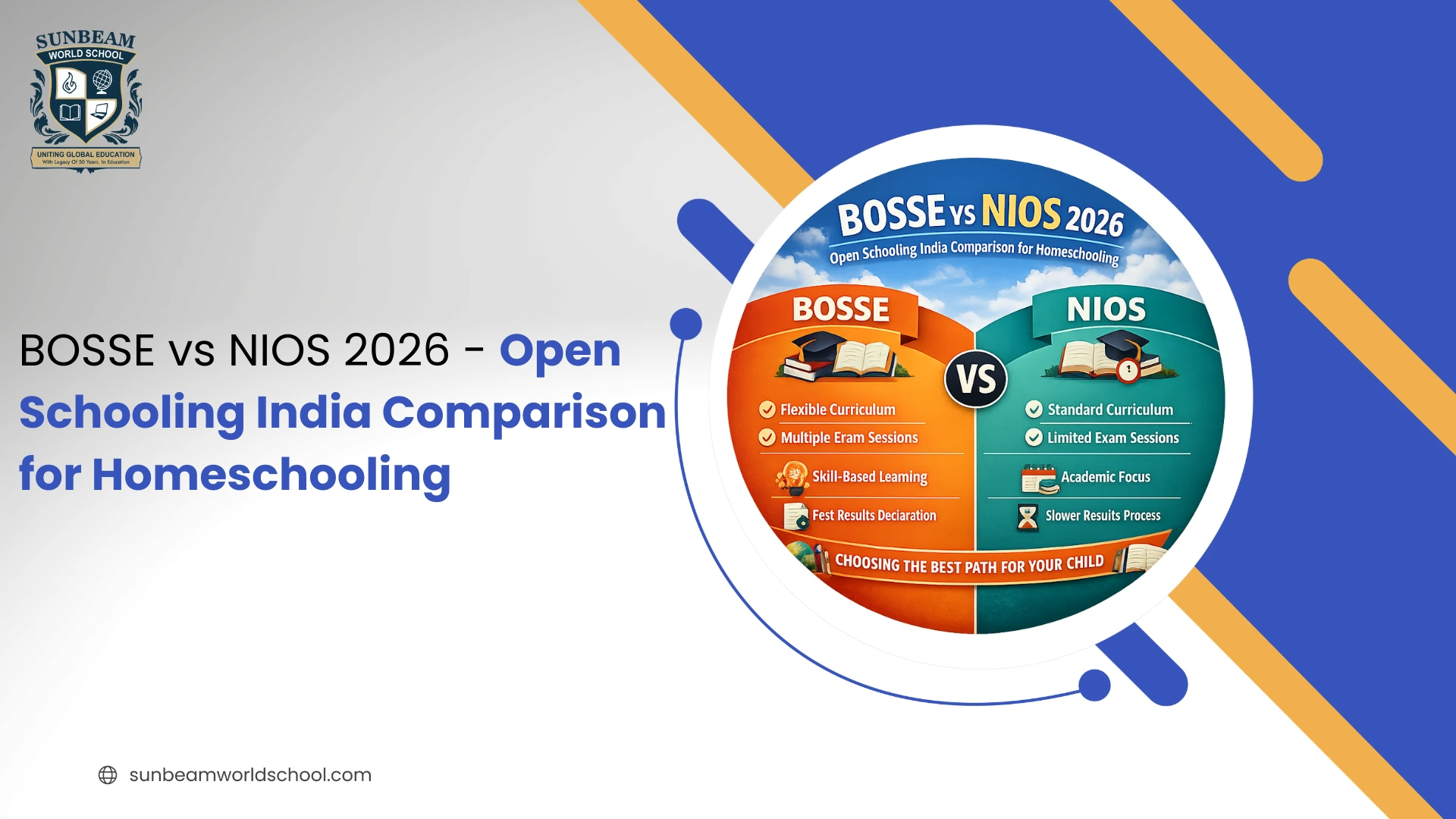
BOSSE vs NIOS 2026- Open Schooling India Comparison for Homeschooling
| Choosing between BOSSE vs NIOS comes down to your child’s learning goals. NIOS is a nationally trusted 35-year-old board, ideal for academic focus, competitive exams, and homeschoolers seeking broad recognition. BOSSE Board India integrates skill education with academics, so students earn vocational certification alongside their Class 10 or 12 diploma. NIOS or BOSSE for homeschooling, support on-demand exams, and provide recognized certificates. Neither is universally better; the right choice depends on whether you prioritize traditional recognition and exam flexibility (NIOS) or skills-based, NEP-aligned learning with vocational outcomes (BOSSE). |
Are you exploring homeschooling options for your child and wondering whether to choose BOSSE or NIOS? Let me tell you, you’re not alone.
In recent years, homeschooling and open schooling have become popular options for many Indian families. There are over 25,000 homeschooling households and more than 72,000 children learning from home across cities and rural areas.
Both BOSSE Board India and NIOS offer flexible learning schedules and recognized certifications, making it confusing to decide which board best fits your child’s goals, whether that’s strong academics, vocational skill development, or preparation for competitive exams like JEE and NEET.
This comprehensive open schooling India comparison breaks down everything you need to know about BOSSE vs NIOS, helping you make an informed choice for your child’s education.
What is BOSSE?
BOSSE stands for the Board of Open Schooling and Skill Education. It was established by the Government of Sikkim under Act No. 14 of 2020 of the Sikkim Legislative Assembly, passed on 21 September 2020. Its official website is bosse.ac.in.
What makes BOSSE different from other state open boards is right there in its name — “Skill Education.” From day one, BOSSE was designed not just to help students pass 10th and 12th exams, but to equip them with employment-oriented skills alongside academic qualifications. This dual mandate makes it genuinely distinct.
Key Features
- On-demand + bi-annual exams (ODES)
- Credit Accumulation System (CAS)
- No upper age limit
- Hindi, English & Regional Languages
- Free downloadable study materials
- DigiLocker integrated certificates
Programmes Available in BOSSE
- Secondary (Class 10 equivalent)
- Senior Secondary (Class 12 equivalent)
- Vocational / Skill courses (standalone or combined)
- Transfer of Credit (TOC) from other boards
- Part admission for failed subjects
Who BOSSE is designed for
School Dropouts
Re-enter education without starting from scratch via TOC or partial admission
Working Adults
Study at your own pace; no classroom attendance is mandatory; exam on demand
Homeschoolers
Full flexibility; NCERT-aligned materials; recognised board certificate
Failed Board Students
Carry credits from the previous board; complete only the remaining subjects
Rural Youth
Reaching the unreached, online admission, downloadable materials, no city required
Skill Seekers
Earn academic + vocational certification simultaneously — NEP 2020 aligned
What Makes BOSSE Distinct?
The BOSSE board in India stands out in the open schooling ecosystem due to its strong focus on flexibility, skill-based learning, and student-centric policies. Here are the key features that make BOSSE unique:
1. Skill Education as a Core Requirement
Unlike many boards where vocational subjects are optional, BOSSE makes skill education mandatory.
- Every student must choose at least one vocational subject
- Focus on real-world employability and practical learning
2. Credit Accumulation System (CAS)
BOSSE allows students to complete their education at their own pace through its Credit Accumulation System.
- Students can pass subjects one at a time
- Credits remain valid for up to 5 years
- Ideal for working students or those needing flexibility
3. Transfer of Credit (TOC)
BOSSE supports academic continuity through Transfer of Credit.
- Students can transfer up to 4 passed subjects from another recognized board
- Helps avoid repeating subjects already cleared
4. Part Admission Option
BOSSE offers Part Admission, making it highly flexible.
- Enroll in 1 to 4 subjects only
- Perfect for students who have partially completed their education
5. On-Demand Examination System (ODES)
With BOSSE, students don’t need to wait for fixed exam cycles.
- Exams can be taken whenever the student is ready
- Reduces pressure and supports self-paced learning
6. Accessible & Affordable Study Materials
BOSSE ensures easy access to learning resources.
- Free digital study materials available on the official website
- Printed books available at nominal cost
7. DigiLocker-Integrated Certificates
BOSSE provides modern digital verification.
- Certificates are DigiLocker-integrated
- Instantly verifiable for colleges, employers, and institutions
8. Fee Concession for Sikkim Students
To promote education locally, BOSSE offers financial benefits.
- 50% fee concession on programme fees
- Applicable for bonafide Sikkim domicile holders
9. Certificate Policy
BOSSE follows a slightly different documentation approach.
- No character certificate issued
- Provides migration and transfer certificates instead
10. Industry-Aligned Curriculum
BOSSE blends academics with practical relevance.
- Academic syllabus aligned with NCERT + NIOS standards
- Vocational subjects designed by industry experts
What is NIOS?
NIOS stands for the National Institute of Open Schooling, which is not just a board – it is one of the largest open schooling systems in the world. Established in 1989 under the Ministry of Education, Government of India, NIOS operates at the national level, making its certificates instantly recognizable across every state, university, and employer in the country. Students completing senior secondary through the NIOS Class 12 program for open schooling benefit from this extensive national recognition. Its official website is nios.ac.in.
NIOS was the pioneer of open schooling in India. Long before BOSSE or other state open boards existed, NIOS was giving second chances to dropouts, flexible pathways to working adults, and structured learning to homeschooling families.
Key Features
- Bi-annual exams (March/April & October/November)
- On-Demand Examination (ODE) at select centres
- 5-year registration validity
- Up to 9 subject choices
- Study centres with labs & advisors nationwide
- Audio-visual and print study materials
Programmes Available
- Open Basic Education (OBE) — Levels A, B, C
- Secondary (Class 10 equivalent)
- Senior Secondary (Class 12 equivalent)
- Vocational Education Courses
- Life Enrichment Programmes
- Diploma & Certificate Courses
National vs State Board Recognition: What Matters More in BOSSE vs NIOS?
The single most important factor in the BOSSE vs NIOS debate is recognition. Here’s the honest breakdown.
NIOS Recognition
- National-level board under Ministry of Education, Government of India
- Recognized by UGC (University Grants Commission)
- Recognized by AIU (Association of Indian Universities)
- Member of COBSE (Council of Boards of School Education in India)
- Certificates equivalent to CBSE — confirmed by AIU
- Accepted for IIT-JEE, NEET, UPSC, NDA, SSC, IBPS and state-level exams
BOSSE Recognition
- Established by Government of Sikkim Act No. 14 of 2020
- Listed by Ministry of Education, Government of India (Board #44)
- Recognized by NIOS itself — a significant national-level equivalency
- Member of COBSE (Council of Boards of School Education in India)
- Recognized by AIU for higher education admissions
- Listed on DigiLocker as a verified certificate issuer
- Recognized by National Medical Commission (NMC)
- Listed by IIT Kanpur as valid for JEE (Advanced) eligibility
- Recognized by IIM Indore for admission eligibility
| NIOS has a longer track record and broader automatic acceptance, particularly with government employers who may be unfamiliar with newer boards. BOSSE’s recognition is surprisingly extensive for a board that is only 5 years old, but it requires more proactive verification in some contexts. |
Open Schooling India: BOSSE vs NIOS Comparison 2026
Want to make an informed choice, BOSSE vs NIOS, then understand the differences in recognition, curriculum, exams, flexibility, vocational focus, and suitability for homeschooling.
| Parameter | NIOS | BOSSE |
| Full Name | National Institute of Open Schooling | Board of Open Schooling & Skill Education |
| Established By | Ministry of Education, Govt. of India (1989) | Govt. of Sikkim, Act No. 14 of 2020 |
| Level | National | State (Sikkim) — National Outreach |
| Programmes | OBE, Secondary, Sr. Secondary, Vocational, Diploma | Secondary, Sr. Secondary, Vocational, Skill |
| Min. Age (Class 10) | 14 years | 14–15 years (15 by exam date) |
| Min. Age (Class 12) | 15 years | Passed Class 10 from recognized board |
| Upper Age Limit | None | None |
| Exam Frequency | Bi-annual + On Demand (ODE) | Bi-annual + On Demand (ODES) |
| Registration Validity | 5 years | 5 years |
| Subject Choice | Up to 9 subjects | 5 subjects + up to 2 additional |
| Language Medium | Hindi, English, Urdu, Regional | Hindi, English, Regional Languages |
| Passing Marks | 33% aggregate + 33% per subject | 33% aggregate + 33% per subject |
| UGC Recognition | Yes | Yes (via AIU) |
| AIU Equivalency | Yes | Yes |
| COBSE Member | Yes | Yes |
| DigiLocker | Yes | Yes |
| NMC Recognition | Yes | Yes (confirmed) |
| JEE (Advanced) | Accepted | IIT Kanpur listed |
| Credit Transfer | Yes | Up to 4 subjects |
| Vocational Focus | Available but optional | Core focus — actively encouraged |
| Study Materials | Print + Audio-Visual + Online | Free download + optional printed copies |
| Syllabus Design | NIOS-developed | NCERT + NIOS academics + industry experts |
| Character Certificate | Available | Not provided (migration/transfer available) |
| Website | nios.ac.in | bosse.ac.in |
Cost Comparison: BOSSE vs NIOS 2026
Both boards are genuinely affordable compared to private schools or coaching institutes. But the details matter, especially when budgeting for multiple subjects or practical exams.
| Fee Component | NIOS | BOSSE |
| Registration (5 years) | ₹1,500–2,000 | ₹1,000 |
| Programme Fee (5 subjects, Secondary) | ₹1,800–2,400 | ₹6,000 |
| Programme Fee (Sr. Secondary) | ₹2,200–3,000 | ₹7,000 |
| Per Additional Subject (Secondary) | N/A | ₹1,200 |
| Per Additional Subject (Sr. Secondary) | N/A | ₹1,400 |
| Exam Fee (per subject) | ₹200–350 | Included in programme fee / ₹300 practical |
| Practical Fee (per subject) | ₹150–300 | ₹300 (Secondary) / ₹600 (Sr. Secondary) |
| Subject Change Fee | ₹250–500 | 500/subject |
Cost Verdict BOSSE vs NIOS:NIOS is generally more affordable, making it ideal for budget-conscious students or homeschoolers, whereas BOSSE offers flexible skill-based programs but at a higher cost per subject. To compare this with the structured online schooling fees at Sunbeam World School, you can review our fee structure for homeschool students which covers both NIOS and BOSSE programs under one platform. |
Why Most Homeschooling Families Choose Open Schooling
Homeschooling offers flexibility, but parents need recognized board certification for higher education. Open schooling boards like NIOS and BOSSE make this possible. Here are the main reasons families prefer them:
1. Legal Recognition and Board Certification
Homeschooled children need a recognized board to validate their education for college admissions, competitive exams, and employment. Open schooling boards provide official certificates that are accepted nationally and internationally.
2. Flexible Curriculum and Subject Choices
Parents can choose subjects that match their child’s interests, academic goals, or vocational aspirations. Open boards allow students to combine academic and skill-based subjects, unlike traditional schools which have rigid curricula.
3. Self-Paced Learning
Life can be unpredictable—travel, illness, or family changes. Open boards like NIOS and BOSSE allow students to study and complete exams at their own pace, making education more adaptable to real-life circumstances.
4. Multiple Exam Opportunities
Open schooling boards provide bi-annual or on-demand exams, giving students the flexibility to attempt subjects when they are ready. This reduces stress and increases success rates compared to fixed board exam schedules.
5. Nationwide/Regional Support and Resources
Open boards offer study centers, practical labs, online resources, and academic advisors. This support is crucial for parents who want occasional guidance or hands-on help for subjects like science or vocational skills.
6. Integration of Vocational and Skill-Based Learning
Boards like BOSSE integrate vocational subjects into the curriculum, allowing students to earn skill certifications alongside academic qualifications. This prepares children for practical careers and real-world opportunities.
7. Cost-Effective Education
Open schooling is often more affordable than private schools. Fees are typically lower, study materials are free or inexpensive, and families save on transportation and other school-related costs.
8. Ideal for Alternative Lifestyles
Families traveling frequently, working parents, or students with unique learning needs can benefit from homeschooling paired with open schooling boards. It provides education without the constraints of conventional school attendance.
NIOS for Homeschooling
NIOS has been the go-to choice for homeschooling families for decades. It offers a 5-year registration window, meaning if life happens – travel, illness, family changes – students have time to complete their subjects without starting over. Parents typically use NIOS books as the core curriculum guide, supplemented with NCERT textbooks, online resources, or private tutors. For families seeking a fully structured and accredited online homeschool program that wraps NIOS learning into guided online classes, expert teachers, and a learning management system, Sunbeam World School’s homeschool program is purpose-built for exactly this.
The nationwide network of study centres with labs and academic advisors is a key advantage, especially for families in smaller cities or rural areas who need occasional in-person support for practical subjects or exam preparation.
BOSSE for Homeschooling
BOSSE is gaining traction among families who want their children to develop practical, employable skills alongside academics. Its vocational integration means a student completing Class 12 through BOSSE could simultaneously earn a skill certification, something NIOS doesn’t mandate.
BOSSE’s study materials are designed to align with the NCERT and NIOS syllabi, so families already using NCERT textbooks won’t find a jarring transition. Materials are available as free downloads or inexpensive printed copies delivered to your address.
How to Choose Homeschooling for Your Child
Choosing homeschooling for your child can feel overwhelming, but with the right guidance, it can unlock personalized learning, flexibility, and skill development.
1. Assess Your Child’s Learning Style
Every child learns differently—some thrive with hands-on experiments, others with reading, videos, or self-study. Identifying your child’s preferred learning method helps tailor the homeschooling approach, ensuring lessons are engaging, effective, and matched to their pace and natural strengths.
2. Determine Your Goals
Define what you want to achieve with homeschooling. Goals could include academic excellence for college, skill-based vocational training, flexible schedules for travel, or extracurricular focus. Your objectives will guide curriculum selection, board choice, and teaching style for optimal outcomes.
3. Choose the Right Open Schooling Board
Selecting the correct board is crucial for certification and recognition. NIOS offers broad acceptance and academic credibility, while BOSSE emphasizes skill integration. Before enrolling, also check the homeschool eligibility and age requirements to confirm your child qualifies for the program and board you choose.
4. Evaluate Curriculum and Resources
Check the quality and accessibility of study materials, online support, practical labs, and vocational modules. Ensure the curriculum aligns with NCERT or standardized academics. Strong resources reduce parental stress and provide your child with structured, effective learning and exam preparation.
5. Plan the Study Schedule
Create a structured routine balancing core academics, vocational subjects, practical exercises, and exam preparation. Even with self-paced learning, a consistent schedule fosters discipline, ensures coverage of all subjects, and helps students manage time efficiently while maintaining academic and skill development.
6. Check Exam Centers and Practical Support
Confirm the availability of exam centers and labs for practical subjects in your area. Accessibility ensures smooth participation in theory and practical exams without travel strain, while on-site support for hands-on subjects enhances learning outcomes and confidence for official assessments.
7. Consider Cost and Affordability
Analyze tuition, registration, exam, and study material costs for each board. NIOS is generally more budget-friendly, whereas BOSSE may involve higher fees but offers vocational benefits. Cost considerations help families balance quality education with financial planning for the entire homeschooling period.
8. Review Long-Term Implications
Ensure the chosen board supports future academic and career paths, including college admissions, competitive exams, and vocational opportunities. Early consideration of long-term outcomes prevents obstacles later and ensures that homeschooling delivers recognized, valuable qualifications for your child’s growth.
BOSSE vs NIOS: Eligibility Criteria for Class 10 & Class 12
Understand the eligibility requirements for BOSSE and NIOS at both Class 10 and Class 12 levels. It will help you understand age limits, prior education, and documentation needed to start or continue their open schooling journey.
| Criterion | NIOS | BOSSE |
| Secondary (Class 10) Minimum Age | 14 years | 14–15 years (must be 15 by exam date) |
| Secondary Prior Education Required | Not mandatory (can join without Class 9) | Not mandatory — can enroll without formal schooling with age proof and literacy declaration |
| Secondary Upper Age Limit | None | None |
| Secondary Required Documents | Age proof, identity proof, passport photos | Age proof (Aadhaar/passport), identity proof, passport photos |
| Senior Secondary (Class 12) Minimum Age | 15 years | No specific age — based on Class 10 completion |
| Senior Secondary Minimum Qualification | Passed Class 10 from any recognized board | Passed Class 10 from any recognized board (BOSSE, NIOS, CBSE, ICSE, State Boards) |
| Need for Class 11 | Not required — direct Class 12 admission allowed | Not required — direct Class 12 admission allowed |
Competitive Exams: Are BOSSE & NIOS Certificates Accepted?
This is the question that matters most to students planning their future — and the answer is more nuanced than a simple yes or no.
NIOS
NIOS certificates are equivalent to CBSE, as confirmed by the AIU. This means NIOS students can appear for IIT-JEE, NEET, UPSC, NDA, SSC, IBPS, and most state-level competitive exams. They can also seek admission to universities and colleges across India and internationally.
BOSSE
BOSSE’s acceptance for competitive exams has grown significantly – IIT Kanpur has listed BOSSE as valid for JEE (Advanced), IIM Indore recognizes BOSSE certificates, and the National Medical Commission (NMC) has given BOSSE official recognition for NEET.
To understand how Sunbeam World School’s programs align with both these boards and what exam pathways they support, see our detailed guide on how Sunbeam aligns with CBSE, NIOS, and other boards.
BOSSE vs NIOS 2026: Career Path Guidance for Students and Homeschoolers
Explore how BOSSE and NIOS certifications align with various career goals, including engineering, medical, government exams, higher education, and international studies. Choose the board that best supports the future academic and professional ambitions of your child.
| Career Goal | NIOS | BOSSE |
| IIT-JEE / Engineering | Accepted | IIT Kanpur confirmed |
| NEET / Medical | Accepted | NMC recognized; confirm with exam authority |
| UPSC / IAS | Accepted | Accepted (open board accepted) |
| SSC / Banking / IBPS | Accepted | Accepted |
| State Entrance Exams | Generally accepted | Verify with specific state authority |
| Central Universities (DU, JNU etc.) | Accepted | Accepted via AIU equivalency |
| ITI / Polytechnic / Diploma | Accepted | Accepted |
| IIM / MBA Programs | Accepted | IIM Indore confirmed |
| International Universities | Generally accepted | Valid internationally |
Vocational & Skill Courses: Where BOSSE Stands Apart
If there is one area where BOSSE and NIOS diverge most meaningfully, it is in their approach to vocational and skill education.
NIOS
NIOS does offer vocational courses, but they sit alongside the academic programmes as an option. Students may or may not take them. BOSSE, on the other hand, has skill education baked into its identity and mission from the very beginning. The board actively encourages every student to take at least one vocational subject.
BOSSE’s Approach to Skill Education
BOSSE’s vocational and skill courses are designed by industry experts, are employment-oriented, and are focused on hands-on experience. They are available independently or in combination with academic subjects at both Secondary and Senior Secondary levels.
This means a student could, theoretically, complete their Class 12 while simultaneously developing a certified skill in areas like IT, retail, healthcare, or hospitality — and enter the job market with two qualifications. This aligns directly with the National Education Policy (NEP) 2020’s emphasis on vocational training and economic self-sufficiency for India’s youth.
Who Should Prioritize Vocational Training
If you are a working professional completing your education, a rural learner preparing for local employment, or a student who wants both an academic certificate and a job-ready skill simultaneously, BOSSE’s integrated approach is a genuine advantage. For students solely focused on competitive exam preparation and university admission, this distinction matters less.
BOSSE vs NIOS: Which Board Is Right for Your Child?
Choose NIOS If You…
- Want the safest, most universally recognized credential in India.
- Are targeting state-level competitive exams where BOSSE hasn’t been individually verified yet
- Prefer a board with 30+ years of track record and widespread employer familiarity
- Need access to study centres with labs for practical science subjects
- Are you a homeschooler who wants maximum flexibility on exam timing over 5 years
- Plan to apply to international universities (NIOS has a stronger global name recognition)
- Want a wider range of subject combinations (up to 9)
Choose BOSSE If You…
- Want academics plus a vocational/skill certification simultaneously
- Are you entering the job market and need employment-oriented training
- Are comfortable verifying board acceptance with target institutions
- Want a board aligned with NEP 2020’s skill development vision
- Are you a working professional or a school dropout wanting an efficient, skill-focused completion
- Have a Sikkim domicile (significant fee discounts apply)
- Want free downloadable study materials with NCERT-aligned content
- Targeting JEE, NEET, or IIM admissions (BOSSE is confirmed eligible)
| The Homeschooling Parent’s Quick Tip: If your child is under 14, focus on learning and exploration first. Decide on a board around age 12–13, based on future goals. For guaranteed recognition, choose NIOS; for skills, academics, and NEP alignment, BOSSE is ideal. |
Our Honest Verdict
NIOS remains India’s most recognized and safe open schooling board, especially for students who haven’t yet identified their target universities or exam bodies, or who face any uncertainty about acceptance. Its three-decade legacy means no admissions officer, employer, or exam authority will question it.
BOSSE, however, is far from a second-tier option. For a board that is barely 5 years old, its recognition portfolio, COBSE membership, AIU equivalency, NMC recognition, IIT Kanpur listing, IIM Indore confirmation, and NIOS’s own recognition of its certificates is remarkable. Its skill-education DNA gives it a genuine edge for students who want to emerge from open schooling both academically qualified and professionally useful.
The question to ask yourself is not “which is better?” but “which fits my specific next steps?”
- Known target institutions + confirmed BOSSE acceptance → BOSSE is a smart, forward-looking choice
- Uncertain path or maximum-safety needed → NIOS is the lower-risk choice
- Want vocational + academic certification together → BOSSE has a structural advantage
- Pure academic focus for JEE/NEET → Either works, with verification
Conclusion
Choosing between BOSSE vs NIOS depends on your child’s learning style and goals. NIOS is widely recognized and suitable for traditional academics, while BOSSE Board India integrates vocational skills and NEP-aligned learning.
For homeschooling parents seeking online education, Sunbeam World School offers structured homeschool curriculum options for both NIOS and BOSSE. Students can study from home, access study materials, and complete recognized open schooling board certifications, making it an ideal choice for flexible, skill-oriented learning.
The best board isn’t the most famous one. It’s the one that fits your life, your goals, and your future plans, verified before you enroll. Start your admission process today and let our counsellors help you choose the right board and curriculum track for your child.
FAQs
1. Is BOSSE a real government board or a private board?
BOSSE is a government board, established by the Government of Sikkim under Act No. 14 of 2020 of the Sikkim Legislative Assembly. It is not a private board. Its certificates are issued by a state government authority and are recognized at the national level.
2. Is NIOS better than BOSSE for Class 12?
For students targeting state-level competitive exams where BOSSE hasn’t been individually verified, NIOS is the safer choice. For students interested in vocational training, JEE, NEET, or central university admissions, both boards work — with BOSSE having some advantages in skill integration.
3. Can a homeschooled child use BOSSE for Class 10 and 12?
Yes, BOSSE accepts homeschooled students. For Secondary (Class 10), a minimum age of 14–15 years and age proof are required — no prior formal schooling is mandatory. For Senior Secondary (Class 12), completion of Class 10 from any recognized board is required.
4. Are BOSSE and NIOS certificates valid abroad?
Both BOSSE and NIOS certificates are valid internationally, subject to the individual university’s or country’s assessment of Indian open schooling qualifications. NIOS has greater global name recognition due to its age. For specific international universities, always check directly with the admissions office.
5. What is the BOSSE exam schedule for 2026?
BOSSE conducts exams twice a year — typically in April and October. For the April 2026 batch, online classes for fresh students commenced in February 2026. The board also offers an On-Demand Examination System (ODES). Check bosse.ac.in for the latest exam timetables.
6. How long does it take to complete Class 10 or 12 through BOSSE or NIOS?
Registration is valid for 5 years in both boards. Students can complete their entire Class 10 or 12 within one year by appearing for all subjects in a single exam cycle, or they can spread subjects across multiple attempts within the 5-year window using the credit accumulation system.
7. Can I transfer credits from CBSE to BOSSE or NIOS?
Yes, both BOSSE and NIOS have a Transfer of Credit (TOC) facility. Students who have passed some subjects from other recognized boards (CBSE, ICSE, state boards) can transfer those credits and only complete remaining subjects through BOSSE or NIOS.
8. What is the passing mark in BOSSE?
Students need a minimum of 33% marks in aggregate across 5 subjects, plus a minimum of 33% separately in the theory and practical components of each individual subject. This is the same passing standard as NIOS.
9. Does BOSSE provide study materials?
Yes, BOSSE study materials are available as free downloads from the official website, or can be purchased as printed copies for a nominal fee. The curriculum is designed in alignment with NCERT and NIOS academic standards, with vocational modules developed by industry experts.
10. Is open schooling (BOSSE or NIOS) accepted for government jobs in India?
Yes, both NIOS and BOSSE certificates are accepted for government job examinations including UPSC, SSC, IBPS, and state-level exams where open schooling qualifications are recognized. Always confirm for specific exams, as some departments may have their own eligibility rules.
In this article
- Top 10 Advantages of Online Schooling and Homeschooling for Students in the USA
- How Online Schooling Helps Students in the USA Learn at Their Own Pace
- 8 Moral Values That You Must Teach Your Kids Today!
- Homeschooling Made Easy with Online School
- The Online School Transition for High School Teens
- Homeschooling Curriculum for Indian Parents
Share this post:


Press and Blogs
Stay updated with our press releases, educational blogs, and more.
Education in the USA is changing faster than ever as more families are inclining towards...
It is perfectly quoted by Albert Einstein, “ Education is not about learning facts but...
You feel that education and the strong health of your child are enough to make...