

 NEWS
NEWS
AIU Equivalency Certificate Explained – Everything You Need to Know in 2026
| An AIU Equivalency Certificate from the Association of Indian Universities (AIU) validates foreign academic qualifications—including high school, undergraduate, postgraduate, and doctoral degrees—by officially recognizing them as equivalent to Indian education standards. It requires submission of authenticated documents (transcripts, degree certificates, proof of accreditation) to the AIU Evaluation Division in Delhi, ensuring eligibility for Indian university admissions, government and private jobs, professional courses, and compliance with regulatory authorities such as UGC, AICTE, NMC, and BCI. |
Studying abroad opens up a world of opportunities, but if you want your foreign qualifications to be recognized in India, you need the AIU Equivalency Certificate. Whether you’re a high school graduate, an undergraduate, or pursuing a master’s or doctoral program, this certificate ensures that Indian universities, employers, and regulatory authorities understand and accept your international education.
From applying to universities to pursuing professional courses or regulated programs, having your foreign degree officially validated makes the process seamless and stress-free. In this guide, we’ll walk you through everything you need to know—eligibility, documents, fees, and step-by-step instructions for obtaining your AIU Equivalency Certificate.
Let’s make things easy for you!

What Is an AIU Equivalency Certificate?An AIU Equivalency Certificate is an official academic recognition document issued through the Association of Indian Universities (AIU) that formally certifies a foreign educational qualification as equivalent to a specific level of education in the Indian system, based on curriculum structure, duration of study, institutional recognition, and academic standards. |
What Is The Association of Indian Universities?
The AIU Equivalency Certificate acts as a bridge between international education systems and India’s regulated academic framework.
India follows a standardized education structure—most commonly the 10+2+3 (school + undergraduate) or 10+2+4 model—while foreign education systems vary widely in:
- Course duration
- Credit structures
- Academic depth
- Recognition authorities
Because of these differences, Indian universities and regulatory bodies cannot directly interpret foreign qualifications on their own. The AIU steps in as the academic authority that evaluates whether a foreign qualification:
- Is academically valid
The issuing institution must be officially recognized in its home country, and the qualification must be awarded through a legitimate, approved academic pathway. - Meets minimum study duration and curriculum standards
AIU assesses whether the length of study, credit load, and subject coverage align with Indian norms for the same level of education. - Corresponds to an equivalent Indian qualification level
The certificate clearly states what the foreign qualification is considered equivalent to in India—such as Class 12, a Bachelor’s degree, or a Master’s degree.
Key Facts About the AIU Equivalence Certificate
Essential information every student and professional should know about applying for, obtaining, and using the AIU Equivalency Certificate in India.
- The certificate is officially issued and approved by the Association of Indian Universities (AIU) through its authorized online application portal.
- It establishes academic equivalence for qualifications earned from recognized and accredited foreign universities and institutions.
- AIU equivalence applies to multiple international education systems, including International Baccalaureate (IB) and other global curricula.
- Mandatory for validating foreign qualifications for undergraduate, postgraduate, and professional academic programs in India.
- Application fees vary based on the level and type of qualification being evaluated.
- Once approved, the certificate can be downloaded and verified online through the official AIU portal for institutional or employer verification.
What Does AIU(Association of Indian Universities) Actually Do?
AIU is not a university and does not award degrees. Instead, it functions as an academic authority and advisory body with the following core responsibilities:
1. Evaluation of Foreign Qualifications
AIU assesses degrees, diplomas, and school-level qualifications awarded by foreign institutions to determine:
- Whether the awarding institution is officially recognized in its home country
- Whether the program structure, duration, and academic content meet Indian standards
- What the appropriate Indian equivalent qualification level?
This evaluation forms the basis for issuing equivalency certifications.
2. Academic Standardization
Indian universities follow regulated education frameworks (such as 10+2+3). Without this standardization, each institution would apply its own rules—leading to confusion and unfair rejections. AIU helps:
- Align diverse international education systems with Indian norms
- Maintain consistency in how foreign qualifications are interpreted across universities
3. Advisory Role to Universities & Regulators
AIU’s recommendations help institutions remain compliant with national education policies. It provides academic guidance to:
- Indian universities
- UGC and other regulatory bodies
- Educational institutions handling international admissions
Why AIU Is Trusted by Indian Universities
Indian universities rely on AIU assessments to make legally defensible admission and eligibility decisions. AIU’s credibility comes from:
- Nearly a century of academic oversight
- Membership of hundreds of Indian universities
- Recognition by government and regulatory authorities
- Long-standing expertise in comparative education systems
Why Is the AIU Equivalence Certificate Mandatory?
The AIU Equivalence Certificate is not just a formality—it is a crucial document that ensures your foreign qualification is recognized and accepted across India. Here’s why it is mandatory:
1. Ensures Academic Validity
Indian universities and regulatory bodies cannot independently verify foreign qualifications. The certificate confirms that your degree or diploma is legitimate, issued by a recognized institution, and meets minimum academic standards.
Without it, universities risk admitting students whose qualifications do not meet the required standards, which can have legal and regulatory consequences.
2. Standardizes Education Across Borders
Education systems vary widely worldwide:
- Some countries have shorter bachelor’s programs
- Some curricula emphasize practical experience over theory
- Credit systems and grading scales differ
The AIU equivalence certificate maps your foreign qualification to the Indian education system (e.g., 10+2+3 or 10+2+4), ensuring universities, employers, and professional councils can interpret your credentials correctly.
3. Required for Admissions to Indian Universities
Most Indian universities, whether central, state, or private, require AIU equivalence for foreign qualifications when applying for:
- Undergraduate or postgraduate programs
- Doctoral or research programs
- Professional courses like MBA, engineering, medicine, or law
Without the certificate, your admission application may be rejected outright.
4. Necessary for Regulatory Compliance
Certain regulatory bodies (UGC, AICTE, NMC, BCI, etc.) mandate equivalence certificates to ensure:
- Applicants meet the prescribed academic standards
- Universities maintain legal compliance
- Foreign qualifications are recognized for employment, licensure, or competitive exams
Universities are accountable for following these regulations, making the AIU certificate a non-negotiable document.
5. Protects Your Career and Academic Credibility
Applying to Indian universities or professional exams without an AIU equivalence certificate can lead to:
- Delayed admissions
- Rejected applications
- Invalidated degrees or job applications
The certificate serves as academic insurance, ensuring your foreign education is officially recognized and accepted across India.
Who Needs to Apply for an AIU Equivalence Certificate
Foreign graduates, students, and professionals need an AIU Equivalence Certificate to validate their qualifications in India for higher studies, employment, or official recognition. Learn more about it:
1. Students with Foreign Academic Qualifications
Anyone who has completed education abroad, whether at the high school, undergraduate, or postgraduate level, needs AIU equivalence to validate their credentials in India. Without this recognition, Indian universities and institutions may not accept foreign qualifications, blocking admission or further studies. This certificate ensures a smooth transition into India’s academic system.
2. Professionals Seeking Higher Education in India
Individuals aiming for advanced studies in India – such as M.Tech, MBA, or PhD—must apply for AIU equivalence if their prior degrees were obtained overseas. Indian universities require this validation to confirm academic standards. Without it, foreign qualifications may be rejected, preventing admission and limiting professional growth opportunities in India’s competitive academic environment.
3. Job Seekers in India
Professionals planning to work in India, particularly in government, public sector units, or regulated professions, need AIU equivalence to prove their foreign degrees’ validity. Employers rely on this certificate to ensure qualifications meet Indian standards. Without it, candidates risk being ineligible for positions or promotions that require formal recognition of overseas education.
4. Migrants or Returnees
Indians returning from studying abroad require AIU equivalence to integrate seamlessly into India’s education or employment sectors. This certification ensures that foreign credentials are formally recognized, preventing administrative or professional barriers. Whether seeking higher studies, certifications, or jobs, AIU equivalence provides legitimacy and avoids potential rejection due to unrecognized foreign qualifications.
5. Students Transferring to Indian Schools
Students moving from international schools to Indian boards, such as CBSE or ICSE, must obtain AIU equivalence to continue their studies. This ensures that prior coursework abroad aligns with Indian curriculum standards. Without it, students may face challenges in enrollment, grade recognition, or syllabus compatibility, making the certificate essential for a smooth academic transition.
How To Apply For The Equivalency Certificate AIU – Step by Step
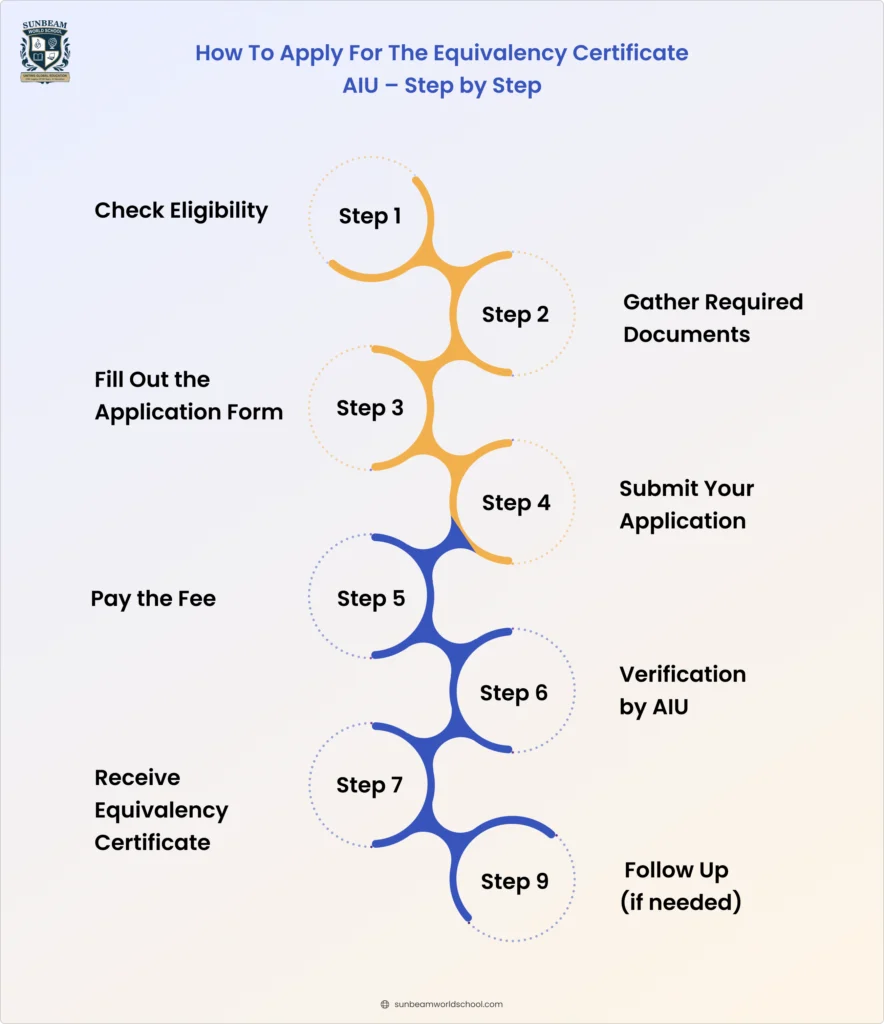
Steps to apply for AIU equivalency certificate
Follow a simple step-by-step process to apply for an AIU Equivalency Certificate, validating your foreign qualifications for higher studies, employment, or official recognition in India.
Whether it’s Class 10 & 12, Diploma/Bachelor, or Masters/Doctoral level programs, the certificate ensures your credentials are officially recognized.
Step 1: Check Eligibility
- Ensure your foreign qualification is recognized by the education authority of the country where it was awarded.
- The certificate is required for students seeking admission in India, professionals needing official recognition, or those applying for government jobs.
Step 2: Gather Required Documents
Prepare the following documents before applying:
- Application Form – Download from the AIU website.
- Degree Certificate / Diploma – Original and notarized copy.
- Mark Sheets / Transcripts – All years/semesters of your qualification.
- Proof of Recognition – Any official accreditation of your foreign university.
- Passport / Identity Proof – As a valid ID.
- Migration / Transfer Certificate (if applicable).
- Processing Fee – As per AIU guidelines.
Step 3: Fill Out the Application Form
- Complete the AIU Equivalence Application Form carefully.
- Ensure all details match your academic documents exactly to avoid delays.
Step 4: Submit Your Application
Submit the filled form along with the required documents either online (if AIU allows e-submission) or via post/physical submission at the AIU office in Delhi. Below is the postal submission address:
To:
The Director (Equivalence),
Association of Indian Universities (AIU)
AIU House, 16, Comrade Indrajit Gupta Marg,
New Delhi – 110002, India
Phone: +91-11-23230059 / 23230060
Email (for queries):equivalence@aiu.ac.in
Step 5: Pay the Fee
- Pay the prescribed processing fee via bank draft, online transfer, or as instructed by AIU.
- Keep the receipt for reference.
- The standard AIU Equivalency Certificate fee is INR 14,160, while an enquiry costs INR 1,180. Payments can be made online (cards, net banking, UPI) or offline (RTGS/NEFT, Demand Draft). Fees are subject to change, and receipts must be retained. Additional courier charges apply if submitting physical documents.
Step 6: Verification by AIU
- AIU reviews your documents, checks the authenticity of your foreign institution, and evaluates the course structure.
- They may contact the university abroad for verification if needed.
Step 7: Receive Equivalency Certificate
- Once approved, AIU issues the Equivalence Certificate, confirming your foreign qualification is equivalent to the corresponding Indian degree.
- You can use this certificate for admissions, jobs, or official recognition in India.
Step 8: Follow Up (if needed)
- Track your application status on the AIU website or contact the AIU office if processing is delayed.
- Typical processing time varies, usually 2–6 weeks depending on verification requirements.
Why an AIU Equivalency Certificate is Important
An AIU Equivalency Certificate is essential to validate foreign qualifications in India, ensuring recognition for higher studies, government or private jobs, and official professional or academic purposes.
- Recognition of foreign qualifications in India
- Admission to Indian educational institutions
- Eligibility for government jobs
- Professional validation
- Higher studies opportunities
- Employment in the private sector
- Avoids legal and administrative issues
- Standardized comparison of qualifications
Which Universities Are Included in AIU?
The Association of Indian Universities (AIU) does not maintain a fixed list of approved foreign universities. Instead, it evaluates each foreign qualification on a case-by-case basis to determine equivalence with Indian degrees.
Key Points:
- AIU recognizes foreign universities that are accredited or officially recognized in their own country by government or national education authorities.
- Indian universities that are members of AIU are automatically included for equivalence and collaboration.
- AIU assesses the program structure, duration, and recognition status before granting equivalence.
- Degrees from unaccredited institutions or online-only programs are usually not accepted.
Tip: Before applying, check that your foreign university is recognized by its national accreditation authority and provide proof when submitting your AIU application.
Can Foreign Students Apply for an AIU Equivalency Certificate?
Yes, the AIU Equivalency Certificate is available to students of any nationality who have completed their education abroad and wish to study in India. The certificate validates that your foreign qualifications—whether high school, diploma, bachelor’s, or master’s—meet Indian academic standards.
To apply, foreign students must submit:
- Proof of their foreign education (mark sheets, transcripts, degree certificates)
- Verification of the foreign institution’s accreditation or official recognition
- Valid identification, such as a passport
This ensures Indian universities and professional institutions can accurately evaluate your credentials, making you eligible for admission, professional courses, or regulated programs in India.
Common Mistakes That Delay or Reject Applications for AIU
Submitting an AIU Equivalency Certificate application can be straightforward if done carefully. However, many applicants face delays or rejections due to avoidable errors. Here are some common mistakes to watch out for:
- Incomplete or Incorrect Application Form: Missing fields, wrong personal details, or mismatched academic information can lead to delays.
- Insufficient or Unverified Documents: Not providing all required mark sheets, degree certificates, or proof of recognition can result in rejection.
- Incorrect Payment or Missing Fee: Submitting the wrong fee amount or failing to include proof of payment can halt processing.
- Failure to Authenticate Documents: AIU often requires notarized, attested, or certified copies. Unverified documents may not be accepted.
- Ignoring University Accreditation: Degrees from unrecognized or non-accredited foreign institutions are not eligible for equivalence.
- Poor Packaging or Submission Method: For postal submissions, using insecure packaging or failing to track courier can lead to lost or delayed applications.
- Not Following AIU Guidelines: Skipping instructions from the official AIU portal or submitting outdated forms can delay approval.
Exceptions to AIU Equivalency Certificate Applications
While AIU evaluates most foreign qualifications, some cases may not be eligible or may require special consideration:
- Unaccredited or Unrecognized Universities: Degrees from institutions not recognized by their country’s education authority are usually not eligible.
- Online or Distance-Only Programs: Foreign qualifications obtained entirely through online or distance learning may not be accepted unless the program is officially accredited.
- Incomplete or Non-Standard Programs: Short-term courses, certificate programs, or programs with insufficient duration compared to Indian equivalents may not qualify.
- Professional/Technical Courses without Equivalence: Some foreign professional or technical programs (like specific diplomas or certifications) may not have a corresponding Indian equivalence, requiring special approval.
- Expired or Outdated Documents: AIU may reject applications if the documents are old, unofficial, or improperly attested.
Quick Tips to Apply for an AIU Equivalency Certificate
|
How Sunbeam World School Can Help With Your AIU Equivalency Certificate
Navigating the AIU Equivalency process can feel overwhelming, especially with strict document requirements, verification steps, and timelines. Sunbeam World School offers expert guidance to simplify this journey for students and professionals:
- Eligibility Assessment: We help you determine if your foreign qualification is eligible for AIU equivalence.
- Document Preparation: Guidance on collecting, notarizing, and attesting all required documents to avoid delays or rejections.
- Application Support: Step-by-step assistance with filling out the AIU application form accurately.
- Fee & Payment Guidance: Clear instructions on processing fees, online/offline payment methods, and keeping track of receipts.
- Follow-Up Assistance: Support in tracking your application status and liaising with AIU if additional verification is needed.
- Academic Counseling: Advice on aligning your foreign credentials with Indian universities or professional programs, making admission and career transitions seamless.
By leveraging Sunbeam World School’s expertise, students can ensure a smooth, stress-free AIU equivalence process, save time, and avoid common mistakes that delay approvals.
Have questions about obtaining AIU equivalence or enrolling at Sunbeam World School? Contact us. to get personalised help.
Conclusion
Obtaining an AIU Equivalency Certificate is a crucial step for foreign students and professionals who want their international qualifications recognized in India. It ensures your degrees are understood, accepted, and valued by universities, employers, and regulatory authorities across the country.
By following the step-by-step process, preparing the correct documents, and understanding eligibility requirements, you can avoid delays and secure official recognition for your education abroad.
Sunbeam World School guides students through this process, helping them make smooth transitions into Indian academic and professional programs with confidence.
FAQs
1. How to apply for an AIU certification in India?
To apply for an AIU Equivalency Certificate, download and fill the official application form from the AIU website. Submit it along with required documents and the processing fee. AIU verifies your foreign qualification and, once approved, issues the equivalence certificate for academic or professional use in India.
2. How much does an AIU certificate cost?
The standard processing fee for an AIU Equivalency Certificate is INR 14,160. If you only want to inquire about equivalence, a nominal fee of INR 1,180 applies. Payments can be made online or via bank transfer/Demand Draft, and receipts must be kept for reference.
3. Who is eligible for AIU equivalence?
Individuals with foreign qualifications from accredited or officially recognized institutions are eligible to apply. This includes students seeking admission to Indian universities, professionals seeking job recognition, or anyone requiring official validation of their foreign academic credentials in India.
4. What is the full form of AIU?
AIU stands for the Association of Indian Universities. It is a statutory organization that evaluates foreign academic qualifications, granting equivalence certificates to ensure that international degrees, diplomas, and certificates are recognized within the Indian education and employment system.
5. Do I need an equivalence certificate for Class 10 and 12?
Yes, students who have completed Class 10 or 12 from foreign boards or international schools often require an AIU equivalence certificate to ensure their qualifications are recognized for admission into Indian universities or colleges. This certificate confirms that their education meets Indian academic standards.
6. Is AIU equivalence necessary for Indian university admissions?
Most Indian universities require an AIU Equivalency Certificate to verify that foreign qualifications meet Indian academic standards. Without it, students may face admission difficulties. Some universities may have additional eligibility criteria, but AIU equivalence is generally mandatory for recognition.
7. Can I apply for AIU if my degree is online or distance mode?
AIU typically does not grant equivalence for foreign degrees completed entirely through online or distance learning programs unless the institution and program are formally recognized and accredited in their country. Applicants should verify their program’s eligibility before applying.
8. How long does the AIU equivalence process take?
The processing time for an AIU Equivalency Certificate usually ranges from 2 to 6 weeks, depending on the completeness of documents and verification requirements. Delays may occur if additional university verification is needed or documents are incomplete.
9. Can I submit my documents for the Equivalence Certificate by post?
Yes, applicants can submit documents via registered post or courier to the AIU Evaluation Division in Delhi. However, AIU increasingly encourages online submissions through their official portal to ensure faster processing and secure tracking of applications.
10. Where do I find official information and forms?
All official forms, guidelines, and instructions for AIU Equivalence Certificates are available on the Association of Indian Universities (AIU) website. Always refer to the official portal for updated procedures, fees, and document requirements to avoid errors or delays.
In this article


Share this post:


Press and Blogs
Stay updated with our press releases, educational blogs, and more.

The Central Board of Secondary Education(CBSE) has announced major changes to the CBSE Board Exams...

Soon in 2026, the CBSE board exams for class 10th and 12th are about to...