
 Autism
Games for Children with Autism to Play at Home
| Fun, age-based games for children with autism at home help develop communication, motor skills, emotional expression, and cognitive abilities. Activities include sensory play (bubbles, play dough, tactile bins), interactive games (Simon Says, ball rolls, role-play), puzzles, and online learning apps. Using clear instructions, visual cues, and interests-based adaptations, these games promote engagement, confidence, parent-child bonding, and social skills, while supporting safe, playful learning and emotional regulation at home. |
If you’re a parent or caregiver of a child with autism, you know play isn’t just fun—it’s a powerful way to help your child learn, communicate, and connect. With autism now affecting about 1 in every 31 children in the U.S., finding meaningful ways to support development at home is more important than ever.
Play allows children to build motor skills, emotional expression, and social understanding, while deepening your bond through shared joy and discovery. These 30 age‑based games make playtime both nurturing and developmental.
Let’s get started!
Why Play Matters in Autism
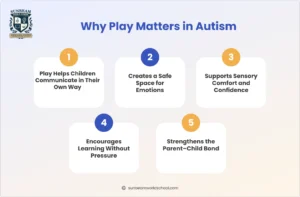
Play supports communication, emotional growth, and confidence in children with autism.
For parents of children on the autism spectrum, play is often more than fun—it is a moment of connection, understanding, and growth. Many autistic children experience the world differently, and play gives them a safe, familiar way to explore that world on their own terms.
At home, where a child feels most secure, play becomes one of the most powerful ways parents can support learning without pressure.
1. Play Helps Children Communicate in Their Own Way
Not every child communicates through words—and that’s okay. Through play, autistic children can express choices, emotions, and needs using movement, actions, visuals, or repetition. Simple games that involve matching, turn-taking, or cause-and-effect allow children to communicate naturally, without being corrected or rushed.
For parents, these moments often reveal small but meaningful milestones—eye contact that lasts a second longer, a shared laugh, or a gesture that says “I want to play again.” Over time, these playful interactions can gently strengthen communication and social understanding.
2. Creates a Safe Space for Emotions
Many autistic children experience big emotions but struggle to express or regulate them. Play offers a calm, predictable space where children can experience excitement, frustration, or curiosity in a way that feels safe. Repeating a favourite game or following familiar rules can reduce anxiety and help children feel in control.
For parents, play becomes a window into how their child processes emotions—making it easier to support them during moments of stress or change.
3. Supports Sensory Comfort and Confidence
Sensory sensitivities can make everyday experiences overwhelming for autistic children. Through sensory-friendly pre-primary learning and carefully chosen play activities—like tactile games, movement-based play, or visual puzzles—children can explore sensory input at their own pace.
At home, this kind of play helps children:
a. Feel more comfortable with textures and movement
b. Build body awareness
c. Gain confidence in unfamiliar sensory experiences
Over time, this can make daily routines smoother and less stressful for both children and parents.
4. Encourages Learning Without Pressure
Play removes the fear of “getting it wrong.” Through games, children naturally practice thinking, problem-solving, coordination, and focus—without feeling tested. Activities like puzzles, stacking, sorting, or role-play support cognitive and motor development in a gentle, engaging way, especially through online special education for children with autism.
For parents, play becomes a reminder that learning does not always need worksheets or instructions—it can happen through laughter, curiosity, and shared moments.
5. Strengthens the Parent–Child Bond
Perhaps the most meaningful impact of play is the emotional connection it builds. When parents follow their child’s lead during play, it shows acceptance and trust. These shared moments—no matter how small—create a sense of safety and belonging.
For autistic children, being understood during play can build confidence. For parents, play becomes a powerful reminder that progress is not only measured in skills, but in connection, joy, and understanding.
How to Choose Games That Work for Your Child
Choosing the right games for an autistic child can feel overwhelming -
especially when every child responds differently. What works beautifully for one child may not work at all for another, and that’s completely normal. The goal isn’t to find the “perfect” game, but to choose activities that respect your child’s comfort, interests, and pace.
Step 1: Start With Your Child’s Interests, Not Expectations
Autistic children often have strong interests—colors, numbers, animals, vehicles, patterns, or specific characters. Games that build on these familiar interests naturally hold attention and reduce resistance.
Instead of introducing something entirely new, adapt games around what your child already loves. If your child enjoys lining up objects, turn it into a sorting or counting game. If they enjoy music, choose rhythm or movement-based activities. When play feels familiar, children are more willing to engage.
Step 2: Match the Game to Your Child’s Sensory Needs
Every autistic child has unique sensory preferences. Some seek movement and touch, while others prefer quiet, visual activities. Choosing games that match your child’s sensory profile helps prevent overstimulation and frustration.
a. For sensory-seeking children, movement games, jumping activities, or textured play can be calming
b. For sensory-sensitive children, puzzles, visual matching, or tabletop games with minimal noise work better
Watching how your child reacts during play is the best guide.
Step 3: Keep Instructions Simple and Predictable
Games with too many rules can quickly feel overwhelming. Look for activities with clear steps and predictable outcomes. Visual cues, demonstrations, or modeling the activity first often work better than verbal instructions.
Repetition is not a setback—it’s how many autistic children feel safe and confident. Allow your child to repeat a game as often as they want before introducing small variations.
Step 4: Choose Progress Over Performance
Play does not need to look “typical” to be effective. Your child may play differently—focusing on one part of the game, playing silently, or taking longer to respond. What matters is engagement, not perfection.
Celebrate small progress: increased attention, reduced frustration, or willingness to try again. These are meaningful achievements that support long-term development.
Step 5: Follow Your Child’s Lead During Play
The most successful games are often child-led. Let your child decide how long to play, when to pause, or how to interact with the materials. This builds trust and helps your child feel respected and understood.
When children feel safe during play, learning happens naturally—without pressure or fear of failure.
Step 6: Know When to Pause or Switch Activities
If your child becomes overwhelmed, restless, or disengaged, it’s okay to stop. Taking breaks or switching activities is not giving up—it’s listening. Play should feel supportive, not stressful.
Over time, these thoughtful choices help create positive play experiences that support learning, emotional well-being, and confidence at home.
What to Avoid When Choosing Games
When selecting games for an autistic child, even well-intended choices can sometimes lead to frustration, anxiety, or withdrawal. Avoiding certain types of games is not about limiting your child—it’s about protecting their comfort, confidence, and emotional safety. Understanding what doesn’t work can be just as helpful as knowing what does.
Avoid Games That Are Too Loud or Overstimulating
Games with flashing lights, sudden sounds, timers, or constant background noise can overwhelm children with sensory sensitivities. Even if a game looks fun, excessive stimulation may trigger stress instead of engagement.
If a child covers their ears, turns away, or becomes restless, it’s often a sign the sensory input is too much. Calm, predictable games usually create a better learning environment at home.
Avoid Forcing Social Play Before Your Child Is Ready
Some games require constant turn-taking, eye contact, or verbal interaction. While social skills are important, pushing them too early can increase anxiety. Autistic children benefit from first feeling safe in solo or parallel play before moving toward shared play.
Allow social interaction to develop gradually and naturally—through comfort, not pressure.
Avoid Games With Complex Rules or Fast Pace
Games that involve multiple steps, time pressure, or quick decision-making can feel confusing and discouraging. When rules change rapidly or instructions are unclear, children may disengage or feel they’ve failed.
Simple, structured games with predictable outcomes help children build confidence and stay focused.
Avoid Comparing Your Child’s Play to Others
Every autistic child plays differently—and that difference is valid. Comparing your child’s play style to siblings, peers, or online examples can unintentionally create pressure or self-doubt.
Progress in play is personal. A child repeating the same activity, focusing on one detail, or playing quietly is still learning in their own way.
Avoid Using Play as a Test or Reward System
When games are used to assess performance or earn rewards, play can lose its sense of safety and joy. Autistic children often thrive when play feels unconditional—not something they need to “earn” or complete correctly.
Play should be a space where mistakes are allowed and exploration is encouraged.
Avoid Ignoring Signs of Fatigue or Overwhelm
If your child becomes irritable, distracted, or withdrawn during a game, it’s important to pause. Continuing despite these signals can create negative associations with play.
Stopping early or switching activities teaches your child that their feelings matter—and that play is meant to support, not exhaust them.
30 Best Age-Based Games for Children with Autism at Home
These age groupings are a guide, not a rule. Every autistic child develops at their own pace. Always follow your child’s comfort, interests, and readiness.
Ages 3–5: Early Play & Sensory Exploration
Focus: Sensory comfort, imitation, movement, emotional safety, early communication
1. Bubble Play
How to play: Blow bubbles and encourage your child to pop or chase them. Observe their reactions to movement, speed, and sensory input. You can make it playful by counting bubbles, naming colors, or trying slow versus fast bubble blowing. This simple activity can be done indoors or outdoors and only takes a few minutes to engage your child fully.
Developmental benefits: Enhances gross motor coordination, visual tracking, and hand-eye coordination. Provides sensory regulation and moments of joy, encouraging engagement and focus.
Tips: Keep bubble sessions short (5–10 minutes), observe sensory tolerance, and praise attempts rather than completion.
2. Sensory Bin
How to play: Fill a bin with rice, sand, or water beads. Let your child explore by touching, digging, or hiding toys inside. Encourage them to scoop, pour, or move materials, and narrate what they are doing to build language and engagement.
Developmental benefits: Supports tactile exploration, fine motor skills, and sensory integration. Encourages calmness, curiosity, and self-directed play.
Tips:Supervise small items, respect texture sensitivities, and celebrate participation.
3. Play Dough Shapes
How to play:Provide play dough for rolling, pressing, and molding shapes. Engage alongside your child, modeling shapes or animals, and allow them to explore independently. Encourage naming objects or making stories with the shapes to enhance interaction.
Developmental benefits:Builds hand strength, fine motor skills, and creativity. Supports focus, regulation, and expressive play.
Tips:Let the child lead and avoid forcing specific shapes; narrate their play to strengthen language skills.
4. Tape Path Walk
How to play:Use painter’s tape to make lines, curves, or shapes on the floor. Encourage your child to walk, hop, or step along the paths. Guide their movements at first, then allow independent exploration. Use descriptive prompts like “step carefully” or “jump to the circle.”
Developmental benefits:Improves balance, coordination, and body awareness. Enhances visual-motor skills and motor planning.
Tips:Keep paths simple, maintain safety, and praise completion to build confidence.
5. Jump & Count
How to play:Ask your child to jump a specific number of times while counting aloud or silently. Encourage different movements such as stomping or clapping to make it engaging. Celebrate small achievements to motivate participation.
Developmental benefits:Enhances gross motor skills, counting, and focus. Supports rhythm, coordination, and self-regulation.
Tips:Keep counting simple and let the child set the pace. Always praise effort over accuracy.
6. Dance Freeze
How to play:Play music and encourage your child to dance freely. Pause the music randomly and ask your child to freeze in place. You can add playful cues like “freeze like a statue” or “hold your balance like a tree” to make it fun.
Developmental benefits:Supports self-regulation, motor control, and listening skills. Encourages body awareness and joyful movement.
Tips:Use familiar music and keep the game lighthearted. Allow rest if your child becomes overwhelmed.
7. Ball Roll Exchange
How to play:Sit on the floor and roll a soft ball back and forth. Encourage your child to anticipate the ball and gently push it back. Incorporate simple counting or color naming while rolling for added cognitive engagement.
Developmental benefits:Promotes social interaction, turn-taking, coordination, and hand-eye coordination. Supports patience and early social skills.
Tips:Avoid forcing eye contact. Keep interactions playful and positive.
8. Shape Hunt
How to play:Walk around the home and find objects matching certain shapes. You can encourage your child to name shapes or describe the objects, making the activity both educational and exploratory.
Developmental benefits:Enhances observation, visual discrimination, and early cognitive skills. Encourages curiosity and engagement with the environment.
Tips:Keep the hunt playful and celebrate all discoveries.
9. Puzzle Play
How to play:Provide age-appropriate puzzles. Demonstrate piece placement initially, then let your child attempt independently. Narrate actions, describe colors and shapes, and praise each attempt.
Developmental benefits:Builds problem-solving, hand-eye coordination, and patience. Encourages focus and sequencing skills.
Tips:Start with simple puzzles and gradually increase difficulty. Celebrate effort and completion equally.
10. Quiet Corner Reading
How to play:Read picture books together in a calm, comfortable corner. Allow your child to turn pages or point at images. Discuss characters, colors, or simple storylines to engage their attention.
Developmental benefits:Supports language development, imagination, and emotional security. Builds bonding and literacy skills.
Tips:Allow your child to skip pages or make sounds; keep the session relaxed and pressure-free.
Ages 6–8: Skill-Building & Structured Play
Focus: Motor planning, attention, emotional recognition, early social skills
11. Obstacle Course
How to play:Transform your living room or backyard into a playful obstacle course using chairs, pillows, blankets, and soft toys. Start by guiding your child through crawling under chairs, hopping over pillows, or balancing along tape lines. Turn it into a fun mission—like delivering a toy from start to finish—to encourage motivation. Let your child repeat the course independently, using verbal prompts like “step carefully” or “crawl like a cat” to make the activity playful and interactive.
Developmental benefits:Enhances gross motor skills, coordination, and spatial awareness. Supports problem-solving, sequencing, and resilience while strengthening core muscles.
Tips:Keep the course safe and predictable. Allow breaks if your child feels tired or overwhelmed, and praise effort over speed or perfection.
12. Simon Says
How to play:Give commands beginning with “Simon says,” such as “Simon says touch your toes” or “Simon says spin around.” Encourage your child to follow only commands prefixed with “Simon says.” You can add fun actions like clapping hands gently, stretching, or balancing to make it more engaging. For children who respond better visually, use cards with illustrated actions.
Developmental benefits:Builds listening skills, self-regulation, attention, and imitation. Supports following directions and cognitive flexibility.
Tips:Keep instructions simple and clear. Use visual aids if needed, and celebrate attempts even if they aren’t perfect.
13. Sorting Station
How to play:Provide objects like blocks, buttons, or toys and ask your child to sort them by size, color, or shape. Narrate what you are doing while modeling, then encourage your child to sort independently. You can make it fun by turning it into a “shop” or “treasure collection” activity to increase engagement.
Developmental benefits:Enhances categorization, attention, visual discrimination, and cognitive processing. Encourages independent thinking and focus.
Tips:Start with familiar objects and fewer categories. Offer praise for effort and completion to maintain motivation.
14. Memory Tray
How to play:Place 5–10 small objects on a tray and let your child observe them for 30 seconds. Cover the tray and ask your child to recall or point to the items. Encourage descriptive language like colors, shapes, or functions. Repeat with different objects or arrangements to gradually build memory skills.
Developmental benefits:Strengthens memory, attention, and visual processing. Supports recall and early problem-solving skills.
Tips:Accept pointing or gestures as answers. Keep initial sessions simple and gradually increase difficulty.
15. Pattern Copy
How to play:Use colored blocks, beads, or shapes to create a simple repeating pattern (e.g., red-blue-red-blue). Ask your child to replicate it. Start with small patterns, and encourage verbal or visual description as they build it. Narrate actions and praise completion to reinforce confidence.
Developmental benefits:Supports sequencing, attention, logic, and fine motor skills. Enhances visual-motor integration and cognitive planning.
Tips:Model the pattern first, then let your child attempt independently. Celebrate attempts, even if the pattern isn’t perfect.
16. Emotion Cards
How to play:Show cards with different emotions (happy, sad, surprised, angry) and ask your child to mimic the face or describe a situation where someone might feel that way. Discuss feelings calmly and use storytelling to connect emotions to everyday experiences.
Developmental benefits:Enhances emotional literacy, empathy, and social understanding. Encourages recognition and discussion of feelings.
Tips:Never force verbal responses; allow gestures, pointing, or facial expressions. Keep sessions short and supportive.
17. Building Blocks
How to play:Encourage your child to stack or create structures with blocks or LEGO. Start with simple towers and gradually increase complexity. You can participate by building together or following their lead. Talk through steps to encourage planning and language development.
Developmental benefits:Enhances creativity, spatial reasoning, fine motor skills, and problem-solving. Supports attention and cooperative play.
Tips:Allow the child to lead and avoid correcting their design. Praise efforts to boost confidence.
18. Mirror Imitation
How to play:Stand facing each other and take turns copying movements, poses, or facial expressions. Start with simple actions like waving or stretching, then add playful gestures like animal movements. Keep a cheerful tone to make the activity fun.
Developmental benefits:Supports imitation, body awareness, and social engagement. Encourages attention and interaction skills.
Tips:
Keep movements slow and easy. Celebrate efforts and laughter to maintain motivation.
19. Toy Car Ramps
How to play:Use books, boards, or inclined surfaces to create ramps for toy cars. Encourage your child to roll cars down ramps and experiment with angles or surfaces. Add storytelling, like racing cars or delivery missions, to make it interactive.
Developmental benefits:Builds cause-and-effect understanding, motor skills, and attention. Encourages curiosity and problem-solving.
Tips:Allow repetition; children benefit from repeated practice. Celebrate successful rolls and discoveries.
20. Board Games (Simple)
How to play:Play age-appropriate turn-based games like Candy Land, Chutes & Ladders, or Uno. Demonstrate rules first and guide your child through taking turns. Keep sessions short and interactive, narrating actions and praising participation.
Developmental benefits:Supports turn-taking, patience, rule-following, and early social skills. Encourages interaction, cooperation, and cognitive focus.
Tips:Avoid strict competition. Celebrate effort, participation, and understanding rather than winning.
Ages 9–12: Independence, Thinking & Social Growth
Focus: Cognitive flexibility, sequencing, cooperation, self-regulation
21. Story Building
How to play:Take turns adding a sentence or idea to a story. Start with a simple prompt like “Once upon a time…” and let your child decide characters, settings, or actions. Encourage descriptive language and imaginative choices, narrating what happens as they contribute. You can use picture prompts or story cubes for inspiration.
Developmental benefits:Enhances creativity, language skills, and sequencing. Encourages imagination, cooperative thinking, and social communication.
Tips:Accept verbal, gestural, or drawn contributions. Celebrate creativity rather than grammar or spelling.
22. Pretend Kitchen
How to play:Role-play cooking, serving meals, or setting a table with toy utensils or real safe items. Encourage your child to narrate actions or serve pretend customers. Join in to model imaginative play but allow them to take the lead.
Developmental benefits:Promotes sequencing, imagination, social interaction, and life skills. Supports fine motor control and storytelling.
Tips:Keep the session playful and non-directive. Praise participation and creativity.
23. Yoga Poses
How to play:Practice simple animal or stretching poses guided by a parent or video. Encourage holding poses, breathing exercises, or slow movements. Narrate actions or create a playful story (“become a tall giraffe” or “stretch like a cat”).
Developmental benefits:Improves body awareness, flexibility, and self-regulation. Supports focus, calming strategies, and coordination.
Tips:Avoid strict posture corrections. Keep the session short, fun, and encouraging.
24. Heavy Work Tasks
How to play:Provide safe objects for your child to push, pull, or carry. Create challenges like transporting toys across the room or “delivery missions.” Narrate actions and encourage pacing to maintain safety and engagement.
Developmental benefits:Supports proprioceptive input, body strength, and emotional regulation. Encourages focus, planning, and problem-solving.
Tips:Keep weights safe and manageable. Praise effort and strategy.
25. Dressing Dolls
How to play:Encourage your child to dress dolls or soft toys, practicing buttoning, zipping, and layering. Narrate steps and ask them to describe actions or choose outfits. Make it playful by pretending the doll is going to school or a party.
Developmental benefits:Enhances fine motor skills, independence, and planning. Supports sequencing and imaginative play.
Tips:Allow self-directed choices. Celebrate attempts rather than perfection.
26. Visual Schedule Game
How to play:Use picture cards or a printed routine to guide your child through tasks (e.g., morning routine, homework, bedtime). Encourage your child to arrange cards and follow the steps in order. Narrate and model as needed, supporting autonomy.
Developmental benefits:Strengthens sequencing, planning, and predictability. Encourages independence and understanding of daily routines.
Tips:Use familiar routines. Reinforce success with praise.
27. Music & Instruments
How to play:Provide instruments or household items (pots, spoons) to create rhythms and sounds. Encourage your child to mimic beats, make up songs, or lead a “band.” Narrate rhythms and describe dynamics to engage listening skills.
Developmental benefits:Supports auditory processing, rhythm, creativity, and self-expression. Encourages focus, timing, and social participation.
Tips:Control volume and keep sessions short. Encourage playful exploration rather than perfection.
28. Matching Cards
How to play:Use cards or pictures and ask your child to match identical items, colors, or shapes. Begin with a small number and gradually increase as skill improves. Encourage verbal description while matching.
Developmental benefits:Enhances visual discrimination, memory, attention, and early reasoning. Supports problem-solving in a structured way.
Tips:Start with simple sets. Celebrate accuracy and effort.
29. Online Movement Videos
How to play:Use child-friendly online videos like GoNoodle or Cosmic Kids Yoga. Follow the movements together, including stretching, dancing, or mindfulness activities. Keep sessions interactive by narrating movements and encouraging participation.
Developmental benefits:Supports coordination, attention, gross motor skills, and self-regulation. Provides engaging movement in a structured, screen-based format.
Tips:Limit sessions to 10–15 minutes. Combine with offline activities for balance.
30. Sorting & Sequencing Challenges
How to play:Ask your child to arrange objects in order, such as by size, color, or shape. Use beads, blocks, or cards. Narrate the sequence and encourage verbal description for additional cognitive engagement.
Developmental benefits:Enhances cognitive flexibility, sequencing, fine motor skills, and problem-solving. Encourages attention and systematic thinking.
Tips:Start simple and gradually increase complexity. Praise attempts and logic rather than speed.
| Note For Parents & Caretakers:
These activities are designed to be playful, flexible, and child-led. The end goal for playing these games is engagement, joy, and skill-building—not perfection. Even short, repeated sessions provide meaningful developmental benefits and strengthen a child’s connection with you. |
Best Online Games for Children with Autism
Safe, engaging, and educational digital activities that support learning, sensory development, and skill-building at home for children of all ages.
| Game / App | Age Group | Developmental Benefits | Parent Tips |
| GoNoodle | 3–8 | Improves gross motor skills, coordination, rhythm, and self-regulation. | Keep sessions 5–10 min for younger kids; join in to model movements. |
| Cosmic Kids Yoga | 4–10 | Enhances body awareness, mindfulness, focus, and emotional regulation. | Encourage verbal cues and descriptive words; maintain a calm environment. |
| ABCya | 5–12 | Strengthens memory, problem-solving, attention, and early academic skills. | Use short sessions; guide if your child struggles with instructions. |
| SplashLearn | 5–10 | Supports math skills, sequencing, logical thinking, and concentration. | Set goals, but avoid pressure; praise effort over speed. |
| Autism Play Garden | 3–10 | Enhances sensory processing, visual-motor coordination, and independent play. | Let your child explore freely; sit nearby to model interactions if needed. |
| Endless Alphabet | 3–7 | Builds early literacy, vocabulary, and letter recognition. | Pause and discuss words together; repeat favourite letters or words. |
| Toca Boca Games | 3–12 | Encourages creativity, social-emotional understanding, and problem-solving. | Focus on exploration rather than “winning”; narrate actions to build language. |
| PBS Kids Games | 4–10 | Supports reading, math, memory, and attention skills. | Limit session length; guide children who need help following instructions. |
| Otsimo Educational Games | 3–12 | Improves communication, fine motor skills, and attention span. | Monitor progress and repeat activities for reinforcement. |
| Dexteria Jr. | 3–8 | Strengthens fine motor skills, hand-eye coordination, and cognitive skills. | Use with a stylus if helpful; repeat exercises for mastery. |
Practical Tips for Parents and Caregivers While Playing with Children with Autism
Simple, effective strategies for parents and caregivers to make playtime with children with autism engaging, safe, and developmentally meaningful at home.
- Follow Your Child’s Lead: Let them choose activities and explore at their own pace.
- Keep Instructions Clear and Simple: Use short, direct instructions with visual cues if needed.
- Use Positive Reinforcement: Praise effort, creativity, and participation, not just success.
- Create a Predictable Play Environment: Keep the play area organized, safe, and consistent.
- Balance Structure and Flexibility: Guide play while allowing creativity and rule modification.
- Integrate Sensory-Friendly Elements: Include soft toys, textures, or movement breaks as needed.
- Practice Patience and Emotional Support: Stay calm, encouraging, and gentle with guidance.
- Encourage Interaction and Communication: Promote turn-taking, imitation, and verbal or non-verbal communication.
- Short and Frequent Play Sessions: Opt for multiple short sessions instead of one long playtime.
- Observe and Adapt: Watch for engagement or distress and adjust activities accordingly.
Red Flags to Watch During Play with Children with Autism
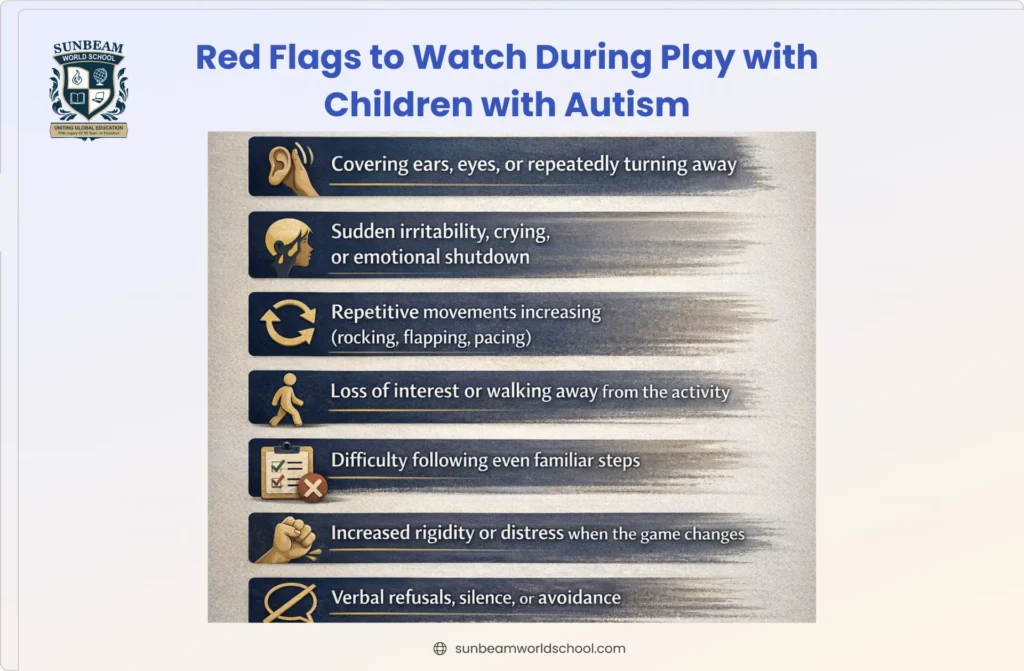
Recognizing these red flags helps caregivers adjust play and support a child’s emotional needs.
If you notice these signs during a game, your child may be feeling overwhelmed, anxious, or overstimulated. These signals are not misbehaviour—they are communication.
- Covering ears, eyes, or repeatedly turning away
- Sudden irritability, crying, or emotional shutdown
- Repetitive movements increasing (rocking, flapping, pacing)
- Loss of interest or walking away from the activity
- Difficulty following even familiar steps
- Increased rigidity or distress when the game changes
- Verbal refusals, silence, or avoidance
What to do:Pause the activity, lower sensory input, or switch to a calming or familiar game. Ending play early is okay-responding to your child’s comfort builds trust and emotional safety.
Green Flags to Watch During Play with Children with Autism
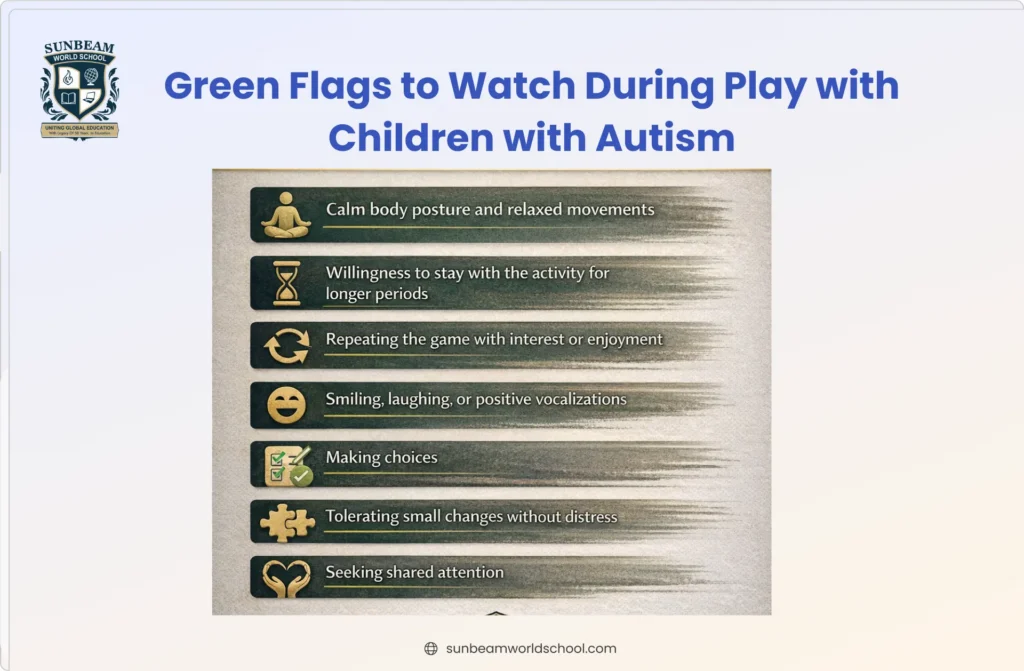
These green flags show a child feels safe, engaged, and supported during play.
These positive signals show that a game is supporting your child’s emotional safety, learning, and confidence. Progress may look small-but it matters.
- Calm body posture and relaxed movements
- Willingness to stay with the activity for longer periods
- Repeating the game with interest or enjoyment
- Smiling, laughing, or positive vocalizations
- Making choices (pointing, selecting, initiating turns)
- Tolerating small changes without distress
- Seeking shared attention (bringing an object, brief eye contact, gestures)
What this means:The game aligns well with your child’s needs. Continue at their pace, follow their lead, and gently build on what’s working—without rushing change.
How Sunbeam World School Helps Children with Autism
At Sunbeam World School, we understand that every child with autism is unique, with their own strengths, challenges, and learning pace. Our approach is individualized, inclusive, and compassionate, designed to nurture growth, confidence, and curiosity in a safe and supportive environment. We combine specialized support, structured learning, and engaging activities to help children thrive academically, socially, and emotionally. For families exploring flexible education options, it is also important to understand how online schools support autistic students through personalized learning plans, trained educators, and adaptable learning environments.
- Personalized Learning Programs -We create tailor-made learning plans for each child, focusing on their abilities and areas of improvement. Our programs combine academic learning, social-emotional development, and life skills, ensuring children develop holistically while progressing at their own pace.
- Special Education Program - Our experienced team includes special educators, therapists, and counsellors who provide focused support in areas such as communication, sensory regulation, motor skills, and social interaction. Using evidence-based strategies, we help children overcome challenges and unlock their potential.
- Inclusive & Supportive Environment - Children learn best when they feel safe and accepted. At Sunbeam World School, we foster empathy, patience, and understanding across classrooms. Peer interactions are guided and positive, encouraging children to build friendships and social confidence.
- Parental Involvement & Guidance - We believe parents are partners in learning. Through regular updates, workshops, and counseling sessions, we empower families with strategies to support their child’s growth at home and school.
- Therapy-Integrated Play & Learning - Learning at Sunbeam World School is never just about academics. Through play-based therapy, structured games, and sensory activities, children practice communication, problem-solving, and emotional regulation in fun and engaging ways.
Conclusion
“Play is the highest form of research.” – Albert Einstein
As a parent or caregiver of a child with autism, you know every moment of connection matters. Play isn’t just fun—it’s a way to help your child communicate, learn, and grow, while strengthening your bond. Choosing games that match their interests and sensory needs gives them confidence and joy.
At Sunbeam World School, we combine personalized Special Education school with Special Education program so children with autism can thrive academically, socially, and emotionally.
Remember, every game you share is a step toward learning, connection, and celebration.

Frequently Asked Questions
What age groups are these autism-friendly games suitable for?
-These 30 games are grouped by age: 3–5 years for early play and sensory exploration, 6–8 years for skill-building and structured play, and 9–12 years for independence, cognitive flexibility, and social growth.
How long should a play session last for children with autism?
+How can parents know if a game is helping their child?
+Can screen-based or online games be beneficial?
+How does Sunbeam World School support children with autism?
+
In this article
Share this post:


Press and Blogs
Stay updated with our press releases, educational blogs, and more.
Online School for Special Needs Students Online schools for special needs students provide flexible, personalised...
Quick Answer: ADD and ADHD are not two different conditions. ADD was the diagnostic term...

Dyslexia, a common learning disability, affects a person’s ability to read, write, and spell regardless...